- EDITORIALLY SPEAKING, WILLIAM ANDERSON
- LETTERS TO THE EDITOR
- BOOKS RECEIVED
- TECHNICAL TALK, JULIAN D. HIRSCH
- THE POP BEAT PAULETTE WEISS
- GOING ON RECORD, JAMES GOODFRIEND
--------
Editorially Speaking
By William Anderson
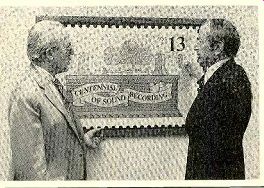
With Henry Brief, executive director of the RIAA, the Editor inspects a blow-up of the "Centennial of Sound Recording" commemorative stamp issued March 23 (first day) by the U.S. Post Office. See this link for details.
TIN FOIL
THE sense of history must be one of those human faculties (like wisdom) that are rather late in developing (if they develop at all), perhaps because we must have ac cumulated some little history of our own be fore we can properly assess others that are not only longer but more important. I don't know, for example, anyone under the age of forty whom I would call suitably impressed with the fact that this year marks the hundredth anniversary of Thomas Alva Edison's invention of the tin-foil phonograph, probably because they can't remember a time when sound-reproduction apparatus wasn't as common as shoes.
We older hands have longer memories, however. Mine goes back not only to my parents' succession of "Victrolas" and the variously acoustic and electric 78's played on them, but to my grandparents' cylinder ma chine and the cabinet of recordings beneath it.
The cylinder boxes were lined with cotton fleece, and they lay on their sides, each in its own cubbyhole, like so many little (2 1/2 x 41/2 inches) wine bottles. I keep one on my desk to remind myself of those simpler days. Its cover bears a legend to the effect that "The Graphophone and Columbia Records were awarded the Grand Prize at the Paris Exposition of 1900," and on the side there's a rather threatening notice concerning who may sell Columbia records and for how much: "The price of this record is twenty-five (25) cents. No sale below that price is authorized." Simpler days indeed; imagine trying to get by with that kind of high-handed price-fixing today! I remember the recordings too, of course, everything from Caruso (Ave Maria, Una Furtiva Lagrima) and McCormack (Roses of Picardy, The Rosary, Mother o' Mine) to Ukulele Ike (Cliff Edwards, that is, singing and playing That's My Weakness Now), Horner Rodeheaver (Brighten the Corner), Julius Tannen (Cohen at the Telephone), and you're not going to believe this--Alma Gluck and the Orpheus Quartet on Aloha De. You're right-they don't make 'em like that any more.
If all that is almost totally lacking in historic resonance for those under forty, perhaps a few recent statistics gathered by the Recording Industry Association of America will ring more impressively. For example, dollar volume for the American record industry rose from a 1935 low point (about forty years ago in the depths of the Depression) of just a few million to almost $2.4 billion (both records and tapes) by the end of 1975. Billboard re ported international sales for the same year as $6,574,543,000. The domestic share of that market is about 36 percent, and putting my mini-calculator together with the almanac's population figure (213 million) gives a 1975 per capita expenditure on discs and tapes in these United States of a little over $11. If you'd like that broken down even further, roughly $6,80 of the total went to buy "contemporary" (which is to say popular) music, $1.30 for country, $1.25 for MOR, $.60 for classical, $.50 for jazz and on down. And all that from a dead start only one hundred years ago.
ON the theory that even a little history is good for everybody, we are including in this issue just enough of it (see "One Hundred Years of Recording," page 62) to whet your appetite for more. That you will find in abundance in either of two standard reference works newly revised and reissued (see page 14) for the centennial: they are Roland Gelatt's The Fabulous Phonograph and Oliver Read and Walter Welch's From Tin Foil to Stereo. The story they tell is a fascinating one, perhaps because so much of it takes place in the nation's courtrooms rather than in the less dramatic confines of the laboratory. With the benefit of today's 20/20 hindsight that be comes quite understandable: there were liter ally billions at stake, and a few folks with a sense of history were foxy enough to know it.
LETTERS TO THE EDITOR

RFI
The RFI article in the May issue is great unquestionably the best that has been done on the subject. How many people have told you by now that illustrations B and C on page 62 are reversed? Murphy's Law lives on!
ROY F. ALLISON President, Allison Acoustics, Inc.
Natick, Mass.
May I congratulate STEREO REVIEW and author John McVeigh for the most useful RFI article I have ever seen. Since I am an amateur radio operator, I have read quite a few articles on radio-frequency and television interference, but none can compare to the one in your May issue. It's most unusual for an article that tells it like it is about suppression in audio equipment to appear in an audio magazine. Now some audiophiles will know a little about the complexities of the problem and how to deal with them. That trouble-shooting chart on pages 58 and 59 is invaluable.
DON OSMUND; Libertyville, Ill.
I am a relatively new reader of STEREO REVIEW. John McVeigh's article on RFI has cured my 7 p.m. "Breaker, 10-4" headaches.
(I never really thought Al Stewart appreciated being called "good buddy.") By replacing home-made connection cables with some $2.95 ones I freed myself from the low-grade CB chatter of my neighbors.
TOM EMPSON, Nashville, Tenn.
The Jazz Attitude
I was disconcerted to read Stanley Dance's comments on Bill Evans in his re view of the Verve jazz reissue series in the May STEREO REVIEW. It is true that none of the Evans recordings contained therein represents him at his best. The trio session with Gary Peacock is an especially disappointing album and was an unfortunate choice for reissue. But Dance's remarks show he doesn't even begin to perceive, let alone appreciate, the stunning emotional intensity that this extraordinary musician manages to create beneath the deceptively lyrical, unprepossessing, "perfect" exterior of his music. Mr. Dance completely missed the point of the Evans remark he quoted (and by doing so was able to use it to support his own negative view). In saying that "jazz is a mental attitude rather than a style," Evans meant that jazz is always recognizably jazz, that cutting across all the incredibly different styles and periods there is always something, some intangible unanimity of approach, that gives it identity.
He did not mean that jazz is an intellectual activity. "Jazz has got to be experienced," Evans once said, "because it's not words, it's feeling." This is what Evans' playing is about. In its gentle way, his music is always reaching toward something direct, true, and overwhelming.
ALAN ROSENTHAL New York, N.Y.
Mr. Dance replies: Quot homines, tot sentent iae. (As many minds as men.) New vs. Old Riders I was disappointed with Noel Coppage's May review of the New Riders of the Purple Sage's album "Who Are Those Guys?" They are middle-class, but not synthetic. Does sounding like the Eagles make them more professional? In my opinion their new sound is more of a new shot for mass popularity at the expense of the people who liked their old one.
Mr. Coppage should be reviewing classical music if professionalism is what he wants.
DON T. JONES Riverdale, Ga.
Texas Cadillac
As I was reading the April issue of STEREO REVIEW for the fifth time, I noted a slight error in Ivan Berger's article on car stereo. The author says that ". . . car radios have either signal-seeking or pushbuttons-not both." My parents own a 1976 Cadillac with a Delco signal-seeking, five-button/ten-station, AM/ FM stereo radio.
STEVE SMITH, Humble, Texas. Be it ever so Humble.
A Worthy Successor
In the three years I've been reading STEREO REVIEW, I have become an avid fan of Steve Simels. It was with some distress, then, that I discovered he had relinquished his column in order to pursue a career elsewhere. My worries were very soon put to rest. Paulette Weiss is not only better to look at (sorry, Steve!) but just as down-to-earth in her views on the present music scene. Her first column was very good, and I am still looking forward to opening each new edition of STEREO REVIEW straight to "The Pop Beat" to get some really good, lively, and honest views on the state of music today.
SEAN KILPATRICK Kelligrews , Newfoundland Quartet Convert
As an oboist, I have been hard to convince, but the state-of-the-art configuration of my current music system (under development these twenty-seven years) has revealed to me the ineffable opulence and tonal supremacy of the string quartet. Accordingly, I have focused my acquisitions on those performances and recordings in the quartet and related literature that have divulged the richness potential in the genre. Irving Kolodin's "Beginner's Guide to Chamber Music" (May) has at one stroke apprised me of more than a dozen seminal works I would have been a long time finding on my own. Four of Mr. Kolodin's recommendations I already own; half a dozen more I possess in other recordings. But six teen others are now on my list for early acquisition-an enrichment I am most grateful for!
B. P. TATUM, Healdsburg, Calif.
... and Wind Booster
Much as I like Irving Kolodin's chamber-music guide in the May issue, I have a small carp. Might not an equally good place to start be chamber music for brass or woodwinds? The existence of a repertoire for these instruments by themselves is never even mentioned; perhaps some people would be intrigued more by a brass quintet playing Bach's Art of the Fugue or a woodwind quintet by Nielsen than by a string duo by Kodaly.
I don't see how brass or woodwind groups could be considered more arcane or less "basic" than string groups, especially for beginners who are more likely to have played a wind than a string instrument in school.
DAN AUGUSTINE, Austin, Tex.
Lily Pons I enjoyed George Jellinek's mostly favor able review of the Lily Pons album in the May issue, but I vehemently disagree with one of his statements: "Vocally, by the Caballe Sutherland standards of today, she was far from perfect." Does this mean that those two artists are devoid of vocal flaws? The Pons voice was indeed unique and capable of soaring into the upper stratosphere with ease. It was not a large voice like Sutherland's or Caballe's, but its beautiful limpid quality was still there long after Pons stopped singing publicly. When she came out of retirement in 1972 for a recital with the New York Philharmonic, the critics were unanimous in their praise of her performance. I do not believe there is a single contemporary soprano capable of maintaining the high degree of vocal excellence sustained by Lily Pons for so many years.
GERALDINE SEGAL, Randallstown, Md.
Larry Who?
I like the constantly changing pictures of your regular columnists, and in the May issue I was pleased to see that they don't spend all their time behind their desks. I recognized Renata Scotto talking with William Livingstone at the heading of "The Opera File," but who is the hunk loving it up with Paulette Weiss at the heading of "The Pop Beat"? MARY BETH CHRISTY San Francisco, Calif.
That would be c-&-w singing star Larry Gatlin, who recently played a gig at New York's Lone Star Café.
Kiss Me Again
Isn't it about time for a new recording of the best-ever musical comedy? And the new version ought to be on two discs since all of Kiss Me, Kate won't fit on one. Cole Porter wrote about eight more songs than were finally used. Since Kate was the peak of his career, I suspect those extras might include some outstanding numbers that should be part of the new album too.
CHARLES L. ANDERSON, Sacramento, Calif.
Get Well Card
Regarding the May record reviews: we fail to see how the supposedly sophisticated critics of such a sophisticated publication could possibly write reviews such as the ones for the latest Abba and Leon Redbone albums.
Has the day come when an album by a true artist (Redbone) is panned, while at the same time an album by a group sometimes referred to as the essence of bubblegum is glorified? Noel! Joel! Where have your critical talents flown to? We wish you two a speedy recovery from whatever's been ailing you.
PETER B. D'AMARIO T. COURTNEY JENKINS, Portsmouth, R.I.
Disc Quality
For some time now I've been watching the fury mount over so-called "bad" records. As a record manufacturer, I think it's time some one brought some very important facts to the public's attention.
First of all, it is doubtful that good manufacturers are not really trying to bring the public the best records possible for the price they are being paid. But that price is much less than it may seem, since the industry has unfortunately allowed itself to be put in a position where discounting is the rule rather than the exception. It is true that list prices have gone up a lot recently, but it is also true that very, very few purchasers pay that price.
The "suggested list price" has been increased so that the distributors will have a better bar gaining position vis-a-vis the retailers. There really is no such thing as a $6.98 record in terms of actual cost to the consumer.
The following may point up the problems faced by the record presser: in the past three to four years, material costs (vinyl) have multiplied three times, electricity (to run the presses, etc.) more than three times, oil and gas (to generate the steam the presses use) more than three times, paper for labels more than three times, and paper for inner sleeves more than four times, while labor costs have doubled. Total costs for record jackets, which require expensive color printing, etc., are of ten higher than for the records to go inside them. Despite all this, the prices charged by the manufacturers are only about 30 percent greater than they were four years ago.
The way the industry has met this cost squeeze has been, in virtually every case, to go to complete automation. Capital expenses have been great, of course, but the result has been, not incidentally, to eliminate the effects of chance and human error from record production. And if anyone thinks that that is why records are "worse" today than they used to be, I challenge him to play one of the old "hand-made gems" on the most modern equipment. The sound of these old pressings is bound to be quite disappointing.
We get a few of our records returned as "noisy," and it's amazing how many scratches we find on them that weren't there when the record was shipped (there are only a few. ways a record can be scratched in the plant, and these are not of that type). Com plaints about so-called "warped" records are also usually unjustified. True, the record may have a slight dish or twist, but not so as to affect its playing quality one iota. (It's easy to make absolutely flat records every time, but the "non-fill" will drive you crazy.) We have also had records returned because of "scuff marks." These are made when the record is drawn across paper; they may show but they don't affect the sound at all. Any collector will have scores of records with such marks.
The problem of poor workmanship is much less serious with records than with many other consumer products today-cars especially-yet it seems to be records that people get most agitated about, to the point of demanding boycotts because the industry doesn't meet their standards. When one considers the enormous number of records shipped daily, the volume of complaints (as monitored, for instance, by the Better Business Bureau) is actually amazingly low. We could ship better records in this country (ship, not make) by tightening down on inspection and increasing the labor force involved in quality control.
But it would mean the $2.98 and $3.98 "specials" would disappear, and I don't think the public is yet ready for that. Considering that the cost of a record includes amortization of the original recording, royalties to the artist(s) involved, design and printing costs for the jacket, money lost in bad debts (another growing problem), pressing, and so on, I think the purchaser is really getting a bargain, per haps one of the very few left.
CLARK F. GALEHOUSE President, Golden Crest Records, Inc.
Huntington Station, N.Y.
I read a good many of the "Letters to the Editor" and am both amused and saddened by the many complaints about record quality.
I know that my age places me in a sort of out side-looking-in position-or maybe "outside the pale." The first phonograph in my boy hood home was an Edison cylinder, and from then until now I have been in love with the phonograph and the collecting of records, some of which I have managed to keep from as far back as around 1910. Our present equipment is stereophonic, and while much of it is not exactly "state-of-the-art," it gives us joy to hear classical music that takes us into a delightful world of almost unlimited extent.
The riches of recorded music we can now en joy were undreamed of not so many years ago. We do have a few warped records and now and then a pop or two, but on the whole they are more than satisfactory. In all the abundance of musical riches available we find little to complain about.
DoN SHELDON; St. Helena, Ore.
Editor William Anderson's reply to Michael S. Flynn's letter concerning disc quality (May) reflects a thorough grasp of the problems faced by all record manufacturers. As a strictly classical label, lacking volume sales and subsidies from a pop record division (or is it the other way around?), Orion was forced by constantly rising costs to go to $7.98 list as of March 1, 1977. This by no means gives us another $1 profit per record; it is closer to 30 cents. We merely hope it will cover the cost of the 50 percent more vinyl we are putting into our records now (less non-fill and warp age), and if a plastic-lined sleeve costs us nearly a dime, so be it.
GIVEON CORNFIELD, President, Orion Master Recordings, Malibu, Calif.
I am an audiophile employed in retail record merchandising. Although I am faced with ever-increasing buyer complaints about defective recordings, in my experience discs to day are on the average of far higher overall quality than used to be the case. We stock many older recordings whose pressings pre date the current controversy over disc quality-and they come back for exchange be cause of noisy surfaces, warping, or off-center holes at least as often as recent releases.
Technological improvements in record vinyl and the metal used for master stampers have made possible an enormous increase in the number of pressings from a given stamper without lowering the average quality, which is a major reason why (as the March "Editorially Speaking" points out) record prices have risen at less than the general inflation rate.
A most important, but rarely noted, factor in the increasing frequency of complaints about disc quality is the ability of average home music systems today to offer clarity and definition far in excess of that available from systems popular even five years ago, let alone ten or twenty. Superior reproduction of what is in the grooves inevitably involves greater susceptibility to noise from all kinds of sources, from dust and static to actual "glitches" introduced in pressing. The problem, really, is that systems for playing records have improved faster than methods of producing and distributing them-which does not mean that the latter have not improved. The differential is what makes it seem that records are getting worse when they are actually, at least from the major labels, cleaner and more consistent than ever before.
If buyers were really willing to finance efforts to improve disc quality further by paying higher prices, the industry would surely respond. But in the meantime there are a few steps the buyer can take on his own to improve his listening without significantly greater expense. First of all: clean your records! Even brand new records fresh from the wrap per are bound to carry some surface dust and chemicals that may add noise, and records you've used a while will pick up more. There are various devices on the market that will remove most surface dirt, and by reducing the static charge on the disc they will help keep it off. It is also a good idea to clean your turntable mat periodically.
At least as essential is regularly inspecting and, when necessary, replacing the stylus in your phono cartridge. A dirty or worn stylus will not only make records sound bad, it will permanently damage them. Many of our customers bring in a stylus only when it is so worn and encrusted with dirt it is a wonder it can track at all. For the background-music system in our store we use a medium-price changer equipped with a low-cost magnetic cartridge, but we make sure it is clean and properly adjusted, with the tone arm oiled and the stylus in good condition. The only things we play on it are discs returned as "defective." Almost without exception, they play very well, without skipping, pops, or audible distortion. The phonograph record may in some ways be the weakest link in the reproduced music chain, but it is hardly the only one, and customers have as much responsibility as manufacturers or retailers to insure that it is playable.
GEORGE ANDROVETTE; BOSTON, MASS.
Perhaps better pressings will result in higher record prices, but there is at least one other company practice sending costs up: needless giveaways. In the past four months my college newspaper has received, from one record company, at least seventeen free popular record albums plus a weekly newsletter, a couple of posters, and a copy of Rolling Stone. The postage alone for all this has run more than $7. None of it was requested, and attempts to stop the flow have resulted in our receiving form letters. I wonder how many other records the companies throw away in this fashion? WES ROBBINS Cambridge, Mass.
Correction
In the New Products column for April it was erroneously reported that the stands for the Ultralinear Models 2001 and 3001 speaker systems are included in the basic prices of the loudspeakers. The manufacturer advises us that they are optional at additional cost. We regret the error.
Books Received
Playback, by Dave Dexter, Jr. Billboard, New York (1976), 239 pages plus index, $9.95.
Singers are still "canaries," record companies "waxworks" to Dave Dexter, whose Forties vocabulary seems particularly appropriate to this gossipy, opinionated, and very entertaining memoir from a man who has been in the business of recording popular music for forty years. Frank Sinatra, Peggy Lee, Doris Day, Benny Goodman, Sammy Davis, Jr., the Beatles-he knew them when, as the saying goes. Recommended.
-L.G.B.
From Tin Foil to Stereo, Second Edition, by Oliver Read and Walter L. Welch. Howard W. Sams & Co., Inc., Indianapolis (1976), 608 pages, $9.95 softbound, $19.95 hardbound.
The subtitle of this substantial volume, long out of print and sorely missed, is "Evolution of the Phonograph." More than half of it is devoted to the acoustic phonographs of Edi son and others, and it treats the technologies and origins (including disputes concerning the origins) of these machines in loving, exhaustive detail. Later chapters provide an over view of modern recording techniques, enlivened by frequently controversial excursions into recording "philosophy." The book is illustrated with photographs, design drawings, and memorabilia.
R.H.
The Fabulous Phonograph, 1877-1977, Second Revised Edition, by Roland Gelatt.
Macmillan, New York (1977), 349 pages, $10.95. This is another revision of a classic, first published in 1955 and updated for the phonographic centenary this year. Gelatt, who currently edits the books and arts sections of Saturday Review, takes a more general, less detailed historical approach than Read and Welch do. Illustrated.
L.G.B.
Unfinished Journey, by Yehudi Menuhin.
Alfred A. Knopf, New York (1977), 393 pages, $12.50. It seems just a little unfair that someone who can play the violin as well as Menuhin should be able to write like an angel too. This autobiographical narrative is rich with anecdote, warm with family feeling, intelligent, reasonable, witty, civilized, and true. One is reluctant to put it down even when finished, but this is an "unfinished journey," so there is a sequel to look forward to.
Just about everybody is in it, from Gerald Ford to Jawaharlal Nehru, making the index handy. W.A.
The Literature of American Music in Books and Folk Music Collections: A Fully Annotated Bibliography, by David Horn.
Scarecrow Press, Metuchen, N.J. (1977), 556 Pages, $20. In a word, bravo! This bibliography is impressively comprehensive in its 1,388 listings (roughly, from the anthems of Billings, William, to the antic rock of Zappa, Frank), candid and informative in its generous annotations. There are 302 more items of interest in the appendix. No serious student of American music, no American music library should be without it.
W.A.
The Recording Studio Handbook, by John M. Woram. Sagamore Publishing Co., Inc., Plainview, N.Y. (1976), 450 pages, $35. John Woram, who we thought was kept adequately busy writing articles for STEREO REVIEW and others, has somehow found time to write a book. It is a good and accessible book, too.
Indeed, Woram's Handbook must rank among the best of the all-around guides to re cording-studio equipment and practice. In stead of focusing on theory and technicalities (although the basics of what the would-be studio engineer must know are there), Woram approaches recording as a working professional in a consideration of the practicalities of his equipment tempered by an educator's skills in selecting, organizing, and communicating his materials. Abundantly illustrated, with useful appendices and an extensive glossary.
R.H.
The New York Philharmonic Guide to the Symphony, by Edward Downes. Walker and Company, New York (1976), 1058 pages, $25.
A collection of program notes for over 450 works in the orchestral repertoire. Musicologist Downes has augmented his notes-from fourteen seasons as annotator for the New York Philharmonic Orchestra-with many musical examples, biographical material, illustrations, and an index to produce an extremely useful and interesting reference book.
L.G.B.
Making Changes: A Practical Guide to Vernacular Harmony, by Eric Salzman and Michael Sahl. McGraw Hill, New York (1977), 222 pages, $8.95 softbound, $12.95 hardbound. For the student of music eager to explore the workings of a Bessie Smith song or a Lennon/McCartney tune, this is a good place to start. Messrs. Sahl and Salzman (the latter is a Contributing Editor of STEREO REVIEW) illustrate and discuss, in a step-by-step, non-academic way, the interaction of such fundamentals as melody, bass, rhythm, phrasing, chord patterns, and voice-leading and how they function in the American popular song-blues, gospel, country, folk, jazz, and rock. Also included are arrangements and compositions by the co-authors and suggested listening examples by current pop artists that make use of harmonic progressions characterizing the different styles. R.S.
International Music Guide 1977, edited by Derek Elley; Sedgwick Clark, U.S. editor.
Tantivy Press, London, and A. S. Barnes & Co., New York (1977), 288 pages, $5.95 soft-bound. First in a new annual series, this volume covers a lot of territory (including such out-of-the-way spots as Afghanistan and Lebanon), though mostly retrospectively. You'll find out a lot about what went on musically last year in places you might be thinking of visiting, but for future use the greater value is in the copious listings of names and addresses of musical institutions, festival sponsors, record stores, and so on. A most engaging feature is a group of biographies and interviews with "Musicians of the Year," including Antal Dorati, Hans Werner Henze, Frederica von Stade, Josef Suk, and Paul Tortelier.
There is also a survey of recorded music re leased around the world last year. D.S.
Technical Talk
By Julian D. Hirsch
ARMS AND THE CARTRIDGE. A recent letter from a reader takes me to task on the subject of phono-cartridge testing. He notes that I do not as a rule identify the make and model of the tone arm used in testing a cartridge except to call it a "typical" arm or a "tone arm of good quality." Since he hears tremendous differences between different tone arms using the same cartridge, he wonders how my evaluations of cartridges in randomly chosen tone arms can have any real significance.
Within the limits of his question, the reader is absolutely correct. If the tone arm can so alter the sound of a cartridge as to make a mediocre cartridge sound fantastic (or vice versa) then no review-by me or anyone else can have any value unless particular combinations of cartridges and arms are specified.
An alternative approach would be to use the same arm for all cartridge tests, assuming that one arm could be found that would satisfy all parties concerned. For some time I did this, using an SME arm, but for practical reasons I find it desirable, whenever possible, to combine the testing of cartridges and record players. Nevertheless, there could be no excuse for my practice if, as my reader claims, the tone arm makes such a great difference in the measured or audible performance of a phono cartridge.
The key question, then, is this: does the arm have a major effect on the sound of a cartridge? Insofar as measurements are concerned, the characteristics of the arm can be expected to affect both the frequency and the amplitude of the low-frequency resonance.
Arm friction is not a significant factor with any arm above a certain quality level. Nor do I find tracking-error variations to be significant among quality tone arms (I cannot recall the last time I measured a tracking error large enough to produce even a small fraction of the distortion inherent in either the record or the cartridge). Antiskating compensation can be a factor, but only if the cartridge is being operated close to the limits of its tracking ability, not under normal listening conditions.
What about tone-arm resonances, which can occur almost anywhere in the audible range? Some of these probably exist in any tone arm, but most of those I have measured have been very high-Q resonances affecting only a very narrow band of frequencies.
There is a possibility that such a resonance could affect the sound, but in my opinion that possibility is very slight.
Circuit capacitances come to mind as a possible source of audible differences, and it is evident that with some cartridges the change of load capacitance from, say, 100 to 350 picofarads will have a noticeable effect on the overall tonal balance. Tonearms differ some what with respect to their cable capacitances, and of course every cartridge manufacturer has his own recommendations. But I take pains to control the load capacitance when testing a cartridge to be sure it falls within the recommended range of values, and in tonearm tests I measure the actual capacitance of the cables and tone-arm wiring from each channel to ground.
ANOTHER capacitance effect has recently come to my attention. The capacitance between the two "hot" leads of the stereo channels in the tone arm can introduce crosstalk at high frequencies (usually above 10,000 Hz), thus reducing channel separation. The variation among tone arms in interchannel capacitance is considerable, and there are equally great differences between cartridges in their susceptibility to crosstalk from this source. It is conceivable that this might account for some observed differences between tone arms. Personally, I doubt it, but it is at least a remote possibility.
I am therefore led-by theory, by tests, and by my own ears-to the conclusion that there is little or nothing in the interaction between a good tone arm and a cartridge that could have a major effect on the sound of the combination.
(I'm sure that part of the problem is in the definition of "major." For some audiophiles any difference that can be heard under any circumstances is automatically a "major" difference.)
--------- Tested This Month: Rotel RT-1024 AM/FM Tuner Dual C919 Cassette Deck TSI 110 and 120 Speaker Systems Ortofon MC20 Phono Cartridge and MCA-76 Pre-preamplifier Miida 3140 AM/FM Receiver----
What are the characteristics that make a tone arm sufficiently "good" not to affect the sound? Several may be specified:
The friction of the arm pivots, as referred to the stylus, is not more than 10 percent of the vertical tracking force.
The low-frequency resonance of the arm/ cartridge combination does not affect the response above approximately 15 Hz by more than 1 dB. (To insure this, the amplitude of the resonance should not exceed 6 or 7 dB.)
The cartridge is terminated in the correct load, which implies that any tone arms used in comparison testing have, within reason, the same capacitance, both to ground and between channels.
There should be no audible mistracking on either channel of any of the program material used, whether because of insufficient vertical tracking force, incorrect antiskating compensation, or both.
There are two kinds of audible difference relevant to this discussion. One is an immediately audible short-term effect. This is best detected in a true A-B test, with not more than a second or two between samplings. The test requires using identical cartridges in the tone arms being compared, which should be on identical turntables and playing the same sections of identical records. One should re peat this test, interchanging the cartridges, turntables, and records, since we are after tone-arm differences and there are no such things as two absolutely identical records, cartridges, or turntables.
If anyone hears a large difference (or even a small one) under such conditions, he is welcome to make his choice of arm accordingly.
But such tests are tedious and time-consuming, to say the least, and when I have performed them I have never heard any of these differences.
The second type of difference is much more subtle and not really susceptible of proof. It is evidenced by a nagging dissatisfaction with the sound of one component and a feeling that another is somehow "better." (Why "different" must always be equated with "better" or "worse" is beyond my understanding, but many people seem unable to make a distinction between the two qualities.) This effect is by no means limited to cartridges. It ac counts, in my view, for many of the preferences people show for certain amplifiers or speakers as well--not to mention cameras, automobiles, and other such conveniences of modern life.
I do not deny or dismiss the subjective reality of such nonrational preferences. I experience the same sort of reactions myself, and I suspect that most other people do also. Like a psychosomatic pain with no organic basis, these strong feelings are completely real to the person experiencing them, yet absolutely unexplainable and nontransferable to anyone else (an equipment reviewer, for example).
GUESS it comes down to this: if you hear certain differences between two products and find one of them clearly preferable, why on earth should you be looking for confirmation-or denial-of your reactions from another person? Buy the one your own ears tell you is "best," be prepared to live with your choice, and don't worry about what the other fellow says. On the other hand, if you do not hear such clearcut differences, and you want to know about those real, physically provable differences that exist between products, you may find our reviews and others helpful. In any case, you are not buying high fidelity components to please anyone but yourself. If you feel your own ears and instincts are more valid guides to your own satisfaction than the opinions of the reviewers, then by all means follow them.
Going on Record
DA CAPO
IN March of this year, Britain's New Scientist published a brief article, by Denys Parsons, whose stated conclusion was as follows:
"Composers tend to place the nine pitch profiles which characterize the first three notes of musical themes in this order of preference:
UP, UP, UP, DOWN, DOWN UP, DOWN, DOWN, REPEAT, REPEAT, REPEAT UP, UP REPEAT, REPEAT DOWN, DOWN REPEAT.
Anybody who has the patience to do a re count will come to the same surprising conclusion. What will the musicologists make of it?" I am not a musicologist, so the gauntlet, so to speak, was not thrown down for me. But what I make of it is that someone has found a new way of jumping to confusions (and I wouldn't be a bit surprised if there were a computer behind it somewhere). In case the above quotation is not absolutely clear and self-sufficient, let me explain that Mr. Parsons is the author of Directory of Tunes and Musical Themes, a book designed to identify for us all those melodies that run through our heads and whose origins we cannot recall. The melodies he wants us to do a recount of are listed according to what he calls "pitch profile" (more accurately, interval-direction profile), which is constructed on the basis that once you have a starting note (the asterisk), the second note can only be up, down, or side ways from it, and the third can have the same possible relationships to the second, and so on. For example, this gives us as a representation of the opening theme of Beethoven's Eroica, though it may be a half-dozen other things as well, since no particular pitches or intervals are signified, only directions.
As a sideline of this worthy task (though one should bear in mind that if Beethoven had had access to the book he might never have written the Eroica, since Mozart had already written that theme), Mr. Parsons began com piling statistics. He limited his counting to the first three pitches of each theme, and found, for example, that 21.5 percent of 7,387 themes of thirty major composers began with the profile UU, while only 2.6 percent began with DR. He found also that another 3,005 themes from 270 other composers followed the same distribution (26.0 to 2.4 percent) and that 3,763 selected popular songs did the same (27.3 to 2.5 percent). On the basis of such figures he came to the conclusion quoted at the beginning of this column.
Now, quite apart from the fact that his list of selected "popular" songs includes such items as The Wombles of Wimbledon and Amo, Amas, I Love a Lass (chorus: "Rorum, corum . ."), as well as the Hare Krishna Mantra, there are certain basic problems here, the primary one perhaps being that of trying to establish anything more than a tele phone exchange on the basis of three notes.
The theme of Beethoven's Ode to Joy, for example, would be represented by *RU URDDDDRUURDR, but the recent pop adaptation of it, A Song of Joy, is correctly listed by Mr. Parsons as *UURDDDDRU URDR. Now these are obviously the same melody, though the first three notes read *RU and *UU respectively, so what is wrong? What is wrong is that the pop adapter, a certain Senor de los Rios, decided to leave out Beethoven's first repeated note, and so, though the melodies are the same, the "pitch profiles" are different-*UU, as you may re member, finished in first place in the thematic sweepstakes, whereas RU ran a bad sixth.
Has someone fixed the race? What Mr. Parsons' little study tells us is not that there are similarities among themes of different composers-we knew that all along-but rather that it is not as simple as it might seem to represent and document those similarities. The pattern *RU also represents Yankee Doodle, Taps, a theme from Hoist's St. Paul Suite, one from Schubert's Great C Major Symphony, and Brahms' Intermezzo in A Minor, Op. 116, No. 2, among other things, and if any of those come closer to Beethoven's Ode than the pop rip-off does, I will eat my piano.
Or, take the case of the maligned DR, the last choice, so the study has it, of composers beginning a theme. Shall we assume, then, that the opening themes of Mozart's G Minor Symphony, Wagner's Meistersinger, Bruckner's Third, Fourth, and Ninth Symphonies, and Chopin's A-flat Polonaise (not to mention the first piano theme in Brahms' First Piano Concerto and the opening themes of the first, second, and fourth movements of the Beethoven Ninth Symphony) are all, in some inexplicable way, "last-choice" material? "Pitch profiles" are fine and useful things in thematic indices, but to expect such note-by-note renderings to tell us anything important about the way composers compose is naive at best. The fact is that in any given theme all the notes are not equally important, and a real profile of the theme would have to take that into account. Certain notes outline harmonic structure, and, from a harmonic point of view, at least, they are the more important. On the other hand, it is often a small quirkiness of construction that gives a theme its real character, and the notes that express that departure from the expected must be reckoned as the important notes melodically.
The dramatic emphasis of Beethoven's Ode to Joy theme, to take an extreme example, lies in that note tied across the bar, specifically in its not sounding again on the first beat of the measure where one expects it. It is, in effect, the absence of that note, rather than the presence of one, that gives the theme its memorable character.
And what of grace notes and other ornaments? Anyone who has heard a theme of, say, Rameau shorn of its ornamentation is aware that though harmonically those small additions signify little (and probably would not even make it into a "pitch profile"), melodically they are the very character of the theme. Then again, if one took the opening theme of Brahms' Fourth Symphony and made every half-note into two quarter-notes (thus adding at least eight notes to the melody), would that really change things very much? Or suppose one made the repeated eighth-notes in the first of Borodin's Polovetsian Dances into a single quarter-note. Would that destroy anything? You can pose any similar question. The answer is most often "yes and no." But that's why I love music so much: it isn't chaotic, but it is so wonderfully unsystematic that it defeats every cocksure effort to pin it down in diagrams.
STILL (to return to Mr. Parsons' thesis), the niggling thought remains that all those statistics must signify something. How about this:
The hierarchy of pitch profiles given expresses the order of preference of the listening public in the way they like themes to be gin. After all, Mr. Parsons selected, quite naturally, those themes, works, and composers that are well known rather than obscure. It's possible. And that might explain why Senor de los Rios changed Beethoven around. To begin with *RU might be all right for a symphony, but he knew instinctively that if you wanted a pop hit, it had to be UU or nothing.
--------
Also see:
BEST RECORDINGS of the CENTENARY--A highly personal selection from among an embarrassment of recorded riches, DAVID HALL
NOISE DILEMMA--Is it possible to have full dynamic range without noise? DANIEL QUEEN