BEST RECORDINGS of the CENTENARY--A highly personal selection from among an embarrassment of recorded riches, DAVID HALL.
David Hall's Best Recordings of the Century (1877-1977)
FROM 1900 to 1948, the year of the first mass-distributed LP records, nearly 500,000 performances of classical music were commercially record ed. The three subsequent decades provided probably double that number, documented via magnetic-tape-to-microgroove-disc technology. It is only the first twenty-five years of the phonograph era that speak rather sparsely to the general public, for the harnessing of Thomas Edison's basic invention to the mass-production techniques and playback equipment developed by Emile Berliner and Eldridge Johnson did not take full effect until just after the turn of the century.
The recordings of the last seventy-five years, however, are so numerous and so varied that, in making even the most personal, idiosyncratic selection of great records, one can really only skim the surface.
Since I do not propose to let that stop me, I'd better warn the reader that the an notated list that follows is biased in several ways. I am first, of course, laying my own musical tastes on the line. Second, I am omitting (with a single exception) pre-electrical "historic" recordings, because of space limitations and because the highly specialized knowledge needed to assess-in some cases even to appreciate-these early recordings is the proper province of specialists. And third, so that this list may be more real than merely theoretical, I have heavily slanted it toward those recordings that are available today, in some form, for general consumption. Of course, the "time frame" of what is actually available on LP has expanded enormously over the past decade. But I would suggest that anyone interested in historical recordings equip himself with a variable-speed turntable that will allow him to hazard his own aesthetic guess as to proper speed and pitch, rather than being at the mercy of the original "78" or a reissue's perhaps fallible engineer.
HERE, then, is my lightly annotated list of "Great Recordings of the Centenary." The record number and label listed are those of the present incarnations, except in the case of 78-rpm recordings, where both the original American issue (if there was one) and the current reissue are given. If the performance is not available today, the number given is that of its last LP issue followed by the notation "out of print." Records are in alphabetical order by composer.
BACH: Goldberg Variations. Wanda Landowska (harpsichord).
VICTOR 78-rpm set M 1022; RCA Victrola VIC 1650. A noble testament by /a grande maitresse of the rediscovered instrument.
BACH: Mass in B Minor (BWV 232). Maria Stader (soprano); Hertha Topper (alto); Ernst Haefliger (tenor); Dietrich Fischer-Dieskau (baritone); Munich Bach Choir and Orchestra, Karl Richter cond. DG ARCHIV 2710001 two discs. A superbly vital and beautifully recorded performance.
Bartók: Bluebeard's Castle. Christa Ludwig (mezzo soprano); Walter Berry (baritone); London Symphony Orchestra, Istvan Kertesz cond. LONDON OSA 1158. An impassioned and stunningly recorded realization of Bartók’s 1911 masterpiece.
BEETHOVEN: An die Ferne Geliebte, Op. 98. Gerhard Hirsch (baritone); Hans Udo Muller (piano). 78-rpm 12246/7; in PREISER LV 85 (available on import). A beautiful transfer job of one of the many great lieder performances by Hirsch.
BEETHOVEN: Symphony No. 5, in C Minor, Op. 67.
Vienna Philharmonic Orchestra, Carlos Kleiber cond. DEUT SCHE GRAMMOPHON 2530516. Is this the ultimate interpretive-sonic realization of this quintessential basic repertoire work?
BEETHOVEN: Symphony No. 7, in A Major, Op. 92. New York Philharmonic-Symphony Orchestra, Arturo Toscanini cond. VICTOR 78-rpm set M 317; RCA Victrola VIC 1502. The Maestro's 1936 performance still remains for me the definitive statement.
BEETHOVEN: Variations on a Theme of Diabelli, Op. 120. Artur Schnabel (piano). HMV ( England) 78-rpm DB 3519/25; in SERAPHIM 6067 three discs. The Old Master in 1937, at the peak of his form and splendidly recorded.
BELLINI: Norma. Maria Callas (soprano); Ebe Stignani (mezzo-soprano); Mario Filippeschi (tenor); Nicola Rossi Letrieni (bass); La Scala, Milan, Chorus and Orchestra, Tullio Serafin cond. SERAPHIM 6037 three discs. "La Divina" in her prime, breathing new life into the classic bel canto opera. A new era of operatic performance was launched with this set.
BERG: Lyric Suite. Juilliard String Quartet.COLUMBIA ML-2148 (out of print). The 1950 Juilliard Quartet's sizzling performance has never, in my estimation, been surpassed. An Odyssey reissue is in order.
BERLIOZ: Les Troyens. Jon Vickers (tenor); Josephine Veasey (soprano); Berit Lindholm (soprano); Roger Soyer (baritone); Peter Glossop (baritone); Covent Garden Royal Opera Chorus and Orchestra, Colin Davis cond. PHILIPS 6709 002 five discs. Berlioz's epochal operatic masterpiece in its (thus far) one and only complete recorded performance, and a mighty fine one at that.
BRAHMS: A German Requiem, Op. 45. Elisabeth Schwarzkopf (soprano); Dietrich Fischer-Dieskau (baritone); Philharmonia Chorus and Orchestra, Otto Klemperer cond. ANGEL S-3624 two discs. The monumental and compassionate aspects of Klemperer's interpretive genius find a near-perfect realization here.
BRITTEN: Serenade for Ten or, Horn, and Strings, Op. 31. Peter Pears (tenor); Barry Tuckwell (horn); London symphony Orchestra, Benjamin Britten cond. LONDON OS 26161. To all intents and purposes, the definitive recorded realization of Britten's youthful masterpiece.
CHOPIN: Fantasia in F Mi nor, Op. 59. Solomon (piano). COLUMBIA ( England) 78-rpm DX 688/9; in ODEON RLS 701/3 three discs (available on import). The young Solomon's impassioned yet superbly con trolled playing of Chopin's great Fantasia is for me the prize item in this "Tribute to Solomon" package.
CRUMB: Ancient Voices of Children. Jan DeGaetani (mezzo-soprano); Michael Dash (boy soprano); Contemporary Chamber Ensemble, Arthur Weisberg cond. NONESUCH H-71255. George Crumb's musical-poetic .tour de force on Lorca's texts may well outlast most other avant-garde works of its time-due in no small measure to this spell-binding performance and the superb recording of it.
DEBUSSY: La Mer. NBC Symphony Orchestra, Arturo Toscanini cond. RCA VIGTROLA VIC 1246. Elemental is the word for Toscanini's reading of Debussy's "Sea Symphony." Vintage 1950 sound or rto, this recorded document is in a class by itself.
DVORAK: Cello Concerto in 8 Minor, Op. 104. Pablo Casals (cello); Czech Philharmonic Orchestra, George Szell cond. VICTOR 78-rpm set M 458; SERAPHIM 60240. The fact that this masterpiece was re corded in the homeland of the Czechs at a time when Casals' own country was being riven by civil war unquestionably ac counts for the unique intensity the cellist brought to this performance. It is unsurpassed to this day.
FRANCK: Chorale No. 2, in 8 Minor. Marcel Dupre (organ). MERCURY 75006. For me, this is the finest of the Three Chorales, Franck's final masterwork; this 1957 recording from New York's St. Thomas Church is the finest documentation both of the music and of Dupre's interpretive artistry.
GABRIELI: In Ecclesiis Benedicite Domino. Gregg Smith Singers; Texas Boys' Choir of Fort Worth; E. Power Biggs (organ); Edward Tarr Brass Ensemble, Vittorio Negri cond. COLUMBIA MS-7071. Giovanni Gabrieli's sumptuous poly-choral masterpiece gloriously performed and recorded in St. Mark's Cathedral, Venice, for which the music was originally written. What more can one ask?
GLUCK: Alceste. Kirsten Flagstad (soprano); Raoul Jobin (tenor); Alexander Young (tenor); other soloists; Geraint Jones Singers and Orchestra, Geraint Jones cond. RICHMOND RS 63512 three discs. The noble line and compassion of Gluck's music provided a splendid vehicle for Flagstad at the end of her singing career. The artist and the music here are wholly one.
GRAINGER: Lincolnshire Posy. Eastman Wind Ensemble, Frederick Fennell cond. MERCURY SRI 75093. Superb folk-song settings, magnificent band scoring, and quite possibly the most impressive re corded band performance achieved up to 1958. I have heard almost nothing as good since.
HANDEL: Messiah: Comfort ye ... Every valley shall be exalted. Aksel Schiyitz (tenor); Danish Young Artists' Orchestra, Mogens Woldike cond. HMV ( England) 78-rpm DB 5239; in SERAPHIM 60227.
The late, great Danish singer and teacher recorded this performance in 1940 and therein set a standard by which all other versions since are judged. Indispensable.
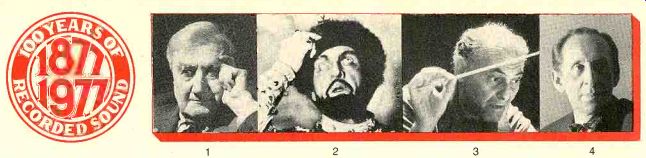
-------
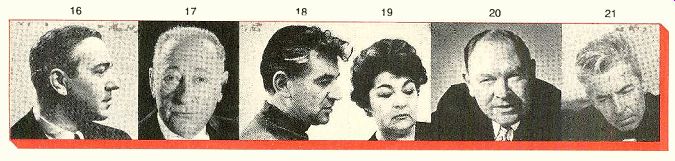
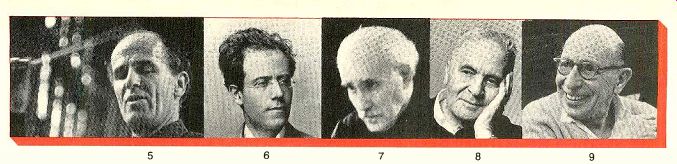
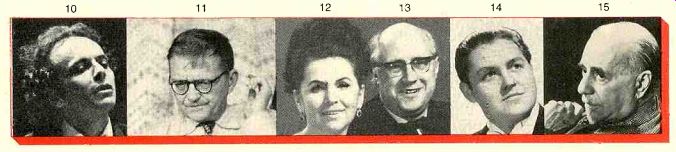
PHOTO QUIZ
(1) Vaughan Williams, (2) Chaliapin, (3) Solti, (4) Horowitz, (5) Willcocks--that's okay--I missed it too, (6) Mahler, (7) Toscanini, (8) Walter, (9) Stravinsky, (10) Maazel, (11) Shostakovich, (12) Vishnevskaya, (13) Rostropovich, (14) Bjoerling, (15) Beecham, (16) Kipnis, (17) Heifetz, (18) Bernstein, (19) Tourel, (20) Moore, (21) Karajan.
-Ed.
-------
The invention of the phonograph one hundred years ago was responsible for the greatest changes in our ways of listening to music since the invention of the concert hall. The documentation of performances it led to was something previously unknown in music, for up to this time a given interpretation, no matter how great, was preserved only in the fallible memories of those who were present on the occasion. In a hundred years, this process of documentation has resulted in the establishment of a huge body of recorded material, most of it still extant in some form or other, that must be constantly sifted through, appraised, and reappraised both by musical scholars and by ordinary listeners in the light of continually changing knowledge and taste.
-James Goodfriend, Music Editor
---------------
HAYDN: The Seasons. Gundula Janowitz (soprano); Peter Schreier (tenor); Martti Talvela (bass); Vienna Singverein Choir; Vienna Philharmonic Orchestra, Karl Bohm cond.
DEUTSCHE GRAMMOPHON 2709-026 three discs. Haydn's celebration of the country life has always been a special favorite of mine. Bohm and his forces achieve a splendidly colorful and virile realization, abetted by gorgeous sonics.
IVES: Piano Sonata No. 2 (" Concord, Mass. 1840 1860"). John Kirkpatrick (piano). COLUMBIA MS-7192. The essence of Ives' musical thought is encompassed in the four movements of this masterpiece, evocative of Emerson, Hawthorne, the Alcotts, and Thoreau. The artist-scholar who gave the first complete performance conveys that essence in all its wholeness in this, his second recording of the work for Columbia.
JANICHEK: Slavonic Mass. Evelyn Lear (soprano); Hilde Rossl-Majdan (alto); Ernst Haefliger (tenor); Franz Crass (bass); Bedrich JaniCek (organ); Chorus and Orchestra of the Bavarian Radio, Rafael Kubelik cond.
DEUTSCHE GRAMMOPHON 138954. If Kirkpatrick's recording of the Ives Concord Sonata can be described as a special sort of artistic testament, so too can Rafael Kubelik's of JanaCek's mighty Miga Glagolskaja. The performance is one- of shattering power, with sound to match.
LEONCAVALLO: Pagliacci: Vesti la giubba. Enrico Caruso (tenor); orchestra. VicroR 78-rpm 88061; in RCA CRM1-1749.
A classic Caruso performance (1907)-here, in this latest LP reissue, with spurious resonances removed through the medium of computer technology. The end result does not yet give us the ultimate in restoration, but it is a big step in the right direction.
MAHLER: Das Lied von der Erde. Kathleen Ferrier (contralto); Julius Patzak (tenor); Vienna Philharmonic Orchestra, Bruno Walter cond.
RICHMOND 23182. A uniquely beautiful and affecting performance of Mahler's great elegiac cycle, matched in eloquence only by Walter's Vienna recording of sixteen years before, done from public performance.
MENDELSSOHN: A Mid summer Night's Dream, Overture. Philadelphia Orchestra, Arturo Toscanini cond. In RCA CRM5 1900 five discs. One of the choicest of several very choice items from the Maestro's 1942 Philadelphia Orchestra series, which had to wait al most thirty-five long years for release.
MEYERBEER: L'Africaine: O Paradiso! Jussi Bjoerling (tenor). VICTOR 78-rpm 12150; in ODEON ALP 1620 (available on import). The young Bjoerling (1938) is heard here in all his full-throated splendor and first-rate musicianship. One of several outstanding Thirties performances on the LP disc.
MOUSSORGSKY: Boris Godounov: Prayer and Death of Boris. Feodor Chaliapin; chorus and orchestra, Eugene Goossens cond. VICTOR 78-rpm 6724; in MELODIYA 018101/16 eight discs (available on import). For all the stage realism of the live Covent Garden re cording of 1928, I have always cherished Chaliapin's one and only electrical studio recording, which reveals far more of the musical aspects of his interpretation. The one LP transfer I know of is in the comprehensive USSR collection.
MOUSSORGSKY: Songs and Dances of Death. Jennie Tourel (mezzo-soprano); Leonard Bernstein (piano). Odyssey Y2 32880 two discs. The number of truly great performances, on or off records, of Moussorgsky's macabre song cycle can be counted on the fingers of one hand. The 1950 Tourel-Bernstein collaboration falls easily into that category and is for me the high point of the Odyssey "Tribute" album.
MOZART: Symphony No. 36, in C Major (" Linz," K. 425). London Philharmonic Orchestra, Sir Thomas Beecham cond. COLUMBIA 78-rpm set M-387; in TURNABOUT THS 65022/6 five discs. Other than the celebrated Magic Flute recording, the finest of Beecham's full-blooded. Mozart is to be found in the London Philharmonic discs of the late 1930's, among which my special favorite happens to be this one of the Linz.
PROKOFIEV: Violin Concerto No. 2, in G Minor, Op. 63. Jascha Heifetz (violin); Boston Symphony Orchestra, Serge Koussevitzky cond. VIC TOR 78-rpm set M 450; in RCA ARM4 0945 four discs. Heifetz's technique and musicality coupled with Koussevitzky and his Boston Symphony in peak form make for a pretty unbeatable combination. The glitter easily shines through even the dull 1937 sonics.
PUCCINI: La Boheme. Licia Albanese (soprano); Ann McKnight (soprano); Jan Peerce (tenor); Frank Valentino (baritone); Nicola Moscona (bass); George Cehanovsky (baritone); NBC Symphony Orchestra and Chorus, Arturo Toscanini cond. RCA VICS 6019E two discs. For me this has the most spontaneity of any of the Toscanini radio opera productions documented on commercial discs. The sentimentality is soft-pedaled here, and what emerges is a fresh work of immensely youthful ardor and impulse.
RACHMANINOFF: Vespers, Op. 37. USSR Russian Chorus, Aleksander Sveshnikov cond.
MELODIYA/ANGEL SRB-4124 two discs. The most profoundly beautiful of all Rachmaninoff's work, done with loving care by his countrymen and superbly recorded. A singularly moving aural and spiritual experience.
RAVEL: L'Enfant et les Sortileges. Frangoise Ogeas (soprano); Jeanine Collard (contralto); others; RTF Choir;
French National Orchestra, Lorin Maazel cond. DEUTSCHE GRAMMOPHON 138675. Ravelian fantasy was never more poignant and comical than in this little operatic excursion into a child's life and psyche. Maazel, his cast, and the recording engineers together bring the whole thing off most beautifully and touchingly.
SCHOENBERG: Variations for Orchestra, Op. 31. Berlin Philharmonic Orchestra, Herbert von Karajan cond. DEUTSCHE GRAMMOPHON 2530627. Karajan not only makes this knotty piece seem as easy as a Mozart or Haydn symphony, he also makes it electrifyingly dramatic. The superb recording helps too.
SCHUBERT: Piano Sonata in D Major (D. 850). Artur Schnabel (piano). Victor 78-rpm set M 888; in ODEON C153 1220/2 three discs (available on import). I have always loved Schnabel's way with Schubert even more than his accomplishments as a Beethoven interpreter. The 1939 reading of the D Major Sonata is only the greatest of many riches in the all-Schubert LP collection.
SCHUBERT: Der Doppelganger. Alexander Kipnis (bass); Frank Bibb (piano). Co LUMBIA 78-rpm 72057D; in Columbia SPECIAL PRODUCTS CSP AM 30405. I know of no lieder performance better calculated to raise the hairs on the back of one's neck than this 1927 Kipnis rendering of Der Doppel ganger, unless it be Helge Roswaenge's Hugo Wolf Society recording of Der Feuerreiter (not yet available in LP format). Columbia's transfer is remarkably fine.
SCHUMANN: Papillons, Op. 2. Alfred Cortot (piano). VICTOR 78-rpm 1819/20; in SERAPHIM 60143. The brilliant and idiosyncratic Cortot is in top form here (he was always, for my taste, a good Schumann interpreter). The recording was a gem in its original two- (ten-inch) disc format; it remains so thirty-seven years later as an LP.
SCRIABIN: Vers la Flamme, Op. 72. Vladimir Horowitz (piano). COLUMBIA M-31620. I think Horowitz can be greater playing the Mendelssohn Spring Song than the most dazzling Lisztian pyrotechnics, but if you want to confront the demonic Horowitz I recommend this incredible Scriabin performance. Is it like this inside an atomic reactor?
SHOSTAKOVICH: Symphony No. 14, Op. 135. Galina Vishnevskaya (soprano); Mark Reshetin (bass); Moscow Philharmonic Soloists, Mstislav Rostropovich cond.
COLUMBIA/ MELODIYA M-34507. Shostakovich's Totenfeier (death celebration) is overpoweringly realized here. No words can do justice to this listening experience; it must be undergone.
SIBELIUS: Violin Concerto in D Minor, Op. 47. Jascha Heifetz (violin); London Philharmonic Orchestra, Sir Thomas Beecham cond. VICTOR 78-rpm set M 309; SERAPHIM 60221. There have been many fine recordings of the Sibelius concerto, but this 1935 collaboration still sets the standard both violinistically and in terms of teamwork. Only the Prokofiev Minor Concerto with Koussevitzky is in the same class as a performance.
R. STRAUSS: Ein Heldenleben, Op. 40. New York Philharmonic-Symphony, Willem Mengelberg cond. VICTOR 78-rpm set M 44; RCA AVM1 2019. The classic performance, con ducted by its dedicatee, and newly restored to some semblance of its pristine state (ca. 1929), which is to say less most of the extraneous noise.
STRAVINSKY: Le Sacre du Printemps. Columbia Symphony Orchestra, Igor Stravinsky cond. COLUMBIA M-31030. The classic performance of the twentieth-century counterpart to Beethoven's Eroica, con ducted in this instance by its creator. A splendid antidote to those recorded performances intent only on mindless virtuosity for its own sake.
TALLIS: Spem in Alium (Forty-part Motet). Kings College Choir, David Willcocks cond. ARGO ZRG 5436. Music of subtle but overwhelming grandeur is magnificently realized through the Kings College Chapel's acoustic ambiance and the recording engineers' art and craft-not to mention the contributions of a superb choir and conductor.
VARESE: Poeme Electronique. COLUMBIA MS-6146. In grandeur of conception and execution, Varese's 1958 masterpiece still makes most other electronic music seem pretty piddling. Now I'd like to see Columbia tackle a four-channel realization.
VAUGHAN WILLIAMS: Symphony No. 4, in F Minor. BBC Symphony Orchestra, Ralph Vaughan Williams cond. VICTOR 78-rpm set M 440; WORLD RECORDS SH 128 (avail able on import). A superb transfer of the composer's 1937 recording. No other performance has conveyed this music's tautness and savagery to such a degree.
VERDI: Te Deum. Robert Shaw Chorale; NBC Symphony Orchestra, Arturo Toscanini cond.. RCA VICTROLA VICS 1331E or RCA GERMANY AT 131. Quintessential Verdi! Quintessential Toscanini! But avoid the electronic stereo version if you can.
WAGNER: Das Rheingold. George London (baritone); Kirsten Flagstad (soprano); Gustav Neidlinger (bass); Set Svanholm (tenor); others; Vienna Philharmonic Orchestra, Sir Georg Solti cond. LONDON OSA 1309 three discs. Operatic stereo came of age in this first John Culshaw-produced spectacular; one can speak of an almost aural-visual phenomenon here. The performance is a Wagnerian's dream come true, and only the finest playback equipment can do justice to the sonics.
WAGNER: Die Walkure: Act Lotte Lehmann (soprano); Lauritz Melchior (tenor); Emanuel List (bass); Vienna Philharmonic Orchestra, Bruno Walter cond. VICTOR 78-rpm set M 298; SERAPHIM 60190. Here is another kind of Wagnerian's dream come true: three of the greatest singers of their era, together with a great conductor and a great orchestra, all in peak form. Any deficiencies inherent in the 1936 sonics are of small moment. This performance sets the standard for all others.
WOLF: Michelangelo Lieder. Alexander Kipnis (bass); Coenraad V. Bos (piano); Gerald Moore (piano). HMV (Eng land) 78-rpm set DB 2045/50; in SERAPHIM 60076, 60163. Sub lime performances of the three somber Michelangelo settings that were to be Hugo Wolf's last musical utterances. These are among the thirty-six songs out of the hundred nineteen recorded for the HMV Hugo Wolf Society series that have thus far been reissued on LP. David Hall is the curator of the Rodgers and Hammerstein Archives of Recorded Sound at New York's Lincoln Center Music Library. A former music editor of STEREO REVIEW and the author of the ur-text The Record Book, he has been a writer on the subjects of records and recording for almost forty years.
--------
Also see:
ONE HUNDRED YEARS OF RECORDING -- "If Edison hadn't invented the phonograph, someone else would have". IVAN BERGER
TWO HUNDRED YEARS OF RECORDING--A slightly unsettling look at what it all could eventually lead to. LARRY KLEIN
AUDIO'S DIGITAL FUTURE--Signal processing by computer will mean the end of noise and distortion. ROBERT BERKOVITZ