ONE HUNDRED YEARS OF RECORDING -- "If Edison hadn't invented the phonograph, someone else would have". IVAN BERGER
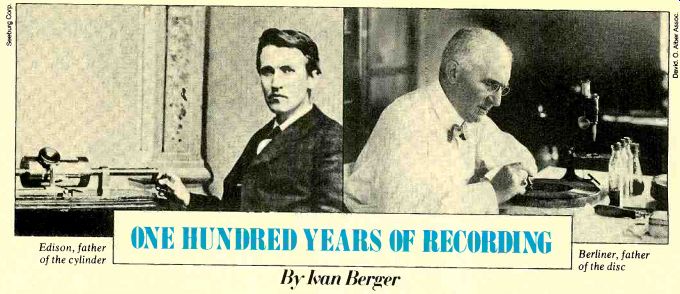
--- Edison, father of the cylinder; Berliner, father of the disc.
ONE HUNDRED YEARS OF RECORDING
By Ivan Berger
THOMAS ALVA EDISON was somewhat deaf. That didn't stop him. Perhaps it even made him extra-sensitive to what he did hear--and its implications. After all, hadn't he nearly invented the telephone? And hadn't he already made more money from telephone patents than Alexander Graham Bell, the man who had succeeded in inventing it in 1876, just one year earlier? Edison, Bell, and Elisha Gray were all starters in a race to be the first with one invention-a "harmonic tele graph" that could send several messages at once over one pair of wires and wound up racing to turn that idea into a telephone. Bell beat Gray to the patent office by mere hours, and Edi son didn't discover until too late that one of his attempts could carry voices, too. So when Edison's next telegraph invention, a dot-and-dash recorder, began to make a "humming sound, resembling human talk heard indistinctly" when played at high speed, Edison was ready at once to change direction toward something that would resemble human speech heard distinctly: the phonograph.
From History's standpoint, he needn't have bothered. If Edison hadn't invented the phonograph, someone else would have--and soon.
Charles Cros, a French amateur scientist, photographer, and poet, had already conceived of a working phonograph some months before. But, perhaps because he was a poet, he lacked either the money or the technical ability to actually construct one.
He safeguarded his place in history (but little else) by depositing his idea with the Academie des Sciences, and it would be ten years before his ideas would be fully implemented. Edison had invented and built the first recorder, but Cros, for all the good it did him, had invented the flat, replicable disc.
The phonograph actually spoke, shocking Edison almost as much as word of it would later shock Cros.
Edison was no great sophisticate, but even he might have chosen more historic words for the first test than "Mary had a little lamb" had he expected History would hear them. "I was never so taken aback in my life," he later said. "I was always afraid of things that worked the first time." But Edison did not build the first "talking machine"--not even, as he is reputed to have jested later, the first talking machine that could be shut off. Nor did he, strictly speaking, build the first recorder. What he did build was the first machine that could record sound and then play it back again. Attempts at making machines that would talk go back in legend to the time of Roger Bacon and Albertus Magnus, and some semi-successful nineteenth-century attempts were well known (even Barnum got into the act). Machines that recorded sound visually went back at least to the late eighteenth century. In 1802, Thomas Young designed such a recorder using many of the techniques Edison re invented seventy-five years later, plus a parabolic recording horn better than Edison's conical one. And in 1857, Edouard Leon-Scott built a device that traced sound waves on smoke blackened paper.
Edison’s phonograph was remarkably simple in construction. A spiral-grooved brass cylinder wrapped in a sheet of tin foil was turned by a crank while a needle mounted on a tele phone-like diaphragm embossed a record of its up-and-down movements onto the tin foil. The recording would wear out after only a few plays, and Edison himself later admit ted that "no one but an expert could get anything intelligible back from it," but no one questioned that it was a marvel. And it made money from the start. By January of 1878, a company had been formed to manufacture and exhibit the little wonder, and some exhibitors found that a single phonograph could earn them over $1,000 a week.
Meanwhile, Edison kept working on his baby and coming up with fresh ideas. A patent application of early 1878 suggested such ideas as the disc phonograph (easier to attach the foil to, but suffering from inner-groove distortion), clockwork motors to re place the hand crank, electrotype duplication of the embossed foil, amplified cutting (by magnetic force or compressed air), noise reduction (by magnetic repulsion of a steel needle and an iron record), tape recording (but not magnetic tape), multi channel records (probably just to increase clarity and volume), electrical recording (though probably just for telephone use), and speaking toys. In an article that same year, he predicted such uses as dictation, talking books for the blind, elocution teaching, music, family voice albums, speaking clocks, language instruction, recording school classes for later review, and telephone recording. Others suggested that the new invention could preserve the voices of the dead (from its frequent mention this seems to have been a particularly powerful idea to Victorians), sound-effects records ("the puffing and rush of the rail road train ... "), audio complaint boxes, "musical kaleidoscopes" that would create new tunes by playing old ones backwards (another idea that seems to have caught the nineteenth century imagination firmly), recorded drama, and the voices of "great singers . . . put into the hand organs of the streets." Of course, the infant phonograph was not yet good enough to carry out any of these sound predictions. As one contemporary writer put it:
The tone of the phonograph is usually rather shrill and piping, but ... The instrument, when perfected ... will undoubtedly reproduce every condition of the human voice.
But it was not to be perfected soon.
The novelty wore off, the crowds drifted away, and so did Edison, off to launch his ten-year effort to produce the electric light and the generating and power systems that would make it workable.
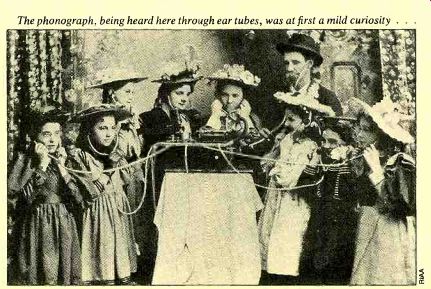
By 1886, however, Alexander Graham Bell, his cousin Chichester Bell, and Charles Sumner Tainter had patented two significant improvements in the phonograph: a "floating" play back stylus that followed the record groove more readily, and the use of wax as a substitute for Edison's tin foil. Wax was the big advance: it made finer grooves possible and thus more time for recording, and it gave clearer sound. That the sound was also less loud was no problem: the "Graphophone" (as the Bell-Tainter group called their machine) was seen mainly as an office dictating machine for which the necessity of listening through ear tubes was no handicap.
Edison later responded with a wax machine of his own, this one with sol id wax cylinders which could be "erased" by shaving off the old grooves and recording new ones.
Soon, the Graphophone also had sol id-wax cylinders. And soon, too, of course, Edison and the Bell-Tainter group were suing each other for patent infringement. The infant recording industry was about to tie itself in knots, but Jesse H. Lippincott cut those knots for a time by buying licensing rights to both sets of patents and setting up the American Graphophone Company to sell talking machines of both types.
LIPPINCOTT had a monopoly on a fast-growing industry, but despite his already proved business acumen the monopoly went broke. The new ma chine was not yet ready for use as a dictating machine, and stenographers, to a man, resisted it. About the only thing that kept the wolf away from the door of the industry was the invention, in 1889, of the coin-operated phonograph. A nickel in the slot at, say, San Francisco's Palais Royal Sa loon would set a record in motion and turn on one pair of listening tubes.
Additional nickels opened up tubes for additional listeners. The nickels rolled in, and by 1891 single-selection phonographs were swallowing them from coast to coast. Grouping the machines for ease of service and to offer a choice of musical selections led to the establishment of "phonograph parlors," ancestors of today's penny arcade. By 1896 there was the Multiplex, which had five cylinders built in.
By 1905, the Multiphone--a real juke box-not only held twenty-four selections but actually let the customer decide which one he'd hear.
What did he hear? At first, not much. For a while, each local sales company recorded its own cylinders.
Then they began to exchange recordings, and North American Graphophone began to act as an exchange.
By 1891 they'd had to issue fifteen supplements to their original recording list, and by 1893 there were twenty-five such supplements. One of the companies, Columbia, had a ten-page record catalog by 1891. It included twenty-seven marches (some by the United States Marine Band con ducted by John Philip Sousa) plus polkas, waltzes, whistling records, hymns, national anthems, speaking records, and songs listed only by such categories as "Sentimental," "Topical," "Comic," "Negro," and "Irish." By 1893 their catalog had expanded to thirty-two pages and included foreign-language courses.
Edison National Historic Site
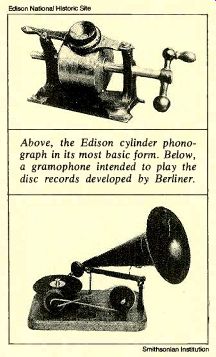
Above, the Edison cylinder phonograph in its most basic form. Below, a gramophone intended to play the disc records developed by Berliner.
Smithsonian Institution During this time Edison himself had been dragging his feet. In 1891, though he was offering to duplicate cylinders for local companies, he was also writing that companies who ignored the "legitimate side" of their business to concentrate on "coin-in-the-slot" would find it a fatal mistake . . . calculated to in jure the phonograph in the opinion of those seeing it only in that form, as . . . nothing more than a mere toy, and no one would comprehend its value or appreciate its utility as an aid to businessmen and others.
But the sales companies were losing money from their "legitimate" business and making profits only from the "toy"! A couple of years later, however, Edison had relented at least enough to see the phonograph as be coming, in his lifetime, "almost as common in homes as pianos and organs are today." Since sound quality was still rather Donald-Duckish and since there was no practical way to mass-duplicate the cylinders, that day was still some years away.
Competition brought prices tumbling down. Machines were first $190, then $140, $75, $40, even $25 (the re cording attachment, of course, was extra). In country and in city, sales were booming for machines and for records as well. Luckily for the musicians of the day, the cylinders produced no million-sellers. At first the rule was one performance, one record, although in time the recordists began surrounding the performers with multiple machines. Later they used multiple recording diaphragms, dubbing the resulting master cylinders with pantographs that copied their traces onto other cylinders. If the master did not wear out too quickly, one run-through of a song might now produce as many as 125 salable copies. But a million-seller would still have taken 8,000 "rounds" at the re cording horn! ARLY recording sessions were nothing like today's.
Studios were small and acoustically "dead," orchestras "huddled together after the manner of a group photograph," violins had tin-horn attachments (brasses and woodwinds substituted for the other stringed instruments), and singers who forgot to pull back from the horn on high or loud notes were likely to be pulled away by anxious engineers. And because the record label hadn't been invented yet, the engineer would stop at each horn before the musicians began and announce the tune, the performers, and other credits. (Continued overleaf)
-----------------
ONE HUNDRED YEARS
But Charles Cros, remember, way back in 1877, had had the answer to the problem of record duplication: record on a flat disc, and you could easily mold, etch, or engrave duplicates to your heart's content. Emile Berliner, a German immigrant to the U.S., patented essentially that system eleven years later, and after a few false starts he began to make a success of it. Fifty of his 7-inch discs could be stacked in the space required for four cylinders, and duplicates could be stamped out like pennies an idea that naturally had great popular appeal. Besides, the zinc etching process that Berliner used for master discs let chemistry do some of the groove-cutting work rather than make the recording stylus do it all. It was actually a "chemical" form of amplification, and the result was a louder groove. The zinc disc still sounded scratchy-"like a partially-educated parrot with a sore throat and a cold in the head"-but it was on its way. In 1897, Berliner replaced his early hard-rubber disc-its grooves had a tendency to flatten spontaneously-with a shellac composition that was used for disc records well into the 1950's.
Also, a year earlier, work had begun on replacing the rough zinc masters with smooth wax and making molds from that.
Meanwhile, Berliner went on to found overseas subsidiaries-the Gramophone Company (now part of EMI) in England, Deutsche Grammophon in Germany, and subsidiaries or divisions in Russia, Austria, France, and Spain-before he himself became a subsidiary (really a partner) of the newly formed Victor Company.
In 1902, the Gramophone Company in England sent some scouts off to Italy in search of talent worthy of its new Red Label series. They found, of course, Enrico Caruso. One might speculate as to what extent the gramophone "made" him (his first Metropolitan Opera contract was offered on the basis of his records), but there is no question that he did much to make the gramophone a success.
The recordings of Caruso and other operatic notables served the industry in three important ways. Because the human voice best fit the limited range of the early records, singers showed the recording process off to its best advantage (that opera singers were accustomed to loud singing doubtless helped). Opera stars brought prestige to the squabbling infant industry. And their records sold: they were such superstars that chefs even named their finest dishes for them-Peach Melba and Chicken Tetrazzini are just two examples found on menus to this day.
IN 1906, Victor took the dust-catching horn off the top of their newest player and folded it down into the wooden cabinet beneath. That meant a slight loss in sound quality but a massive gain in sales. The Victor was now furniture; it was acceptable in terms of interior decor. Victor's name for the new model, "Victrola," became a generic term for decades.
Meanwhile, the cylinder market was dying. The public preferred the disc's massive advantage in convenience over the slight sonic advantage the bulky, fragile cylinders enjoyed.
By 1912, Columbia, long since em barked in the disc business, abandoned the cylinder field to Edison. A year later, Edison entered the disc field himself, though vowing never to abandon his loyal cylinder-record customers. His discs used the same vertically cut ("hill-and-dale") groove his cylinders did and were therefore incompatible with the more widespread laterally cut discs. But there were sound technical reasons for his choice as he saw it. Further more, non-standard records were hardly new: the buyer was already faced with records using different groove widths, different speeds, sizes from 5 to 20 inches in diameter, and even grooves that ran "inside out" from the label to the rim.
Edison's "Diamond Disc" system had much to recommend it: hard, smooth, phenolic-plastic surfaces (Edison had to assemble a group to in vent the plastic), fine grooves (150 per inch against the lateral disc's 90, which permitted a compact 10-inch disc to play for four minutes or more), a motorized tone arm that reduced groove wear, and "permanent" jeweled styli. The tone arm even had a cueing lift. When Edison introduced his system with the first of a series of "Tone Test Recitals" live-vs.-recorded sound comparisons-stores began to sell off their Victrolas at a discount.
Victor (and the rest of the industry) had some other troubles as well. Radio soon began to cut into their audience. The box that brought free entertainment-and live, just as it happened-into the home began to push the phonograph out of the living room and up to the attic. And radio's sound was better, too, with increasingly sensitive microphones, plus amplifiers and loudspeakers to take the place of the phonograph's acoustic horns. It was obvious that the phonograph could use some of the same technical medicine. In short order the first electrical reproducer, the Brunswick Panatrope, appeared, with electric pick up, amplifier, and speaker. It wasn't long before the marketplace was full of electric phonographs.
Unfortunately, these innovations notwithstanding, the phonograph was foundering, and the Depression seemed the final blow. What ultimately saved the adolescent industry, as it had saved the infant one, was the coin-operated phonograph. The juke box, now blaring its offerings to everyone within earshot rather than piping its sound privately through ear tubes, served as a major means of exposure for new records. Just as important, it was a major customer. In 1939, for instance, more discs (13,000,000 of them) were sold for juke-box use than for any other purpose. Such hits of the thirties as Beer Barrel Polka, Ella Fitzgerald's A-Tisket, A-Tasket, and Kay Kyser's Three Little Fishies sold as many as 300,000 copies each.
------ The phonograph, being heard here through ear tubes, was at first a mild curiosity .
At the onset of World War II, civilian production of everything slowed to a trickle.
Shellac imports from the Orient ceased, and record companies were forced to buy and grind up old recordings to eke out their dwindling virgin supplies. But this did not stop phonograph development. The need for a light, unbreakable disc-and the shellac shortage-led to the use of vinyl as a record material. And the need for high-quality recordings through which Britain's RAF Coastal Command could demonstrate the difference in sound between German and British submarines led Decca in Eng land to the "FFRR" (Full Frequency Range Recording) process. Finally, exposure to sophisticated electronics gear-plus its postwar availability as surplus-led many Americans to wonder if such techniques could improve their own home sound systems.
In late 1948, Columbia unveiled the 12-inch long-playing (LP) vinyl record. Columbia had taken bits and pieces adopted and dropped by others (such as the microgroove approach Edison used as early as 1926, the 33 1/3-rpm speed Victor had tried and failed with in 1931) and had put them together in a way that made the total system work. Not that it was easy. It took Columbia only three months to bring playing time up to 16 minutes per side, but two years more to get it up to the goal of 22 minutes per side, a figure chosen because analysis showed that 96 percent of all important symphonies took less than 45 minutes to perform. It was a "total" system. Longer play required a finer groove. The finer groove required a material that could withstand the higher tracking pressures brought about by the finer stylus point. That, and the need for a smoother, more finely moldable surface, meant the adoption of vinyl.
So far, so good. But a few months before the scheduled introduction, Columbia's research team was told that the first offering of LP records must include Beethoven's Eroica, a symphony requiring a side one of 29 minutes, or seven minutes more than had been achieved up until then. The solution Columbia found was variable groove spacing, or variable pitch. An engineer, following the music with a score as the record was cut, used a pitch control on the cutting lathe to bunch the grooves more closely together during soft musical pas sages, saving a great deal of space on the record side. As a loud passage approached the engineer reverted to wider spacing to accommodate the larger groove excursions.
As the LP began to run away with the market, Victor was ominously si lent. Then, in 1949, the company sprang a system of its own, the familiar large-hole 45-rpm 7-inch disc. The 45 never did succeed in the market Victor had intended for it, but it ultimately became the standard format for popular singles and the mainstay of every juke box in the nation.
MEANWHILE, another technical development, tape, was about to join hands with the LP to bring about a major revolution in the recording industry.
Tape was destined to spawn an entire industry of its own, of course, but its impact on the recording industry which remains largely one of disc re cording-amounted to a total trans formation. A tape recorder can go anywhere and record anything. Furthermore, the final tape can be turned into discs at the recordist's leisure.
He doesn't even have to own disc cut ting and pressing facilities himself, for the major record companies are pleased to get the business on a sub contract basis.
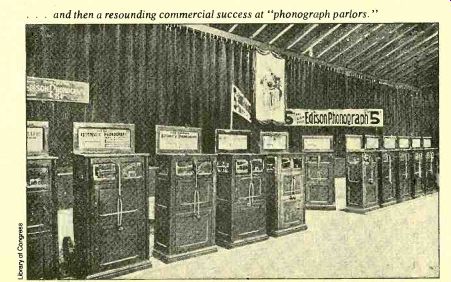
------- ... and then a resounding commercial success at "phonograph
parlors."
As a result, new record companies bloomed like dandelions, and record producers by the dozen began to fly off to Europe, where musicians were cheap and unions unobtrusive. And that was not tape's only effect. The conversion from earlier records' four-minute sides to LP's twenty minutes and more imposed a considerable strain on performers, who were expected to maintain the same high levels of musicianship throughout. As the record industry was finding, minor imperfections that slip by in con cert become glaring errors the third, or sixth, or twentieth time a listener hears them on a record. Moments be fore the cracked note or the audience cough are due, his subconscious braces him for the expected blow.
Tape changed all that. Unlike a disc-cutting lathe, a tape recorder can be stopped at any time for rest periods and retakes. Coughs can be edited out, along with clicks, pops, and ticks in older recordings being rereleased.
Isolated passages-even isolated notes, if need be-can be spliced together to form a perfect whole.
It was tape that also made possible first stereophonic and then quadraphonic sound. Like everything else in sound-recording history, stereo wasn't new. A. D. Blumlein, a British inventor, had patented what is essentially today's method of putting two channels of signal into one record groove in 1931, but his ideas had been all but forgotten when it first occurred to the tape-recording industry that tape could hold more than just one track of signal. The earliest commercial tape machines designed expressly for stereo and binaural sound appeared in 1947. The first stereo discs as we know them today would not come until 1958, or more than ten years later. A similar sequence of events took place more recently when experiments with four-channel tapes in 1969 preceded the first quadraphonic discs by several years.
TODAY the disc record is looked upon as the end product of a perfect frenzy of multitrack activity involving tape and (increasingly) computer systems. And some are inclined to believe it is an end product that is rapidly approaching obsolescence. We'd prefer not to take a stand on this issue right now, except to point out that the disc remains unsurpassed in its technical capabilities for sound reproduction and unchallenged in the affections of its many users. It appears sensible, therefore, to sit back and let the next hundred years take their course.
--------
Also see:
TWO HUNDRED YEARS OF RECORDING--A slightly unsettling look at what it all could eventually lead to. LARRY KLEIN
AUDIO'S DIGITAL FUTURE--Signal processing by computer will mean the end of noise and distortion. ROBERT BERKOVITZ