TAPE TALK--Theoretical and practical tape problems solved. by CRAIG STARK
Coercivity and Quality
Q. Exactly what is "coercivity"? It seems that a high-coercivity tape is better than one with low coercivity, but I don't know why. Why should one tape be better than another because it's harder to magnetize?
PETER WENTWORTH; New Canaan, Conn.
A. A Contrary to your assumption, coercivity is not the force needed to magnetize a tape. Just the opposite, in fact. Coercivity represents the force required to demagnetize a tape once it has been fully magnetized. Its importance in tape comes about because at short wavelengths (high frequencies at slow tape speeds) oxide particles tend to become de magnetized in the very process of recording with them. Since high coercivity implies a high degree of resistance to this self-demagnetizing process, more of the highs stay on the tape. This is the factor that gives some of the "high-bias" cassette tapes an advantage on the treble end of the audio spectrum.
Cassette Compatibility: A Quick Check
Q. Is there some way I can tell quickly which cassettes are best to use with my recorder? The manufacturer doesn't say which ones it was adjusted for, and I have no test equipment.
LAWRENCE MARTIN, San Diego, Calif.
A. A Interstation FM "hiss" is probably your best bet. Record about a minute's worth at a very low recording level (-10 dB or a bit less) on several cassettes and leave the FM tuner on. Now, when you play these test sections back, switching between "source" and "tape" with your amplifier or receiver, you can make a pretty direct "A-B" comparison. (You'll have to raise the playback level of the cassettes so the two sounds seem to be equally loud.) If the cassette sounds dull, your machine was probably adjusted for a tape with a "hotter" high end. If there is more apparent high-frequency content in the recorded material than on the "live" FM source, the opposite is probably true.
In using this quick check it is important that your recordings of FM noise be made at a lower-than-normal level, since there is much more high-frequency energy in the interstation hiss than in ordinary music, and you could drive the tape into treble saturation with anything close to a 0-dB record level. You will probably be able to detect a slight loss at the extreme high end with almost all cassettes, but with a good one and a good machine adjusted for it this should be very minor.
Splicing Cassettes
Q. I am seriously considering splice editing my cassette tapes to desired recording times. I would like your opinion as to the possibility of obtaining sturdy and long-lasting splices. How do tape manufacturers splice the leader onto their tapes?
- J. ROGERS; Springfield, Ill.
A. Splicing cassette tapes is no fun, and no matter how careful you are, there is some possibility that a splice will become sticky in time. Spliced-up professional master tapes are normally stored in a "played" condition partly because high-speed rewinding immediately before playing will break loose any sticky spots that may have developed during storage.
You'll need a splicing jig that holds the tape ends in perfect alignment and has a cutting slot in it, and if the jig doesn't have a built-in cutter you'll need a package of single-edge razor blades. You'll find a variety of cassette-width tape splicers at most audio dealers. You should demagnetize the razor blade in the same manner as you would a tape head, for a magnetized blade will cause a "pop" to occur at each splice. Most important, you must be careful to use splicing tape (sold by audio dealers either in rolls or in convenient precut lengths). Never use ordinary pressure-sensitive cellophane tape for splicing, as its adhesive is sure to bleed out from the edges of the splice and cause sticking later on. So long as you stay with a "name brand" splicing tape you're likely to be using the same product manufacturers (and recording studios) use.
The splicing tape will be slightly narrower than the cassette tape itself, and must be care fully aligned so it doesn't have an exposed corner. Manufacturers with automated machinery have the advantage here. I use tweezers to lay the splicing tape on, so that oil from my fingers won't foul the adhesive. When it is in place, press it down with a rubber pencil eraser to work out the air bubbles.
And remember: the splice always goes on the backing, not the oxide side of the tape; un like the case with open reel, the cassette's oxide side faces outward, away from the hubs.
CrO2 for Cars
Q. Many automobile stereo cassette players have no selector switch for chromium-dioxide tapes. I record CrO2 cassettes on my home deck and want to play them on my car unit. Should I record them with the regular ferric-oxide position at home, since that's how they will be played back in the car?
VOYLE R. DAWSON, Nadervfile, Ill.
A. A CrO2 tape, properly recorded but played back in "ferric" mode, will have about 4 to 5 dB too much treble response. And if you record and play back a chromium-dioxide (or equivalent) cassette ...
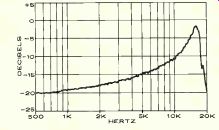
... with your machine set for ferric oxide, the distortion will be boosted along with the higher frequencies. (The accompanying graph shows what the response would look like.) However, there's no harm in trying a couple of properly recorded CrO2 tapes in your car to see how they sound. The extra high-end boost may compensate for the treble losses in your player and speakers.
Hiss and Track
Width I've been told that the reason so many of Q the new open-reel decks are half-track instead of quarter-track stereo is because you get a better signal-to-noise ratio by using wider tracks. I don't see why. Won't you also pick up twice as much hiss as well as twice as much signal, leaving you just where you were before?
LARS JOHNSON, Fargo, N.D.
A. A Doubling either the track width or the tape speed doubles the signal voltage (6-dB increase) that can be developed in the playback head. Noise, however, is made up of (nearly) random frequencies whose volt ages add together on a "root-mean-square" (rms) basis where doubling produces only a 3-dB increase. The 3-dB difference between the two figures represents the net potential gain obtainable by using either twice the track width or twice the speed. Half-track operation also has the advantages of less crosstalk and greater freedom from dropouts, particularly those dropouts that result from edge damage (and show up on the left channel of a quarter-track machine).
--------
Also see: AUDIO BASICS--The Phonograph: Still on Top.