Reviewed by: RICHARD FREED; DAVID HALL; GEORGE JELLINEK; PAUL KRESH; STODDARD LINCOLN; ERIC SALZMAN
ALBENIZ: Iberia, Books 1 and 2. Michel Block (piano). CONNOISSEUR SOCIETY CS 2120 $7.98. ALBENIZ: Iberia, Books 3 and 4; Navarra. Michel Block (piano). CONNOISSEUR SOCIETY SC 2121 $7.98.
Performance: Frequently poetic
Recording: Excellent
ALBENIZ: Iberia, Books 1-4. Aldo Ciccolini (piano). SERAPHIM SIB-6091 two discs $7.98.
Performance: Crisp
Recording: Very good
Aldo Ciccolini, always a more than depend able performer, gives us a crisp, generally enjoyable account of Albeniz's masterwork, not without occasional flashes of elegance; the recorded sound of his piano is very good in deed, and the Seraphim price makes the set still more attractive. Michel Block, however, seems to me to go a good deal deeper into the essence of this music; his playing is more flex ible and frequently poetic, with a conspicuously wider range of both color and mood.
Moreover, he benefits from even finer sound, the Connoisseur issue includes the supple mentary piece Navarra, and it is further en hanced by Peter Eliot Stone's exceptional an notations. Block's Iberia is a thoroughly satis fying presentation in its own right-more so than Francisco Aybar's, issued on the same label about two years ago, but inevitably less ...
------------
Explanation of symbols:
= reel-to-reel stereo tape
= eight-track stereo cartridge
= stereo cassette
= quadraphonic disc
= reel-to-reel quadraphonic tape
= eight-track quadraphonic tape
Monophonic recordings are indicated by the symbol
The first listing is the one reviewed; other formats, if available, follow it.
-----------------
... so than Alicia de Larrocha's magical performance in London set CSA-2235 (wherein she includes not only Navarra but the entire suite Cantos de Espana). Attractive as the various other versions may be, it is Larrocha's that remains the most fulfilling. R.F.
C. P. E. BACH: Trio Sonatas in C Major, B Minor, and B-Flat Major. Eugenia Zukerman (flute); Pinchas Zukerman (violin); Samuel Sanders (harpsichord); Timothy Eddy (cello). COLUMBIA M-34216 $6.98.
Performance: Pushy
Recording: Dry
If you are seeking the Sturm and Drang, the sentimental, the bizarre and spastic writing usually associated with Bach's second-eldest son, stay away from this disc. Here the innovator is writing in an archaic trio-sonata idiom that lacks the strength of the Baroque and has not yet caught the elegance and clarity of the Classical style. The music simply plods along without climax or shape.
In a brave attempt to make these pieces interesting, the Zukermans force the tempos and play with an aggressiveness that is entirely unbecoming to the placid, dull music. Since C. P. E. himself left explicit performance instructions and Quantz bequeathed us an equally detailed account of how to play the flute in the appropriate style, it seems rather strange that the Zukermans perform the mu sic as they do. If the music is to come off at all, it will come off only in the, original style, about which we know more, perhaps, than we do of any other. - S.L.
J. C. BACH: Sinfonia in D Major, Op. 18, No. 4; Sinfonia in D Major, Op. 18, No. 6; Sinfonia in B-Hat Major, Op. 18, No. 2.
TELEMANN: Don Quichotte Suite. Stuttgart Chamber Orchestra, Karl Munchinger cond. LONDON CS 6988 $7.98.
Performance: Excellent
Recording: Rich
Johann Christian Bach is one of the few men who comes off well in Mozart's letters. Mozart loved him as a person, admired his music, and, with the possible exception of Haydn, learned more from him than from any other of his contemporaries. Yet today most people ignore "the London Bach" or pass him off with the old "Mozart without soul" cliché. Admittedly, Johann Christian was no Mozart, but he did write music of a noble simplicity, filled with elegant melodies, that deserves a wider audience than it presently enjoys. We should be grateful to Karl Munchinger for recording these beautiful works and lavishing on them the loving care that is so often reserved for Mozart.
So many conductors, when confronted with relaxed, spacious music of the Classical era (these relatively late works of the London Bach are truly Classical), feel the need to push it forward, as though to apologize for the very quality that is its essence. Munchinger does not fall into that trap, bless him, but rather brings out the long-lined, free melodies Bach spent so much time and care to create.
Yet he never lets the fabric go slack: the textures are well articulated, and there is a constant sense of direction that points up the beautifully molded contours of the music. Johann Christian is here served with the opulence his music deserves.
After hearing the three Bach pieces, one wishes Munchinger had offered us a fourth in stead of the Telemann suite. Don Quichotte is always a winner because of its good-natured fun and wit, but the Stuttgart outfit simply is not as convincing in Baroque music as it is in Classical. S.L.
J. S. BACH: Arias (see Collections-Janet Baker) ; J. S. BACH: Toccata and Fugue in D Minor (BWV 565); Toccata, Adagio, and Fugue in C Major (BWV 564); Toccata and Fugue in D Minor ("Dorian," BWV 538); Toccata and Fugue in F Major (BWV 540). Lionel Rogg (organ). ANGEL D S-37265 $7.98.
Performance: Mixed
Recording. Splendid
One of the most striking characteristics of Baroque instrumental music is its dramatic juxtaposition of the rhapsodic and the well-ordered. The form most apt to make an issue
of this sharp stylistic contrast is the toccata and fugue. Lionel Rogg is excellent in the well-ordered parts: his performances of the fugues are strong, rhythmically well-marked, and clearly articulated. When it comes to the rhapsodic, however, he is too strongly attached to the written page. The broad gestures and fanciful flights of figuration in Bach's toccatas suffer from a literal reading of the rhythm markings; they fall on each other in spastic gasps because of a lack of space between them, space the listener needs to register the full impact of the music's constantly changing moods.
The sound of the organ at St. Peter's Cathedral, Geneva, is a fine, robust, Romantic one, excellently captured in this four-channel re cording. Mr. Rogg prefers it full most of the time, though, and rarely treats us to the highly colored solo stops so frequently required by this music.
-S. L.
BARBER: Excursions (see MACDOWELL)
BEETHOVEN: String Quartet No. 15, in A Minor, Op. 132. La Salle Quartet. DEUTSCHE GRAMMOPHON 2530 728 $7.98.
Performance: Impeccable but bland
Recording: Excellent
The La Salle Quartet is a splendid ensemble, but one whose energies, as suggested by this release and an earlier one of the Op. 130 Quartet and Grosse Fuge, are more effectively directed to material other than the late Beethoven quartets. To be sure, what is bland to one listener may be "straightforward" to another, and what one finds expressive may strike another as overindulgent, but I cannot help feeling that the hasty traversal of the Heiliger Dankgesang here simply misses the point of the work. Were these fine musicians afraid a confrontation with what we may call (for lack of a better term) the "mystique" of Beethoven's valedictory quartets might tempt them into the self-conscious bathos that is the opposite extreme of the note-perfect bland ness they have settled for here? Whatever the reason, while there is an abundance of first rate playing per se, there is precious little sense of real involvement, and what ought to be one of the most sublime and fulfilling experiences music has to offer comes out in stead merely as a demonstration of impeccable bowing and fingering. The Quartetto Italiano (Philips 802.806) probably balances polish and Innigkeit more successfully than any other foursome currently represented in a re cording of Op. 132, though the Vegh Quartet, displaying a bit less of the former quality, shines with still more of the latter (in Telefunken 6.35040). The lower-price versions by the Hungarian Quartet (in Seraphim SID-6007) and the Yale Quartet (Vanguard VCS-10005) also yield more of the Beethoven essence than this handsomely played but curiously unmoving new entry.
-R.F.
BLOCH: Schelomo. SCHUMANN: Cello Concerto in A Minor, Op. 129. Mstislav Rostropovich (cello); Orchestre National de France, Leonard Bernstein cond. ANGEL 0 S-37256 $7.98.
Performance: Expansive
Recording: Very good
The combination of Rostropovich and Bern stein in Bloch's Schelomo led me to expect something like the epochal Feuermann Stokowski-Philadelphia Orchestra collaboration of 1940, which for fiery dramatic impact and urgency has never been equaled. As it turns out, there are differences, but the new team does come close. The major point of difference lies in the more expansive view of the music taken by Rostropovich and Bern stein-and, of course, there is the difference that comes from the finest current recording technology, enhanced by effective use of four-channel ambiance. The end result is a mind-boggling experience in sonic richness, together with a projection of musical detail (inner voices, subtle but significant figurations, and the like) far surpassing that of any previous recording of Schelomo I have heard.
The final climactic statement of the main theme, which paves the way for the "all is vanity" epilogue, is just plain shattering in its musical-dramatic impact.
When it comes to the Schumann concerto, though, I find the similarly expansive treatment rather too much for the essentially intimate, almost frail, substance of the work. I lean toward the Walevska-Inbal version on Philips--a disc that offers as coupling, by the way, a fine and somewhat tauter treatment of Schelomo.
-D.H.
DVORAK: Suite in A Major, Op. 98 ("American"). Berlin Radio Symphony Orchestra, Michael Tilson Thomas cond. The American Flag. Joseph Evans (tenor); Barry McDaniel (baritone); St. Hedwig's Cathedral Choir; RIAS Chamber Choir; Berlin Radio Symphony Orchestra, Michael Tilson Thomas cond. COLUMBIA M-34513 $6.98.
Performance: Energetic
Recording: Crisp but crackly
-------------------
American Art bongs
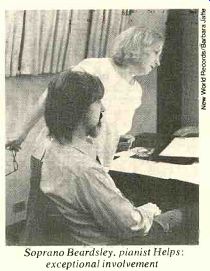
---Soprano. Beardsley, pianist Helps: exceptional involvement
THE title of this collection of American songs is the last line of Paul Bowles' Once a Lady Was Here (to his own verse). Another composer who is as active in the realm of words as in that of music is also involved in this production: Ned Rorem has contributed a fascinating "personal survey" of "The American Art Song from 1930 to 1960" that should be required reading for anyone interested in this still largely neglected (on the part of the public) segment of American music, and he has also provided thoughtful and provocative introductions to the songs recorded here. I mention Rorem's essay before discussing the music because it is every bit as valuable as the songs themselves, and it should by all means be read thoroughly before the record is heard.
Perhaps few of the songs tremble on the edge of greatness, but there could hardly be more representative illustrations of the variety of styles and the level of craftsmanship that went into defining a specifically American school of art song (relying not a whit on folk material) The Chanler and Citkowitz songs in particular should come as both a discovery and an embarrassment to those who pride themselves on being connoisseurs of melodies and lieder. The degree of identification and involvement on the part of the interpreters here, pianists as well as singers, is also exceptional. There is not only an example of performance participation by a composer (Helps at the piano in his own very effective little cycle at the end of the recital), but a brief vocal duet that Gramm sings with himself (via over dubbing) in Chanler's Moo Is a Cow. Copyright problems, apparently, kept some of the texts from being printed, but the unusually thorough documentation includes information on just where to find them. A valuable and most enjoyable production.
-Richard Freed
BUT YESTERDAY IS NOT TODAY.
Chanler: The Children; Once upon a Time; The Rose; Moo Is a Cow; Thomas Logge. Bowles: Once a Lady Was Here; Song of an Old Woman. Duke: Richard Cory; Luke Havergal; Miniver Cheevy. Donald Gramm (baritone); Donald Hassard (piano). Citkowitz: Five Songs from "Chamber Music." Copland: Song. Sessions: On the Beach at Fontana. Chanter: These, My Ophelia. Barber: Sure on This Shining Night. Helps: The Running Sun. Bethany Beardslee (soprano); Robert Helps (piano). NEW WORLD RECORDS NW 243 $8.98.
-------------------------
--------------------------
Late G & S: Grand Duke
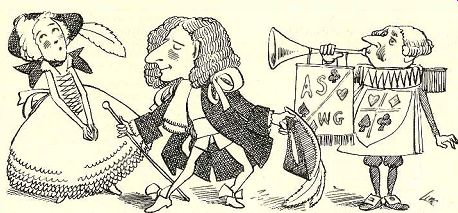
THE curtain went up on the marketplace of Speisesaal, in the imaginary Grand Duchy of Pfennig Halbpfennig, on March 7, 1896, when The Grand Duke, or The Statutory Duel opened at the Savoy Theatre in London.
After that curtain went down 123 performances later, the D'Oyly Carte Opera Company didn't produce this last of the Gilbert and Sullivan operas again until April 5, 1975. The success of the revival led to the decision to record the score, thus making complete on the London label the entire cycle of Gilbert and Sullivan collaborations in D'Oyly Carte productions--with the exception of their earliest effort, Thespis, for which most of the music seems to be missing.
For the plot of The Grand Duke, Gilbert went all the way back to Thespis, which dealt with a company of actors taking over the roles of the gods on Olympus. In The Grand Duke the setting is around 1750, and a theatrical troupe, headed by an ambitious manager named Ernest Dummkopf, is involved in a plot to assume positions of royalty in a Ruritanian duchy. From then on, the story grows hopelessly complicated, involving the statutory duel of the subtitle, wherein the drawing of cards decides a duel's outcome rather than the shedding of blood; the machinations of the cheap Grand Duke Rudolph and his penny-pinching fiancée the Baroness von Kraken feldt; a court coup in which the company of theatrical imposters appear in costumes for Troilus and Cressida so as to look like ancient Greeks; the ducal aspirations of the company's comedian Ludwig; a whole rigmarole having to do with the eating of sausage rolls as a conspiratorial ritual; and a mass wedding at which the Prince of Monte Carlo appears to invent the game of roulette.
MANY people feel that The Grand Duke is the one Gilbert and Sullivan opera that failed, but if that is so, it is certainly one of the theater's most delightful failures. I have heard the entire work, including spoken dialogue, as produced for the BBC by Stanford Robinson, and it holds up absorbingly. On the new London release we have the score alone, and an exhilarating score it is. This-is a more continental Sullivan than we are accustomed to hearing, one who takes advantage of the play's locale to supply lilting waltzes and dances as well as a spectacular Roulette Song that is hard to get out of your head once you've heard it. Gilbert's lyrics are surely as brilliant as their predecessors, the highlights being Ernest Dummkopf's "Were I a king in very truth," the Grand Duke Rudolph's "When you find you're a broken-down critter," and a melodramatic dissertation by Julia, the troupe's leading lady, on what constitutes a first-rate part for the stage. The choral and orchestral passages glitter with Offenbachian effervescence-and here is where the D'Oyly Carte really shines. Anyone who has heard previous rather amateur attempts to commit this piece to records is sure to be thrilled by the difference.
The Grand Duke, though, is more ambitious operatically than anything else in the series except for Princess Ida, and it makes vocal demands on the singers that the D'Oyly Carte's soloists today cannot always match.
Julia Goss is surprisingly adept at meeting the challenges of her coloratura role, but John Ayldon doesn't have quite the honeyed baritone needed to bring off the Roulette Song as well as I have heard it done by others. (Yet, like so many of the D'Oyly Carte principals, he makes up in enthusiasm what he lacks in vocal prowess.) As Rudolf, John Reed is his usual chuckling self, much improved in comic presence over the years but still a bit too leering in his approach. Meston Reid makes an excellent, imperturbable Ernest Dummkopf, company veteran Kenneth Sandford is splendidly droll as Ludwig, and Lyndsie Holland is perfectly cast as the miserly Baroness, whose parties are ruined for her by her guests' appetites but who loves a glass of good wine when it's provided out of somebody else's budget.
Conductor Royston Nash, though a mite too military at times in his beat, has proved himself a worthy successor to the adroit Isidore Godfrey (who directed most of the other Lon don recordings of Gilbert and Sullivan).
. . . certainly one of the theater's most delightful failures . . .
Now that the D'Oyly Carte's version of the series is complete on discs in stereo (a number of the operas are also available on excellent-sounding cassettes, and more, including The Grand Duke, are reportedly on the way), it is possible to look back on it as a whole. The main things that stand out in such an overview are the enthusiasm of the presentations, the brilliance of the orchestral playing and the choral singing, the excellence of the recorded sound, and-above all-the marvelously pre served sense of style. Earlier versions provided stronger comedians--Martyn Green and Peter Pratt--and there were better endowed, real opera singers such as Elsie Morison on hand when Sir Malcolm Sargent put his series together for Angel. But for overall precision and panache nothing matches these latest tries. It's too bad the complete dialogue has been included in only a handful of the sets (H.M.S. Pinafore, The Pirates of Penzance, Patience, Iolanthe, and The Gondoliers), but perhaps the D'Oyly Carte will take care of that lack in future recordings.
-Paul Kresh
GILBERT AND SULLIVAN: The Grand Duke, or The Statutory Duel. John Reed (baritone), Rudolph; Meston Reid (tenor), Ernest Dummkopf; Kenneth Sandford (baritone), Ludwig; Michael Rayner (tenor), Dr. Tann hauser; John Ayldon (baritone), Prince of Monte Carlo; Jon Ellison (baritone), Ben Hashbaz; James Conroy-Ward (baritone), Herald; Barbara Lilley (soprano), Princess of Monte Carlo; Lyndsie Holland (contralto), Baroness von Krakenfeldt; Julia Goss (soprano), Julia Jellicoe; Jane Metcalfe (soprano), Lisa; Patricia Leonard (mezzo soprano), Elsa, Second Girl; Anne Egglestone (mezzo-soprano), Gretchen, First Girl; Beti Lloyd-Jones (mezzo-soprano), Bertha, Third Girl; Glynis Prendergast (soprano), Olga. D'Oyly Carte Opera Company and Royal Philharmonic Orchestra, Royston Nash cond. LONDON OSA 12106 two discs $13.96.
[For the seasoned Savoyard who would like to indulge in a luxurious retrospective of the en tire collection, the American Heritage Society has produced a spectacular package containing a superbly illustrated book on Gilbert and Sullivan (by Christopher Hibbert) and a three-record set (drawn from the London series) of excerpts from all the operas right through The Grand Duke reviewed above-and including a trio from Cox and Box, the tuneful result of Sullivan's early collaboration with Francis Burnand. The selections, ranging from individual patter songs to the complete first-act finale of Iolanthe, have been chosen with exceptional intelligence (and are clearly set in the context of the action by Richard Traubner's lucid descriptions in the notes). The surfaces are flawless. To obtain this treasure-box of splendors, send $37.50 to the American Heritage Catalogue Department, P.O. Box 1776, Marion, Ohio 43302. That's real coin, and they could never have shaken it loose from the purse of the Baroness von Krakenfeldt, but for the devotee-or the novice seeking to get better acquainted with the G&S repertoire-it's worth every pfennig.-P.K.]
--------------
--------------
The story of how Antonin Dvorak came to write his American Suite and The American Flag is almost more interesting than the mu sic. As Andrew Cosgrove puts it in his fascinating liner notes, in June 1891 "the son of a Bohemian butcher received a telegram from the wife of a New York grocer" that led to the composition of the New World Symphony as well as the two works presented here. The butcher's son was Dvorak, the grocer's wife a Mrs. Jeanette Thurber, who was offering the composer the director's chair at her National Conservatory in New York City. A year later, Dvorak took up the offer. When he arrived, it was the four-hundredth anniversary of Columbus' discovery of America. Mrs. Thurber had found just the poem for him to set for the occasion, an eight-part patriotic piece out of which the composer somehow managed to create a rhapsodic cantata for chorus and or chestra, on an oversize scale and in a rather Teutonic idiom. The poetry by Joseph Rod man Drake, with its overblown lines about the standard of Freedom, "the azure robe of night," and the "stars of glory," is fustian stuff, yet the music has stretches of striking eloquence. It is sung and played with hearty enthusiasm by the combined forces here, but it is not likely to replace The Star Spangled Banner.
The American Suite, which started out as a five-movement piano work, contains a greater measure of the characteristic Dvorak charm, including the sort of American. Indian melodic material he used to even more telling advantage in his American Quartet. Thomas again delivers an enthusiastic reading. Dvorak never heard either of these works in his lifetime.
Both bear his imprint and contain some inspired pages; even so, and even with such en thusiastic performances as these, one has the feeling that he didn't miss too much. The sur faces on my review copy crackle almost to the point of unacceptability. P.K.
RECORDING OF SPECIAL MERIT
FAURE: La Bonne Chanson, Op. 61. RAVEL: Chansons Madecasses. POULENC: Le Bal Masque. Dietrich Fischer-Dieskau (baritone); Wolfgang Sawallisch (piano); soloists from the Berlin Philharmonic. BASF G22765 $6.98.
Performance: Excellent
Recording: Very good
It has been more than sixteen years since Fischer-Dieskau recorded French songs (a Debussy/Ravel collection on Deutsche Grammophon, deleted years ago), and I don't believe La Bonne Chanson has been recorded before in its chamber-music instrumentation (string quartet and double bass added to the piano). Nor, for that matter, has Sawallisch appeared as pianist on a record issued in this country until now. More to the point than such statistical observations, this fresh new release is a splendid package in which the performances of the two longer works are down right stunning. Fischer-Dieskau does not match Souzay's extraordinary feeling for the Chansons Madecasses (Philips 839.733LY), and perhaps no non-Frenchman can hope to, though he is more successful here than in his earlier try for DG. But he sounds thoroughly ...
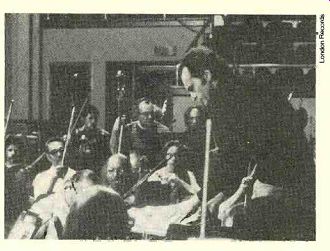
LORIN MAAZEL: a remarkably fresh presentation of the Franck symphony
… at home in the Faure and the Poulenc. La Bonne Chanson gains, I think, in the warmer-textured setting with strings, and Le Bal Mas qui as heard here is a special delight for the period music-hall flavor projected by the instrumental octet as well as Fischer-Dieskau's uninhibited identification with the satirical spirit of the texts. The recording is close-up but very well balanced, the pressings quiet, and full trilingual texts are included.
-R.F.
FAURE: Pelleas et Melisande-Suite, Op. 80 (see FRANCK)
FRANCK: Symphony in D Minor.
FAURE: Pelleas et Melisande-Suite, Op. 80. New Philharmonia Orchestra, Andrew Davis cond. COLUMBIA M-34506 $6.98, MT-34506 $7.98.
Performance: Good
Recording: Good
RECORDING OF SPECIAL MERIT
FRANCK: Symphony in D Minor; Symphonic Variations for Piano and Orchestra. Pascal Roge (piano); Cleveland Orchestra, Lorin Maazel cond. LONDON CS-7044 $7.98.
Performance: Superb
Recording: Gorgeous
Maazel's earlier recording of the Franck symphony, made with the RIAS Orchestra for Deutsche Grammophon more than fifteen years ago, was one of the best of its time, but I do not remember its being as good as this new Cleveland version, which strikes me as a more than reasonable candidate for the top of the current list. It is surely the finest thing Maazel has done in Cleveland since his first recording there (the Prokofiev Romeo and Juliet issued four years ago); he has the orchestra at the very top of its form, and his reading informs the work with great dignity and credibility. He seems to have found the ideal tempo for each of the three movements, pressing on just enough to sustain momentum and con vey an exceptional sense of alertness, but never enough to counter the essentially expansive character of the work. Rhythms are secure; sensitively handled dynamic contrast is used as an effective expressive device. Every big moment makes its proper point; none is overindulged. What it all adds up to is a remarkably fresh presentation of an extremely familiar work--without being a self-consciously "different" one--and London/Decca has provided a gorgeous but unexaggerated sonic frame for the superb playing that is heard from every orchestral choir and section soloist.
Andrew Davis' Franck is the sort of performance anyone would be delighted to hear in the concert hall, but it is not really exceptional. His view of the work, too, is generally clean and un-sentimentalized, with well-judged tempos and tidy playing, but his version misses the conviction and elegance of Maazel's or the older ones of Monteux, Beecham, and Martinon. The New Philharmonia in this instance shows less spirit than the Clevelanders and is far less richly recorded.
Of the two fillers, neither of which is likely to sway a decision one way or the other, Davis' Faure is the more imaginative choice, and it is beautifully played; I hope Columbia re-couples it with something other than the Franck symphony. On the Maazel disc, Pascal Roge, in his first recording with orchestra, does very well indeed by the Symphonic Variations, and the orchestra's participation in this work, too, is unusually eloquent. - R.F.
GLINKA: Songs (see Collections-Galina Vishnevskaya)
RECORDING OF SPECIAL MERIT
HAYDN: La Vera Costanza. Jessye Norman (soprano), Rosina; Helen Donath (soprano), Lisetta; Claes H. Ahnsjo (tenor), Count Errico; Wladimiro Ganzarolli (bass), Villotto Villano; Domenico Trimarchi (baritone), Masino; Kari Lovaas (soprano), Baroness Irene; Anthony Rolfe Johnson (tenor), Ernesto. Orchestre de Chambre de Lausanne, Antal Dorati cond. PHILIPS 6703.077 three discs, $20.94.
Performance: Very good
Recording: Excellent
The steady routine and relative security Haydn enjoyed in the Esterhazy Castle were clearly beneficial to his productivity in the field of orchestral and instrumental music.
His development as an opera composer, on the other hand, suffered because of it. There was a wealth of operatic activity at the castle, and the performances under Haydn were probably as good as could be found anywhere in Europe during that period (1760-1780). But the prince did not like comic operas (for which Haydn exhibited a decided flair), and librettists for entertaining and sophisticated "semi-serious" opera were, apparently, not available. La Vera Costanza (1779) is typical of the necessary dramatic compromises: the buffa elements are not funny enough, while the heroic and even cruel gestures are not convincing.
This set is the second in a series undertaken by Philips in association with Radio Suisse Romande, a project that may lead to recordings of all Haydn's operas. The performances are so painstakingly prepared and beautifully executed that I find myself torn between gratitude and frustration. Again and again we are regaled with evidence of Haydn's craft, imagination, wit, and ingenuity, yet the end result is an unsuccessful opera. There are some inspired arias and beautifully constructed ensemble finales, but the lacunae between these high points seem endless. In general, the ratio here between action and padding seems the opposite of what it should be.
The performance, however, is remarkable.
Dorati's leadership is a model of elegance and precision, considerate of the expert and musicianly singers but equally devoted to the realization of Haydn's delicious orchestral writing. Above all, he obtains an animated ensemble performance that deserves uniform praise.
The rich and finely detailed recorded sound permits clean continuo registration (Maestro Dorati is at the harpsichord). This is not for the average opera lover, but as documentation of a little-known phase of Haydn's encyclopedic activity it is peerless. -G.J.
RECORDING OF SPECIAL MERIT
LEONI: L'Oracolo. Joan Sutherland (soprano), Ah-Yoe; Tito Gobbi (baritone), Chim Fen; Richard Van Allan (bass), Win-Shee; Ryland Davies (tenor), San-Ltn; Clifford Grant (bass), Hu-Tsin; Huguette Tourangeau (mezzo-soprano), Hua-Qui. John Alldis Choir; National Symphony Orchestra, Rich ard Bonynge cond. LONDON OSA 12107 two discs $15.96.
Performance: Very good
Recording: Very good
Set in San Francisco's Chinatown around the turn of the century, Franco Leoni's L'Oraco lo, a grisly one-actor, served for many years as a vehicle for Antonio Scotti. It has received few performances anywhere since 1933, when the great baritone chose it for his historic farewell to the Metropolitan. On the occasion of this rediscovery I am happy to say that Richard Bonynge, that imaginative searcher for opera's lost treasures, has struck ... well, silver, at least.
L'Oracolo takes a little more than an hour to perform, and there is never a dull moment.
Musically, it shows a definite indebtedness to Puccini (La Boheme, mainly), a graceful gift of melodic expression, little in the way of an individual profile, but great skill in fusing voices, chorus, and off-stage effects into a flowing and always colorful continuity. These qualities were perhaps not appreciated when the opera was new (1905) and Puccini, Mascagni, Leoncavallo, Giordano, and Cilea were also enriching the repertoire. Considering the current state of operatic writing, Franco Leoni may yet be given grateful recognition.
Tito Gobbi is a singing actor in the Scotti mold; his portrayal of the murderous, despicable Chim-Fen is commanding and terrifyingly real. Joan Sutherland sings prettily in the love scene and with convincing delirium in the sordid final moments. As her doomed lover, San-Lui, Ryland Davies is refined, but too ...
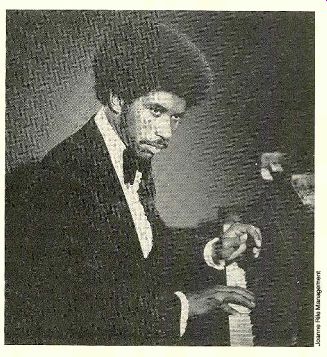
-------- LEON BATES: ... making a case for MacDowell's Fourth Sonata on a
fine debut disc---
.... light in tone. Richard Van Allan's peculiar tone production distorts his vowel sounds in the low range, but he handles the upper part of his demanding music impressively. Good contributions by Huguette Tourangeau and Clifford Grant round out the cast. Richard Bonynge underplays the shock effects and concentrates, successfully, on obtaining a polished and transparent realization of what turns out to be a very rewarding score. The fourth side of the two-disc set contains orchestral "Reminiscences" of Leoni's music for James Bernard Fagan's play The Prayer of the Sword. There are six brief sections, all engagingly melodious in a lighter vein, all beautifully played.
- G.J.
MACDOWELL: Piano Sonata No. 4, Op. 59 ("Keltic"). BARBER: Excursions. WALKER: Sonata No. 3. Leon Bates (piano). ORION ORS 76237 $7.98.
Performance: Good
Recording: Good
For years there has been talk of an "integral" recording of MacDowell's four piano sonatas, but no such project has yet materialized, and the Sonata Tragica (No. 1) even now remains unaccounted for in the catalog. It seems a strange lapse in this age of the "Complete Set," but the continued neglect of No. 1 does not make Leon Bates' fine account of No. 4 any less welcome. MacDowell dedicated this work (together with its immediate predecessor, the Norse Sonata) to Grieg, a composer with whom he had more than a few characteristics in common; we are reminded of this particularly in the opening movement of this 1901 sonata, while in the tempestuous final movement there seem to be thinly disguised allusions to MacDowell's own Second Piano Concerto. Bates deals effortlessly with the work's technical demands and is almost equally successful in realizing the element of fantasy underlying its three movements. He makes so strong a case for the Fourth Sonata, in fact, that I wish he had given us the Sonata Tragica on the other side of the disc instead of the g E 5 Barber and Walker pieces. Not that he does any less well by them than he does by the MacDowell, but Zola Shaulis' somewhat more persuasive (and more richly recorded) version of the Excursions is part of a disc made indispensable by the inclusion of the Bloch sonata (CRI SD 295), and George Walker's Sonata No. 3, unlike his stimulating Trombone Concerto, gives the impression that the composer was more interested in effects for their own sake than in communicating with his listeners. The three performances, though, add up to quite a debut disc for Bates, from whom we shall surely be hearing more. R.F.
RECORDING OF SPECIAL MERIT
MAHLER: Symphony No. 9, in D Major. Chicago Symphony Orchestra, Carlo Maria Giulini cond. DEUTSCHE GRAMMOPHON 2707 097 two discs $15.96, 3370 018 $15.96.
Performance: Superb
Recording: Superb
From its very first disc documentation-with Bruno Walter and the Vienna Philharmonic in a public performance on the eve of the Nazi takeover of Austria-to this latest one almost forty years later, the Mahler Ninth has been fortunate in most of its recorded realizations.
During the stereo era alone we have had at least three of the very top rank: Columbia's with Bruno Walter, Angel's with Otto Klemperer, and Philips' with Bernard Haitink. And now we have yet another to equal those, but with a difference.
The difference is in the singing quality Giulini brings to the end movement, a quality that takes precedence even over the compassion of Walter, the starkness of Klemperer, or the stern control of Haitink. Not that Giulini can't bring stern control into play when the musical situation so demands: the Rondo-Burleske is here as gnarly and rough-hewn as one could ever want, and it is played with surpassing brilliance. But it is in the last movement that Giulini and the Chicagoans come through in altogether inspired fashion. The lambency that has already distinguished the performance here bursts into a sustained tonal glow equaled in my memory only by the greatest public performances of Stokowski's Philadelphia Orchestra or Koussevitsky's Boston Symphony. Rarely indeed does one hear such string sound as in the opening pages of the finale in this recording. Indeed, the performance as a whole has much in common with my remembered impressions of Koussevitsky's, who had his own special flair for the work. In all, then, this is another outstanding recorded performance of Mahler's Ninth to add to the extensive roster of splendid ones already available. D.H.
RECORDING OF SPECIAL MERIT
MESSIAEN: Vingt Regards sur! 'Enfant Jesus. Michel Beroff (piano). CONNOISSEUR SOCIETY CS2-2133 two discs $15.96.
Performance: Superb
Recording: Excellent
If anyone can make the unique style and sub stance of Messiaen's musical language palatable, it is certainly Michel Beroff, as he has al ready proved in the Angel recording of the Quartet for the End of Time. Quite simply, there are marvelous sonic events in the Vingt Regards, events that receive a most remarkable realization through the wizardry of Beroff's fingers and his command of the pedals. Whether or not one cares for Messiaen's aesthetic as expressed in his somewhat hyperbolic expatiations on his own music, one can only be impressed by his command of all the sonic resources of the keyboard medium timbre, rhythm, commanding line, harmonic tension-relaxation, and the rest-drawing freely as well on Gregorian chant, Oriental music, bird song, and other exotica. And yet the whole thing is no hodgepodge but a coherent listening experience, aided in this in stance, I must admit, by the composer's own vivid program annotations included in the Connoisseur Society album. This Vingt Regards was, moreover, excellently recorded by Pattie Marconi in France and splendidly mastered by Connoisseur Society over here. Clearly the album's Grand Prix du Disque was well deserved.
D.H.
MONTEVERDI: Vespro Della Beata Vergine (Vespers, 1610). Elly Ameling, Norma Burrowes (sopranos); Charles Brett (alto); Anthony Rolfe Johnson, Robert Tear, Martyn Hill (tenors); Peter Knapp, John Noble (basses);Choir of King's College, Cambridge; Early Music Consort of London, Philip Ledger cond. ANGEL 0 SB-3837 two discs $15.96.
Performance: Aggressive
Recording: Reverberant
In an attempt to overcome the stodginess of the traditional interpretations of early sacred music, many conductors and choirmasters have infused vitality into the genre by means of quicker tempos and more vigorous rhythms. In other words, they have quite rightly begun to treat the music as music rather than as fervent expressions of religious dogma. But Philip Ledger, in this reading of the Monteverdi Vespers, seems to have gone too far in that direction. - In striving for brilliance, he has pushed the tempos beyond the point of vigor into downright skittishness, forcing the chorus to the point where the boys sound raucous and on the verge of cracking.
This drive is also reflected in the solo pieces, and it results in some rather ugly sounds there too. The aggressiveness has turned the smooth Renaissance lines into a jagged, contourless muddle, especially in the instrumentally conceived rhythmic modifications, which frequently come out like yelps. Although there are a few passages that tolerate such exaggeration ("Lauda Jerusalem," for example), the overall effect is simply frantic.
Left to their own devices in the concertos, the soloists are generally excellent. Elly Ameling loses her vibrato and produces the sensitive singing we expect of her. Robert Tear, right at home in this florid idiom, is thrilling in the almost Oriental coloratura of the final Gloria, in which he is joined by Anthony Rolfe Johnson. Also notable is the performance of the Duo Seraphim by all three tenors.
And the Early Music Consort of London turns in a performance of such accurate into nation and brilliance that the musical climax of the recording occurs in the instrumental Sonata Sopra "Sancta Maria." - S.L.
MORALES: Magnificat Secundi Toni. Motets: Emendemus in melius; Lamentabatur Jacob; Andreas Christi famulus; Jubilate Deo omnis terra; Pastores, dicite, quidnam vidistis. Pro Cantione Antigua, London, Bruno Turner cond.DEUTSCHE GRAMMOPHON ARCHIV 2533 32157.98.
Performance: Very good
Recording: Excellent
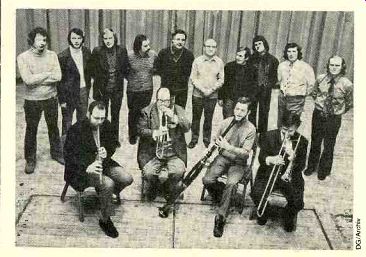
The Pro Cantione Antigua comprises a small, all-male chorus and a supporting group of early-instrument players. The sound of this re cording is quite different from the more commonly heard unaccompanied choral readings that were until recent years considered appropriate for the performance of Renaissance sacred music. The exclusive use of male voices (countertenors replacing women) produces a rich, full sound, and the instrumental doubling, besides creating intriguing coloration, also adds rhythmic vigor to the music and greatly contributes to the articulation of the vocal lines. These forces especially enhance the Morales Magnificat, which alternates the Gregorian chant for this text with polyphonic settings of it that embody the chant melody in carefully woven imitative textures. Each verse is treated to a different instrumentation, which not only lends tonal variety but also reflects the moods of the individual verses.
The excellent performance helps one realize why it was that Morales was so renowned for his Magnificats.
Of the motets on the album, two are sung without instruments. The performances re mind one that voices are infinitely more supple and expressive when left to their own devices than when accompanied. Only winds are used to accompany the other motets, and, while they add to the sound, the old instruments are necessarily rather stiff and cumber some, which takes away from the highly expressive vocal writing. The true artistry of the vocalists here is best displayed without the instruments. But both accompanied and unaccompanied performances are historically correct, and if the use of one seems to preclude the advantages of the other, this record at least lets us sample both ways.
-S.L..
MOZART: Arias (see Collections-Stuart Burrows)
RECORDING OF SPECIAL MERIT
MOZART: Flute Concerto No. 1, in G Major (K. 313); Flute Concerto No. 2, in D Major (K. 314); Andante in C Major for Flute and Orchestra (K. 315). James Galway (flute); Lucerne Festival Strings, Rudolf Baumgartner cond. RCA ARL1-2159 $7.98, ARS1-2159 $7.98, ARK I-2159 $7.98.
Performance: Marvelous
Recording: Good
RCA must be out to corner the market in Mozart flute concertos, having issued the same program with Rampal less than two years ago (FRL1-5330) and now giving us a no less marvelous package with Galway. Both flutists are superb, of course, so it is very much a matter of "How happy could I be with either. . . ." Aside from the cadenzas (each plays his own, equally tasteful), the most conspicuous differences are to be noted in the slow movements of the two concertos and the finale of K. 313.
The slow movement of the latter is an Adagio non troppo in which Galway seems to ignore the "non troppo" and offers instead a very slow and dreamy nocturne, whose hypnotic effect is actually enhanced by the slight haze over the orchestra from the somewhat over-reverberant acoustics (but not by the noisy surfaces of the two copies I received). In the finale Galway's pacing, less perky than Rampal's, seems closer to the Tempo dimenuetto marking, while in the slow movement of K. 314 (Mozart's transcription of his Oboe Concerto) it is Rampal who is more expansive and dreamlike. Both soloists enjoy first-rate collaboration from their respective conductors, and both discs are so enticing that the differences between them may simply be seized upon as an excuse for acquiring them both. (It should be noted that the Rampal recording is also available on MHS 863 at much less than the RCA price.) R.F.
NICOLAI: The Merry Wives of Windsor (see Best of the Month, page 79)
POULENC: Le Bal Masque (see FAURE)
PUCCINI: Messa di Gloria. Kari Lovaas (so prano); Werner Hollweg (tenor); Barry McDaniel (baritone); Chorus of the West German Radio, Cologne; Frankfurt Radio symphony Orchestra, Eliahu Inbal cond. PHILIPS 9500 009 $7.98.
Performance: Good
Recording: Excellent
Here is an enjoyable rendering of a thoroughly ingratiating piece of music that all Puccini enthusiasts should own without trying to find in it more than the earmarks of an immensely gifted youth (it was his graduation exercise, completed in 1880 at age twenty-two). Melodic felicities abound in the Mass, though at times they are compromised by youthful in sensitivity. The jaunty dance tune Puccini uses for his Agnus Dei illustrates this problem, and yet the way he brings back an initially insignificant march theme for the blazing conclusion of the Gloria already foreshadows the theatrical genius to come.
The choral and orchestral performances are very good throughout. Tenor Hollweg is the most effective of the three soloists. Miss Lovaas is entirely competent, and Mr. McDaniel sings stylishly but without enough sonority in his solos. The recording is faultless.
-G.J.
PUCCINI: Tosco (Highlights). Vladimir Atlantov (tenor), Mario Cavaradossi; Tamara Milashkina (soprano), Tosca. Orchestra of the Bolshoi Theater, Mark Ermler cond. CoLUMBIA M-345I6 $6.98.
Performance: Disappointing
Recording: Mediocre
This disc includes virtually all the music of Tosca and Cavaradossi except the Scarpia scenes. It was meant to be released in time for Vladimir Atlantov's Metropolitan debut as Cavaradossi last March, but that event failed to materialize. I wish I could say the same about the recording, for it does little for the
---- PRO CANTIONE ANTIQUA: demonstrating Morales' just renown
------------------
G. Faure, E. Ameling , ...
Complete Songs of Faure---"Faure's uniqueness ... lies in, the flawlessness of his jewels."
By Ned Rorem
ASKED how fast a song of his should go, Gabriel Faure replied: "When the singer is bad-very fast." The quip sounds glib. But remember, Composers do have fewer preconceptions about their songs than about their sonatas; song is subject to legitimate distortion by virtue of a singer's range and sex. On a more personal level, and surely unbeknownst to Faure, the quip suggests a shady truth:
maybe his songs are all intrinsically slow. Mu sic necessarily reflects the humor of its com posers. Those of broad scope, like Chopin and Strauss, are choleric-melancholics capable of both the inherently fast and the inherently slow. Narrower sanguinaries like Rossini or Scarlatti conceive only allegros (their slow pieces being really fast pieces played slow), while phlegmatics like Delius and Faure are men whose fast pieces are really slow pieces played fast.
Or so I had always believed.
Already at twenty, confusing love with knowledge, I cast myself as an American authority on French song. Ravel and Poulenc sat at the top of the ladder, Debussy and Duparc on middle rungs, and at the bottom, with Gou nod , crouched Faure. Those dozen Faure chestnuts that I knew (Prison, Au Cimitiere, Le Secret, etc.) seemed mere bloodless models for Poulenc's vital copies. During the next decades my closed mind gave the composer nary a thought.
Now, two recorded sets of Faure's "Complete Songs," both originating in France, have come out in the United States in honor of the fiftieth anniversary (three years late) of Faure's death. Having listened to all 104 songs of surprise I realize what I've been missing.
Yes, he does compose basically slow mu sic. Even in La Bonne Chanson with its busy piano, the voice never patters a la Poulenc, but moves at the "sensible" speed of conversation. Within the slowness there is not much variety-little rhythmic invention, no contrapuntal curiosity. Nor is Faure tunefully spacious. His famed graceful vocal lines are graceful by dint of exquisite prosody, pregnant pauses, "telling" twists of phrase. They do not soar in the Puccinian sense, are not obviously virtuosic, do not "show off" the voice. The French word for song is melodie (a tune is an air). But song writers, unlike opera writers, seldom compose a sweeping melody in the English sense of that word. Poems can't sweep; only prose, bolstered by orchestra, can.
BEING decorated emissions of the verse he admired, Faure's songs are exclusively declamatory, one note to a syllable. And they lack guts. Then why can one listen, hour after hour, to song after song, without indigestion but with quickening delight? For the reason that one can stroll through room after room of Renoirs with a growing sense of welcome.
Hunger, as the French say, comes with eating, and familiarity breeds not contempt but more familiarity. Faure's uniqueness, like Renoir's, lies in the flawlessness of his jewels, which, though they resemble each other, are self-contained. Perfection may be a minor virtue (greatness always walks with a limp), but a virtue it remains. Faure is a harmonist.
Though he is known as a tunesmith, his craft shows less in tune itself than in chords rising from below, like sap through a lily's stem, to color the pitch or figure-and, by extension, the word, thereby changing or at least heightening the poem's meaning.
The world's best song composers of the past always majored in poetry, either contemporary or of the preceding generation. Invariably, though, they ventured toward-even dwelt long among-more distant poets: Debussy to Charles d'Orleans, Ravel and Poulenc to Ronsard. Faure is the only prolific song composer I can think of whose texts, with one brief exception (Moliere), are drawn exclusively from his own century. The statistic is noble, the details plebian.
People always ask if second-rate poems can make first-rate songs. Yes, but only if the composer thinks the poems are first-rate.
Faure was known to be cultured and up-to-date, frequenting both Mallarme's "Tues days" and Robert de Montesquiou (the model for Proust's Baron de Charlus), who showed him Verlaine's verse. Yet the composer never set Mallarme, and, except for Verlaine, the great poetry he did use fell flat. As experienced through Faure, Victor Hugo seems too weak and Baudelaire too strong. Unlike Debussy, Faure is not devious; he says what he says. He preferred now-dim poetasters such as Prudhomme (Nobel laureate though he was), Bussine, Samain, Mendes; and also one Louis Pommeny, official supplier of verse to soprano-composer Pauline Viardot, who was mistress to Turgenev and the first big-time performer of Faure's songs. Their paraphernalia was quaint: endless perfumes, dreams, girls, sighs, sorrow, dead leaves, living waters, tears, roses, moons and dawns and graveyards. But Faure's staunch conviction, through his convincing gifts, convinces us.
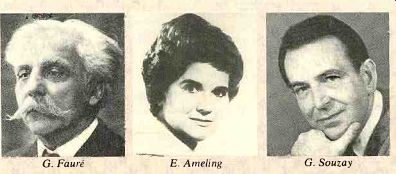
The first and much better of the sets of "Complete Songs" is a two-volume set (four discs) issued by Connoisseur Society, originally recorded by Pathe-Marconi in France. It features baritone Gerard Souzay and soprano Elly Ameling, with Dalton Baldwin as accompianist. "Accompanist" has servile overtones.
I prefer simply pianist. Still, if accompanist may pertain to pianist and singer (who accompany each other through an adventure where in their instruments mesh), then Dalton Bald win is the best since Gerald- Moore. He can play. He is not self-effacing. In those many moments where the piano is in fact an accompaniment-a strumming, an ostinato, a flow Baldwin becomes more than mere support: he is the velvet upon which rubies are offered, the landscape against which portraits are sketched. Faure, however, was the first melodiste to give the keyboard an identity. Even in the relatively early Claire de Lune and Nocturne the vocal lines seem afterthoughts, imposed on a self-styled piano solo, while in the icy Chanson d'Eve voice and piano form complements of independent counterpoint--the closest Faure, or indeed any Frenchman of the period, came to straight polyphony. When Dalton Baldwin plays with an Achilles heel, it is precisely during these rare linear sections (such as the inexpert twos-against-threes in Comme Rayonne). He is otherwise accurate, economical, generous, tasteful without passivity, and (especially with Souzay, his daily collaborator for twenty-five years) persuasively inevitable-assets which make him, al though he is American, ever so French, at least on the surface.
French too (although she is Dutch) is Elly Ameling, at least on the surface, with her neat-tailored, non-vibrato concepts. The sound is sapphirine, all notes (except an un stable middle C) being more gleamingly focused than any light soprano's since Teresa Stich-Randall. Her diction is dutifully clean in French, as indeed it is in English here (Melisande's Song is Faure's one foray into Eng lish-and, incidentally, in harmonic and thematic plotting; it is an esquisse for the later Chanson d'Eve). Ameling's main fault is her faultlessness. You wait in vain for a risk, an eccentricity. Listen to her bland and proper Nell, then recall (if you are lucky) the Nell of Nell Tangeman or of Povla Frijsh with their hot enthusiastic swoops. Yet, if Ameling's Chanson d'Eve, for ripeness and energy, falls short of Phyllis Curtin's (Cambridge Records, 1964), it is nevertheless there that her nubile hues glimmer most favorably. The cycle is Faure's only extended vocal piece that does not sound better in a masculine voice. Insofar as the suite of poems is intoned by, and mirrors, what is often called Feminine View point, one might be tempted to name it Fe male Art, were not both composer and poet ( Belgium's symbolist, Charles van Lerberghe) men. Yet what woman composer today would select such fragile texts, or dare to concoct such scented sonorities as have come to be known, erroneously, as Ladies' Music? Other centuries, other stigmas. Faure the man, with that Mark Twain face and irreproachable domesticity, was bourgeois to the teeth, as were virtually all French composers (though not poets or painters) of the nineteenth century.
His dialect was delicate, like Monet's or Mallarrne's, but no less manly than Berlioz's or Delacroix's, for art, though sexual, is without sex. Faure is never ribald like Ravel and Poulenc. Unlike Ravel and Debussy, but like Poulenc, he is often religious. Debussy's only known public reaction to Faure is ambiguous:
"We heard a Ballade by the Master of Charms, almost as lovely as pianist Mme.
Hasselmans herself who kept having to straighten her shoulder straps, as they fell down at every scale. I somehow associate these gestures with the music of Faure him self. The play of fleeting curves that is the essence of his music can be compared to the movements of a beautiful woman without either suffering from the comparison.
The male timbre was, in fact, Faure's ruling texture. His metabolism, his heartbeat, his humor (mentioned earlier) are baritone by nature--that is, words sung which are slower, not faster, than words spoken. During his final years the composer adopted as his protégé Charles Panzera, to whom L'Horizon Chimerique is dedicated. Panzera in turn inaugurated the age of the French song recital, establishing a convention by which "Faure" be came synonymous with "baritone." Pierre Bernac a generation later inherited the mantle. Eventually his protégé, Gerard Souzay, took over. Years have passed.
THAT Souzay's voice is no longer young alters our pleasure no more than do evening shadows in a gorgeous oak. Among such shadows the melodie comes to roost. Souzay's sound gives off an exhausted hint of nasal sadness which to me is quintessentially French. The cycle Mirages was composed for Madeleine Grey (still indomitable in the Rue Blanche when last heard from), but can you imagine another voice than Souzay's inflecting those bittersweet opening bars? As the Baronne de Brimont's harmonious swan glides forth from Souzay's lips, the whole land of France somehow fans out the same way all of America is echoed on those last discs of Billie Holiday-not through sense but through sound. Listen to the unfolding of the nine moods in La Bonne Chanson: how the voice swerves in and out of the shade like the tinted edges of a Rouault pastel fading imperceptibly from midnight blue to cobalt to azure.
Purple metaphors do not a critic make. Bu just as Souzay's most singular quality--the Frenchness of his musicality--cannot be taught, neither can it be described except through comparison. His least singular quality is all too describable, if harmless. In contras to Ameling, who inclines to under-do, Souzay sometimes tries too hard. Apres un Reve is a case: he will not let the words sing themselves, he must feel them, interpret them. Interpretation, of course, is the forte of Bernac who is the only reliable teacher of French song literature in the world today. But what works for the teacher may not be needed when a pupil's voice, in itself, is evocative.
Souzay commits likable word-errors here and there, substituting an et for an ou, quand for a lorsque, a front for a coeur (Frijs used to do this too, accidentally on purpose maybe, to prove that her comprehension wasn't rote). With Ameling we have an agree able Faure performer, but with Souzay w have the definitive one. And with Dalton Baldwin as the equalizing force in this health menage a trois nations, we have a magic keyboardist.
The accompanying notes contain a spirited essay by one Jean-Michel Nectoux; it is trans lated by Royal S. Brown, who also provide clear, knowledgeable translations of all the songs, including the just-discovered unpublished L'Aurore. The surface sound i smooth.
THE second version of Faure's "Complet Songs" is the Musical Heritage Society's se of six discs which offers (except for L'Au rore) the identical repertoire in much the same chronology. The major cycles, Poeme d'un Jour, La Chanson d'Eve, La Bonne Chanson Le Jardin Clos, Mirages, and L'Horizo Chimerique, are interspersed with the sixty odd miscellaneous songs. Except for L Chanson d'Eve, sung with studently style b Anne-Marie Rodde in a not especially nice soprano, the burden of performance falls o Jacques Herbillon. Herbillon's baritone is exact, his diction admirable, but after Souza the effects are lame, the sound precious.
In the duets, Rodde is joined by Sonia Nigoghossian (on the Connoisseur Society se Ameling is dubbed with herself). The pianist Theodore Paraskivesco, is capable. The record sound is hard. Included in the album is a intelligent and opinionated article by a Philippe Olivier idiosyncratically translated b David M. Greene. Greene also made the poem translations, which are more comprehensible in their bilingual layout than those with the Connoisseur set.
FAURE: Songs (Complete). Gerard Souza (baritone); Elly Ameling (soprano); Dalto Baldwin (piano). CONNOISSEUR SOCIET CS-2127 (Volume 1) two discs $15.96 CS-2128 (Volume 2) two discs $15.96.
FAURE: Melodies (Complete). Jacques He billon (baritone); Anne-Marie Rodde (so prano); Sonia Nigoghossian (soprano); Theodore Paraskivesco (piano).
MUSICAL HERTAGE SOCIETY 3438/3448 six discs $29.7 (plus 95C handling charge from the Musical Heritage Society, Inc., Oakhurst, N.J. 07755).
----------------------
... reputation of the Bolshoi's two illustrious singers or that of the distinguished Ermler, to say nothing of-Puccini.
Soprano Milashkina offers her best singing in the moving, truly prayerful "Vissi d'arte." Elsewhere, though, she sounds tired and strident, and her top notes are wanting in free dom. Atlantov has voice in abundance, but on this occasion his singing is bereft of subtlety, charm, and musicianship. Coarse sound re production and sluggish conducting complete the dismal picture. G.J.
RECORDING OF SPECIAL MERIT
PURCELL: Birthday Odes for Queen Mary:
Come Ye Sons of Art; Love's Goddess Sure.
Norma Burrowes (soprano); James Bowman and Charles Brett (countertenors); Robert Lloyd (bass); Early Music Consort of London, David Munrow cond. ANGEL S-37251 $7.98.
Performance: Elegant
Recording: Like a bell
The most striking quality of this recording is the ravishing sound: the balance between the vocal forces and the ensemble of early instruments is perfect, and the result is a melting sonority rare to the world of records. In the performances ease prevails, nothing is forced, each phrase is lovingly turned, and gentle elegance wins the day. We are also blessed with two equally matched countertenors, James Bowman and Charles Brett. Each is capable of handling detailed ornamentation, and when singing together they blend into one sound in music that ranges from vigorous trumpet melodies to chains of drooping thirds. The singing of Norma Burrowes and Robert Lloyd is of such excellence that their every verse is a joy.
Not a weak link mars this beautiful, curiously wrought chain of solos, duets, choruses, and ritornellos. As for the music, it is Purcell at his best.
The well-known Come Ye Sons of Art reveals the English fascination with Italian music, while Love's Goddess Sure demonstrates the more typical penchant for the French style.
The styles, of course, have profited from the sea change and are wedded to a harmonic idiom that only Restoration England could produce. Purcell must have admired his queen greatly and been particularly fond of her to write her such exquisite music for a routine, commissioned birthday offering.
-S.L.
RACHMANINOFF: Songs (see Collections Galina Vishnevskaya)
RAVEL: Chansons Madecasses (see FAURE) RIMSKY-KORSAKOV: Scheherazade, Op. 35. Saint Louis Symphony Orchestra, Jerzy Semkow cond. TURNABOUT QTV-S 34667, $3.98.
Performance: Rather prosaic
Recording: Extraordinary
If recorded sound were the only factor under consideration here, this would rank very near the top of the roster of the twenty or so disc versions of Rimsky's colorful warhorse. The sonic realism achieved by Marc Aubort and Joanna Nickrenz in taping this performance can only be described as startling, especially in four-channel playback. There is a splendid richness to the climaxes, a fine sense of space, and an elegant capturing of detail with out outsize exaggeration.
Regrettably, Jerzy Semkow and his players have to compete against recorded versions by the world's finest virtuoso orchestras. I'm afraid it's a losing battle.
-D.H.
SCHUBERT: Mass No. 5, in A-flat Major (see Best of the Month, page 80)
SCHUMANN: Cello Concerto in A Minor, Op. 129 (see BLOCH) RECORDING OF SPECIAL MERIT SCHUMANN: Quartet in E-flat Major for Piano and Strings, Op. 47; Quintet in E-flat Major for Piano and Strings, Op. 44. Beaux Arts Trio; Samuel Rhodes (viola); Dolf Betteiheim (violin in Op. 44). PHILIPS 9500.065 $7.98.
Performance: Outstanding
Recording: Warm and full
Last November, in reviewing this same coupling by Thomas Rajna and the Alberni Quartet on CRD 1024, I found it more pleasing than any other current pairing of these two works. I enjoy it no less now than I did then, but the new Philips release is more persuasive still, and may well represent the finest version of each of the two works considered individually as well as of the pair in tandem. The approach is similar to that of the English players-bristling energy in the fast movements and a tasteful caressing of Schumann's plaintive themes in the slow ones-but how the deeper maturity and refinement of the Beaux Arts team tell at every point! It is partly that-a matter of seasoning-and partly, too, simply a more subtle kind of intensity and more eloquent phrasing on the part of the individual players. A Pressler and a Greenhouse do make a difference, after all, in the marvelous material Schumann wrote for their instruments in these works, and so does the way they and their associates "breathe together." Beautiful sound, too-warm, full, and well balanced.
- R.F.
TCHAIKOVSKY: Swan Lake, Op. 20. Lon don Symphony Orchestra, Andre Previn cond. ANGEL SCLX-3834 three discs; $24.98, 4X3S-3834 $23.98.
Performance: Lacks momentum
Recording: Very good
Previn's recording of The Nutcracker (Angel SB-3788) was such an all-round winner that expectations were high for his coverage of Tchaikovsky's other, rather grander ballets.
His Sleeping Beauty (Angel SCLX-3812), however, proved disappointing, with only its smoother sound (and its four-channel capacity, for those so inclined) to recommend it over Ernest Ansermet's altogether more elegant account of that score (London CSA-2304). Part and parcel of Ansermet's elegance are the thrust, momentum, and vitality that fail to make themselves felt in Previn's version-and so it is again with the new Swan Lake. It is all quite handsomely played (and how nice to have violinist Ida Haendel on records again), but it just doesn't come to life.
-R.F.
TELEMANN: Don Quichotte Suite (see J. C. BACH)
WALKER: Sonata No. 3 for Piano (see MAC DOWELL)
-----------------------
We Quintessence of Ives
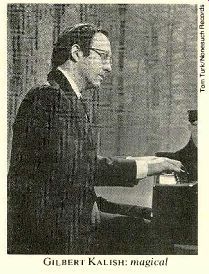
FOR me, the quintessence of Charles Ives' musical thought is embodied in this fabulous masterpiece evoking Emerson, Hawthorne, the Alcotts, and Thoreau. I felt this back in 1939 when I first heard John Kirkpatrick play the piece at Yale, and with all the Ivesiana since brought to light and document ed on discs, still feel that way. Not even the grandiose vistas of the Fourth Symphony match, in my estimation, the Concord Sonata, especially in compatibility of musical means and ends. And it is big enough, in every sense of the word, to be effective and moving in a variety of realizations-a view expressed by Ives himself at different times. Thus this Nonesuch disc with Gilbert Kalish, one of the most intelligent and sensitive of Ives interpreters, takes a place beside the magnificently architectural reading of John Kirkpatrick (Columbia) and the tautly nervous and brilliantly virtuosic one of Aloys Kontarsky (Main stream). I would not be without Kirkpatrick's realization of the Concord, nor would I want to pass up the demonic Kontarsky version, but Gilbert Kalish's special brand of pianism adds another and deeper poetic dimension to this singular masterpiece of the keyboard literature. Kalish, like Kontarsky, includes the optional parts for other instruments; John Graham plays the few measures for viola, and Samuel Baron's flute is an utterly magical reincarnation of Thoreau's.
"Magical" is perhaps the best term to de scribe Kalish's traversal of the score. His Emerson is more stately and ruminative than most, the musical discourse becoming altogether spellbinding in the pages immediately following the carillon-like climax. His Hawthorne movement is not quite so phantasmagoric as some, but there is more humor, notably in the ragtime and Irish jig bits that crop up here and there. His performance of The Alcotts finds its match only in Ives' own, as documented in Columbia's four-disc centenary album. And as for the Thoreau movement, it is the most deeply poetic realization of this elusive and evanescent music I have yet to hear, thanks not only to Kalish's "fine-turning" but also to Baron's flute in the final pages. But all this musical-poetic wizardry would go for nothing were it not for the painstaking work of recording engineers Marc J. Aubort and Joanna Nickrenz. With this disc they have added yet another to a long line of distinguished achievements.
-David Hal
IVES: Piano Sonata No. 2 (" Concord, Mass., 1840-1860"). Gilbert Kalish (piano); John Graham (viola); Samuel Baron (flute). NONE SUCH H-71227 $3.96.
GILBERT.KALISH: magical
---------------------
COLLECTIONS
JANET BAKER: Bach Arias. Christmas.Oratorio: Bereite dish, Zion. Cantata No. 190: Lobe, Zion, deinen Gott. Cantata No. 129: Gelobet sei der Herr. Cantata No. 34: Wohl euch ihr auser wahlten Seelen. St. John Passion: Es ist vollbracht. Anna Magdalena Notebook: Bist du bei mir. Cantata No. 6: Hochgelohter Gottessohn. Cantata No. 161: Komm, du siisse Todesstunde. Easter Oratorio: Saget, saget, mir geschwinde. Cantata No. 11: Adz, bleihe doch. Magnificat: Et exultavit. Janet Baker (mezzo-soprano); Academy of St. Martin-in-the-Fields, Neville Marriner cond. ANGEL O S-37229 $7.98.
Performance: Dull
Recording: Excellent
Although Janet Baker is one of the finest singers on the scene today and Neville Marriner has a well-deserved reputation for his readings of Baroque music, this album is a disappointment. I have nothing but admiration for Miss Baker's sumptuous, beautifully focused voice and technical accuracy, and Mr. Marriner provides good support with a praise worthy precision of ensemble. But somehoweverything sounds identical, submerged in a uniformly encompassing expressive style that is applied indiscriminately to each aria regard less of its musical content. The dullness this leads to is aggravated by the somber mood of almost all the arias the artists have selected.
The inclusion of a few recitatives or some more joyous arias would have broken the monotony. Moreover, I am somewhat dubious about the musical validity of a recording of Bach arias out of context, especially when nothing new or exciting is brought to them.
S.L.
RECORDING OF SPECIAL MERIT
STUART BURROWS: Mozart Arias. Don Giovanni: Il mio tesoro; Mita sua pace. Die Entfiihrung aus dem Serail: Hier soil ich; Wenn der Freude; O wie angstlich; Ich bane ganz. Die Zatiberflote: Dies Bildnis; Wie stark ist nicht dein Zauberton. Cosi Fan Tutte: Un' aura amorosa; Ah In reggio; In qual fiero contrasto. Idomeneo: Fuor del mar. Stuart Burrows (tenor); London Philharmonic Orchestra and London Symphony Orchestra, John Pritchard cond. L'OSEAu LYRE DSLO 13 $7.98.
Performance: Elegant
Recording: Excellent
Stuart Burrows is an exemplary vocalist: clean in his attacks, pure in intonation, elegant in his phrasing, and consistent in sustain ing a legato line. Happily, he also avoids the trap of the overly instrumental approach:
there are expression and emotion in his sing ing, but always sensitively controlled, staying clear of violent dynamic contrasts.
During the course of this generous display of Mozartian writing for tenor, the technical challenges include not only the familiar breath-defying "II mio tesoro," but also the less well-known and quite hazardous "Ali to veggio" (Cosi Fan Tutte) and the dramatic, al most Florestan-like "Fuor del mar" (Idomeneo). I wouldn't say that these are blithely tossed off, but Burrows copes with them ca pably, with unfailing musicianship and with out ever compromising his manly, rounded, and agreeable tone quality. This is Mozart singing as good as we can get from a tenor to day. Peter Schreier may run him a close second, but Burrows is far more idiomatic in the Italian arias. Excellent accompaniments, too.
G.J.
MUSIC OF THE MORAVIAN TROMBONE CHOIR. Antes: Three Chorales. Cruse: Three Sonatas. Hus: Communion Hymn. Anon.: Moravian Funeral Chorales; The Liturgical Year; Moravian Chorale Cycle. Los Angeles Philharmonic Trombone Ensemble, Jeffrey Reynolds cond. CRYSTAL S 222 $6.98.
Performance: For trombone lovers only
Recording: Very good
If your idea of bliss is an hour-long concert of religious music drawn from old Moravian manuscripts and played by a choir of trombones, you should add this record of meticulously annotated chorales and anthems to your collection without delay. If, on the other hand, seventy-six trombones, or even five of them, send you diving for soundproof shelter, it might be advisable to let this one go.
Here is music drenched in religious history, much of it discovered in the archives of Moravian settlements in Pennsylvania towns with such Biblical names as Nazareth and Bethlehem, and in Salem, North Carolina. In their churches and musical colleges, the deeply religious settlers, having fled from persecution in Bohemia and Moravia, sang and played the distinctive music of their faith. The emphasis on brass instruments dated back to medieval Germany, when musicians would climb the towers of walled towns and play to announce religious and civic events or to warn of such catastrophes as fires. It is not music of much melodic or emotional interest, but it does possess an austere nobility, and there is a lot of it here. The trombone ensemble of the Los Angeles Philharmonic performs with great virtuosity. Over the long haul, though, a trombone is a trombone.
- P.K.
====================
THE RENAISSANCE OF THE LUTE--An enormous literature is waiting to be rediscovered, IGOR KIPNIS
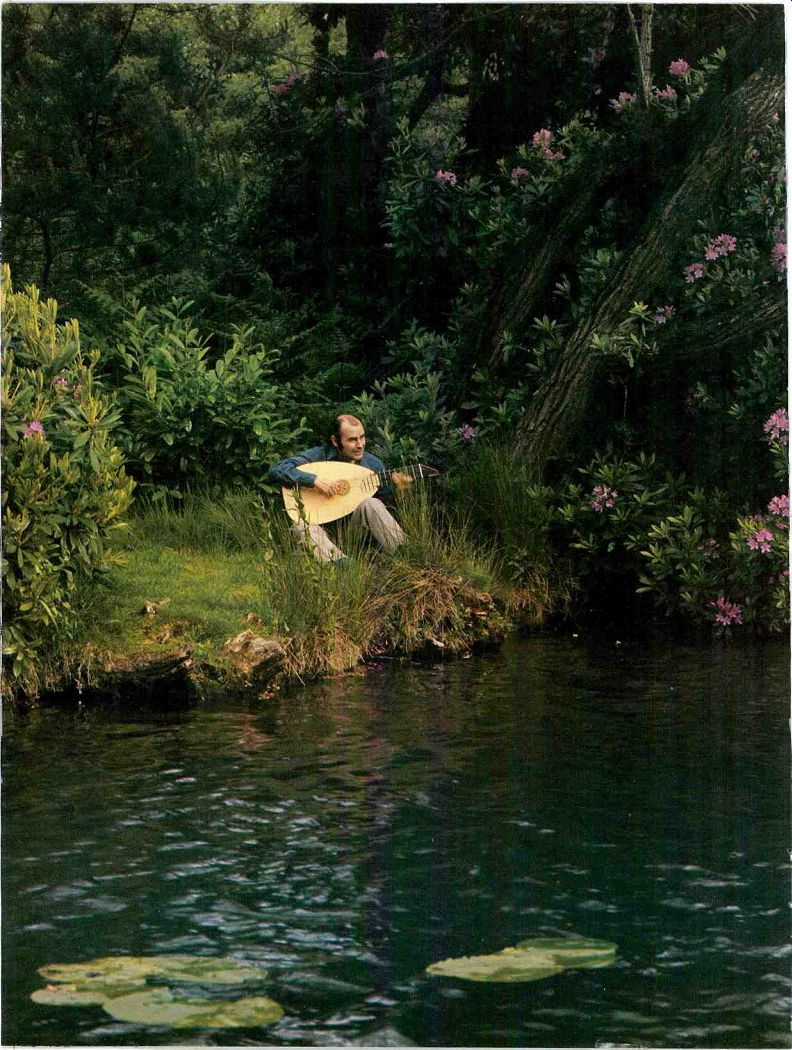
AMONG instruments long relegated to history, few have made more spectacular comebacks recently than the lute. Perhaps this is because of its relationship to the guitar, so incredibly popular today. With the rediscovery of additional older repertoire and, no less important, a burgeoning interest in hearing old music played on the instruments of its own time, it is not very surprising that a number of guitarists have taken up the lute as a sometime alternative-and in some cases have even moved over to it entirely.
The history of the lute dates back to the early Middle Ages, and its introduction to Western civilization may be traced to the invasion of Spain by the Arabs in 711 A.D. Until around 1500, of course, the instrument had no print ed repertoire; this was to come first from Venice, followed in short order by the early sixteenth-century publications of German and French printers.
Together with already existing manuscripts, an immense body of solo lute music was swiftly accumulated. (From English sources alone, for example, we have today around two thousand such pieces created between 1540 and 1620.) Nor was this the full extent of the lute's repertoire, since the pear-shaped instrument, with its fretted fingerboard and pairs of strings tuned in unisons or octaves, was also much in demand for accompaniment and ensemble work.
Over the centuries the lute evolved from a sensitive but workable instrument that could be mastered by virtually any gentleman into an exceedingly complex one suitable only for skilled specialists. The fifteenth-century lute of nine strings became, by the first quarter of the eighteenth century, an unwieldy twenty-four-string instrument (eleven pairs plus two single top strings). Compare this to the guitar's six single strings, with its consequently simpler tuning and tablature (the special type of notation used for these instruments), and it is easy to see why the guitar eventually superseded the lute in popularity with both players and composers.
Judging at least from his recordings, a perfect example of a guitarist turned lutenist is the forty-five-year-old Austrian Konrad Ragossnig. For DG Archiv he has produced what is perhaps the largest, if obviously not totally comprehensive, survey of Renaissance lute music yet committed to discs. The first volume, of English music (Archly 2533 157), which I reviewed most favorably more than a year ago, has now corded discs devoted, respectively, to lute music from Italy, Spain, Poland and Hungary, Germany and the Netherlands, France, and-as if that were not enough-a marvelous assemblage of works for combinations of two and three lutes from the same period and al most as many countries.
A good many of the works chosen are reasonably familiar from other lute and (especially) guitar collections-for instance, the Luis Milan pavanes, the Narviez variations on Guardame las Vacas, the dance settings of Jean-Baptiste Besard and Pierre Attaingnant, and the satiric Juden Tantz of Hans Newsidler. To these, however, Ragossnig adds enough lesser-known examples of the varied types of dances, contrapuntal pieces, settings of popular songs, and variations that were the mainstay of the lute repertoire in this period to provide discoveries for even the dedicated lute buff. He plays them all, on a David Rubio instrument, with expressivity, clarity, and a good feel for direction and climax. His interpretations are sprightly or moving as required, and, although some might object to his occasional use of fingernails (rather than fingertips) to pluck the strings, these recordings can safely be ...
--- "Over the centuries the lute evolved from a sensitive but workable instrument that could be mastered by virtually any gentleman into an exceedingly complex one suitable only for skilled specialists." ----
.... recommended as among the best of their type and overall as a most pleasurable anthology. If buying all seven would disorder either your budget or your musical digestion, I'd be inclined to recommend singly the album of mu sic for two and three lutes as perhaps the most tantalizing appetizer.
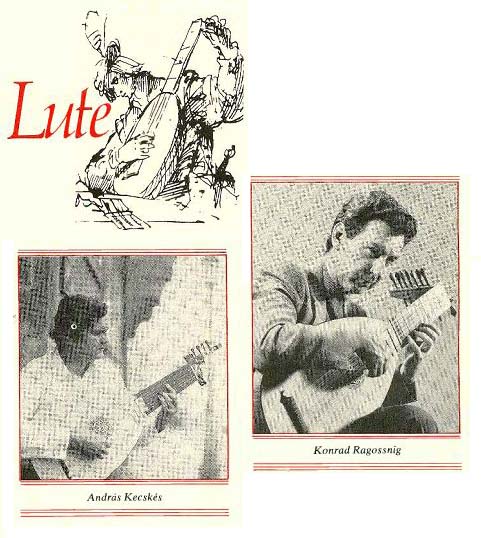
A rather smaller survey of sixteenth-and seventeenth-century European lute music, available on the Hungaroton la bel, features Andras Kecskes in works by Hungarian, Czechoslovakian, Polish, and Austrian composers, as well as pieces by others written in the styles of these countries (Hans Newsidler's Der Polnisch Tantz for example). Kecskes' playing of the twenty-five brief and relatively simple pieces (most of them dances) is technically and stylistically skillful, if a little low-key in terms of personality, sprightliness, and brilliance. The monochrome dynamics are partly offset, however, by the rhythmic pulse provided by accompaniment from some period percussion instruments (played by Agnes Meth)--a rather curious but very effective addition.
The lute reproduction is somewhat too close-up but clean, and the program duplicates only a very few pieces from the Ragossnig set.
Kecskes demonstrates another of the lute's roles on an overly reverberant Harmonia Mundi disc entitled "The Pleasures of the Renaissance," where he provides the accompaniment for six mid-sixteenth-century to early-seventeenth-century lute songs as well as eight instrumental pieces, mainly dances, from Central Europe. On his own, the lutenist performs four brief solos (including the anonymous English Greensleeves and Kemp's Jig). His partners are Zeger Vandersteebe, a countertenor whose lower range is more pleasing to the ear than the upper reaches, and Rene Clemencic, who performs brilliantly on recorders and percussion. (Kecskes, incidentally, is a member of the redoubtable amencic' s Viennese early-music ensemble.) An especially intelligently conceived program by James Tyler, an American now working in England, involves no fewer than four instruments: a normal Renaissance lute, a larger bass lute with the same number of strings but differently tuned, an eighteen-string theorbo (an archlute with far greater bass capacity), and, finally, an eighteenth-century English-made guitar.
The album, entitled "Music for Mer chants and Monarchs," offers, among Andrcis Kecskes other entertaining fare, some anonymous early-seventeenth-century music that might have been heard at an English ale house, three pieces by Hans Newsidler (who described himself as a burgher of Nuremburg), two pieces written by Michelangelo Galilei (brother of the astronomer Galileo) for the Duke of Bavaria, and dances and song settings for the Medici court in the mid-seventeenth century by Carlo Calvi.
Tyler's scholarly style is admirable and his technique very secure, though I would describe his playing as more gentle and lyrical than dynamically virtuosic. Not least among the delights of this well-recorded disc are the guitar selections by Calvi and his contemporary, Giovanni Paolo Foscarini, which attest to the popularity of the Spanish guitar in Italy during the seventeenth century and help explain why this instrument, far mellower and brighter than the modern guitar, was in a position to rival the brighter-sounding-and higher-status-lute.
David Rhodes, who has recorded other lute works by Bach's friend Sylvius Weiss (1686-1750), performs a suite and a chaconne by that composer on the second side of his new Titanic disc, "Baroque Guitar and Lute." Most of the opening side is devoted to Robert de Visee's D Minor Suite, played (like the music of two other French composers, Frangois Campion and Henri Frangois de Gallot) on a J. Van Lennep reproduction of a Baroque guitar. Its sound is intriguing in color, but Rhodes' performances on both guitar and lute tend to be rhythmically wayward, which may be acceptable in freer, prelude-like pieces but not in dance movements. (Contrast his style in playing Weiss with that of Eugen Muller-Dombois on the recently re leased ABC Classics 67006, "The Baroque Lute 1"--a fine introduction to later music for the lute.) Compared to that of his colleagues on the other discs reviewed here, Rhodes' technique is uneven. Moreover, his ornamentation is not always cleanly executed and his use of the strumming rasgueado (in the Konrad Ragossnig guitar works), though interesting at first, deteriorates through excess into an annoying mannerism-quite unlike the more subtle way Tyler employs it on his album. Titanic's engineering, which produces a somewhat dry sound on the guitar side, dispenses with the usual stereo placement and gives the solo instruments to the left channel, the right one being reserved for room ambiance. The program annotations are scholarly but not always to the point.
-David Rhodes
The British Oryx label presents an all-Bach recital of partly original, partly transcribed works for lute played by the late Walter Gerwig. Although the reproduction is extremely good, it is worth noting that these soberly conceived but pleasing performances, originally recorded by Barenreiter in Ger many, were released eleven years ago on Nonesuch (H-71137) and are still available on that label. The interpretations compare favorably with the livelier if idiosyncratic Narciso Yepes re cording of Bach's complete lute works on DG Archiv 2708 030.
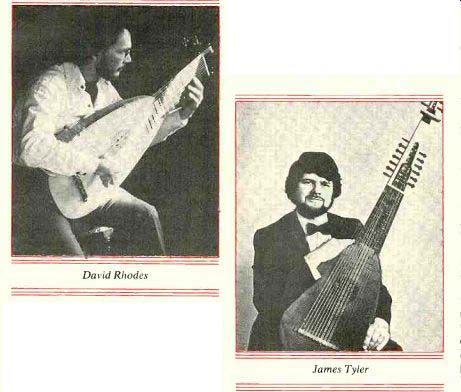
LUTE playing has always been an introverted art, and it takes a very special kind of artist to project the instrument fully. This is by way of introducing not only the finest lute recording of the present batch but, in my opinion, the greatest performances on that instrument yet committed to disc. Julian James Tyler Bream's first solo lute recording--on Westminster XWN 18429, released in the mid-Fifties-was devoted entirely to music of John Dowland, and in the years since he has continued to pay special attention to the often intensely melancholic outpourings of this grandest of Elizabethan lutenist-composers.
(Dowland is well represented, for example, on Bream's RCA albums LSC-2819, 2987, and 3331.) His latest RCA collection, entitled simply "Lute Music of John Dowland," contains a dozen pieces, of which the majority are either dances or "fancies" (contrapuntal fantasias). It is the latter, in fact, that give this album its special distinction, for Bream provides the most ravishingly, touchingly beautiful versions of the well-known Farewell and Forlorn Hope fancies (Nos. 3 and 6, respectively, in the new Poulton/Lam edition) that I could ever imagine.
Equally fantastic are his virtuosity and the excitement he generates in the few faster pieces, such as the extraordinary A Fancy (No. 73). Also notable is the fact that, through multiple recording, Bream plays two duets with himself My Lord Chamberlain, His Gaillard and the popular My Lord Willoughby's Welcome Home (Nos. 37 and 66a)--but these emerge without a hint of gimmickry. The reproduction, though at too high a level and consequently requiring a stiff volume cut for pleasant listening, is immaculate. The greatest praise I can bestow on this superb al bum is that, after having listened to well over twenty-four sides of (mainly) lute music in a period of a few weeks for this assignment, I played Bream's disc through not once but three times in succession.
------------------------
LUTE MUSIC OF THE RENAISSANCE.
Volume 2, Italy. Music by Capirola, Spinacino, Francesco da Milano, Molinaro, Barbetta, Terzi, Negri, and Santino da Parma. Volume 3, Spain. Music by Milan, Mudarra, and De Narvaez. Volume 4, Poland and Hungary. Music by Cato, Polak, Drugoraj, Bak fark, and Anon. Volume 5, Germany and the Netherlands. Music by Judenkonig, Newsidler, Moritz von Hessen, Waissel, Ochsenk hun, Adriaenssen, Howet, Sweelinck, Van den Hove, Vallet, and Anon. Volume 6, France. Music by Attaingnant, Le Roy, Ballard, and Besard. Konrad Ragossnig (Renaissance lute). DEUTSCHE GRAMMOPHON ARCHIV 2533 173, 2533 183, 2533 294, 2533 302, 2533 304 $7.98 each.
MUSIC FOR TWO AND THREE LUTES. Music by Molinaro, Johnson, Pacoloni, Adriaenssen, Robinson, Hassler, Dowland, Van den Hove, V. Galilei, Piccinini, and Anon. Konrad Ragossnig, Jurgen Hubscher, and Dieter Kirsch (Renaissance lutes). DEUTSCHE GRAMMOPHON ARCHIV 2533 323 $7.98.
CENTRAL EUROPEAN LUTE MUSIC, SIXTEENTH-SEVENTEENTH CENTURY. Music by Bakfark, Heckel, Waissel, Dtugo raj, Newsidler, Cato, Polak, Chilesotti, Sto baeus, Craus, Phalese, and Anon. Andras Kecskes (lute); Agnes Meth (tabor and timbrel).HUNGAROTON SLPX 11721 $6.98.
LES PLAISIRS DE LA RENAISSANCE. Music by Planson, Castro, Picchi, Caccini, Cara, Rotenbucher, Japart, Phalese, Dowland, Morley, and Anon. Zeger Vander steene (counter-tenor); Rene Clemencic (Renaissance recorders and percussion); Andras Kecskes (lute). HARMONIA MUNDI HMU 963 $7.98.
MUSIC FOR MERCHANTS AND MONARCHS. Music by Newsidler, Foscarini, Robinson, Mellii, Calvi, M. Galilei, and Anon. James Tyler (Renaissance lutes, archlute, Baroque guitar). SAGA 5420 $6.98.
BAROQUE GUITAR AND LUTE. Music by De Visee, Gallot d'Angleterra, Campion, and Weiss. David Rhodes (Baroque guitar and lute). TITANIC Ti-5 $7.00.
BACH: Prelude in C Minor (BWV 999); Fugue in G Minor (BWV 1000); Suite in A Major (BWV 1007); Suite in E Major (BWV 1006), excerpts; Suite in E Minor (BWV 996), excerpts. Walter Gerwig (lute). ORYX 1202 $6.98.
DOWLAND: A Fancy, No. 5; Captain Digo lie Piper's Gaillard; My Lord Chamberlain, His Gaillard; Resolution; Mr. Lanton's Gaillard; Forlorn Hope Fancy; Sir John Souche's Gaillard; Piper's Pavan; My Lord Willoughby's Welcome Home; Gaillard to Lachrimae; Farewell; A Fancy, No. 73. Julian Bream (lute). RCA ARL1-1491 $7.98.
-------------------------------
====================
ADs:
Audition free for 10 days Karl Bohm’s superb Deutsche Grammophon recording of Greatest Symphonies
SPECIAL BONUS: Mozart's Piano Concertos Nos. 12 and 26 All 4 International Award-Winning Records For Less Than The Price Of 1!
Your Introduction To The Unique Money-Saving Program That Offers Free Auditions Of Prize-Winning Recordings By The Leading Concert Artists Of Our Time!
Wolfgang Amadeus Mozart--music's greatest natural genius-divinely gifted beyond any other musician who ever lived! And into his six greatest symphonies he poured a multitude of his most astonishingly beautiful, incredibly moving inspirations! Symphony No. 41, "Jupiter" Symphony No. 40 in G-minor Symphony No. 39 in E-flat Symphony No. 38, "Prague" Symphony No. 36, "Linz" Symphony No. 35, "Haffner" Extra! Symphony No. 32 Now you are invited to hear these miraculous works in their finest recording ... interpreted with extraordinary empathy by Karl Bohm . . played to perfection by the Berlin Philharmonic Orchestra ... captured in unsurpassed stereo realism by Deutsche Grammophon. So outstanding is this recording that it has won three of the music world's most eagerly sought honors: the Grand Prix International du Disque, Edison Award and Deutsche Schallplatten Prize! In addition, you will also receive Mozart's Piano Concertos Nos. 12 and 26, "Coronation," superbly performed by soloist Geza Anda with the Salzburg Camerata Academica-winner of the coveted Grand Prix des Discophiles.
Now enjoy and keep these 4 superb albums for less than the price you'd pay for 1! Because these magnificent recordings have met with almost unprecedented acclaim, they have been chosen to introduce you to The Great Awards Collection, a totally new concept in home listening. You may enjoy all eight masterpieces, on four superb-quality, imported records, for 10 days absolutely free. Then keep all four, if you wish, for only $6.98 (that's less than the price you'd pay for just one record)! Simply mail the coupon at right today.
Here's how the program works...
As a member of The Great Awards Collection you will receive only the finest recordings of prize-winning concert performances by preeminent orchestras, conductors and soloists. There is no minimum number of recordings you must buy.
And you can cancel your membership at any time.
What's more, every superb recording you choose to examine comes to you on a free 10-day trial basis. So you'll never waste a penny on disappointing purchases! Approximately 14 times a year you will receive the current issue of our Great Awards Collection Bulletin highlighting an exceptional Selection of the Month and other brilliant classical releases reconvened by a distinguished jury of musicians, scholars and musicologists. If you want to examine the Selection of the Month you need do nothing. It will be shipped to you automatically.
If you want any other selection, just mark your choices on the order card you will receive and re turn it by the date specified. If you do not want any selection, just check the proper box on your order card and return it by the date specified. It's that simple! Special half-price bonus offer saves you money! In addition to great music, you'll enjoy great savings with our half-price bonus plan. For every record you buy at our low members' price (always well below suggested retail), you may choose an other one from a list of award-winners and other critically-acclaimed LPs and pay just half that price! A truly economical way to build your library of superb classical recordings.
How many records are you committing your self to buy when you return the attached coupon? None at all! Even your introductory set of Mozart's Six Greatest Symphonies and Piano Concertos 12 and 26 comes to you on approval.
Audition it free for ten days, then either return it--or keep it for only $6.98 for all four records (plus a small postage/handling charge).
Here at last is the ideal way to acquire a connoisseur's record library in easy stages. You listen at home to every award-winning selection you elect to examine before deciding whether to buy it! Please act today! Begin your money-saving, no-obligation membership in The Great Awards Collection by mailing the coupon for your free trial, with four- for: less- than--the- price-of-one purchase option of this essential collection of Mozart's Six Greatest Symphonies and exquisite Piano Concertos Nos. 12 and 26.
Eight ways The Great Awards Collection helps you enjoy fine music more than ever!
1. The greatest music by the world's immortal composers.
2. A major, award-winning recording yours to audition each month.
3. Superior imported LPs--silent surfaces.
4. Free ten-day trials of all selections.
5. All selections always far less than retail price.
6. Extra savings with Half-Price Bonus Plan.
7. No obligation to buy--no minimum purchase.
8. Money-saving introductory offer.
Send no money now Mail coupon TODAY!--Listen for 10 days free. Keep all 4 for less than the price of 1!
The Great Awards Collection. 175 Community Drive Great Neck, N.Y. 11025
Please send me, for my free audition, the triple-award-winning recording of Mozart's Six Greatest Symphonies by Karl Bohm, together with Geza Anda's award-winning performance of Mozart's Piano Concertos Nos. 12 and 26.
I may return the set after 10 days and owe nothing, or keep it and pay only $6.98 for all four Deutsche Grammophon records, plus a small postage/handling charge.
This is all four records for less than the regular price of one! Each month I will also be notified of major award-winning recordings available to Great Awards Collection members free for 10 days. For every one of these records I buy at your members' price (always below suggested retail), I may also choose one record at half that price from your special list. I am not obligated to buy any minimum number. I may cancel my membership at any time.
NAME (please print)
ADDRESS
APT. NO.
CITY STATE ZIP
Offer limited to the 48 connecting states.
Offer expires 12/31/77. Limit: one membership per household.
Only new members eligible:
NOTE: All applications are subject to review and we reserve the right to reject any application. 'sales tax added for New York residents.
-----------------------------
Understanding more music (Vinyl 4-LP set)
What you need to know to increase your listening pleasure
Understanding more about music ... can be as easy as listening to your favorite recordings.
An important set of recordings created to help you expand your understanding of music This unique four-disc album is interesting, easy to comprehend, and instructive. It is the first project of its kind to approach the understanding of music through its basic elements:
rhythm. . . melody . . harmony. . . texture.
If you have wanted to know more about music--or simply to enjoy it more--Stereo Review's GUIDE TO UNDERSTANDING MUSIC will be the most rewarding step you can take in that direction.
Written and narrated exclusively for Stereo Review by David Randolph, Music Director of the Masterwork Music and Art Foundation, this fascinating set of stereo records will help you become a more sophisticated, more knowledgeable listener--and a more completely satisfied one as well. It will give you an "ear for music" you never thought you had.
In the GUIDE TO UNDERSTANDING MUSIC, David Randolph first discusses, by means of recorded narration, how the composer uses and unifies all the basic musical elements. After each musical point is made in the narration, a musical demonstration of the point under discussion is provided. Thus you become a part of the creative musical process by listening, by understanding, by seeing how music's "raw materials" are employed by composers and performers to attain their highest level of expressivity and communication through musical form.
Charge your order to:
This exclusive four-disc recording is just . . . $21.98
Postpaid for all four 33 1/3 rpm stereo long-play records, a price made possible by the availability of the consultative and production facilities of Stereo Review and its staff. Under ordinary auspices, a work of this nature and importance would cost much more.
FOUR STEREO RECORDS
RECORD I The Elements of Music:
1. Rhythm 3. Harmony
2. Melody 4. Texture
RECORD II Sense and Sensation in Music (The Instruments of the Orchestra)--How Music Is Unified
RECORD III Form in Music-Words and Music
RECORD IV Can Music Tell a Story or Paint a Picture?--The Interpretation of Music
Over 200 Musical examples which have been carefully chosen from among thousands of recordings by major record companies as the best illustrations of musical points made in the re corded narration. In addition, supplementary musical demonstrations were specially recorded for this album.
Booklet enclosed The accompanying booklet is a valuable complement to the album. it presents 'David Randolph's straightforward professional approach to music, and shares the insights and understanding of his many years of experience in bringing music to listeners as well as advice on how you can make the best use of the album.
If you already have some knowledge of music, the Guide to Understanding Music can expand and enrich that knowledge. If you've always wanted to understand music but have been discouraged because it looked to difficult and time-consuming, the Guide to Understanding Music can show you how easily and quickly you can make yourself at home with any music.
GUM, CONSUMER PRODUCTS DIVISION, 595 Broadway, New York, N.Y. 10012 SR-87 Please send Guide To Understanding Music . $21.98, postpaid ($26.98 outside U.S.A.)
========
========
------------
Also see:
BEST RECORDINGS OF THE MONTH--Opera: Otto Nicolai's The Merry Wives of Windsor... Orchestral/Choral: Franz Schubert's Mass No. 5 ... Rock: John Cale's "Guts" ... Pop Vocal: Bonnie Raitt's "Sweet Forgiveness," Barbara Cook's "As of Today".