BEST RECORDINGS OF THE MONTH--Opera: Otto Nicolai's The Merry Wives of Windsor... Orchestral/Choral: Franz Schubert's Mass No. 5 ... Rock: John Cale's "Guts" ... Pop Vocal: Bonnie Raitt's "Sweet Forgiveness," Barbara Cook's "As of Today".
======
STEREO REVIEW'S SELECTION OF RECORDINGS OF SPECIAL MERIT--BEST OF THE MONTH
The Merry Wives of Windsor: the Sort of Work Schumann or Mendelssohn Might Have Composed If They'd Had Nicolai's Sense of Theater THE recorded repertoire may be vast, but there is still room for exploration and joyous discoveries. I am sure that the first complete recording in some twenty-five years of Otto Nicolai's The Merry Wives of Windsor (we have had good "highlights" on Angel and Deutsche Grammophon, but they are gone new, too . . . ) will fall into the latter category for many opera lovers. This brightly melodious master piece by the greatly gifted but short-lived (1810-1849) Nicolai is the German answer to the comic operas of Rossini and Donizetti, the kind of work such contemporaries as Schumann or Mendelssohn might have composed had they possessed Nicolai's sense of the theater. Indeed, the best pages of Nicolai's score bring Mendelssohn to mind with the transparency of the writing and constant flow of witty inspiration.
Comparison with Verdi's Falstaff, which is based on the same Shakespeare play, is unavoidable, but those who are prompted to look patronizingly at Nicolai miss the point. The decades that separate the two operas (1849 to 1893) were crucial in musical history.
In contrast to the harmonic advances and overall sophistication of the Verdi Boito masterpiece, Nicolai gives us the traditional Singspiel of Mozart and Weber. And so, where the music of Falstaff flows with a mercurial continuity, that of The Merry Wives of Windsor is frequently halted by long stretches of spoken dialogue. Further more, as the title implies, the central interest in the Nicolai opera lies in the charming and conniving wives; Sir John goes through the familiar indignities, but he remains only a foil for the formidable females.
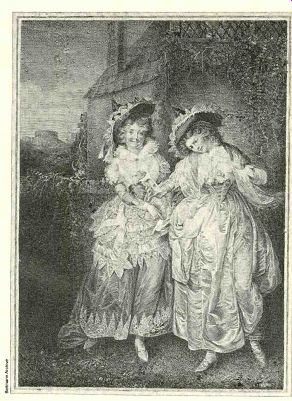
----------------- The Merry Wives: Mistress Page and Mistress Ford compare notes (engraving after a painting by Wm. Peters).
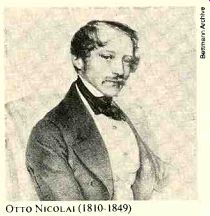
------------ Otto NICOLAI (1810-1849)
The Deutsche Grammophon set is a virtual triumph. Bernhard Klee's lovingly paced direction is perhaps a shade too meticulous at the expense of exuberant spontaneity, but he draws a precise and radiant-sounding performance from orchestra and singers alike. The casting could hardly be bettered. The voice of Edith Mathis is a trifle light for Frau Fluth (more girlish than womanly), but it projects all the wit and charm the role requires and is handled with perfect accuracy in the florid passages.
Helen Donath and Hanna Schwarz complete the trio of Merry Wives; they are as excellent in all their individual opportunities as they are ravishing in ensemble.
Kurt Moll is an outstanding Falstaff, pouring out solid, rich tones with grave pomposity, liquid ease, and in unwavering observance of perfectly centered intonation. He is effectively contrasted to Bernd Weikl, a Fluth attractive in his sound and convincing in his outrage.
Memories of Fritz Wunderlich (the Fenton on the deleted Angel disc of highlights) intrude on my appreciation of Peter Schreier's contribution: he is a good singer who nearly matches Wunderlich's technique, but not his warm, ingratiating timbre.
The spoken dialogue in this opera causes a bit of a problem with non-Ger man-speaking audiences. Deutsche Grammophon has provided a narration (in German) as a means of streamlining the spoken passages between musical numbers. It is not a very good solution, but this minor flaw should not be held against the total effort: a delightful op era brilliantly performed and recorded. The album presentation, too, is admirably done.
-George Jellinek
NICOLA: The Merry Wives of Windsor. Kurt Moll (bass), Sir John Falstaff; Bernd Weikl (baritone), Herr Fluth; Siegfried Vogel (bass), Herr Reich; Edith Mathis (soprano), Frau Fluth; Hanna Schwarz (mezzo soprano), Frau Reich; Helen Donath (soprano), Anna; Peter Schreier (tenor), Fen ton; Karl-Ernst Mercker (tenor), Sparlich; Claude Dormoy (tenor), Dr. Cajus. Chorus and Orchestra of the German State Opera, Bernhard Klee cond. DEUTSCHE GRAMMOPHON 2709 065 three discs $23.94.
A Schubert Missa Solemnis as Jubilant, Lyrical, and Engagingly Colorful as Rosamunde
ALL six of Schubert's Masses have been almost as neglected on records as they have been in live performance, though Seraphim's recent rein statement of Erich Leinsdorf's fine Berlin recording of the last in the cycle (the E-flat, D. 950, on S-60243) brought to a total of three the number of versions of that work listed in the current issue of Schwann. Unlisted in those pages for several years has been the E-flat's immediate predecessor, the Mass No. 5, in A-flat (D. 678); it has just turned up on a new Nonesuch disc, conducted by Dennis Russell Davies, and it is one of the nicest surprises of the year.
The Mass in A-flat was completed in 1822, the year of the Unfinished symphony. It is a Missa solemnis, contemporaneous with the more grandly scaled one by Beethoven. Actually, the designation more aptly suits the E-flat Mass, for the A-flat is more jubilant than solemn, a most attractive blend of Schubert's characteristic lyricism with the theatrical/virtuoso elements in the Masses of Mozart and Haydn. (Indeed, in view of Schubert's curious omission of portions of the text, one might even question whether his Masses were really intended for actual liturgical use.) The scoring, for the winds in particular, is as engagingly colorful as that of the Rosamunde music composed the following year. (The Osanna is surely a shepherds' chorus, the Benedictus a flowing romance that opens out into another woodland fantasy.) Davies' expert and communicative ...
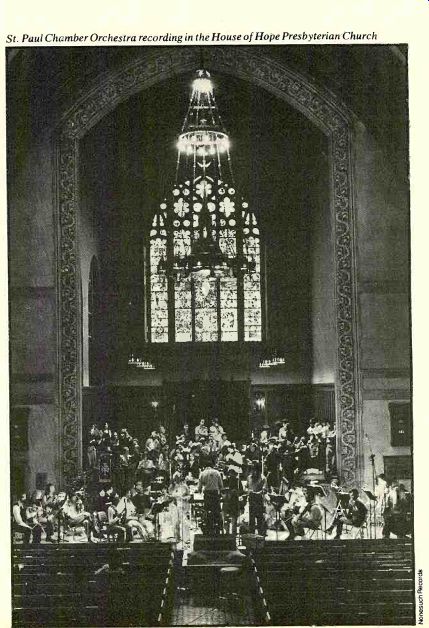
St. Paul Chamber Orchestra recording in the House of Hope Presbyterian
Church
.... performance represents much more than the filling of a gap in the catalog.
Though unlisted in Schwann, the Angelicum recording under Antonio Janigro has been available on MHS 878 for nearly a decade, and it is by no means unpleasing. But the new version knocks it out of court in just about every respect. First of all, good as Janigro's concept is, Davies' is more inspiriting still; in place of the nondescript Italian soloists, Davies has a first-rate quartet; his choral forces are at least equal to Janigro's, and his
Saint Paul Chamber Orchestra conspicuously out shines the Milanese ensemble in both the brilliance and the warmth of its playing. Enfolding it all is the rich and realistic sound, which leaves the com petition even further behind. All in all, a stunning production, one that should go a long way toward making this splendid work as familiar and beloved as Schubert's instrumental compositions and songs.
-Richard Freed
SCHUBERT: Mass No. 5, in A-flat Major (D. 678). Marlee Sabo (soprano); Jan DeGaetani (mezzo-soprano); Paul Sperry (tenor); Les lie Guinn (baritone); Carleton College Choir, Chamber Singers, and Festival Chorus; Saint Paul Chamber Orchestra, Dennis Russell Davies cond. NONESUCH H-71135 $3.96.
------------
John Cale's Best Cuts: A Welcome Combination Of Rock, Brains, And Guts
JOHN CALE'S music is not for every body. Born in Wales and conservatory trained, he studied under John Cage until the early Sixties, when he decided rock-'n'-roll was more adventurous than contemporary "serious" music. He founded the Velvet Under ground with Lou Reed and mostly defined the electronic drone of their first two albums.
It took the outside world about eight years to catch up with what the Velvets were doing; David Bowie, Mott the Hoople, and Roxy Music were some of the results. John has been making solo albums since 1970's "Vintage Violence," most of them as brilliantly idiosyncratic (if commercially unsuccessful) as Reed's were mindless and self compromising, and now it looks as though the world of mainstream music and John Cale are finally ready for each other.
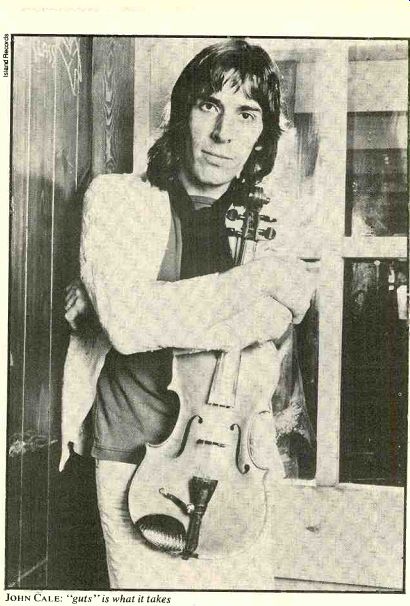
JOHN CALE: "guts" is what it takes.
It must get tiresome working perpetually in the future. Aside from his solo projects, Cale produced the Stooges' first album (in 1969, and effectively the birth of punk rock as it exists today), Nico, the Modern Lovers, and Patti Smith. Always associated with the rock avant-garde, his music now has real pop elements as well; it rocks hard, and many of the lyrics reflect a mature-adolescent sensibility akin to that of, say, the poet Charles Bukowski or novelist Henry Miller. Meanwhile, his musical discipline is constant, and his rich musical background informs everything he does with an intelligence, a sense of sonic nuance, that nobody else in rock quite matches. He consistently pulls off the rare feat of making solid rock-'n'-roll that's literate with out being collegiate, complex without being show-offish.
"Guts" is a compilation of the best cuts from his three previously released Island albums. I would have liked to see them release his British-only "Hel en of Troy" album (his best work) in stead, but this one will serve as a fine introduction. Not averse to doing covers, he takes to its logical conclusion the depression Elvis' macho yowl fought against in the original version of Heartbreak Hotel, and his interpretation simply plows under Jonathan Rich man's original of Pablo Picasso.
Of Cale's own songs, Leaving It All Up to You is at once the strangest and the most characteristic. Angry, con fused, and controversial (it was originally deleted from "Helen of Troy" because of a reference to Sharon Tate), it's a masterful juxtaposition of total musical discipline with attitudinal frenzy that even manages to make Charles Manson funny without offending (and I'm easily offended by cheap nihilism these days).
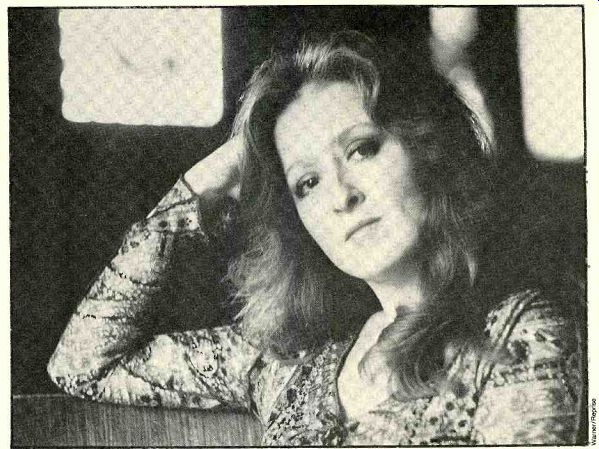
--------- BONNIE RAITT: a voice that's salty but pretty
In Guts, the protagonist knows another man is bedding his wife. Although he still loves her anyway, he'd like to kill them both and himself as well. But, like the rest of us, he's paralyzed by his civilization and even perhaps by his better instincts. He finally decides that both his rival's blandishments and his own paranoid fantasies are "familiar hyperbole." Guts is what it takes, I'd say, to let songs like this out of yourself in public in the first place. In that light, Fear Is a Man's Best Friend speaks well for it self by title alone.
Cale sings most of this stuff like a Jim Morrison with self-critical faculties. Though there is neuroticism in this music, he's not narcissistic about it (that's rare these days), and his honesty and sense of humor bring a warming universality to everything he does.
Meanwhile, he's got the chops to orchestrate this vision on a level I can only compare (in rock terms) to Bernard Herrmann. John Cale will probably never be a superstar-he's too subtle, for one thing. But this isn't coming from the obscure fringes of the rock avant-garde either-it's simply some of the most viscerally intelligent rock made in years. If you pick up on it, shout it from the housetops. John deserves that much.
-Lester Bangs
JOHN CALE: Guts. John Cale (vocals, guitars, bass, keyboards, percussion); vocal and instrumental accompaniment. Guts; Helen of Troy; Pablo Picasso; Fear Is a Man's Best Friend; Mary Lou; Leaving It All Up to You; Gun; Dirtyass Rock 'n' Roll; Heartbreak Hotel. ISLAND ILPS 9459 $6.98, Y8I-9459 $7.98.
Bonnie Raitt: Getting More Impressive All the Time
BONNIE RAITT has got to be one of the very best. She has a great voice that's salty but pretty, good taste in music, great credibility with people who live with music, and an ability to convey the essence of a song that's get ting more impressive all the time.
"Sweet Forgiveness," her latest album for Warner Bros., has all these elements and backs them with extraordinary instrumentals.
Bonnie's interpretive skills--and her band's rhythm section--come to the fore in Runaway, the old Del Shannon-Max Crook song, which she redefines in such a way as to discover real emotional quality. For the first time, the words and the phrasing make sense together.
She's picked out other good songs, too. Jackson Browne's My Opening Farewell is an excellent one. Paul Siebel's Louise, which Bonnie has been doing on stage for some time, is given simple and perfect acoustic backing and a compassionate but not overly mushy reading; you may never hear a better one.
From that pastoral folkie extreme, she moves with no apparent difficulty and nary a hitch to a rhythm-and-blues stomper, About to Make Me Leave Home, on through Browne's interlaced lyrics, on through the hard-rock piece Three Time Loser, and eventually to the kind of post-rock pop song Karla Bonoff (of Linda Ronstadt album fame) writes. A couple of the songs-Three Time Loser, which attempts too little, and the title song, which attempts too much-aren't up to the standard of the others, but then they aren't bad either.
Raitt is the kind of performer who has a reason for recording every song she records-a reason beyond merely filling up albums-and it shows. This is one of those albums I'll play on my own time. A lot.
-Noel Coppage
BONNIE RAITT: Sweet Forgiveness. Bonnie Raitt (vocals, guitar); Will McFarlane (guitar); Jeff Labes (keyboards); Dennis Whit ted (drums); Freebo (bass). Sweet Forgive ness; Gamblin' Man; Runaway; Two Lives; About to Make Me Leave Home; Three Time Loser; My Opening Farewell; Takin' My Time; Louise; Home. WARNER BROS. BS 2990 $6.98, M82990 $7.97,0 M52990 $7.97.
--------------------
The New Barbara Cook's New Recording: Superb Musicianship and Bittersweet Wisdom
WILL wonders never cease? Well, sometimes they pause for a little. The wonder that was Barbara Cook, the singing ingenue of all those Broadway shows (The Music Man, She Loves Me, The Gay Life, and so many others), dropped out of theatrical sight and hearing for several years, leaving behind only the memory of some spectacular evenings. Her eight-show-a-week performance as Cunegonde in Leonard Bernstein's Candide (which included her unforgettable Glitter and Be Gay aria, the Sempre Libera of American lyric theater) remains an in credible feat to this day.
I can't say that I missed her very much while she was away, however. She had always seemed to be a super-competent performer: I always responded strongly to the Puccini-esque vibrato of emotion she poured into such things as 'Til There Was You, and the very real heart-wrencher she made out of the Dietz-Schwartz Magic Moment still gets me every time I hear it.
But she also had a touch of steely un-reality about her--she was going to get it right, by God, or strangle in the attempt. She had a rigid, Olympian quality that somehow made her work seem impersonal.
When Barbara Cook returned to performing a few years ago it was as a cabaret and concert artist, and she revealed herself as a wonder of a totally different kind, no longer the cool vocal acrobat I remembered. First, there was a womanliness in place of the ingenue-girlishness; then there was the bitter sweet wisdom of her lyric readings; and finally there was the same superb musicianship, now suffused with light and shade that put a personal signature on every piece of material she touched.
--------
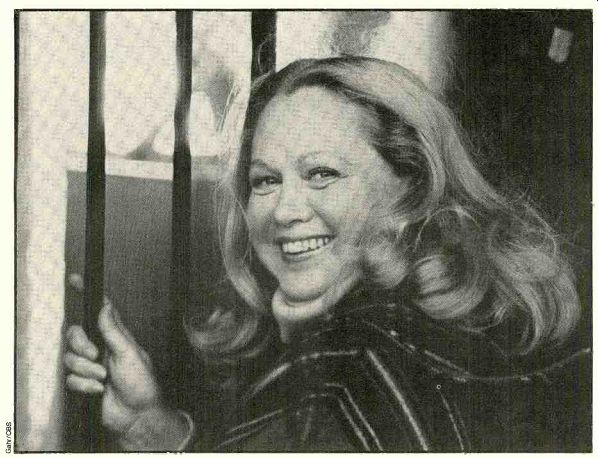
BARBARA COOK: absolute mistress of her talent--------------
She had filled out in oils the angular pencil sketch that was her talent.
That she's lost none of the strength or immediacy of her earlier performing style but only enriched and enlarged upon it can be heard, and gorgeously, on her new Columbia release "As of Today." It contains magnificent performances that range all the way from Irving Berlin standards (What'll I Do and Let Me Sing and I'm Happy) to the demanding, cerebral intensity of Janis Ian's Stars and the throwaway charm of Leslie Bricusse's You and I. She's on top of it all, all the way, absolute mistress of the music, the lyrics, and her own wide-ranging talent. Trot on down to your local record store and salute the return of a fine singing artist.
-Peter Reilly
BARBARA COOK: As of Today. Barbara Cook (vocals); orchestra. Ain't Love Easy; Why Did You Promise Me the World?; You and I; Sing a Song with Me/Let Me Sing and I'm Happy; It Was; One More Love Song/ What'll I Do; Waiting; Candlelight; Stars. COLUMBIA PC-34493 $6.98, PCA-34493 $6.98, PCT-34493 $6.98.
======================
Also see: