Popular Discs and Tapes
(missing pages: Two Choice Disco Cuts, EDWARD BUXBAUM)
=====================
Re-discovered: Historical Beatle facts
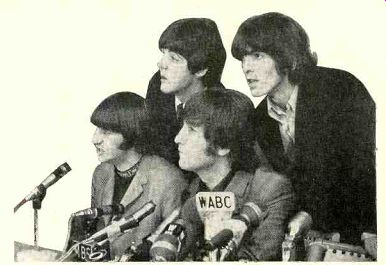
HISTORY, as the mother of a friend of mine once observed, is a thing of the past.
Thus, two hitherto unreleased live albums documenting the major pop phenomenon of the last decade are, logically, mere historical artifacts. But the strange thing is that the Beatles, who no longer exist as a unit and have not made a new record together in seven years, resolutely refuse to lie down and be come history.
Despite the best revisionist efforts of various pop-music critics and musicians, high school kids far too young to have experienced the Beatles firsthand still find them "relevant" and have, in droves, shelled out money for last year's Capitol repackaging ("Rock and Roll Music," SKBO-11537). Even John Lennon is a Beatles fan again. Consider this:
what Seventies performer's formative work could be released more than twelve years later and stir up anywhere near this much excitement and anticipation? "Elton John's Basement Tapes"? "Bette Midler at the Improv"? "The Eagles in Linda Ronstadt's Kitchen"? But the Beatles are as vital a pop presence as ever, and the question of their ultimate significance--whether they were merely one generation's kitsch or real music makers-is still unanswered.
AND now, the rumors behind the news.
Both of the new sets have existed for quite a while in one form or another, attaining an al most legendary status. The Capitol package, "At the Hollywood Bowl," was originally re corded-at two live shows, in 1964 and 1965-with an eye to release and, in fact, actually reached the acetate stage long ago (and went on to become the most widely circulated of all Beatles bootlegs). A snippet from it has been in the catalog for lo, these many years as part of the still available schlock "documentary" Capitol whipped together called "The Beatles Story" (STBO-2222). But now, original Beatles producer George Martin has taken the old three-channel masters, cleaned them up as best he could, mixed them for stereo, and sequenced the cuts intelligently. The resulting new disc is highly listenable, if not quite up to contemporary sonic standards.
But it certainly stands comparison technically with any other live album from the same period--"Five Live Yardbirds" or "Beach Boys Concert," for example.
"Live! at the Star-Club," on the European Bellaphon label, distributed here by Atlantic records on the Lingasong label, is far more primitive. It was recorded with a single microphone on a nonprofessional machine in the crowded club in Hamburg, West Germany, where the Beatles worked out in the days be fore they became international celebs. The sound, unsurprisingly, is pretty rank, al though the club atmosphere is faithfully caught. The Beatles themselves are reportedly pleased with the Capitol release, but the Hamburg set is a bit too raw for them. The P.A. doesn't cut through the audience hubbub very well, although the instruments are loud and clear (the drums overpoweringly so). The whole thing sounds pretty much like the recordings you might make of your own garage band with a portable cassette machine.
The music? Well, it's delightful on both recordings. The sheer energy and drive of the group are so winning that even the technical deficiencies of the Hamburg set are almost forgivable. Both John and Paul are in superb vocal shape; listen to John in Twist and Shout or Paul in Long Tall Sally on the Capitol re lease-and they were singing without monitors, remember, so from their perspective it was in effect a cappella. Ringo demonstrates why two whole generations of session drummers have felt compelled to cop his style.
George plays with the kind of youthful fire that he now seems unable to summon up, and Paul was already the superb bassist he is to day (the major revelation of the German tapes). At least judging from this recorded evidence, John and George are merely waxing nostalgic when they claim that the Beatles declined as a performing band once they became famous. In terms of tightness and overall musicianship, the 1964 and 1965 concerts are clearly superior to the group's earlier work.
When David Crosby described the Beatles' ...
---- . . . what's important about these albums is that they're fun . . . ---
... interaction at their height as "telepathic," he wasn't far off.
I've deliberately resisted the temptation to indulge in any of the standard socio-musico logical yammer that discussions of the Beatles usually bring forth from even the most sober observers. At this point, another Wilfrid Mellers tome on Dorian Modes and the Loss of Innocence is the very last thing we need.
What's important, I think, about both these albums is that . . well, they're fun. I defy you to listen to them without grinning, especially if you were around at the height of Beatlemania. Even if you're too young to be in that category, you'll probably still have the same reaction, except that your appetite will be whetted for more-in which case, Lord knows, there's a big enough catalog for you to investigate. In the meantime, regardless of What It All Meant, it's good to have both "Live! at the Star-Club" and "The Beatles at the Hollywood Bowl" around. Thanks again, lads.-Steve Simels
THE BEATLES: At the Hollywood Bowl. The Beatles (vocals and instrumentals). Twist and Shout; She's a Woman; Dizzy Miss Lizzie; Ticket to Ride; Can't Buy Me Love; Things We Said Today; Roll Over Beethoven; Boys; A Hard Day's Night; Help; All My Loving; She Loves You; Long Tall Sally. CAPITOL SMAS-11638 $6.98, 8XW-11638 $7.98, 4XW-11638 $7.98.
THE BEATLES: Live! at the Star-Club in Hamburg, Germany, 1962. The Beatles (vocals and instrumentals). I Saw Her Standing There; Roll Over Beethoven; Hippy-Hippy Shake; Sweet Little Sixteen; Lend Me Your Comb; Your Feet's Too Big; Red Sails in the Sunset; Everybody's Trying to Be My Baby; Matchbox; Talkin’ Bout You; Shimmy Shake; Long Tall Sally; Remember You; Twist and Shout; Mr. Moonlight; A Taste of Honey; Besame Mucho; Reminiscing; Kansas City; Ain't Nothing Shakin' Like the Leaves on a Tree; To Know Her Is to Love Her; Little Queenie; Falling in Love Again; Ask Me Why; Be Bop a Lula; Hallelujah, I Love Her So.
LINOA SONG LS-2-7001 two discs $13.98, or BELLAPHON BLS 5560 two discs $11.98 (from Jem Records, Import Record Service, P.O. Box 343, 9001 Hadley Road, South Plainfield, N.J. 07080; include 700 handling charge).
-----------------------
[...] ant surprise. Sure, lead singer Willy DeVille has pinched his entire vocal style from Mick Jagger, and the band, in part because of Jack Nitzsche's production, has the same kind of crude, ragged sound found on the albums Neil Young made with Crazy Horse. Still, overall, DeVille's sound is closer to that of Ben E. King's Spanish Harlem and Jay and the Americans than it is to, say, Television or the Ramones. Call me a terminal Sixties type if you will, but I rather like Mink DeVille for just that reason.
This isn't music for everybody; there's a lot of posturing here that isn't totally believable, and these boys are certainly not slick enough to impress the Aerosmith fans whose atten tion they'll have to attract if they're ever going to make it big. Still, I'm predicting that, provided they don't start believing their own hype too soon, Mink DeVille is going to be around for a while. They sound like New York, not just the Bowery.
-S.S.
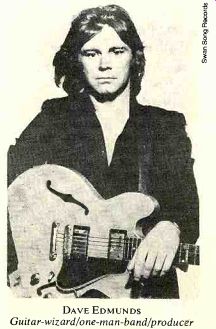
DAVE EDMUNDS -- Guitar-wizard/one-man-band/producer
RECORDING OF SPECIAL MERIT
DAVE EDMUNDS: Get It. Dave Edmunds (guitar, keyboards, bass, drums, vocals); other musicians. Get Out of Denver; I Knew the Bride; Back to School Days; Here Conies the Weekend; Worn Out Suits, Brand New Pockets; Where or When; Juju Man; Git It; and five others. SWANSONG SS 8418 $6.98, TP 8418 $7.97, CS-8418 $7.97.
Performance: Terrific, but . . .
Recording: Excellent
It's hard to know what to make of Dave Edmunds once you get over your initial awe at the scope of his talents. I've enjoyed every one of his all too rare records, and they invariably create instant fans anytime I play them for other people, but I'm beginning to think that the reason he isn't a household word goes beyond a mere lack of promotion. Maybe some people are just born to be cult figures.
Anyway, for the uninitiated, Edmunds is sort of a combination Eric Clapton and Roy Wood, the ultimate guitar-wizard/one-man band/producer. With deceptive ease, he can reproduce the sound and style of literally any one in rock. He's already done Chuck Berry, the Everly Brothers, Bob Dylan, and the Phil Spector girl groups (!), and on "Get It" he takes on Elvis, Hank Williams, the Beach Boys, Dion and the Belmonts, and a few others so obscure I haven't been able to place them. If that sounds as if he's too clever for his own good, it's meant to; such imitation merely requires facility, and only Edmunds' total commitment to the music keeps him from being nothing more than the Todd Rundgren of the Rock Revival.
There are, however, some indications here that he's beginning to find his own voice at last. There are more originals than usual, and while they're all period evocations (surf stuff, rockabilly, straight country) they have a marvelously relaxed groove to them that recalls such early-Seventies pub bands as Brinsley Schwartz and the current Graham Parker (not surprising, really, since Edmunds has worked with both of those outfits). If this is the direction he's going to explore in the future, we should be in for a treat. On this album, he has as usual displayed remarkable intelligence in the choice of cover material (Get Out of Denver, an early Bob Seger tune) and in matching the production approach to individual songs; the Dion thing is rearranged a la Phil Spector, the Hank Williams updated a few years to sound like Carl Perkins, and so forth. I really hate to nitpick about Edmunds, be cause he deserves a much wider audience.
Lord knows this is a terrific album-honest, unpretentious, and entertaining-and I wouldn't like to frighten anybody away from it by voicing my reservations. Let's simply say that one senses here an unrealized potential, that Edmunds has it in him to make a truly classic record that will succeed in synthesizing all the different kinds of music he loves. While "Get It" isn't that album, it's close enough for you to take the title literally. All he needs, I suspect, is a bit of audience feedback.
-S.S.
BRYAN FERRY: In Your Mind. Bryan Ferry (vocals); Chris Spedding (guitar); Paul Thompson (drums); other musicians. This Is Tomorrow; All Night Operator; One Kiss; Love Me Madly Again; and four others. AT LANTIC SD 18216 $6.98, TP-18216 $7.97, CS-18216 $7.97.
Performance: Not half bad
Recording: Good
I must be mellowing or something. I was all prepared, you see, to have the time of my life blasting this record with my heaviest, snidest ammunition. I had a score to settle and was even ready to use such cheap shots as suggesting that Bryan and his new bride Geri name their first kid Staten Island. After all, this is the man whose avant-garde pretension, fashionable Angst, and impossibly mannered vocals resulted in an incredibly overrated string of recorded embarrassments that made me long for a Tiny Tim comeback.
-------------
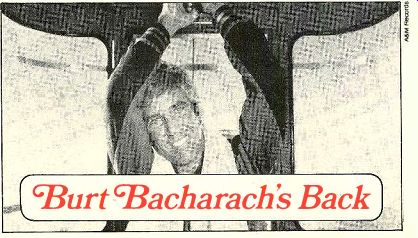
OVER the last decade or so, Burt Bacharach has been demonstrating not only that he can make charming music, but also that old smoothies can still make out like cat burglars in the tough, "thug"-dominated world of pop. "Futures," the Master's newest offering on A&M, is another engaging, smoothly clicking piece of stagecraft cannily designed to satisfy the tastes of his large and admiring audience.
For several years, while she trooped her one-woman show from Pasadena to Poland, Marlene Dietrich-old Madame Perfectionist herself-employed Bacharach as her musical director. One lesson he seems to have learned well from the experience is to make the action fit the image. As a result, Bacharach's music sounds just like he looks--a look we're repeatedly exposed to as this jet-setting com poser/personality turns up on TV commercials, in fan magazines, on talk shows, in tennis exhibitions, at star-studded movie premières, or posing in front of his own racing stables.
Bacharach is the sun-tanned darling of the God of Singles Bars. He's The Guy Who Al ways Makes Out-certainly in his business life, but, even more important, in his "relationships." He floats easily from invitation to invitation, suavely plying his practiced charm on any female within range of his dazzling smile. Willing to be little boy, father, or brother as the occasion demands, he always, al ways keeps his cool, always has it made.
His music reflects this sort of "attitude dancing." The nervous, carefully crafted, completely contemporary (though a bit square) style, based on rapid successions of crescendos, is more concerned with flashy dramatic effect than with either content or melody. It accurately typifies those restless, searching people, intent on attaining the good (material) life, who buy all that stuff advertised on TV.
One of the ways Bacharach had it made was his fortunate association with lyricist Hal David, a highlight of which was their brilliant score for Promises, Promises. But the two have taken mostly separate paths in recent years, and it's become evident that when he's not supported by a writer with gifts equal to David's, Bacharach tends to lapse into a musical rhetoric that is so merely "charming" that at length it is not even that. The good news about "Futures" (which bodes well for Bacharach's own) is that he has once again teamed with Hal David, along with two other writer friends, James Kavanaugh and Neil Simon.
Simon's contribution is the lyrics for Seconds ("Seconds, I missed him just by seconds . . ."). The song is a pretty good tear jerker, but its mean-minded, cleverness-at-any-cost tag lines ("And all the men I've met since then/Were seconds reveal a vulgarity that probably accounts for Simon's phenomenal commercial success. On the other hand, Kavanaugh's two songs-The Young Grow Younger Every Day and We Should Have Met Sooner--are both very, very good. Sooner is about two people who settled for the suburban dream and now can't escape it, while Young is a finely crafted song about promise and hope that is beautifully performed! here by Peter Yarrow. But the blockbuster of the album is Hal David's No One Remembers My Name, a you-can't-go-home-again song that ends with the triumphant realization that the present is just fine and the struggle to get away from home was well worth it after all.
IF I seem to be damning Bacharach with faint praise, it may be because, when I used to hit the bars myself, I generally got drunk, stepped on feet, tried to talk to everyone about Camus, and went home alone-and all the while there was some guy like Bacharach in the crowd, smilingly accepting the easy homage offered him. Dyspepsia may be linked to envy, but we must leave room for the possibility that one man's musical celebration of life(style) may be just so much rice pudding to another. Sorry, Burt.
-Peter Reilly
BURT BACHARACH: Futures. Burt Bacharach (keyboards); James Anders, Peter Yarrow, Joshie Armstead, Melissa Mackay, Sally Stevens, Marti McCall (vocals); orchestra. I Took My Strength from You; Us; Futures; Where Are You?; We Should Have Met Sooner; No One Remembers My Name; The Young Grow Younger Every Day; Another Spring Will Rise; Seconds; When You Bring Your Sweet Love to Me; Time and Tenderness. A&M SP-4622 $6.98, 8T-4622 $7.98, C) CS-4622 $7.98.
-----------------
But, as I said, I must be mellowing, because I actually like "In Your Mind." It doesn't sound a bit like Bryan Ferry (well, maybe a little). It sounds like a limited but imaginative singer rooted in r-&-b (the skeleton in Ferry's closet is that his college band used to do James Brown material) singing some attractive, quirky tunes backed by one of the solidest session aggregates I've heard in some time. Guitar whiz kid Chris Spedding and ex-Roxy thumper Paul Thompson are particularly good. This kind of thing is palpably unfair to reviewers, like me, who don't like having their preconceptions shattered, but obviously a much better deal for the listener. Two years ago, when panning one of his earlier albums, I joked that Ferry was the first rock star to raise sneakiness to the level of genius. I guess I was more on target than I realized, for in making an almost delightful album Bryan has pulled off the sneakiest move of his career.
- S.S.
RECORDING OF SPECIAL MERIT
GRACIE FIELDS: The Amazing Gracie Fields. Gracie Fields (vocals); orchestra. Sally; Wish Me Luck; Danny Boy; Ave Maria; Sing as We Go; Heaven Will Protect an Honest Girl; and six others. MONMOUTH-EVERGREEN MES/7079 $6.98.
Performance: Immortal
Recording: Well restored
Gracie Fields--"Our Gracie" to her huge British audiences--is probably the greatest star the English music halls have come up with in this century. At her peak in the Thirties, when most of these recordings were produced, her films and radio appearances made her the highest paid and easily the best loved performer in Britain. The only American equivalent to her particular kind of National Treasure status would be Will Rogers. Well, it's easy to hear what all the fuss was about in this marvelous collection of her work (it unfortunately leaves out her post-war resurgence as a top star in England and America based on her hit Now Is the Hour, but perhaps that will appear at a later date). Here Gracie is often simply glorious as she runs through such classics as The Biggest Aspidistra in the World, Will You Love Me When I'm Mutton?, and Heaven Will Protect an Honest Girl in her broad Lancashire accent and her gamily love lorn style. And, like all great stars, she can be gloriously awful too, as in such gaspers as Danny Boy, Annie Laurie, and (hold on!) Ave Maria (sung in Latin!). This is an album to make you star-crazy all over again even though we live in an era when the number of real stars seems to have shrunk to almost nothing.
-P.R.
PETER GABRIEL. Peter Gabriel (vocals, keyboard, flute, recorder); vocal and instrumental accompaniment. Moribund the Burgermeister; Humdrum; Slowburn; Down the Dolce Vita; Waiting for the Big One; and four others. ATCO SD 36-147 $6.98, TP 36-147 $7.97, CS 36-147 $7.97.
Performance: De Millean
Recording: Kubrickian
Peter Gabriel used to be the lead singer for Genesis, which, like Yes and Queen, specialized in loud, heavily ornamented rock, full of sonic filigree and tinsel, colored bulbs and twinkling lights. Only in Genesis' case some body forgot to include a Christmas tree to hang it all on. Santa never came for Genesis as he did for Yes (which didn't have a tree either but was sly enough to hang it all on an organ player named Rick Wakeman). Genesis had no sold-out arenas, no stockings bulging with fat royalty checks, just glitter.
So Gabriel departed Genesis (leaving their prospects even bleaker) to make his way as a Solo Artist. His debut album was extravagantly produced by Bob Ezrin, who can do no wrong in my book since he manages to put the voices of his self-sired moppets somewhere on every album he does-proof positive that the nuclear family is not dead. In Ezrin's extended family are a group of prodigious Toronto-based musicians, including guitarists Steve Hunter and Dick Wagner and drummer Joey Chirowski. But, because of the strict rules of the Ezrin family, they don't always get to display their talents very much, which is a shame.
Gabriel's album is produced so elaborately that everybody involved but Ezrin plays second fiddle. Gabriel does a semi-credible impersonation of Randy Newman as he sings about the big Southern California earthquake, but that's about the extent of his vocal ability, and his original compositions are . . . well, somehow I can't see Moribund the Burgermeister becoming a standard--or even a future K-Tel nostalgia item. On stage with Genesis, Gabriel used to dress up as a toadstool, and such experiences tend to leave their mark. Come to think of it, this album isn't all that different from Genesis, at that-more tinsel without a tree.
-Lester Bangs
MARVIN GAYE: Live at the London Palladium. Marvin Gaye (vocals); vocal and instrumental accompaniment. All the Way 'Round; Since I Had You; Come Get to This; Let's Get It On; Got to Give It Up; Trouble Man; and three medleys. TAMLA T7-352R two discs, $7.98, 9-352NT $9.98, 9-352NC $9.98.
Performance: Lackluster
Recording: Good
Marvin Gaye has recorded a score of great performances since the 1960's-Hitch Hike, I Heard It Through the Grapevine, Ain't That Peculiar, Inner City Blues, and You're All I Need to Get By are among them-but his craftsmanship belongs more to the recording studio than the stage. Three sides of this double-disc album are of a live performance in which Gaye sings medleys of his long string of hits, but the pedestrian arrangements make them all sound like the same song; the dynamics, twists and turns, and gritty moods of the original studio performances are pressed flat as a Peking duck. The fourth side, thrown in for good (and commercial) measure, is the unedited eleven-minute-plus version of Got to Give It Up, which has been a hit in the discos.
There is nothing to commend here except the drummer, who should receive an award for devotion to duty. Gaye is better than this al bum shows, and he deserves better. J. V.
THE STEVE GIBBONS BAND: Rollin' On. The Steve Gibbons Band (vocals and instrumentals). Wild Flowers; Light Up Your Face; Now You Know Me; Mr. Jones; Till the Well Runs Dry; Tulane; and eight others. MCA, MCA-2243 $6.98, MCAT-2243 $7.98.
Performance: Energetic
Recording: Good
Here is an album that answers a burning question: "What ever happened to Trevor Burton?" Burton, you may recall, was the original bassist with the Move (he did the Eddy Cochran imitations on their first album) who quit that group long before they became cult heros in America. Move drummer Bev Bevan characterized him as "a great musician who's never found himself." Where he finds himself now is with an aggressive rock band from his home town that makes likable but forgettable noises. Gibbons is an okay singer, and the Trevor Burton fans out there (all six of you) will doubtless be reassured to know that your hero is playing well, but "Rollin' On" isn't much of an album. There's a nice version of Tulane (the last good song Chuck Berry wrote) that shows the band's heart is in the right place, though, so I think I'll keep it.
One-song albums like this are cropping up with increasing frequency lately, by the way; it's a pity the industry seems to want to phase out singles entirely. S. S.
RECORDING OF SPECIAL MERIT
WAYLON JENNINGS: OP Waylon. Waylon Jennings (vocals, guitar); Richie Albright (drums); Ralph Mooney (steel guitar); Sherman Hayes (bass); Clifford Robertson (key boards); other musicians. Luckenbach, Tex as; If You See Me Getting Smaller; Lucille; Sweet Caroline; I Think I'm Gonna Kill My self; Till I Gain Control Again; Satin Sheets; and four others. RCA APLI-2317 $6.98, APSI-2317 $7.98, APK1-2317 $7.98.
Performance: Authoritative
Recording: Very good
Waylon's last album was hurt by having too many vaguely similar songs in it, and this one is quite a radical departure from that: here is what they used to call a mixed bag. Mostly it's a good one, much more interesting than "Are You Ready for the Country," and only a little too interesting in a negative way a few times.
These have to do not with versatility-Waylon has the vocal prowess to handle tougher and even more "foreign" stuff than this-but with how he identifies with a particular song: Luckenbach, Texas and If You See Me Get ting Smaller portray characters he can get into playing; Lucille (which first caught on for Kenny Rogers) and Sweet Caroline (a golden oldie by Neil Diamond) are supposed to come out of the heads of characters Waylon can't quite see himself being. So he takes Lucille out on a prolonged, spaced-out guitar solo that reinforces the ambiguity you can hear in his voice about doing this thing at all. The guitar break almost says it was all a joke. Well, it's good he can't identify with these types, I say-Caroline does have a nice melody, but the wording of the refrain, as it is revealed here where you can hear it, is clumsy and lazy. The good news includes another cover, of Till I Gain Control Again, which doesn't cut Emmylou Harris' cover but makes some interesting expressions in its own way, and one of those with which Waylon does identify, all the way, Brand New Goodbye Song., In between, there's piano and there's even a brief blare of horns, but mostly it's the same basic band going through a series of new turns to suit new twists of melody and beat. It's not a great Waylon album but it's a good Waylon album. N.C.
JETHRO TULL: Songs from the Wood. Jethro Tull (vocals and instrumentals). Jack-in-the-Green; Cup of Wonder; Ring Out, Solstice Bells; and six others. CHRYSALIS CHR 1132, $6.98.
Performance: Hollow
Recording: Slightly hollow
One nice trend I've noticed among the poseurs who sometimes dominate contemporary music: sooner or later, they always tip their hand, and you no longer have to spend quite so much time explaining to ear nest acquaintances exactly why you know in your gut that groups like Jethro Tull are shams. (Or else you find after a while that you just don't care, since you know that anybody with any sensitivity will eventually make the same discovery.) These guys tip their hand, in their over-zealous efforts to keep the old Man-for-All-Musical-Seasons puff inflated, by opening their mouths to pontificate about music and inadvertently revealing that they don't know a damn thing about it.
(Once I interviewed Jethro Tull's leader, Ian Anderson. Asked what he thought of jazz, he replied that he didn't understand it but suspected it was all a fake, some kind of hoax perpetrated on the public. "What about Ro land Kirk?" I asked. "Oh yes, I did hear one song by him once-Song for a Cuckoo. Quite liked it." That was nice of Anderson, considering that anybody familiar with both performers could tell that he stole his entire flute style from Kirk-from just one song, according to his own admission.)
On the surface, this new Jethro Tull LP is a sylvan romp, more genial and less curmudgeonly than its predecessors. But you don't have to listen to it very long to pick up on the underlying attitude, which is as up-tight, pretentious, and haughty as ever. This music and its creator's pose have never been anything but ugly and trite. -Lester Bangs
DOUG KERSHAW: Flip, Flop & Fly. Doug Kershaw (vocals, fiddle, accordion, viola electra); Johnny Sandlin (guitar); Neil Larson (keyboards); other musicians. Rag Mama Rag; Louisiana Blues; Twenty-Three; You Won't Let Me; Bad News; Black Rose; I'm Walkin'; and four others. WARNER Bros. BS 3025 $6.98, M83025 $7.97, M53025 $7.97.
Performance: Good
Recording: Good
The ragin' Cajun seems fairly tame here, but after listening a while you realize he's made an absolutely unclassifiable album, ranging all over the place for sources if not whole songs.
His is a visual act; even on television you can tell he's pretty rough as a fiddler (that's masked here by fairly dense arrangements), but his antics are so distracting you may not be able to tell how well he sings. Here you can, yet here he really doesn't get into some of the songs with the gusto they deserve.
Waylon Jennings outclasses him on Billy Joe Shaver's Black Rose, Fats Domino does like wise on I'm Walkin', so does Joe Turner on the title song, and so forth. What's missing from the Kershaw versions is not style or soul but, of all things, fire. Still, his singing is impressive when you consider all the material ...
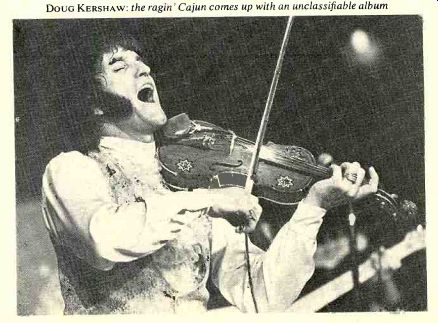
---------------- Doug KERSHAW: the ragin' Cajun comes up with an unclassifiable
album
... and what diversity there is. The arrangements are a little bulky, though, and try to be too many things to too many people. Taking on all kinds of songs is one thing, taking or Lone song in all kinds of ways is another. Without the visual element, the strong personality that's supposed to be the thing about a Kershaw performance is buried. Less ambition! More enthusiasm! An occasional "Aaaiiieee" does not a ragin' Cajun make. N.C.
IAN MATTHEWS: Hit and Run. Ian Matthews (vocals, guitar); instrumental accompaniment. Tigers Will Survive; Just One Look; Help to Guide Me; Shuffle; Hit and Run; The Frame; and three others. COLUMBIA PC-34671 $6.98, PCA-34671 $6.98, PCT-34671 $6.98.
Performance: Overproduced
Recording: Good
I've liked most Ian Matthews albums and thought the arrangements were among their strong points, but here the arrangements seem overdone. Matthews has crossed the line where the fancy stuff starts to interfere with the singer's emotional contact with the song.
Not in every track, of course; he's a fine singer who obviously still wants to get into the meaning of the words. But here he's making certain adjustments, apparently to change with what he takes to be the times, and a lot of fake jazz riffing by guitar and sax seems to be a major element of the attempted change. Too much stuff is played with technique exalted over feeling, and that eventually overpowers the way a lot of it is sung. The song selection is a little weird, too, compared to the kind of stuff Matthews has written and sung m the past. Again, it suggests that he suspects people don't pay a hell of a lot of attention to-the words any more. The opening song by Terry Reid, The Frame, is particularly sloppy. It's as if the whole thing were calculatedly light weight, and it doesn't figure. Matthews will have to do at least one more album before we can get a fix, through triangulation, on his present position. -N.C.
BROWNIE MCGHEE: Blues Is Truth. Brownie McGhee (vocals, guitar, piano); instrumental accompaniment. The Blues Had a Baby; I'm Going to Keep on Loving; Walk On; Rainy Day; Christina; Wine Sporty Orty (Drinkin' Wine Spo-Dee-O-Dee); and six others. BLUE LABOR BL 117 $6.98.
Performance: McGhee 10, sidemen 0
Recording: Good
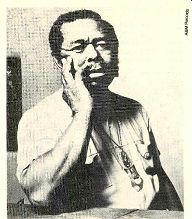
BROWNIE MCGHEE: polished, warm, urbane vocals.
Brownie McGhee is a superior blues singer of vast experience. Much of his career has been well spent in company with Sonny Terry, whose blues harmonica playing pretty much defines that art form.
Without Terry this time around, McGhee is backed by several sidemen, among them Louisiana Red on guitar and a harmonica player named Sugar Blue. Nearly all the songs are McGhee's own, and they are sturdy material, especially the title tune and The Blues Had a Baby (and They Called It Rock and Roll).
McGhee's vocals are polished, warm, forceful, and urbane. What detracts from the al bum is the looseness of the sessions; they are so loose that the band never seems to be quite able to end a tune together. McGhee kiddingly points this out on Key to the Highway when he says, "Now we goin' out together-for once." (They don't.) Still, McGhee's own performances more than make up for the sloppiness of the sidemen. J. V.
ELLIOTT MURPHY: Just a Story from America. Elliott Murphy (vocals, guitars, Farfisa organ, marimba, harmonica, tambourine, harmonium); vocal and instrumental accompaniment. Drive All Night; Summer House; Rock Ballad; Think Too Hard; Anastasia; and four others. COLUMBIA PC-34653 $6.98, PCA-34653 $6.98, PCT-34653 $6.98.
Performance: He thinks too much
Recording: Fine
There's absolutely no point to delving into an album as deep as Elliott`Murphy (the self-pro claimed "F. Scott Fitzgerald of rock") claims this one is until we've paused a bit to scratch the surface. I mean, the guy's promotors actually try to sell this record with the line that "He could write a book. But he chose rock and roll instead." This raises the question of just which book he would have honored us with had rock-and-roll not claimed his talents:
Tender Is the Night? The Decline of the West? Principia Mathematica? Miss McIntosh, My Darling? I suppose we will never know, which is actually a kind of relief. After being sandbagged by such heavy recent books as JR and Gravity's Rainbow, both of which I miserably failed to comprehend, I just don't think I'm up to another masterpiece. I was going to settle for watching Captain Kangaroo when a batch of review albums arrived and I was able to seize upon "Just a Story from America" as the solution to my problem: culture without pain. Right on this record we get references to Anastasia (pretender to the throne of all the Russias), Errol Flynn, and Rhett Butler. Not exactly Spengler, Marx, and Freud, of course, but Murphy does try; in the past he's written songs to, about, or with passing mentions of Eva Braun, Marilyn Monroe, Patti Smith, and Danny Fields, among others. Be fore Bruce Springsteen broke through, certain rock critics were tentatively elevating Murphy to Next Dylan status, just because his lyrics were fairly literate and his songs sounded like "Blonde on Blonde" played by a radio station getting leakage from a Lou Reed broadcast.
The trouble is, Murphy's modern in just the way that Springsteen is not. While Springsteen actually believes and feels all that hub cap chivalry stuff, Murphy is cool and sophisticated-so cool and sophisticated that his last two albums consisted mainly of namedrop ping (Patti Smith was "Lady Stiletto"), lit.--major purges, and ever-so-sincere songs about how much he really wants to be a famous superstar but, y' know, gee, he's getting all these ambivalent feelings ... "Just a Story from America" is Murphy's best album yet, though that isn't saying much.
If you can get past the Springsteen-steal car song and the weird sense of history that produces such lines as "Anastasia please come home/Your daddy the Czar is on the tele phone/His little girl so lost and alone/It makes him cry," you'll still have to contend with the fact that his singing sounds affected from first note to last. Murphy is the Al Stewart of counterfeit street-poets.
-Lester Bangs
BONNIE RAITT: Sweet Forgiveness (see Best of the Month )
RECORDING OF SPECIAL MERIT
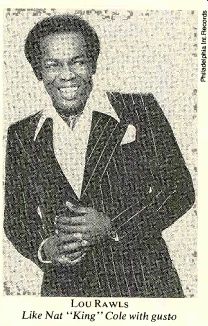
Lou RAWLS Like Nat "King" Cole with gusto
LOU RAWLS: Unmistakably Lou. Lou Rawls (vocals); instrumental accompaniment. Spring Again; Early Morning Love; Some Day You'll Be Old; Secret Tears; All the Way; and four others. PHILADELPHIA INTERNATIONAL PZ-34488 $6.98, PZA-34488 $6.98, PZT-34488 $6.98, PZQ-34488 $7.98, PZQ-34488 $8.98.
Performance: Excellent
Recording: Very good
"Unmistakably" is one of the best albums Lou Rawls has made in years. He's singing out better and bigger than ever, and the result is a delightful, old-timey jaunt reminiscent of years-ago Nat "King" Cole in one of his more exuberant moods. The big-band sound, provided by the arrangements of Bobby Martin and Jack Faith, and the production work of the omnipresent Gamble-Huff, who are also responsible for six of the songs here, glides along behind Rawls with the silvery purr of a brand-new 1953 T-Bird. As bad as the material often is-and it can be woeful in such things as We Understand Each Other, a song about "communicating," or Early Morning Love-Rawls flies high, wide, and frolicsomely above it. Rawls never made it on records on the scale that everyone thought he would at the beginning of his career, but now that several years have passed and there is a whole new audience that has nothing to compare him with, he might just make it very big in deed (as the success of his disco hit You'll Never Find Another Love Like Mine from his last album intimated). He certainly deserves to on the basis of the kind of loose-jointed, easy entertainment he offers here. P.R.
MINNIE RIPERTON: Stay in Love. Minnie Riperton (vocals); orchestra. Young, Willing, and Able; Could It Be I'm in Love; Can You Feel What I'm Saying; Stick Together; Gettin' Ready for Your Love; and four others. EPIC PE-34191 $6.98, PEA-34191 $6.98, PET-34191 $6.98.
Performance: Very good
Recording: Good
Minnie Riperton has one of the truly unique voices in pop: dramatic, warm, and highly expressive even into the upper reaches of what sounds like a real coloratura soprano. It's mostly wasted here, though, in what is billed as "a romantic fantasy set to music." It's actually an assortment of sodden ballads, all co authored by Minnie, that would sink a combination of Ella Fitzgerald and Mado Robin. Riperton's singing is, as usual, just fine-it's the rest you'll have to block out.
P.R.
MARLENA SHAW: Sweet Beginnings. Marlena Shaw (vocals); orchestra. Pictures and Memories; Yu-Ma; Walk Softly; I Think I'll Tell Him; No Deposit, No Return; and five others. COLUMBIA PC-34458 $6.98, PCA-34458 $6.98, PCT-34458 $6.98.
Performance: Good
Recording: Good
Marlena Shaw has been around for a while. Starting as a child performer at the Apollo in Harlem, she went on to sing with the Count Basie Orchestra, tour the night-club circuits, ro and cut recordings for several small labels.
The experience shows, and in all the right ways. She's easy and assured, with a generous jazz-pop style that can handle almost any thing. Unfortunately, "almost anything" is just about what she's been given here in the way of repertoire. Only the title song, Sweet Beginnings, is worthy of her talents-every thing else seems like a prolonged vamp. Bert deCoteaux's production, arrangements, and conducting don't give her much, room to swing out, but then what's there to swing out about? This is a disappointing major-label debut. P.R.
MEL TILL'S: Heart Healer. Mel Tillis (vocals, guitar); instrumental accompaniment. Heart Healer; Wedding Bells; Play It Again, Sam; Someone Else Tends the Garden; Burning Memories; and five others. MCA MCA-2252 $6.98, T-2252 $7.98, C-2252 $7.98.
Performance: Coolish
Recording: Good
Mel Tillis has a fine, smooth voice and is a groundbreaking, though not very prolific, songwriter. His arrangements have been get ting slicker and slicker lately, though, and my overall impression of this one is that it is standoffish and cool. I wonder whether being on television a lot lately could be having an effect on him, since you probably have to be cool in the more cutthroat outlets of showbiz, like TV, to keep from getting eaten alive. A couple of years ago Tillis could sing about working at the sawmill and make me believe he'd been there; this time it sounds more like he's dutifully reporting on some movie he saw and found mildly interesting. Real life, Mel, give us real life ... more about Ruby taking her love to town and that sort of thing. N.C.
UTOPIA: Ra. Todd Rundgren (vocals and instrumentals); Utopia (vocal and instrumental accompaniment). Overture/Communion with the Sun; Magic Dragon Theatre; Jealousy; Eternal Love; Sunburst Finish; Hiroshima; Singring and the Glass Guitar. BEARSVILLE. BR 6965 $6.98, M8-6965 $7.97, M5- 6965 $7.97.
Performance: Synthedelia
Recording: Equal to the purpose
Tapes played backwards, fourteen-minute electric fairy tales, songs about the sun god and how your mind is flying, unnecessary sound effects-these are a few of the elements in Todd Rundgren's sonic wonderland.
This sort of stuff was popular among rock musicians, from the Beatles on down, around 1967-1968, but at the time Rundgren was apparently too busy to listen as he was trying to make it in a fine Philadelphia band called the Nazz. Now, a decade later, he has finally harkened to the psychedelic call. It's a long way from the Nazz to Utopia, but the worst of the old ersatz psychedelia had more charm than Rundgren's current musical tirades. The world did not make him the superstar he de served to be for writing winsomely wimpy love ballads such as Hello, It's Me, and I suspect that Utopia is his revenge. It's too bad, because a great talent is going to waste, but at this point it doesn't look as if things will ever get any better for either Rundgren or the people who admire his gifts. Lester Bangs BEN VEREEN: Ben Vereen (vocals); orchestra. By Your Side; You and I; What's the Reason; Guess You Know Me Girl; and three others. BUDDAH BDS 5680 $6.98.
Performance: Restrained
Recording: Clattering and busy
Ben Vereen seems oddly restrained in this overproduced bit of slickery. His TV appearances are so full of "lovingness" that you can't escape his moist rapture at being Ben Vereen In Person. Here, though, plowing through enormous arrangements with a flotilla of back, side, and foreground singers swooping around him, he sounds distantly over-tracked and puny. Most of the material is as weak-kneed as the performances, but Stop Your Half Steppin' Ma Ma has a clattering energy and at least sounds as if Vereen were in the same studio as everyone else. P.R.
DISCO -- RECOMMENDED DISCO HITS
KEITH BARROW. COLUMBIA PC-34465 $6.98, PCA-34465 $7.98, PCT-34465 $7.98.CAMOUFLAGE: A Disco Symphony. HONEY BEE HB 24001 $6.98.GIORGIO MORODER: Munich Machine. CASABLANCA NBLT 7058 $6.98. MORNING, NOON & NIGHT. ROADSHOW RSLA 726-G $6.98, EA 726-H $7.98. NEW YORK COMMUNITY CHOJR. RCA APL 1-2293 $6.98. (List compiled by David Mancuso, owner of the Loft, one of New York City's top discos.)
RECORDING OF SPECIAL MERIT
YOUR ARMS TOO SHORT TO BOX WITH GOD (Alex Bradford-Micki Grant-Vinnette Carrol). Original-cast recording. Salome Bey, Clinton Derricks-Carroll, Vinnette Carroll, Sheila Ellis, Delores Hall, William Hardy, Jr., Hector Jaime Mercado, Stanley Perryman, Mabel Robinson, William Thomas, Jr. (vocals); chorus and stage band, Eddie Brown cond. ABC AB-1004 $7.98, 8020-1004N $8.95, 5020-1004N $8.95.
Performance: Glorious
Recording: Excellent
----------------
Annie
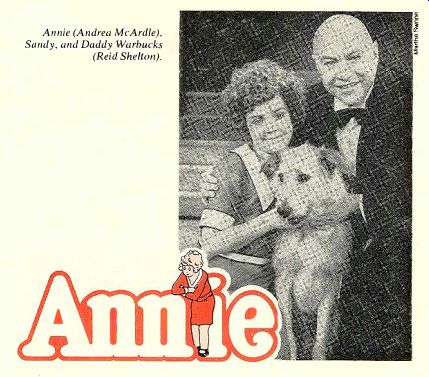
Annie (Andrea McArdle), Sandy, and Daddy Warbucks (Reid Shelton).
CHARLES Strouse and Martin Charnin's Annie is probably the squarest, most conventional thing to hit Broadway since the palmier days of George M. Cohan. But no matter how far you have your sophisticated musical lip curled in advance, and no matter how oh-God-not-another-quaint-little-million-dollar-musical you've allowed your head to get, it's ten to one that you'll be as entirely captivated ("Gloriosky!") by Annie's genuine charm and great big ricky-tick musical heart as I am.
First off, this is one of those superbly well done Columbia original-cast albums, in the tradition of My Fair Lady, Mame, and Cabaret. that almost make the need to see the show itself superfluous. Larry Morton and Charles Strouse's production couldn't be improved on: the listener is thrust directly into the center-stage action, and as the slight, sentimental tale of Annie's being rescued from the orphanage by Daddy Warbucks, her search for her real folks, the machinations of Miss Hannigan and her cohorts to pass off a false couple, their come-uppance at Warbucks' mansion in the presence of none other than FDR and his entire cabinet-and at Christmas! unfolds, you begin to feel as close and as tail waggingly friendly to the characters as dear old ("Arf !") Sandy (who, unfortunately, does make an appearance here vocally).
Moreover, Annie, with all its easy virtues, elephantine airs and graces, absolute technical perfection, and warmth (to say nothing of the Swiss-watch organization of all of its elements), is The Broadway Musical. That unique, and uniquely American, contribution to the world lyric theater has taken an awful drubbing in the last few years; one of the quickest ways to show you were in was to declare that Broadway-particularly its musicals-was out. If you had to like something, well, you just might admit that Chicago has a certain Brechtian validity-I mean, after all, the Ebb-Kander score does have a kind of sour-ass message: none of us are any damned good and the only way to beat the system is to join it and then give lessons in corruption. But Annie gives that whole cynical cliché a wonderfully raucous send-up in a Weillish number called We'd Like to Thank You (Herbert Hoover). It is sung in fine proletarian style by the residents of a sub-pontine Hooverville, particularly by one anonymous Mother Courage in the chorus who asks melodramatically, "Whoever thought I could steal!!??" About a minute into the overture, right after the signature song (called Tomorrow-a bit droopy and Inspirational, but it'll do, it'll do), the orchestra cranks up, lets out, and starts to soar with You're Never Fully Dressed Without a Smile. And man, Broadway Is Back! All I could picture was hundreds count 'em-hundreds of chorus girls hoofing up a storm, but the reality of it is that in the show the song is performed first by a typical radio "charm" singer (Rudy Vallee?) of the... music that is meant purely and simply to entertain ...
---
Thirties and then segues back to the orphan age where the kids do their own interpretation of what they've just heard on the radio.
From that moment on I was a pushover for all that followed, including It's the Hard-knock Life, done by the same kids; the hilarious Little Girls, in which, as the dreadful Miss Hannigan who is in charge of the orphanage, Dorothy Loudon tells of her premonition of someday winding up in the nut house be cause, while other women seem to be dripping in diamonds and pearls, all she seems to be doing is "dripping with girls"; I Think I'm Gonna Like It Here, where Annie is first introduced to the splendors of Daddy Warbucks' palatial Fifth Avenue mansion; Easy Street, in which Miss Hannigan, her rotten-rotten brother Rooster, and his shady lady Lily plot together how they're going to get there; Something Was Missing, Daddy Warbucks' sentimental little lilac-colored-spotlight ode to Annie; and even the finale, a deliriously corny and endearing Big Number called A New Deal for Christmas, featuring FDR and cabinet members ("Sing up, Harold!") Ickes and Frances Perkins. About the only number in the show that just wouldn't go down is a bummer called N.Y.C.; it's about the joys of New York (there are some), but it sounds as if it were whipped up between crises for the re election campaign of Hizzoner Abe Beame.
Andrea McArdle, in the title role, sings her songs with an unaffected, genuinely childlike charm, and aside from an at times disconcerting vocal resemblance to Bernadette Peters she's an ideal non-camp Annie. Reid Shelton as Daddy Warbucks is good verging on excel lent, but it is Sandy Faison as Grace, Warbucks' secretary, who makes the single strongest impression as one of the new breed of Broadway singers. She has no solo number of her own, but she's heard in several of the group songs, and she's very, very good. Doro thy Loudon, who doesn't seem to have been around for several years, is back with a re sounding boom, and she's only superb as Miss Hannigan: scheming, selfish, querulous, with a heart and a world-view of pure lead.
Charles Strouse's credits go back to include such hit shows as Bye, Bye Birdie, Applause, and Golden Boy, and in Annie he has hit an easy stride, composing music that is meant purely and simply to entertain. That writing such music is by no means purely simple can be evidenced by the fact that no one since Irving Berlin seems to have been able to make a consistent career out of it. Martin Charnin's lyrics are thoroughly professional, wisely avoiding camping up the subject or the era and graced with a nicely felt tinge of admiration for a simpler-or so it seems now-time.
ANNIE is, of course, based on Harold Gray's famous comic-strip. But there was an earlier "Little Orphant Annie," a poem in dialect by James Whitcomb Riley, about a little housemaid who "come to our house to stay,/ An' wash the cups and saucers up, an' brush the crumbs away." Riley's Annie told absolutely enthralling ghost stories. Gray Strouse-Charnin's Annie simply spins out a little fable and charms us. But no matter how high your musical brow or how sophisticated your taste, this album will surely seduce you "Ef you Don't Watch Out!"
-Peter Reilly
ANNIE (Charles Strouse-Martin Charnin). Original Broadway-cast recording. Andrea McArdle, Reid Shelton, Sandy Faison, Robert Fitch, Dorothy Loudon, others (vocals); orchestra, Peter Howard cond. COLUMBIA PS 34712 $7.98.
------------------------
I put this record on my turntable with trepidation. I hated the title, and anyhow, I wasn't sure I'd be able to endure still another passion play brought up to date with noisy music. I needn't have worried. Your Arms Too Short is often tumultuous, but it is never noisy. In this high-spirited treatment of the Book of Matthew, the Gospel is in good hands. The hands are largely those of Vinnette Carroll (Don't Bother Me, I Can't Cope), who wrote the book (with a little help from St. Matthew), directed the show, and also appears in it, but the songs are by Micki Grand and Alex Brad ford, and they are pretty wonderful.
Much of the score is preserved intact here, and it's a glowing experience, a constant celebration weaving in the story of Jesus from His early triumphs in Jerusalem through the Crucifixion and the Resurrection, with the emphasis on the joys of faith rather than the sorrows the Saviour endured. Delores Hall and Salome Bey are two strong gospel singers with a sure grasp of the idiom, while Clinton Derricks-Carroll, the son of a Knoxville preacher (and the stepson of Vinnette Car roll), knows exactly how to convey the fervor of sermons, psalms, and songs such as We're Gonna Have a Good Time, the exuberant finale that makes you want to stand up and stomp and clap with the whole ensemble.
P.K.
RECORDING OF SPECIAL MERIT
ANTHONY BRAXTON: The Montreux/Berlin Concerts. Anthony Braxton (sopranino, alto, and bass saxophones; clarinet; flute); Kenny Wheeler (trumpet); George Lewis (trombone); Dave Holland (bass); Barry Altschul (drums, percussion). H-46M . . . B-BW4; 84"-KELVIN . . G; and five others. ARISTA AL 5002 two discs $9.98.
Performance: Braxtonian
Recording: Very good remotes
I was somewhat disappointed by Anthony Braxton's last Arista release ("Duets 1976- AL 4101), but he redeems himself with this two-record set of concert performances from the Montreux and Berlin festivals. Those pretentious diagrams identifying each selection are back, but the music is without pretense.
There's some wonderful work by trumpeter Kenny Wheeler, and Dave Holland and Barry Altschul build a solid rhythmic foundation.
The selection that ends the first side has some particularly effective-and very swinging ensemble playing by Wheeler and Braxton.
Whimsey and Weill (Kurt, that is) enter into the last cut of side two, which-like so many of Braxton's pieces-starts off a bit disjointedly and then suddenly comes together, making uncanny sense. Sides three and four are more of the same-yet completely different, if you know what I mean-making this a set no Braxton devotee ought to be without.
- C.A.
FIRST COSINS JAZZ ENSEMBLE: For the Cos of Jazz. First Cosins Jazz Ensemble (instrumentals). Psalm; Flat Meat; I Don't Know; and seven others. CAPITOL ST-11589, $6.98, 8XT-I1589 $7.98.
Performance: Lethargic
Recording: Good
Capitol--a company on whose records one could once find such names as Art Tatum, Duke Ellington, and Leadbelly-recently announced that it was returning to jazz, but if this lethargic excursion to Muzaksville is any indication of what they have in mind, they might as well go back to whatever it was they were doing before. The percussion section sounds like one of those awful rhythm devices that are built into electric home organs these days, and saxophonist Rudy Johnson, the album's featured horn player, plays solos of the Grover Washington, Jr., variety. In case you might be wondering what the Cos is all about, Bill Cosby is credited as music consultant. I used to be a disc jockey in Philadelphia, and when I played Louis Arm strong's Hot Five recordings, Bessie Smith, or early Ellington, Cosby (then a student at Temple University) frequently complained that I was playing "Mickey Mouse music." Need I say more?
- C.A.
RECORDING OF SPECIAL MERIT
DIZZY GILLESPIE: The Development of an American Artist, 1940-1946. Dizzy Gillespie (trumpet); with His Sextet, His All-Stars, the Tempo Jazzmen, the Joe Marsala Sextet, Sa rah Vaughan, and the orchestras of Cab Calloway, Les Hite, Coleman Hawkins, Billy Eckstine, Oscar Pettiford, Boyd Raeburn, Lucky Millinder, and Georgie Auld. Pickin' the Cabbage; Kerouac (two excerpts); Good Bait; Interlude (Night in Tunisia); Disorder at the Border; Co-Pilot; Confirmation; 'Round Midnight; and twenty-five others.
SMITHSONIAN COLLECTION. R 004 two discs $9.00 (from the Smithsonian Collection, P.O. Box 1641, Washington. D.C. 20013).
Performance: Sparkling
Recording: Good transfers
Truly innovative jazz musicians-I mean the kind who turn the music itself around-seem to be an endangered species. Where are the Armstrongs, Youngs, Christians, Parkers, and Coltranes of today? Well, if their equivalents are to be found among the younger generation of musicians, I have yet to hear them, which is not to say that we haven't seen some extraordinary new talent emerge in recent years. Of the surviving innovators of old, none has had the impact of John Birks "Dizzy" Gillespie, who came out of the Swing Era sounding like Roy Eldridge and developed a style that became the model for all modern jazz trumpet players. Gillespie not only set the pace for his own instrument, he was also a major force in developing modern jazz, or be bop, as it was called.
This album traces Gillespie's development from 1940 to 1946, a period that saw him help build and cross the bridge from swing to bop.
It was a period of confusion and polarization during which the walls of style grew more and more impenetrable as young musicians joined with defectors in a direction that had the traditionalists (some of whom even considered swing a betrayal of jazz) screaming heresy.
But as the jazz war raged, some great music was being created on both sides, and the thirty-three selections assembled for this set by Martin Williams make up a generous sample of a music in transition. We hear Dizzy in a traditional big-band setting with Cab Calloway (who called Dizzy's music "Chinese" and eventually fired him for throwing a spit ball) and in an informal session at Monroe's Uptown House as captured by Jerry Newman's portable disc-cutter in 1941. We hear him with Billy Eckstine and Sarah Vaughan, the vocalists of the Bop Era, and in the unlikely company of stride pianist Cliff Jackson on a session that demonstrates the stylistic transition that was taking place. But we do not hear Gillespie with Charlie Parker, a celebrated association that was recorded early enough for inclusion in this set and would have been excellently represented by a selection from the November 1945 Savoy session (with Miles Davis) that yielded Billie's Bounce and Ko Ko. That session is, of course, available now on a Savoy album ("Bird/The Savoy Recordings"-Savoy SJL 2201), but I still think one of the alternate takes might well have been used by Williams in place of one of the four Cab Calloway sides. Nevertheless, this is a fine album filled with outstanding music, an notated in a scholarly way by Williams (with interesting comments by Gillespie himself), richly illustrated with photographs (the double album has a four-page insert), and generously endowed with discographical data.
Most important, it delivers what it promises.
C.A.
BOB JAMES: Three. Bob James (keyboards); Grover Washington, Jr. (soprano and tenor saxophones, tin whistle); orchestra. One Mint Julep; Jamaica Farewell; and three others. CTI CTI-6063 $6.98, CT8-6063 $7.98, CTC-6063 $7.98.
Performance: Spiritless
Recording: Very good
BOB JAMES: Four. Bob James (keyboards); Orchestra. Pure Imagination; Tappan Zee; El Verano; and three others. CTI CTI-7074, $6.98, CT8-7074 $7.98, CTC-7074 $7.98.
Performance. Less spiritless
Recording: Very good
Since he signed with the CTI label, Bob James has given his unabashed commercial touch to countless albums, including two, titled simply "One" and "Two," under his own leader ship. When I reviewed "One," I called it "a fine example of lush, jazz-flavored pop" and expressed a hope that it would soon be followed by "Two." It was, and now we have you guessed it-"Three" and "Four." I should be in seventh heaven, but I'm not.
Enough is enough, and four albums of this sort of slightly-hipper-than-Mantovani mood music is more than enough.
"Three" features Grover Washington, Jr., who has had exaggerated success playing the saxophone in a manner that would pale in comparison with a Lester Young warm-up. It is a plodding, monotonous thirty-six minutes of lush, predictable James arrangements played with apathy by a large assemblage that includes such CTI regulars as Hubert Laws, Eric Gale, and Ralph MacDonald plus twelve strings and a harp. Get the picture? "Four" is essentially more of the same, though there are moments when some of the musicians actually seem to show some interest in what they are doing. Both these albums are very slick, well produced, and obviously high-budget excursions destined for that wide market of people who want little more out of music than a beat to gyrate to. But when I look at the talent on hand and imagine what music it could have created, I have to regard "Three" and "Four" as meaningless waste.
Bob James, for the moment at least, is on a treadmill. I understand he has now left CTI.
Perhaps the split will be good for both of them. C.A.
RECORDING OF SPECIAL MERIT
EDDIE JEFFERSON: The Jazz Singer. Eddie Jefferson (vocals); various instrumental groups, including Howard McGhee (trumpet), James Moody (tenor saxophone), and Osie Johnson (drums). Body and Soul; So What?; Moody's Mood for Love; Sister Sadie; and eight others. INNER CITY IC 1016 $6.98 (from Inner City Records, 43 West 61st Street, New York, N.Y. 10023).
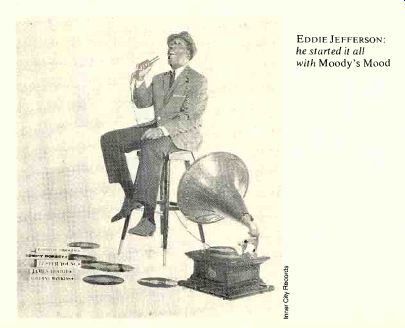
---------- EDDIE JEFFERSON: he started it all with Moody's Mood ------
Performance: The source
Recording: Very good
King Pleasure's recording of Moody's Mood for Love-a 1952 vocal version of James Moody's 1949 solo on I'm in the Mood for Love-established Pleasure as a jazz singer and introduced a novel vocal concept that was carried further by Annie Ross, perfected by Lambert, Hendricks & Ross, and recently bastardized by a French vocal group called Quire. Though Pleasure is often believed to have originated the concept of setting lyrics to improvised instrumental solos, the man who started it all-by writing the Moody's Mood lyrics sung by Pleasure-is Eddie Jefferson, who recalls singing this sort of thing for friends as far back as 1939. Jefferson, now fifty-nine, began recording twenty-five years ago, but he never had a hit to equal the one he had helped King Pleasure create. Still active today, he is frequently heard at informal sessions in Greenwich Village lofts, and he has recently continued his recording career on the Muse label.
Except for Body and Soul and one other selection (I believe it was Now Is the Time), which appeared as a single on the Triumph la bel in 1961, the recordings in this album made at three different sessions in 1959 and 1961-are now being released for the first time. The overall sound is a bit dated, as are some of the lyrics (it is, of course, the pre-electronic Miles Davis that Jefferson de scribes in So What?), but this music was meant to be heard at another time, when it would have been considered very hip. I don't know why it took so long to make this album available, but it deserves to be heard; indeed, if it had been released in 1961, a reissue at this time would not have seemed inappropriate.
Eddie Jefferson is in good form here, the repertoire runs the gamut from Pine Top Smith to Charlie Parker, and the accompanying groups include enough formidable soloists to stand on their own. Jefferson's vocal style does not lend itself to the instrumental style of today, but just as we can still enjoy the oral wah-wahs and growls of Baby Cox on those Ellington sides of the Twenties, Jefferson's vocal twists and turns will continue to please generations to come. They typify vocal jazz of the Fifties as much as the scat singing of Leo Watson-Jefferson's prime inspiration typifies the heyday of 52nd Street.
C.A.
JONES/BROWN/SMITH. Hank Jones (piano); Ray Brown (bass); Jimmie Smith (drums). My Ship; Alone Together; Rockin' in Rhythm; and five others. CONCORD JAZZ CJ-32 $6.98 (from Concord Jazz, Inc., P.O. Box 845, Concord, Calif. 94522).
Performance: Smooth
Recording: Good
It is only to be expected that a trio made up of pianist Hank Jones, bassist Ray Brown, and drummer Jimmie Smith would play good, sometimes excellent, and always tasteful jazz, as they do here. Anything less than good from these men would have given me some thing to write about. The only news I can re port about this album is that Hank Jones plays electric piano on four of the tracks, and he does that very well indeed. C.A.
OLIVER LAKE: Holding Together. Oliver Lake (soprano and alto saxophones, flute, percussion); Michael G. Jackson (guitars.
mandolin, flute, percussion, vocals); Fred Hopkins (bass); Paul Maddox (drums, percussion). Machine Wing; Usta B; Hasan; and three others. BLACK SAINT BSR 0009 $7.98 (from J.C.O.A., 6 West 95th Street, New York, N. Y. 10025).
Performance: Multifaceted
Recording: Good
Oliver Lake, having banged a bass drum and clashed cymbals in a drum and bugle corps, took up the alto saxophone in 1960. His inspiration was Paul Desmond, then going full guns with the Dave Brubeck Quartet, but any traces of Desmond that might have been found in Lake's playing have long since vanished. Lake, who is a major force in BAG (Black Artist Group), the St. Louis equivalent to Chicago's AACM avant-garde movement, cites Jackie McLean as a major influence, but that, too, seems to have passed and he is very much his own man on this album. I don't think I have ever previously heard anything played by the three men who complete this quartet, but they are all excellent musicians.
There is wonderful unity throughout this set of intensely personal, free-flowing, free-form music. Though some of the sounds might grate on the ears of a purist, the quartet never resorts to the kind of tasteless gimmickry that so often mars music of this genre.
Two earlier Oliver Lake albums have been released in this country on the Arista label, but this one-though recorded in New York last year-is an Italian import. I believe the
Arista albums are also of European origin. A group of this caliber should not have to look outside the U.S. for a recording contract, and I hope their next album appears on a label that can give it the distribution and promotion it deserves. -C.A.
RECORDING OF SPECIAL MERIT
MARKY MARKOWITZ: Marky's Vibes. Marky Markowitz (trumpet, flugelhorn); Urbie Green (trombone); Al Cohn (tenor saxophone); John Bunch (piano); Milt Hinton (bass); Mousey Alexander (drums). Four Flights Up; On the Alamo; Over the Rainbow; and three others. FAMOUS DOOR HL-111, $6.98 (from Harry Lim Productions, 40-08 155th Street, Flushing, N.Y. 11354).
Performance: Fine mainstream
Recording: Very good
Irvin "Marky" Markowitz, now approaching fifty-four, came up through the ranks of the big bands (Dorsey, Raeburn, and Herman).
Unlike many of his fellow sidemen, however, he remained in the background, making his living as a virtually anonymous studio musician. Now, thanks to veteran producer Harry Lim, Marky has come forward to do an album of his own-his first, I believe. It speaks well for Lim, long a friend of good, straightforward jazz, that he has turned an album over to a relatively unknown musician while under playing the presence on it of such established participants as Al Cohn, Urbie Green, and Milt Hinton, who could surely sell more records for Lim's small but dedicated Famous Door label. Markowitz may not have the name, but he does have the skill: good technique, rich tone, and a relaxed style rooted in the swing tradition. And his colleagues all seem to be enjoying themselves, which makes this a most pleasant album in a small-band tradition that will remain with us as long as jazz musicians are around. C.A.
CARMEN McRAE: At the Great American Music Hall. Carmen McRae (vocals); instrumental accompaniment. Them There Eyes; Paint Your Pretty Picture; On Green Dolphin Street; A Song for You; On a Clear Day; and fifteen others. BLUE NOTE LA-709-H2 two discs $7.98, EA-709-1 $7.98, CA-709-1, $7.98.
Performance: Unflappable
Recording: Very good
Carmen McRae is one of those legendary singers with a supple style who seems to have been born into the world full-blown. Hasn't there always been a Carmen McRae to come on loud, lamenting, bluesy, and lyrical with all those songs about the' agony of love? Such voices seem not to have evolved, but to have been with us from the start. McRae is heard here in a huge San Francisco music hall where she was recorded live in 1976. After a while it all begins to seem excessive, since the mood is largely lovelorn and the cheering from the gallery becomes increasingly difficult to tolerate by the fourth side.
But the singer herself is unflappable throughout; mesmerically moving in such ballads as On a Clear Day, Never Let Me Go, and A Song for You; saucy and insouciant in T'Ain't Nobody's Bizness If I Do; and almost a match for Ethel Waters herself in a curiously earnest version of Miss Otis Regrets. She gets support from some of the best jazz musicians in the business-Dizzy Gillespie on trumpet, Marshall Otwell on keyboards, Ed Bennett on acoustic and fender bass, Joey Baron on percussion. Too much of a good thing, perhaps, but a good thing for sure.
P.K.
RECORDING OF SPECIAL MERIT
CHARLIE ROUSE: Cinnamon Flower. Char lie Rouse (tenor saxophone); various orchestras. Waiting in the Corner; Roots; and five others. DOUGLAS NBLP 7044 $6.98.
Performance: Rousing
Recording: Very good
Tenor saxophonist Charlie Rouse played in the bands of Billy Eckstine and Dizzy Gilles pie in the mid-Forties, but he is best known for the ten years or so he spent with the Thelonious Monk group. When Monk faded from the scene in the early Seventies, Rouse began free-lancing, and in 1975 he formed a sextet that put heavy emphasis on Brazilian music.
This album features Rouse in various combi nations, ranging from seven to ten players, performing (with one exception) compositions and arrangements by Dom Salvador and Amaury Tristau-who, judging by their sound, I presume are Brazilian. The result is a superb blend of wild rhythms and hot, bop-rock tenor that is bound to get your whole body in motion, and it's all done with much taste and skill. Grover Washington, Jr., and Bob James should be locked up with this record for a very long time. Maybe they'd learn something.
C.A.
RALPH TOWNER: Diary. Ralph Towner (twelve-string and classical guitar, piano, gongs). Dark Spirit; Icarus; Erg; Ogden Road; and four others. ECM ECM-1032 ST $7.98, 8T-1-1032 $7.98, CT-1-1032 $7.98.
Performance: Fine entry
Recording: Very good
With so many young guitarists these days hiding their weaknesses behind electronic accessories, it is always refreshing to hear Ralph Towner play au naturel, so to speak. Not that I like everything he does-what he did when he teamed up with John Abercrombie bored me-but most of his work is engrossing.
"Diary" is Towner's latest ECM release in this country, but it was recorded over four years ago. A multiple-track technique allows him to play piano, guitar, and gongs simultaneously. As a rule, this sort of thing does not work-there is none of the rapport that, ideally, develops between musicians in a studio--but I have no qualms about anything that is happening here. Towner is a versatile player, and his musical mind has explored many varied directions. Raga, rock, Baroque, blues-all come together here in a well-pro portioned blend that Ralph Towner enters in his "Diary" with skill and feeling. C.A.
---------------------
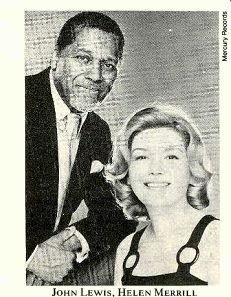
---JOHN LEWIS, HELEN MERRILL
With Merrill And Lewis the Rapport Is Just Fine
IT took a long time for old friends Helen Mer rill and John Lewis to get together in a re cording studio, but their new Mercury album was well worth waiting for. Merrill and Lewis are alone together on all but three of the selections, and whether they're alone or with the excellent trio of Hubert Laws, Richard Davis, and Connie Kay, their rapport is just fine.
Hearing Merrill's voice rise and fall effortlessly in unison with Laws' flute on Lewis' The Singer (originally titled La Cantatrice) and Django is pure joy after one's ears have been assaulted by the likes of Flora Purim and Ursula Dudziak. Django, a hauntingly beautiful tribute to the late Belgian guitarist Django Reinhardt, opens this wonderful album with a sound that is very reminiscent of a passage in Villa-Lobos' Bachianas Brasilieras No. 5, but is also a throwback to some of Ellington's early scores for soprano voice and clarinet. The relaxed, ethereal mood that prevails through out this Merrill-Lewis encounter is set by Django, and if you are as taken by what follows it as I was, you'll have your stylus right back at the start of the first groove before the last dulcet note of Noel Coward's Mad About the Boy has dissolved from your tranquilized mind. Encore!
-Chris Albertson
HELEN MERRILL/JOHN LEWIS. Helen Merrill (vocals); John Lewis (piano); Hubert Laws (flute); Richard Davis (bass); Connie Kay (drums). Django; I Didn't Know What Time It Was; Angel Eyes; Close Your Eyes; Alone Together; Yesterdays; The Singer; How Long Has This Been Going On?; Mad About the Boy. MERCURY SRM-1-1150 $6.98, MC-8-1-1150 $7.95, MCR-4-1-1150 $7.95.
LOUIS VAN DYKE: 'Round Midnight. Louis van Dyke (piano); bass and drum accompaniment. Django; The Entertainer; Valse; Sweet Georgie Fame; and six others. COLUMBIA M-34511 $6.98.
Performance: Cocktail time in Amsterdam
Recording: Good
Reading Peter Venudor's notes to this album made me suspect a put-on, another attempt by Columbia's Masterworks department to break into the pop field. After all, calling Louis van Dyke "the most brilliant of the current generation of Dutch piano players" is just about equivalent to calling me "the most gifted jazz writer born in Iceland." I don't recall that encomium doing anything for my ego, and Holland hasn't exactly been a breeding ground for jazz pianists. The line that really got me, however, was the one boasting that Mr. Van Dyke had been "invited to accompany such great vocalists [my italics] as the Anita Kerr Singers, Salena Jones, and Coretta King." Now I simply had to hear this record. Was it actually a humorous aside by Horowitz? Was it Andre Watts baring his roots? Did it mark the return of Jonathan Edwards? Well, any of the above would have been preferable to what I heard when I played "'Round Midnight." I guess there really is a Louis van Dyke, a capable technician who plays pretty but without verve and-for someone billed as " Europe's foremost jazz pianist"-with a surprising lack of feeling. What next, Masterworks? "Coret ta King's Greatest Hits"?
- C.A.
LEE WILEY: On the Air. Lee Wiley (vocals); instrumental accompaniment. You Came to My Rescue; Three Little Words; You Turned the Tables on Me; Here's Love in Your Eyes; The South in My Soul; I'm Comin' Virginia; A Thousand Good Nights; and seven others. TOTEM 1021 $6.98 (from Kiner Distribution Co., P.O. Box 742, Redmond, Wash. 98052).
Performance: Excellent
Recording: Variable reprocessing
Lee Wiley was a precocious, gifted, and very womanly balladeer who never quite made it to the top in the Thirties and Forties but was well regarded by jazz musicians for her phrasing, feeling, and impeccable timing. She could take a lyric line and extend it to the utmost limits imposed on it by a given tune, then snap it back on the beat like a rubber band. She was a "discovery" of bandleader Paul White man, who had also "discovered" Mildred Bailey.
Though Wiley's career did not take fire the way it might have, she always kept the respect of musicians and knowledgeable fans.
Her recording dates after the Thirties were sporadic, mostly as a guest artist or as the star on semi-private and limited-edition sessions.
She died in 1975, a minor legend whose performances remain highly prized.
The recordings in this archive set are taken from radio-broadcast air-checks between 1932 and 1936, some made with the Whiteman orchestra and some with Rudy Vallee's band.
Many of them were made when Wiley had not yet reached twenty. Her vocals are canny, fluid, and tempting; her voice, style, and in tent are not those of the radio vamp singer, but of a "nice" girl who would do anything for her man. The tunes and lyrics, of course, are from an era of American songwriting that has never been equaled for sentimentality, sophisticated bathos, and pure emotional tug. I recommend the singer and the songs. J.V.
------------
========
SLEEPING BEAUTIES OF R-&-B---Did you get to the party too late to hear some of the good stuff?
by VINCE A LETTI
MOST people are spared the knowledge of exactly how many records are released each week, but those of us who have to carry all of them home from the post office know that it is a staggering .
figure. Happily, a certain number of them prove to be quite listenable, even memorable. Somewhat fewer about one in twenty-five, I'd say actually last through the week and be come favorites. But what may seem a small percentage to a reviewer is probably more records than most consumers buy or even hear about in Sleeping beauties of RG.b Awakened by Vince Aletti a year, and many of these favorites, often some of the very best records issued each year, simply slide unnoticed into vinyl limbo.
One of the discouraging things about organizing this bevy of sleeping beauties was the discovery that many of the rhythm-and-blues records I'd hoped to rescue from obscurity were already cut-outs, dropped from their record companies' active catalogs after a year or two of disappointing sales or lost through the demise of an entire label. There are a lot of them still out there, though, still in print and still available, and I've chosen six of these. My own taste tends toward invigorating disco styles, Philadelphia sophistication, emotional voices and emotional lyrics, but the selection be low is a mixed bag containing some thing for everyone.
Facts of Life is a two-man, one-woman trio whose first album, "Sometimes" (released earlier this year on Kayvette 802), falls into that down-to-basics, soap-operatic area where rhythm-and-blues and country and-western overlap. Produced by Millie Jackson, queen of lowdown soul, the album is at its best when dealing with Jackson's own favorite subjects: adultery and "gettin' it on." Caught in the Act is a minor classic in this genre--a short, deftly dramatic dialogue over a quietly understated rhythm track that begins like this:
"Get dressed, baby, I'm afraid we're caught./Your husband is here-some body musta tipped him off." The woman gives the situation a nice, nasty bite when she announces her only regret is the timing of the interruption: "We were in the midst of heaven," she swoons, "When hell broke in on us." The music through out is serviceable, occasionally catchy, but not very ambitious, so it's the vocals-robust and gritty-and the unabashed directness of the songs themselves that make the album an especially enjoyable example of the Southern r-&-b tradition.
Dee Dee Sharp, of course, is the girl who made Mashed Potato Time in 1962, followed it up almost immediately with Gravy, and then disappeared from the radio and the record-hop circuit as abruptly as she'd arrived. While out of the public eye, however, she married producer Kenny Gamble, half of the brilliant, trend-setting Gamble and Huff team.
They brought her back in 1975 on one of the most satisfying albums to come out of Philadelphia that year, "Happy 'Bout the Whole Thing" (Philadelphia International PZ-33839, C) PZA 33839). Here, Sharp replaces the hard-edged cuteness of her singles with a smooth Philadelphia soul sophistication, though producer Bobby Martin never allows it to smother the real delight and sass in her voice.
The material is strong and widely varied:
10cc's I'm Not in Love sends Sharp zigzagging across her emotional range, from whispering to shouting and back again; Love Buddies is a casually sexy testament to modern romance; and both Share My Love and the title track, Happy 'Bout the Whole Thing, are energetic dance numbers that Dee Dee romps through in high spirits. This is one of the best comeback albums in recent years.
Perhaps the most immediately striking thing about Carl Carlton is the similarity of his sharp, young-boy voice to that of Stevie Wonder in his early years: both have the same cut ting, raw-honey quality, almost shrill around the edges yet bursting with sweetness. Carlton's last album, "I Wanna Be with You" (ABC D-910, 8022-910H, 5022-910H), released at the end of 1975, was also his best, primarily because it brought him together with Bunny Sigler, Philadelphia's most eccentric, unpredictable, and entertaining producer. Sigler, who also wrote most of the songs here, provides Carlton with a collection of bright, upbeat tracks that the singer makes the very most of, strut ting his stuff with breathy exuberance. Though the material is uneven and Sigler's quirky arrangements are occasionally difficult to dance through, for the most part this is a match made in heaven. Carlton has the perfect adolescent tone and attitude to get away with a song called Spend the Night ("So I can make love to you") and such lyrics as "Take Liz Taylor, Vonetta McGee/My baby looks so much better to me."
Vernon Burch is another singer who might easily be confused with Stevie Wonder. Not only does he sound like Wonder at his peak, he is also capable of writing songs of Won der quality. Burch's "I'll Be Your Sunshine" (United Artists LA342-G), one of the strongest debut albums by a black performer in 1975, is com posed entirely of original material that he produced and arranged along with veteran pop producers Tom Wilson, Spencer Proffer, and Denny Diante. Clearly, there's a debt to Ste vie here-most noticeably on Loving You Gets Better with Time, the lovely, gently pulsing song that opens up the album-but Burch is no imitator; he's taken Wonder's inspiration and translated it into his own style. The bulk of the album is given over to high-powered dance cuts in a chunky rock-and-soul mixture that's a refreshing departure from the prevailing disco sound. But the slower songs have enough strength and vitality to keep them from being overwhelmed or reduced to mere filler status.
Another impressive 1975 debut was Angelo Bond's "Bondage" (ABC D-889), an album that deserves comparison with some of Smokey Robinson's best solo work. Like Robinson, Bond is a singer-songwriter from Detroit with a plaintive, achingly sweet voice and the wit and precision of a short-story writer. He man ages to deal with the most sentimental themes without turning to cliché or mush, and even the flaws are covered up by the emotional sureness and purity he brings to them. Reach for the Moan is a short sketch about a poor family that draws strength from the mother's words: "Reach for the moon, you may land among the stars/ But you're gonna make it, I know that you are." In He Gained the World (But Lost His Soul), Bond sums up the life and death of a gospel singer turned rock star in three verses of quick, brilliant detail. Elsewhere, he sings about loving two women and losing both (Man Can't Serve Two Masters), about temptation (Eve), about neglect (I Never Sang for My Baby), and, with touching affection, about his gambling, womanizing father (What's So Bad About Feeling Good?). This richly rewarding, beautifully crafted album should not be overlooked.
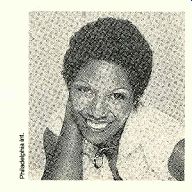
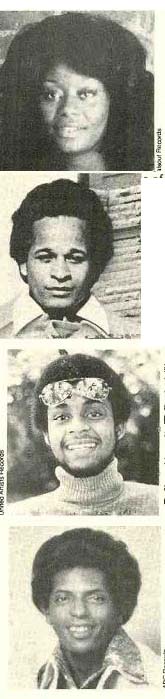
Loleatta Holloway is a big woman with an even bigger voice. Her roots are in belting Southern r-&-b and gospel, and she sings with a magnificent, unrestrained fervor rarely heard these days outside of black churches. Her finest album, "Loleatta" (Gold Mind GZS 7500), came out at the beginning of this year; it hit hard and fast with the disco crowd but slipped by nearly everyone else. There's no reason, though, why this should remain a cult record. Under the direction of Nor man Harris, another Philadelphia master, Holloway shouts and sizzles her way through a collection of love songs that put even Aretha Franklin's to shame. The disco cuts, especially Hit and Run and Dreamin' (which ends in a terrific gospel rave-up), are frantic and fierce, set in dense, swirling arrangements that are among the sharpest the genre has to offer. The ballads, particularly Worn Out Bro ken Heart, are almost painfully emotional. Both ends of the spectrum are treated with equal drama, and whether Holloway is singing or just talking to you, she's utterly riveting. This is surely one of the hottest female vocal albums this year.
------------
=========
ADs:
To find out how much better our cartridge sounds, play their demonstration record! There are some very good test and demonstration records avail able. Some are designed to show off the capabilities of better-than-average cartridges ... and reveal the weaknesses of inferior models.
We love them all.
Because the tougher the record, the better our Dual Magnet cartridges perform. Bring on the most stringent test record you can find. Or a demanding direct-to-disc recording if you will. Choose the Audio-Technica cartridge that meets your cost and performance objectives. Then listen.
Find out for yourself that when it comes to a duel between our cartridge and theirs ... we're ready.
Even when they choose the weapons! What you'll hear is the best kind of proof that our Dual Magnet design and uncompromising craftsmanship is one of the most attractive values in high fidelity.
For their records ... and yours!.
INNOVATION-PRECISION – INTEGRITY----- AUDIO-TECHNICA U.S., INC. Dept. 87F, 33 Shiawassee Avenue, Fairlawn, Ohio 44313, USA. In Canada. Superior Electronics, Inc.
========
Inspecting a metal mother in the Plating Department.
The importance of precision in quality control and accurate playback for analysis of sound, are the reasons MCA states... "Stanton is totally reliable, we depend on it".
MCA (Music Corporation of America) is one of the truly big ones in record production. Quality control in every aspect of their manufacturing, planing and printing is of crucial importance. That is why they use Stanton's Calibrated 681 Series, both in their quality control operation and in their playback for analysis of audio quality.
They even go so far as to "use the needle to test the Mother (Nickel) ... and it stands the wear".
Throughout the recording industry, both the large and the small depend on Stanton for every aspect of the record-producing operation. Each of the 681 Calibration Series is guaranteed to meet its specifications within exacting limits and the most meaningful warranty possible . . . individual calibration test results comes packed with each unit.
Whether your usage involves recording, broadcast, or home entertainment, your choice should be the choice of the professionals ... the Stanton 681.
For further information write to: Stanton Magnetics, Terminal Drive, Plainview, N. Y. 11803. USA.
1977 STANTON MAGNETICS.
========
Also see:
THE AUDIBILITY OF DISTORTION IN LOUDSPEAKERS--Surprising results when you test with music instead of sine waves, PETER FRYER [Aug. 1977]