THE
AUDIBILITY OF DISTORTION IN LOUDSPEAKERS--Surprising results
when you test with music instead of sine waves, PETER FRYER [Aug. 1977]
.
The Audibility of: Intermodulation; Delayed Resonance; and Doppler Distortion in Loudspeakers
By Peter Fryer
IN some quarters of the audio world it has long been taken as gospel that small fractions of a percent of a given kind of distortion can make an otherwise good loudspeaker unacceptable to critical listeners. It is further alleged that esoteric technical measurements employing sine-wave or white-noise signals that are flat to several mega hertz are capable of demonstrating this.
It has always seemed to me and my fellow researchers, however, that such demonstrations missed the point entirely, that the whole question of the audibility or inaudibility of these minute distortions really comes down to this:
How much distortion can the human ear detect on the kind of signals loud speakers are designed to reproduce? For the vast majority of people that means music, whether classical or popular, and not sine or square waves. And it also means listening rather than watching the oscilloscope of a spectrum analyzer.
Since there have been some suggestions that intermodulation distortion is one of the worst culprits in respect to making speakers-and other components-sound nasty (and most speakers are supposed to produce at least some of it) the engineering staff at the Wharfedale Works of Rank HI FI in England decided to tackle it first in an effort to determine its subjective rather than its theoretical audibility.
Intermodulation distortion (IM) is caused by nonlinearities in the reproduction chain, and it consists of new "unmusical" frequencies added to two or more input signals at some point during the process of reproduction. These IM products are "unmusical" because they are not harmonically related to the tones present in the original signal; therefore, they must sound bad. Presumably you can expect to be able to hear very tiny amounts of IM-unlike the case with "harmonic" distortions (HD), which often merely amount to more of what the musical instruments produce anyway. In brief, HD can be said to change the tonal coloration of the music, while IM changes content.
How could we find out how much can actually be heard of the various distortions? Well, we decided independently to use an approach very similar to that described by Robert Carver for his investigations on crossover distortion (STEREO REVIEW, May 1973). It involves generating electronically "pure" distortion (the very concept of "pure distortion" is somehow fascinating!) and adding known amounts of it to a loudspeaker which is either normally free of it or is being used in such a way that it generates very little of it.
Intermodulation Carver described how an amplifier was set up to produce known amounts of crossover distortion at the turn of a switch. But what can you do to a loud speaker that will cause it to produce specific amounts of intermodulation, Doppler, or other desired "test" distortions without having it simultaneously produce a variety of other extraneous distortions which would cloud the issue? In the case of IM, a device known as a balanced modulator can be used to give pure "first-order" components of intermodulation distortion (these being frequencies that are the mathematical sum and difference of the high and low frequencies in the music signal). When building this device we made sure that it could provide IM outputs down to less than 0.1 percent since we tended to support the generally held view that even very minute amounts of this kind of distortion would be disturbingly audible. however, when we reached our preliminary test stages we thought our carefully built apparatus had gone wrong be cause even at its output of 1 or 2 percent none of us could hear any difference when the distortion was added to the music. The device had to be redesigned to give up to 10 percent measurable distortion and 100 percent total for demonstration purposes-quite a surprise to all parties concerned.
"We found pronounced differences in distortion-detecting ability between the different classes of listeners." 1 After several false starts and design modifications of our testing equipment, the listening tests commenced in ear nest using several different types of music and different "classes" of listeners. The first thing we noticed was just how awful intermodulation distortion sounded. In fact, it did not sound much like a loudspeaker fault at all. Rather it sounded like a mistracking phono cartridge or a very small transistor radio straining to be heard (I must be one of the very few audio engineers who has actually been paid to make a perfectly good loudspeaker sound like a transistor radio). The second thing we noticed was that with most kinds of music it took about 5 to 6 percent distortion to be detectable, but piano music was more revealing. For example, with Liszt's Piano Concerto No. 4, 2 percent distortion was clearly audible. The situation changed radically when two pure tones were used; 0.1 percent could then be heard when the conditions were right.
We found pronounced differences in distortion-detection ability between the different classes of listeners. Skilled listeners such as audio engineers and people who listened critically to a lot of classical music were able to detect as little as one-fifth as much distortion as those who listened only to pop music or were not in the audio business. It also seemed (admittedly on the basis of a very small sample) that women were less able to detect IM distortion than men-a result perhaps best left without comment.
Delayed Resonance Since at normal listening levels less than 1 percent IM is produced by most loudspeakers, we felt safe in assuming that IM is not an intolerable or even audible problem under most circum stances. It therefore seemed best to concentrate our efforts on those distortions we can actually hear in loud speakers-but, once again, which are they? Well, one distortion was uncovered a very long time ago by D.E.L.
Shorter at the BBC; he called it "delayed resonance." Despite the fact that manufacturers seldom if ever mention the delayed-resonance phenomenon, it is one of the distortions one can actually hear, mainly because most speakers produce lots of it. The cause of this distortion can best be described as "the speaker carrying on broadcasting long after the program has finished," and it results when parts of the cone assembly store energy and continue to re lease it after the music ceases. Figure 1 (next page) illustrates the effect.
It is possible to measure this type of distortion in a number of ways, one of which employs a computer. The measurement gives a number of curves showing how much the speaker continues to radiate, at various frequencies, so many milliseconds after the input signal has been switched off, and these curves often reveal peaks and dips which do not show up on normal steady-state (sine-wave) frequency-response curves. Figure 2 shows a typical spectrum of delayed energy after an interval of 1 millisecond.
Having charted the peaks and dips resulting from this delayed-resonance phenomenon, we nevertheless (as with ...
---------------
DISTORTION in LOUDSPEAKERS
...the threshold of audibility lies somewhere between 2 and 6 percent in program music, though the test signals that reveal distortion best permit as little as 0.1 percent to be detected."
--------------------------
...other measured distortions) had no idea how audible they were. To find out, a second distortion simulator was built to introduce measured amounts of the equivalent of these delayed resonances into a loudspeaker that was free of them. Once again we had some preconceived ideas we "knew" were right be fore we had actually done the experiments. In this case we supposed that resonances which were sharp and high (and would therefore "ring" or oscillate for the longest period of time) would be the most easily heard and the most objectionable.
Once again our ideas proved wrong in practice. Tests were run to relate the audibility of resonances of different Q value (Q indicates the sharpness and width of a resonant peak) against a background of wide-band noise, classical orchestral music, and "pop." It seems that since they cover a large portion of the audio spectrum, the low-Q (broader and flatter) resonances are excited for a greater proportion of the time, whereas sharper resonances are very rarely triggered by program music. However, when the peak is very broad and low (a Q value of less than 1), the audible effect is simply an increase in loudness over a portion of the frequency range, and this can be audibly compensated for--with some success--by an equalizer. Such low-Q peaks are, in any case, less objection able than those resonances having Q's between 1 and 5.
As with other kinds of distortion, there is a test signal that most easily shows up delayed resonance. Just as a two-tone test signal is most effective for IM and a single pure tone for cross over distortion, delayed resonance is best shown up by white or pink noise.
With its own test signal, this kind of distortion can be heard up to an order of magnitude more easily than with a musical program. Taking a few random results, peaks having a Q of 25 at 1,000 Hz have to be about 4 dB above the normal response curve before they can be heard in pop music, whereas peaks having a Q of 1 can still be heard when they are 12 dB below response-curve level. With white noise, this figure would be closer to 25 dB below response-curve level. Classical music gives rise to figures just above midway between these two extremes.
Doppler
The next kind of distortion we decided to look (listen?) into is a real hot potato. Some experts say that it is totally irrelevant and never audible, while others maintain that it is very important in deed and that even minute amounts of it completely destroy the musical experience. Clearly, it appears to be largely a matter of opinion. The distortion I refer to is caused by the Doppler effect.
Doppler distortion occurs as follows: consider a single speaker cone reproducing two frequencies at once--100 and 10,000 Hz, for example. During each half-cycle of the 100-Hz signal the same speaker reproduces 50 cycles of the 10,000-Hz signal. The cone has a relatively large excursion at 100 Hz and a far smaller one at 10,000 Hz. The net result is that the listener is hearing a cone producing 10,000 Hz that is also alternately moving toward and away from him at a rate of 100 times a second. Thus (if you recall the Doppler effect from high-school physics) the first 50 cycles of the 10,000-Hz tone are "compressed" by the advancing cone and the frequency is increased; the next 50 cycles of 10,000 Hz are stretched out (and the frequency de creased) as the speaker cone retreats.
---------------
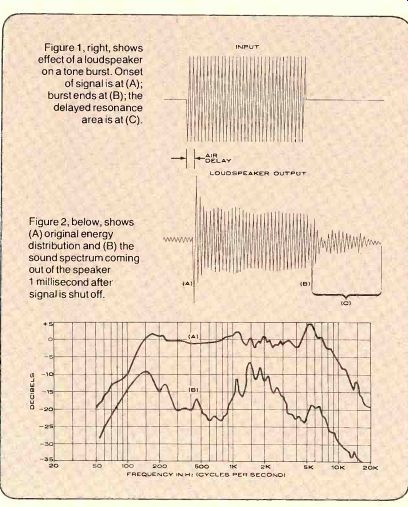
Figure 1, right, shows effect of a loudspeaker on a tone burst. Onset of signal is at (A); burst ends at (B); the delayed resonance area is at (C).
Figure 2, below, shows (A) original energy distribution and (B) the sound spectrum coming out of the speaker 1 millisecond after signal is shut off.
--------------------------
There is no question that speakers do produce this distortion, and the smaller the driver involved and the wider the frequency range that it must cover, the more of this distortion occurs. however, the real question again is the sensitivity of the human ear to Doppler effects in loudspeakers reproducing music. It was with great interest that we set about building a device to simulate Doppler distortion. We found we could simulate Doppler effects by using an electronic delay line whose delay could be varied at a rate determined by a low-frequency signal. This electronically variable delay can simulate the effect of low-frequency cone excursion on a simultaneous high-frequency signal. With the particular instrument we designed, we were able to simulate a total voice-coil/cone movement of 150 mm (±75 mm), or almost 3 inches! So, with open minds, and not knowing which of the two camps of opinion was more nearly correct, we fed some music containing very low organ notes (Camille Saint-Saens' Third Symphony) through the simulator into a four way speaker which inherently had very little of this distortion. Our Doppler-effect device made the music sound as though it were being produced by a smaller and smaller single-cone, full-range loudspeaker. The first thing we noticed was that most of the time, even with the simulator on full, there was not enough low-frequency energy in the music signal to produce any audible effect. But when the low organ notes came on and modulated the higher frequencies present in the music, we found that the small amounts of Doppler distortion generated were not particularly unpleasant and their detectability was perhaps half of that for inter-modulation distortion.
Figure 3. Graph of some of the sideband frequencies produced by the Doppler effect. The two test frequencies are f1 and f2. These will result in the generation of spurious frequencies at 2f1, at f2-2f1, at f2 at f2 at f2 1-2f1, and at 2f2. Other less significant interactions are not shown.
WHEN it comes to expressing this distortion as a precise percentage, we run into several problems. We can either express it as a percentage of frequency shift (in which case the percentage will be constant whatever the upper frequency being shifted around), or we can express the amplitude of the extra frequency components (which appear as a result of the Doppler action) as a percentage of the upper frequencies' "un-shifted" amplitude (Figure 3 shows the "extra" frequencies or sidebands produced as a result of the Doppler effect). In this latter case the percentage increases as we increase the upper frequency; for example, if we are feeding our 100-Hz and 10,000-Hz signals to the speaker, the 10-kHz signal would result in twice as much distortion as a 5-kHz signal would.
This dependence on the upper frequency used makes giving percentages of Doppler distortion in music difficult, though of course the percentage of frequency shift is unaffected. It turned out that our first design for a Doppler-simulating machine was fine for pure tones (the specific test signal for this kind of distortion), when it showed that about 0.2 percent of upper-frequency (4,000 Hz) amplitude distortion was detectable-corresponding to 0.015 percent of frequency shift. But it could be used on music only when the music consisted mostly of two relatively pure tones-such as a track from Mike Oldfield's "Tubular Bells." In such a case, it showed that about 5 to 6 percent distortion of the upper frequency was audible. To obtain an absolute value of the amplitude distortion, another delay line was used to cancel out the "carrier" (or non-shifted upper frequencies), leaving only the new frequencies created by the Doppler effect. These could then be measured as a percentage of all frequencies and would give us an absolute value. Fortunately, in the case of "Tubular Bells," this figure turned out to be about the same as that calculated by assuming the music consisted of only two frequencies. As for other pro gram material, organ music had a detection level at 9 percent, and distortion of 8 percent and below remained undetectable on a pop vocal recording.
On the basis of our research, we are prepared to state that, with the possible exception of small full-range units, loudspeaker systems used under domestic listening conditions will never produce enough Doppler distortion to be audible on conventional program material.
There are still a number of other distortions that can be studied through this line of approach; indeed, even after we had reduced "delayed-resonance" distortion to below audible levels we could still hear phenomena that we would judge worthy of investigation. We have already begun to probe into cavity and reflection effects in loudspeakers. There are also diffraction effects, simple harmonic distortion, and other orders of intermodulation distortion worth investigating.
These last two, oddly enough, are quite difficult to generate in pure form.
is clear that for those distortions that actually produce "extra" tones (intermodulation, Doppler, crossover, and, I suspect, harmonic), the thresh old of audibility lies somewhere between 2 and 6 percent in program music, though the test signals that reveal them best permit as little as 0.1 percent to be detected. Those distortions that modify the response in some way, such as delayed resonance and box reflections, are far less disturbing in that the threshold of detection with music is about 13 to 15 percent. When special test signals are used, the threshold of detection falls to 3 to 5 percent. however, speakers produce more of these latter kinds, and they are the most significant form of distortion investigated so far. All in all, I guess we can count ourselves lucky that the ear al lows music to mask significant amounts of these distortions, for otherwise the job of the loudspeaker designer would obviously be much more difficult than it already is!
--Dr. Peter Fryer devises new speaker measurements at Rank HI FI England. He assesses distortions and studies speakers with holography and delayed-gating techniques.
Also see:
THE SPEAKER KIT--There's plenty to do for those who can't resist the urge to do it themselves WILLIAM KANNER
SOME STRAIGHT TALK ON SPEAKER DESIGN--It has to do largely with the art of manipulating trade-offs, GEORGE SIOLES