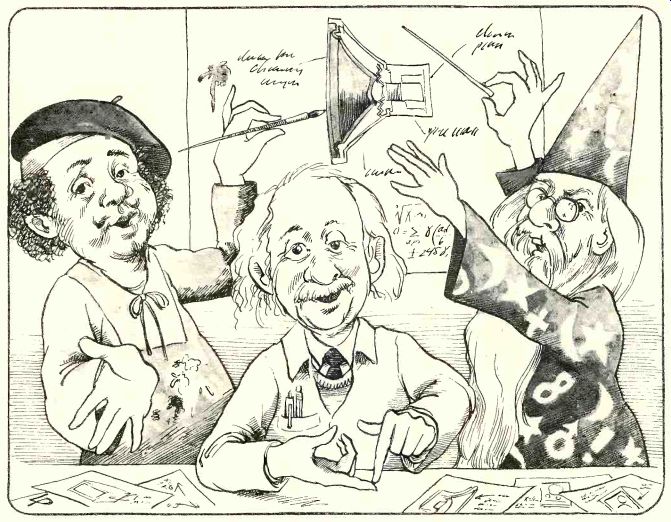
SOME STRAIGHT TALK ON SPEAKER DESIGN--It has to do largely with the art of manipulating trade-off.
Competent designers can get pretty much what they are looking for; their speakers usually sound different simply because they are looking for different things.
By George Sioles
I AM engaged in what some consider to be a rather mysterious occupation, part art, part science, and perhaps just a dash of magic. Granted that it may look that way to outsiders, the fact of the matter is that the work of the speaker designer is neither mysterious nor magical. It is, however, fascinating for those who enjoy wrestling with problems and making design choices involving electronics, acoustics, mechanics, and musical aesthetics.
The first thing that must be said is that no one these days designs a loud speaker system-or any other product, for that matter-in a vacuum. Though a designer can, on the one hand, draw upon the research, the designs, and even the products that have gone be fore, he is hemmed in on the other by considerations involving visual aesthetics, manufacturing costs, and the realities of the marketplace.
Perhaps because the design problem involves so many different elements, it attracts many kinds of problem-solvers. And so there is no such thing as a stereotypical speaker designer. They vary all the way from the eager young enthusiast gifted with a "golden ear" and not much technical training to go with it to the experienced technologist with advanced degrees who knows far more than he actually needs to design an acceptable speaker. The former owes his job to the still-popular belief in the intuitive or "talent" aspect of acoustics. The latter knows that acoustics is not an intuitive field and is there fore suitably wary in his approach to design problems.
Outstanding audio designers have the faculty of creativity coupled with an objectively critical attitude and backed by a broad knowledge of engineering and music. Some confirmation of this is provided by one psychologist's observation that most creative output in pure mathematics takes place by the age of twenty, in physics by the age of thirty, and in product development in the late forties-presumably because years must pass before one ac quires the necessary experience in the various aspects of art, science, and commerce that have to do with product development.
How does a speaker designer go about his business? The first-born de sign is typically an effort to exorcise the creative devil: the designer senses an unrealized need, comes up with a novel solution, and cannot rest easy until he has tested it. For example, faced some years ago with a tweeter that had limited power-handling ability but potentially excellent response characteristics, I realized that I could use numbers of them to achieve both power handling and wider dispersion by mounting them on differently facing planes-initially on the facets of a dodecahedron. This first product was later followed by several others based on the same principle. (The first design of a sequence is frequently the most innovative one; subsequent designs are usually scaled-down variations on the theme.) Speaker designers often go through a progression in their professional development. They become involved first with transducers-say, the design of specific drivers having certain pre scribed characteristics (an example would be a woofer that will produce the required low-frequency response in an enclosure of a given size-a relatively simple and totally analytical problem).
But these are things most designers can handle well enough. To understand the whole reproduction/perception process, to develop a design "philosophy," if you will, a designer must go beyond transducer design to learn about room acoustics and how they influence speaker performance, about psychoacoustics and how sound is perceived by the brain. It is when these (and other) factors are well understood that refinements in design beyond the obvious become possible.
These additional considerations also introduce frustration, of course, for the acoustics of the listening room, al though certainly part of the total design problem, are rarely under the design er's control (low-frequency losses, for example, can be quite variable-low in rooms with plaster, brick, or cinder block wall construction, high in cases where light wallboard is used). Some designers have nonetheless attempted ...
--------------
Which Frequency Response?
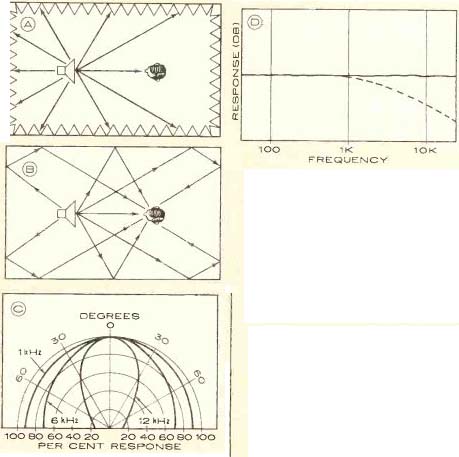
THE frequency-response curve is one of the few pieces of data that, correctly interpreted, can tell you something about how a loud speaker really sounds. But one vital question must be answered first: which frequency response? All speakers have at least two major response curves, and knowing which one you're looking at is vital to the interpretation.
In the totally sound-absorbent (anechoic) room of Figure A-and A also in open air-the sound radiated by the speaker in directions other than toward the listener is completely lost. Thus, when the listener is directly in front of the speaker, only its on-axis frequency response is heard.
This is the curve most often presented in specification sheets. In Figure B, a highly reflective room assures that virtually all the speaker's radiation in every direction will reach the listener, so that what he hears is closer to what is called the loudspeaker's acoustic-power response.
This distinction would not matter if the speaker's on-axis and power responses were identical or at least very similar. They almost never are, however. Figure C shows the output of a hypothetical tweeter as it varies with frequency and direction. At 0 degrees (on axis), the curves for 1, 6, and 12 kHz correspond, suggesting a flat on-axis response. But, at 60 degrees off axis in either direction, the 12-kHz output has decreased to a small fraction (about 20 percent) of the 1-kHz output, which is anything but a flat response. From this example it is apparent that a typical speaker has numerous different frequency responses that will combine in a normally reflective room to give an over all response.
Figure D compares the on-axis response of a system using the tweeter of Figure C (solid line) with the probable power response (dashed line) it would exhibit in a reflective room.
Under normal circumstances, the power response is closer to what the speaker would actually sound like than the on-axis response is-unless one were very close to it.
For better or worse, a typical listening room is neither perfectly absorbent nor perfectly reflective. A speaker designer must therefore give serious consideration to how he will adjust the two frequency responses to best control the sound the listener will actually hear.
---------------------
"...the acoustics of the listening room, although certainly part of the total design problem, are rarely under the designer's control..." ---
...to deal with these problems in different ways. Reflections by the room boundaries (walls or floor) that affect bass response because of interference effects can be dealt with by adjusting the mounting position of the woofer within its cabinet. (It is best to get the woofer as close as possible to the room boundaries so that the interference dip produced by the distance from the boundaries moves up in frequency to the range handled by the mid-range driver which is then spaced further from the boundaries than the woofer, effectively eliminating the output loss.) One can also position the speakers asymmetrically with respect to the room boundaries, thus getting a dip at different frequencies for the two stereo channels.
This helps minimize the net irregularity in response. Ideally, the serious designer would like to be able to specify exactly how his speaker will be installed because the best placement means, simply, the best response.
FOR many of these same reasons, the speaker designer would also like to exercise some control over the recording sessions that produce the records that will be heard through his speakers.
This is but wishful thinking, of course, for not only are the recording sonics well out of the speaker designer's control, they are not even standardized from studio to studio. Some employ a number of microphones "close up," with the performers randomly arranged or recorded at different times, mixing the results appropriately into left and right channels to produce the stereo phonic perspective. Others use crossed, directional microphones at some chosen "optimum" distance to pick up left and right sections of a musical group. Since the frequency balance of the recording is affected by the directional effects of musical instruments and the control-room "balancing" of multiple mike outputs, it is apparent that a working familiarity with them is of great importance when it comes time to make judgments about various speaker-design trade-offs.
All that is largely in the area of theory; what of the nuts-and-bolts questions? To start with a basic one: some companies manufacture one or more of their own drivers, but many others either have them built to specifications or simply modify available units.
"Rolling your own" does not ensure good results any more than buying standard parts suggests poor ones. It has been my good fortune to have lived in both worlds sequentially, and there have been some interesting surprises.
When I first became involved in loudspeaker-system design in the early Fifties, there were very few manufacturers of high-fidelity loudspeaker systems, and all of them made their own drivers.
In the late Fifties there was a sudden proliferation of speaker manufacturers (the list is still swelling), most of them not manufacturing their own drivers. I was more than a little surprised to learn, early in the game, that the mass produced products of the OEM (origin al-equipment manufacturers) people were so good. In fact, it was easy to obtain drivers with whatever specifications one desired, and at favorable prices. And in truth, many of the things that were being done by those who built their own drivers in the early Fifties (and even later) added cost to the product without really improving acoustic performance.
Aside from such cost-adding cosmetics, there was at the time a magnet-structure weight race whose best analogy could perhaps be discovered in the concurrent horsepower race in automobiles. A woofer, for example, was of ten judged solely on the size of its cone and the weight of its magnet; the bigger both were, the better. These days it is generally understood by audiophiles that there is an optimum magnet weight for a given woofer, depending on the size of the enclosure and the effective diameter and mass of the cone. In de signing an acoustic-suspension speaker, for example, one must pay close attention to the "Q" figure-the ratio of reactance to resistance at a resonance frequency. A "Q" of larger than 1 means there will be a peak at the fundamental in-box woofer resonance; a "Q" of 1 means that the bass response will be flat down to the resonance frequency and fall off below it; and a "Q" of less than 1 means that the speaker will start to lose output at frequencies above the resonance frequency.
Obviously, a designer must control the value of "Q" to obtain the desired bass response, and that means control ling the variables that affect it: cone diameter (the larger the cone, the higher the "Q"), magnet weight (the greater the weight, the lower the "Q"), en closure volume (the greater the volume, the lower the "Q"), and the mass of the cone and voice coil (the greater the mass, the lower the "Q").
(As an aside on this matter of speaker measurements, it is interesting that some people still believe a massive cone is inherently incapable of producing the rapid attack of a steep wave-front. This is a beautiful example of how intuition can lead one astray. The frequency components that produce the rapid rise time associated with good transient response are handled not by the woofer, but by the high-frequency drivers. The real or imagined slowness of response of the woofer has no bearing on whether the system as a whole is capable of the proper reproduction of transients.)
SOMEWHAT further along in the design process, the designer will submit detailed woofer specifications (mass, voice-coil characteristics, magnet flux, etc.) to one or more of several manufacturers of drivers, or he may select suitable units from one of their catalogs. Although woofers are assembled, by and large, by the suppliers to the de signers' own specifications, tweeters and mid-ranges are generally stock items. But since the designer has such a wide choice available from U.S. manufacturers (and others in Germany, Holland, Denmark, England, France, and-of course-Japan), there is no shortage of suitable units for a given purpose.
When samples of the specified units arrive, the designer tests them first in an anechoic chamber. Why? Because the detailed behavior of a driver can be investigated most readily without room-boundary reflections that would confuse the data. What he is looking for are undamped resonances, adequacy of power handling, polar response (used to assess the acoustic power radiated vs. frequency, since the frequency response on the principal axis gives only a small part of the total picture), and so on.
(Parenthetically, on the matter of sound dispersion, dome tweeters might seem-intuitively-from the shape of their radiating surfaces to have broader dispersion at high frequencies, and many advertisements suggest that they do. Not so. Whatever its shape, a radiating surface 1 inch in diameter has some "beaming" at very high frequencies. Figure 1 shows a typical set of responses, taken at various angles from the principal axis, that make this clear.) The choice of a cone as against a dome tweeter hinges in general on whether or not the design will use one or several tweeters-and what they will cost. Because of the larger voice coil in the dome type, power-handling capacity is greater than it is in the smaller-coil cone type. But the larger voice coil means that a larger (more expensive) magnet will also be required to attain the same efficiency.
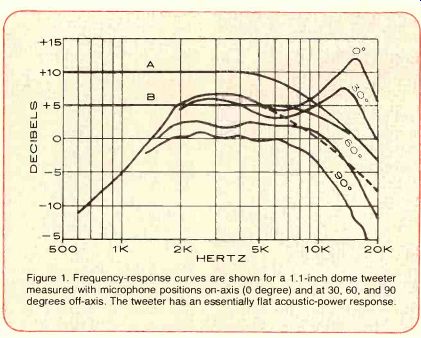
Figure 1. Frequency-response curves are shown for a 1.1-inch dome tweeter measured with microphone positions on-axis (0 degree) and at 30, 60, and 90 degrees off-axis. The tweeter has an essentially flat acoustic-power response.
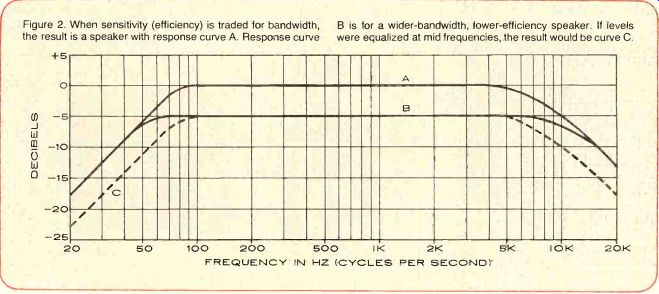
Figure 2. When sensitivity (efficiency) is traded for bandwidth, the result is a speaker with response curve A. Response curve B is for a wider-bandwidth, lower-efficiency speaker. If levels were equalized at mid frequencies, the result would be curve C.
Woofer-cone size is another choice that must be made. The larger the woofer, the greater the acoustic-power output for a given cone excursion. But, all others things being equal, a driver of smaller diameter will provide a lower resonance frequency in an enclosure of fixed volume, and therefore a more extended low-frequency response. And that is what is meant by "trade-offs." Once suitable drivers have been chosen, they are combined in geometrical (acoustic) configurations that (1) conform to the budget and (2) produce the acoustic-power response and dispersion characteristics the designer wants.
---
"the fact that the better speakers are sounding more and more alike should be reason for rejoicing..."
---
It should be obvious that not all designers are pursuing the same goals in every design. Some are looking for very high efficiency, which usually corresponds with very high power-output potential. Others are looking for the very flat acoustic-power response and wide dispersion that characterize "neutral"-sounding speakers, and they are content to let the efficiency fall where it must. Still others prefer enhanced low-frequency or high-frequency output-or both-in the interest of providing impressive thumps or sizzles for those hooked on such sound effects.
Figure 2 shows the form of one type of trade-off that engineers refer to as "gain-bandwidth product." Curve A shows a high level of output (for a given level of input) with roll-off at both the high and low frequencies. Contrast this with Curve B, which depicts a less-efficient speaker with a wider and flatter range (note that at 25 Hz and 20 kHz, speaker B is actually more efficient than its high-efficiency competitor). The point is that all these individual measurements and values affect each other, and everything can not be accomplished in one package. It can therefore be seen that what typifies the speaker-design process more than driver-validation techniques and other (quite necessary) measurements is the decision making, the deliberate choice of just those characteristics the completed speaker is intended to have.
Competent designers can get pretty much what they are looking for; their speakers usually sound different simply because they are looking for different things.
Having selected the drivers and assembled them in a box, the designer can proceed with the crossover net work, which is designed to adjust the frequency-response characteristics of the drivers to protect the high-frequency units from potentially damaging low frequencies. The final curve defining overall performance is actually derived from a larger number of response measurements taken at various points equi distant from the speakers and summed to obtain the speaker's omnidirectional frequency response-which is another way of saying acoustic-power response, the single most important characteristic of speaker performance. Finally, there are listening tests in a "calibrated" listening room to check on the objective measurements. If what we hear doesn't seem "right," we go back to our earlier work, review it carefully, and determine (if we can) what went wrong.
LISTENING tests are carried out in a number of ways. Some companies use statistical methods-a panel of "golden ears" listens to a number of speakers (the one under evaluation plus those considered to be its competitors) concealed behind acoustically transparent but optically opaque screens. A variety of program material is used by the panelists to evaluate the various unseen and unidentified speakers, which are then rated numerically by preference or characterized by such purely subjective descriptives as "natural," "balanced," "open," "hollow," "nasal," etc. Japanese manufacturers (among others) also use such techniques, but their jurors are frequently selected at random rather than being specially chosen for their trained ears.
Some designers like to ear-check speakers using "pink noise." Such a signal played through a flat speaker yields no sense of pitch, and therefore is very revealing of any overemphasis of a part of the frequency range. But this test, like all others, is fraught with peril, for any quasi-absolute ear test of speaker "neutrality" should be done in a listening room whose transmission characteristic is known to be uniform and that means an awfully good room.
Lesser rooms require that speaker locations be interchanged so that any perceived differences are due only to the speaker and not the room. And when "accuracy" is being evaluated, the listening levels of the reference and test speakers must always be kept equal, for it is well known that on an A-B test the louder speaker will almost always be perceived by the listener as the "better" one.
Obviously, all designers do not approach their problems in the same way, and all the work that goes into a design and its evaluation has not been de scribed here. But it should nonetheless be clear that the process is neither mysterious nor magical. Not only are the electro-acoustical laws governing speaker design easily understandable, but they can even be programmed (for woofer/cabinet operation) into a computer for optimization.
THESE days, the products of competent speaker designers, whatever their technical persuasion, tend to sound more alike than different. Those differences that do exist are the result of the trade-offs in "Q" value that are chosen, acoustic-power response, efficiency, octave-to-octave balance, and the like. From the consumer's point of view, the fact that the better speakers are sounding more and more alike should be reason for rejoicing, for it means they are all getting closer to the accurate reproduction of the recorded "reality" even though they are approaching the task from many different directions.
---- George Sioles, president and chief engineer of Design Acoustics, Inc., has worked as an acoustic designer for twenty-five years, occasionally on products other than speakers.
============
ADs
Ohm Acoustics
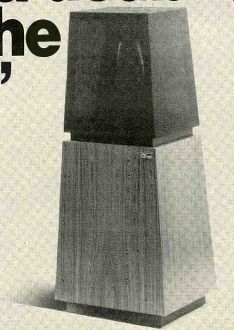
"The Ohm F may well be the finest speaker on the market and is certainly without a doubt among the top few." Reprinted from the 1977 edition of THE COMPLETE BUYER'S GUIDE TO STEREO/HI-FI EQUIPMENT.
If you'd like to find out what hi-fi experts from all around the world have to say about the patented Ohm F coherent sound loudspeaker, please visit your Ohm dealer or write to us at the address below. An informative full-line brochure that explains how the Ohm F works is also available.
Ohm Acoustics Corp. 241 Taaffe Place, Brooklyn, N.Y. 11205. Ohm, Canada Ltd. 9 Oriole Crescent, Toronto, Ontario M5P 1 L6
------------
Now speakers with the brains to make your system perform better.
And the guts to make it sound better.
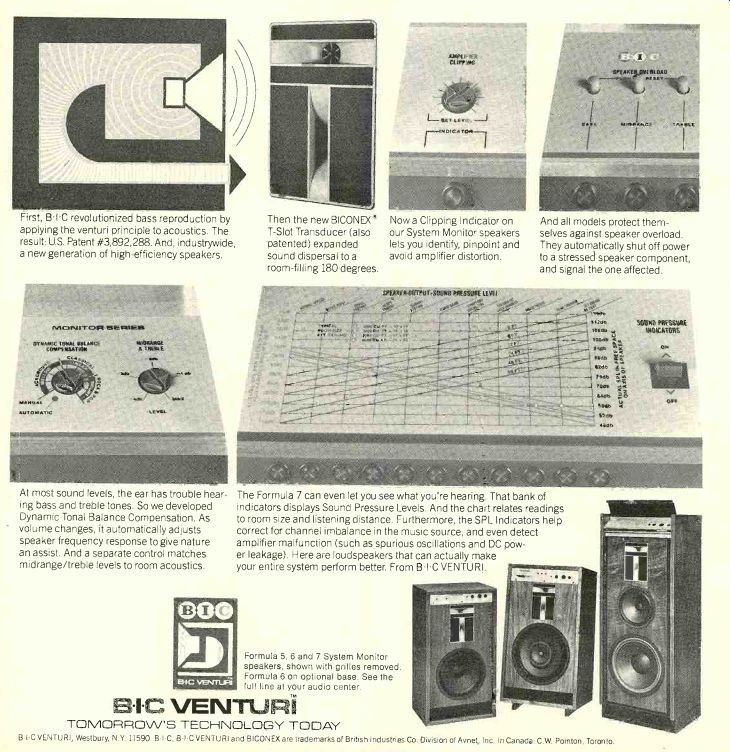
First, BIC revolutionized bass reproduction by applying the venturi principle to acoustics. The result: U.S. Patent #3,892,288. And, industry-wide, a new generation of high-efficiency speakers.
At most sound levels, the ear has trouble hearing bass and treble tones. So we developed Dynamic Tonal Balance Compensation. As volume changes, it automatically adjusts speaker frequency response to give nature an assist. And a separate control matches midrange/treble levels to room acoustics.
Then the new BICONEX T-Slot Transducer (also patented) expanded sound dispersal to a room-filling 180 degrees Now a Clipping Indicator on our System Monitor speakers lets you identify, pinpoint and avoid amplifier distortion.
And all models protect themselves against speaker overload.
They automatically shut off power to a stressed speaker component, and signal the one affected.
The Formula 7 can even let you see what you're hearing_ That bank of indicators displays Sound Pressure Levels. And the chart relates readings to room size and listening distance. Furthermore, the SPL Indicators help correct for channel imbalance in the music source, and even detect amplifier malfunction (such as spurious oscillations and DC power BIC VENTURI.
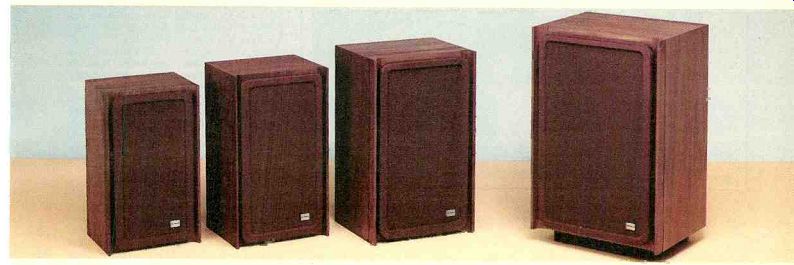
Formula 5, 6 and 7 System Monitor speakers, shown with grilles removed.
Formula 6 on optional base. See the full line at your audio center.
BIC VENTURI TOMORROW'S TECHNOLOGY TODAY -- BIC VENTURI, Westbury, N.Y. 11590. BIC. VENTURI and BICONEX are trademarks of British Industries Co. Division of Avnet, Inc.
----------------
BOSE--A New Direct/Reflecting Speaker of Outstanding Performance, High Efficiency, Moderate Cost, and Exceptional Versatility.
The Model 601 is a totally new, Direct/ Reflecting loudspeaker from Bose.
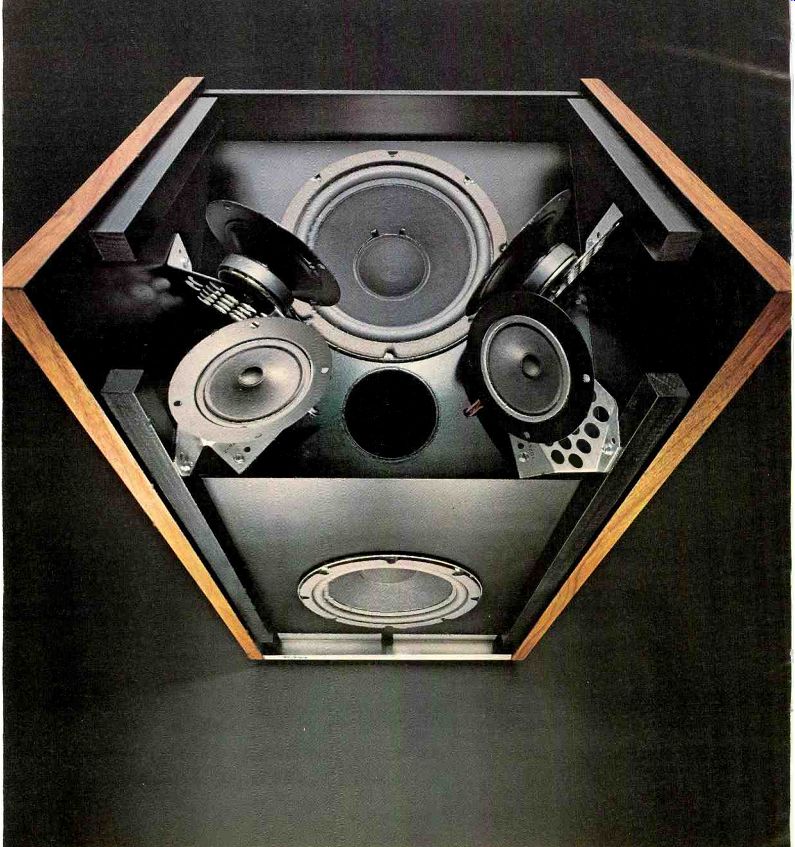
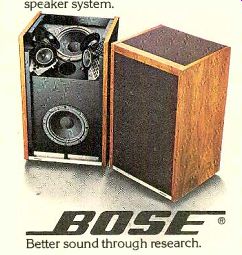
It employs a unique arrangement of six drivers in each enclosure (four tweeters and two woofers) to achieve a level of tonal accuracy and spatial realism comparable only to the world renowned Bose 901 Series III.
The result is an open, spacious sound and a feeling of realism which can not be achieved by conventional speakers with front-mounted drivers beaming directly at the listener. Such conventional designs are aimed almost exclusively at producing accurate frequency response, while largely ignoring the spatial qualities so critical to the impact of a live performance.
In the Model 601, these important spatial qualities are accurately repro
-----------------
This complex pattern of reflected and direct sound is the key to the spatial realism of the Model 601.
These performance qualities, along with high efficiency, moderate cost, and great versatility of speaker placement in practically any listening environment, make the Model 601 a loud speaker of exceptional value.
The Concept Behind Bose Direct/Reflecting Speakers.
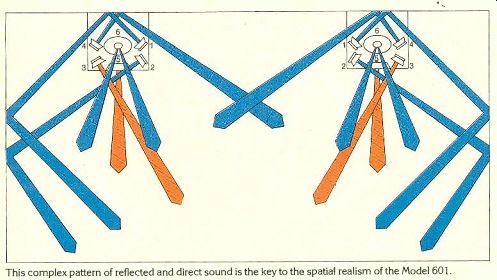
Like the 901 Series III (the most advanced development of Bose design concepts and state-of-the-art manufacturing techniques),the Model 601 is a Direct/Reflecting speaker system. It's designed to reflect the greater part of its sound output off the back and side walls of the room, surrounding the listener with the same kind of balance of reflected and direct sound experienced in a live performance.
--------------
duced through the careful positioning and orientation of all six drivers in each speaker enclosure.
The Tweeters.
Three tweeters in each enclosure (1, 2, and 4) provide reflected sound, creating a feeling of spaciousness, while one tweeter (3) radiates the smaller proportion of direct sound needed for a strong center image and crisp, sharply defined details.
Two of the tweeters are also positioned to radiate sound upward through the acoustically transparent top grille, thus avoiding interference from furniture in the room.
The Woofers.
There are two 8-inch woofers in each Model 601 enclosure, one aimed for ward (5) and one angled upward (6) to contribute an important component of reflected sound. The use of two smaller woofers provides a cone area equal to that of a single much larger driver, while offering important performance benefits at low and middle frequencies.
Each high-output woofer is capable of better dispersion and smoother midrange performance than a larger woofer, while they work together to provide bass response of exceptional power and clarity.
Accuracy of Tonal Balance.
With all four tweeters covering the same upper frequency range and the two woofers covering the same lower range, small response irregularities of individual drivers are averaged and smoothed in a way that can not be duplicated using single drivers.
Efficiency.
The Model 601 is also a highly efficient speaker that can deliver superior reproduction of all kinds of music using an amplifier or receiver having as little as 20 watts of power per channel.
The Proof.
For a detailed description of the concepts and technology that make possible the superior performance of the Model 601, write for a full-color brochure to Bose, Dept. SR8, The Mountain, Framingham, Mass. 01701.
But for the real proof-your listening enjoyment-just visit any authorized dealer and ask him to introduce you to the newest Bose Direct/Reflecting ® speaker system.
BOSE: Better sound through research.
Cabinets are walnut veneer. Patents issued and pending.
----------------------
No artificial ingredients.
We don't pick up a woofer here, a tweeter there, and cram them together in a creaky box.
We make everything from scratch.
The enclosures, the crossovers, the drivers, and even our own paper.
Because if there's anything we hate, it's loudspeakers that editorialize on the music.
So, to keep our sound perfectly real, we control everything to the nth degree. And then some.
Not just the components and the manufacturing.
But also the testing.
We test our speakers by sight.
With laser holography that actually creates a picture of the sound patterns they produce.
We test our speakers by instruments. With anechoic chambers that give our sound waves no place to hide.
We test our speakers by ear. With engineers who, in turn, have their hearing tested every day.
This isn't easy.
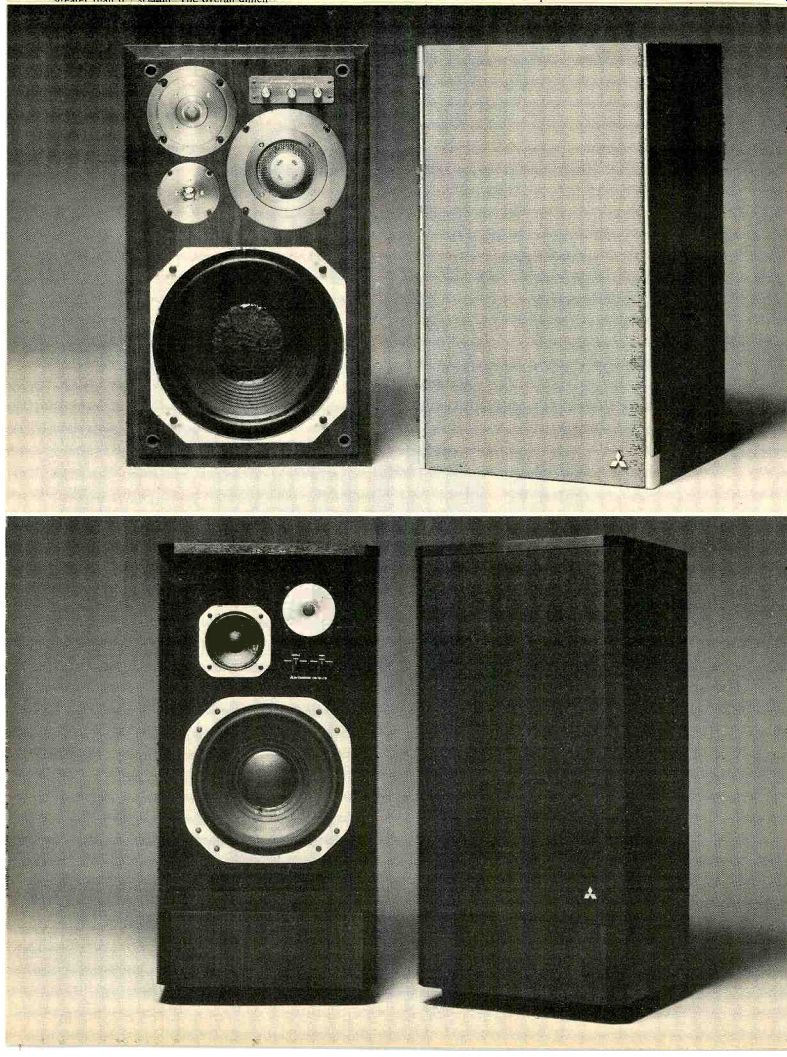
This isn't cheap. But if the result is loudspeakers like those at the left, who's to say it's not worth it? The DS-303 (top left) is a 4-way acoustic air suspension bookshelf system with a frequency response of 30 35,000 Hz. A power-handling capacity of 100 watts. And an acoustic pressure level of 90 dB/W @ 1 meter.
The DS-50CS (lower left) is a 3-way bass-reflex floor-standing system with a frequency response of 25-20,000 Hz. A power-handling capacity of 80 watts. And an output acoustic pressure level of 92 (113/W @ 1 meter.)
Both are so good, they're sold as part of The System. The only one name, one-look, one-warranty, high performance audio system with speakers as good as the amplifier. An amplifier as good as the pre-amp. A pre-amp as good as the turntable.
A turntable as good as the tuner.
A tuner as good as the speakers.
With no weak links anywhere.
So if you're considering a new pair of loudspeakers, we hope you'll spend some time with ours.
Because how many other speakers could go through all that testing? And live to speak about it? MITSUBISHI AUDIO SYSTEMS
For more information write Melco Sales, Inc., Dept. SR, 3030 East Victoria Street, Compton, California 90221.
--------------------
Credentials Like These Are Worth Reading
When you're buying speakers, you want to talk specs. And we don't blame you.
In fact, we encourage it. Because when you invest your good money in a pair of speakers, you want more than just a pretty cabinet.
Consider the new Jensen Spectrums.
These good sounds didn't just happen.
They're the result of extensive engineering efforts and exhaustive testing.
Testing that ranged from exacting measurements in laboratory "live" rooms and anechoic chambers to in-depth consumer surveys.
Examine our Spectrum Model 540.
It's an excellent example of the superb specs you'll find throughout the Jensen Spectrum Series.
The Spectrum 540 is a 3-way, 4 element system that is so efficient it can be driven with as little as 10 watts continuous power. Its maximum power rating is 75 watts continuous.
The woofer is a 127 long-throw, high compliance design. Special acoustic suspension and infinite baffle enclosure give you extremely low distortion. And a high temperature voice coil affords high power handling. Magnet structure weight is a hefty 4 1/2 lbs. with a Gap Flux Density of 10,000 Gauss.
Two 3 1/2" cone midranges give excellent power handling and eliminate break-up in the critical midrange region. Tuned isolation chambers control response at the low end of the midrange spectrum. They also provide acoustical isolation in the cabinet between the midranges and the woofer. An edge damped rim suspension with specially treated molded cone offers sharp, clear, midrange reproduction.
A 1 1/2" Mylar rear damped hemi spherical dome tweeter offers a dispersion of 170 degrees. Its large, lightweight voice coil gives high power handling, yet maintains a low mass for good high frequency reproduction.
Tweeter and midrange controls allow you to adjust your Spectrum System to room conditions and listening preferences; controls are front mounted for convenience, continuously variable, calibrated in db attenuation from a maximum, or flat, response.
FREQUENCY RESPONSE
About as flat as you can get... and that's good. The Frequency Response Range is an admirable 25 to 25,000 Hz.
TONE BURSTS
"Blurring" and "Overshoot" are reduced to a minimum in this acid test of transient response. The Spectrum 540 re produces each waveform accurately with low distortion.
TOTAL HARMONIC DISTORTION MODEL 540
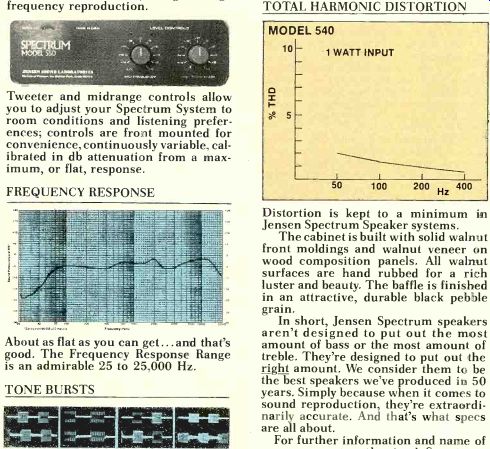
Distortion is kept to a minimum in Jensen Spectrum Speaker systems.
The cabinet is built with solid walnut front moldings and walnut veneer on wood composition panels. All walnut surfaces are hand rubbed for a rich luster and beauty. The baffle is finished in an attractive, durable black pebble grain.
In short, Jensen Spectrum speakers aren't designed to put out the most amount of bass or the most amount of treble. They're designed to put out the right amount. We consider them to be the best speakers we've produced in 50 years. Simply because when it comes to sound reproduction, they're extraordinarily accurate. And that's what specs are all about.
For further information and name of your nearest authorized Spectrum Dealer, write to: Jensen Sound Laboratories, Dept. SR-87 United Parkway, Schiller Park, Illinois 60176.
JENSEN SOUND LABORATORIES
Division of Pemcor. Inc Schiller Park, Illinois 60176
---------------
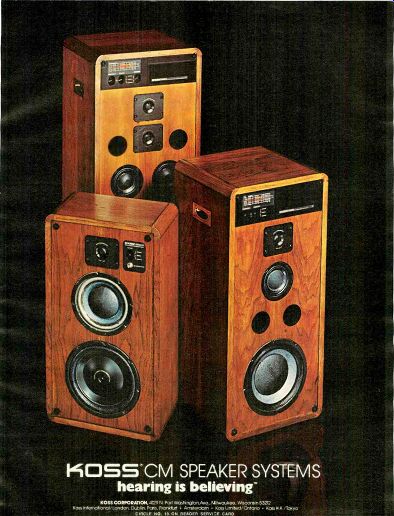
Introducing the Koss Theory of loudspeaker design and the three new Koss CM speaker systems that prove it.
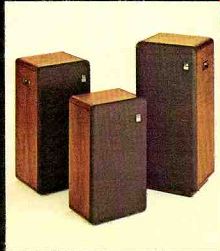
When Koss invented the stereophone, music lovers and audio experts were amazed at the low distortion, broadband frequency response, and high efficiency achieved by the Koss drivers. Indeed, the resultant Sound of Koss created a revolution in the audio industry.
Today, the exciting new Koss Theory of loudspeaker design has created another revolution.
By developing a complex series of audio engineering formulas and by utilizing the precise knowledge of modern computer science, Koss engineers have created a breakthrough in loudspeaker technology of such significance that it heralds the second major revolution in loudspeaker design technology.
For the first time, it's now possible to scientifically derive and produce the optimum system parameters for any loudspeaker.
By computerizing the Koss Theory and by first selecting the number of band passes desired in the system, the system's desired efficiency, the f3, low bass cutoff, and the desired cabinet size; Koss engineers are able to derive specific design parameters for every component in the total system. In fact, the Koss Theory is so sophisticated that even the structural design of the cabinet and the precise positioning of the components in the cabinet for optimum dispersion and phase coherency are specified.
Of course, what's really important is not the Koss Theory itself but the sound of the three new Koss speakers that prove it. Indeed, with current technology, there are no speakers available at similar prices that can match the Koss CM 1010 two bandpass loudspeaker, the Koss CM 1020 three bandpass loudspeaker or the Koss CM 1030 four bandpass loudspeaker in low distortion, high efficiency, and broadband frequency response.
But then, the incredible sound of these three new speakers isn't surprising when you consider some of the revolutionary new features they offer:
Take for example, the CM 1010's unique mass aligned 10-inch passive radiator that enhances the lower 2 octaves of the bass and allows for the use of a specially designed 8-inch woofer to reproduce the critical midrange up to 2.5 kHz. With the alignment mass in place, the CM 1010 reproduces a maximally fiat response from an f3 of 35 Hz on outward. However, by removing the alignment mass, those who prefer more acoustic energy in the 50 to 80 Hz range can create an f3 of 40 Hz and a low bass ripple of 1% dB centering on 60 Hz.
Or take the CM 1020's dual port design that provides an optimal cross sectional port area for proper cabinet tuning. Or the unique parallel midrange design of the CM 1030. By utilizing two 4%-inch drivers operating in parallel, Koss engineers were able to decrease the excursion of each driver thus creating a dramatic decrease in potential driver distortion and an equally exciting increase in the overall brilliance and presence of the midrange response. Then again there's the Koss high bandpass 1-inch dome tweeter and unique acoustic transformer that creates an incredible 6 dB increase in headroom.
And, of course, there's also the patented quasi second-order crossover network that provides a smooth, acoustically invisible transition from bandpass to bandpass.
But those are just some of the revolutionary features offered by the new Koss CM loudspeakers.
Why not prove the Koss Theory of loudspeaker design to yourself by asking your Audio Dealer to give you a full demonstration of the beautiful Sound of Koss. Or write to Fred Forbes, c/o the Koss Corporation, for our free, full color CM loudspeaker brochure. Once you've heard these revolutionary new loudspeakers, we think you'll agree: hearing is believing.
1977 Koss Corp.
---------
Two Bold Statements:
1. Synergistics has engineered the very best loudspeakers for your stereo system...regardless of the price!
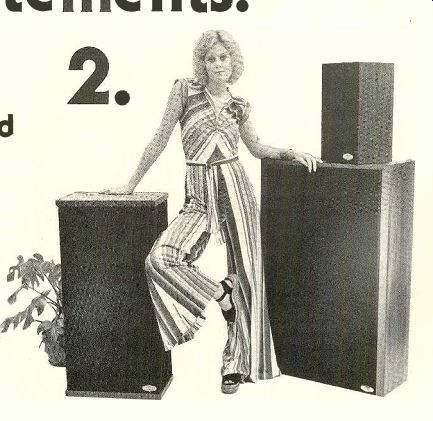
Each Synergistic loudspeaker, from our smallest two-way model S-12 to our six-element, four way model S-72 has been engineered to more perfectly complement the other components in a stereo system. This "synergistic coupling" results in greatly improved total system sound quality. The chart below shows you the Synergistics model we recommend in various total system price ranges. All seven Synergistics models are true "audiophile" loudspeakers capable of reproducing wide dynamic range and musical clarity previously associated only ...
---------
Total System Price Recommended Synergistics Loudspeaker
Under $450 Model S-12A
Under 500 Model S-22A
Under 600 Model S-32A
Under 700 Model S-42A
Under 850 Model S-52A (Tower)
Under 1,100 Model S-62A (Tower)
Under 1,500 Model S-72A (Array)
-----------
...with "monitor-type" speaker systems; yet, all Synergistics models will realize optimum performance when operated with low-to-medium powered receivers and amplifiers.
What does all this mean to you? Simply stated, it means that whether you're spending under $450 or as much as $1,500 for your system, there's a Synergistics loudspeaker specifically designed to enhance the overall sound quality.
SYNERGISTICS: cooperative inter-action in a system where the total effect is greater than the sum of its component parts.
For More Information Write To: Synergistics, P.O. Box 1245, Canoga Park, California 91304.
-------------------
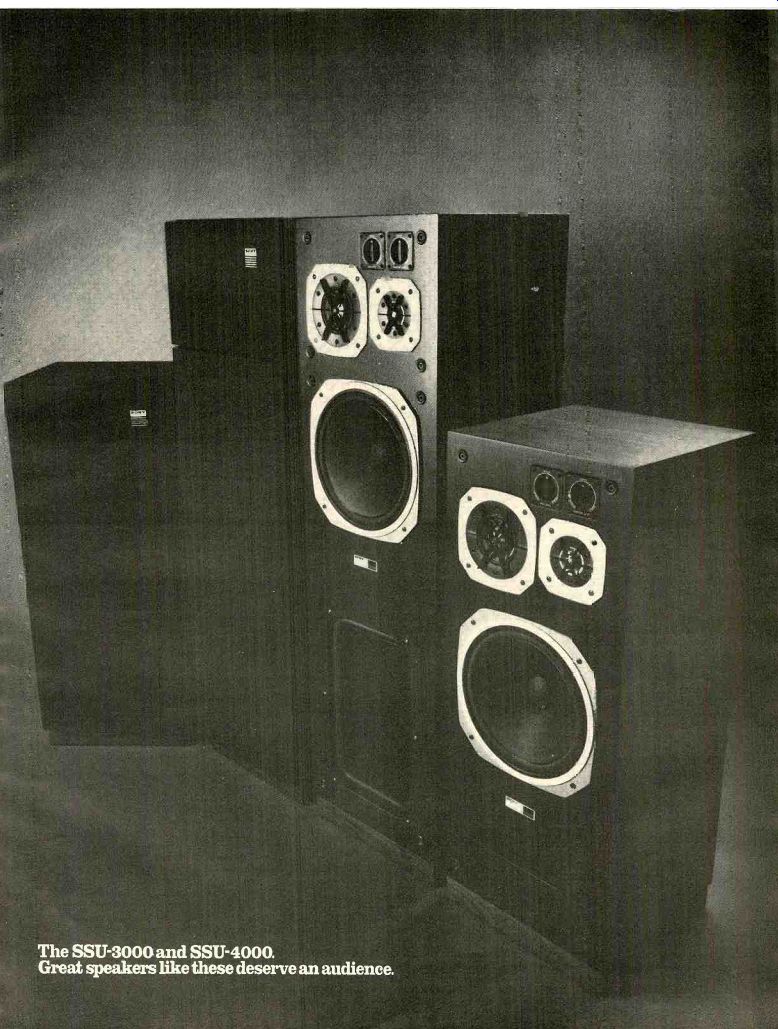
After people learn what we’ve done, no one will heckle our speakers.
We're as close to the impossible as possible.
Our new speakers color sound.
Anybody's speakers do.
Should someone tell you otherwise, they speak with forked frequency response.
We at Sony approached the development of our new speaker line with this grim reality in mind.
Thus our goal was to create speakers with a minimum of coloration. With a frequency response flat and wide. With low distortion. And with repeatability.
Which is critical. Which means that each speaker we turn out will sound like the one before and the one after.
Searching and researching.
Our basic dilemma was that speaker specs don't specify much.
You can build two speakers with identical specs, and find they'll sound non identical.
That's because your sophisticated ear can pick up differences our clumsy measurements can't.
Some examples:
You can hear how pure water is. The purity of the water in which the pulp for the speaker cone is pressed will influence the sound. (Spring water is the best.) But water purity would hardly change the frequency response-or any other measureable characteristic.
Nor would the dye used to color the cone-or the glue used in gluing the cabinet.
But you'd hear the dye and the glue.
And there are dozens and dozens of elements that interact this way.
So our job was mammoth. To correlate these factors in order to reach the goal we outlined earlier. Changing one changes the other and almost changed our minds about going into the speaker business.
But we stuck it out. And found the answer to the juggling of these variables thanks to a major technological innovation.
Trial and error.
That's why we labored for three years to bring you our speakers. While other manufacturers rushed frantically to market with theirs.
We keep the whole world in our hands.
Once we understood how to control the sound of our speakers, we realized we had to control what went into our speakers.
So we did the only logical thing.
We built a plant.
And pursuing that logic, we built it at a place called Kofu. Which is at the base of Mt. Fuji. Where we can get all the spring water we want.
This factory does nothing but produce-under outrageously close control-the components for our speakers.
Whatever we do buy, we specify so carefully that our vendors have night mares about us.. (It's unfortunate that we can't make everything ourselves, but only God can make a tree, and only wood can make a fine cabinet.) Few companies make this effort.
So it's safe to say that when it comes to exercising this kind of control, our speakers are a voice in the dark.
Improvements that are heard and not seen.
As you can see, there's a lot that goes into producing a speaker that's not easily seen. (One beautiful exception-the handsome finish on our cabinets.) That includes the carbon fiber that we mix into the speaker cone paper.
Carbon fiber is light and strong.
(Why they don't use it in girdles we'll never know.) Light, so our speaker is more efficient. Meaning you need less power to operate it. Meaning you are closer to the ideal of converting electrical energy to mechanical energy without a loss of power.
Light, so our speaker cone reacts quickly to stops and starts in the signal. The result: improved transient response.
Strong, to prevent the cone from bending out of shape in the high frequency range.
Moreover, carbon fiber doesn't resonate much. It has what's called a low Q, and it took someone with a high IQ to realize it would absorb the unwanted vibration rather than transmit it down the cone.
We also cut down on unwanted vibration (as opposed to the wanted vibration, which is music), by using a cast aluminum basket rather than a stamped, shoddy cheap metal one.
We could go on, but at this point the best thing would be for you to move on to your nearest Sony dealer. And listen.
Because the results of our three years of labor will be clear after three minutes of listening.
At which point, far from heckling our speakers, you'll be tempted to give them a standing ovation.
1977 Sony Corp. of America. Sony, 9W. 57 St., NY., NY 10019.
SONY is a trademark of Sony Corp. Suggested retail prices: SSU-3000, $300 each; SSU-4000, $400 each.
----------------
EPI speaker systems
AT LAST, EAST MEETS WEST. Traditionally, the audiophile has had to choose between the East Coast Sound and the West Coast Sound, each with its own particular advantages and disadvantages: The East Coast Sound is extremely accurate. The dispersion characteristics of East Coast speakers are, as a rule, excellent. Unfortunately, they usually need a lot of power to perform.
West Coast speakers are noted for their efficiency and volume. Unfortunately, accuracy isn't one of their strong suits.
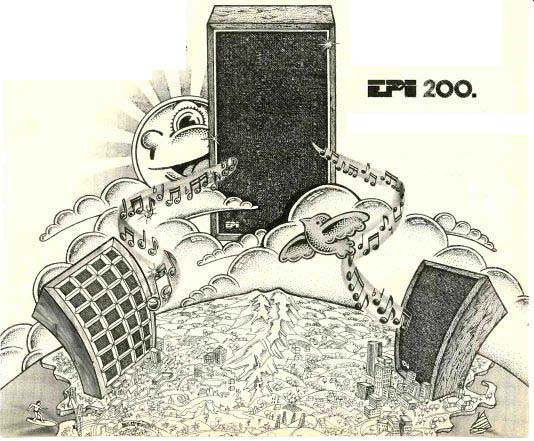
Introducing the EPI 200.
After years of research and development, the engineers at EPI have created a speaker that combines the best qualities of East and West With its 12-inch passive radiator, the EPI 200 has all the efficiency of the most popular West Coast speakers.
A 30-watt receiver powers it with ease.
With that power, the EPI 200 produces the kind of sound EPI is famous for: Linear Sound.
A pure, rich, accurate sound from 20,000 Hz all the way down to 34 Hz And dispersion? In a word, the Model 200's dispersion characteristics are superb. Up to 15,000 Hz, the speaker's off-axis dispersion is down an average of only 3db-a performance even other East Coast speaker makers can only dream about.
At $400, the EPI 200 would be an exceptional value. But at under $300, it is nothing short of phenomenal.
The EPI 200: The best of the East. The best of the West. EPI is a product series of Epicure Products, Inc., Newburyport, Mass. 01950.
EF4 200.
----------------
HPR-12 Magnum by RTR L Efficiency Expert 1 watt drives the system to 92 dB How do you judge an efficient speaker? Audiophiles conclude speaker system efficiency reflects the total output of all components. And that's what makes the new HPR-12 Magnum by RTR a remarkably efficient system.
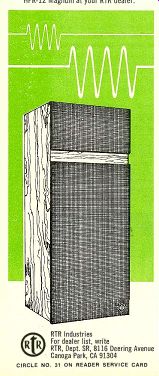
The speaker can handle 100 watts of program material--one watt will drive it to 92dB. That's efficiency! HPR-12 Magnum displays equally impressive linearity performance characteristics. The 12" Helmholtz driven passive radiator combines with an active 12" woofer and 3" voice coil to deliver the power of many ported systems while maintaining a solid bottom end. High frequencies handled by two tweeters and one piezo-electric super tweeter complete the overall balance and smoothness. A rarity in a super efficient speaker.
If efficiency, smoothness and balance are your goals, audition the new HPR-12 Magnum at your RTR dealer.
RTR Industries For dealer list, write RTR, Dept. SR, 8116 Deering Avenue Canoga Park, CA 91304
----------------
At Audioanalyst, stereo imaging is more than a two dimensional matter, Our Phase Matrix speakers pinpoint performers in space with new accuracy.
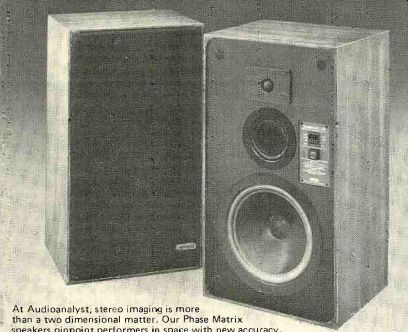
It is as if they were reassembled in their places before you, to the left, the right, even in front of or behind where the speakers actually stand.
The Phase Matrix Group includes four elegant loudspeakers with a family appearance. All offer smooth, extended bass response and a neutral, uncolored midrange. Add to this optimum dispersion characteristics which, in conjunction with our unique Phase Matrix (patent pending), virtually eliminate phase cancellation for exact, three dimensional imaging unsurpassed by speakers costing far more.
The Phase Matrix Group of loudspeakers is available only through a select network of audio specialist retailers, all noted for offering exceptional service to their customers. For the name of the dealer nearest you, please contact us at the address below. Your reply will be given immediate attention.
Audioanalyst, Inc., P.O. Box 262, Brookfield, Conn. 06804.
----------------
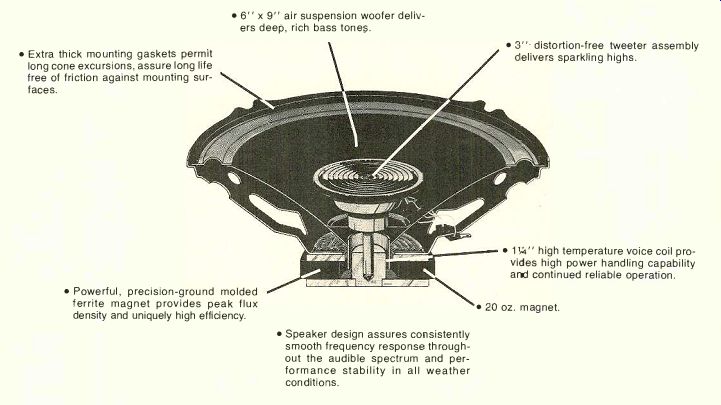
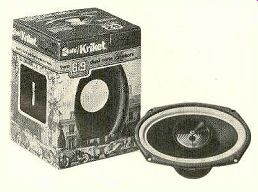
Available at car stereo dealers everywhere.
Who says you can't match the quality of your home stereo in your car, truck or van?
6" x 9" air suspension woofer delivers deep, rich bass tones.
Extra thick mounting gaskets permit long cone excursions, assure long life free of friction against mounting surfaces.
Powerful, precision-ground molded ferrite magnet provides peak flux density and uniquely high efficiency.
Speaker design assures consistently smooth frequency response through out the audible spectrum and performance stability in all weather conditions.
3" distortion-free tweeter assembly delivers sparkling highs.
1 1/4" high temperature voice coil provides high power handling capability and continued reliable operation.
20 oz. magnet.
EVERYBODY EXCEPT AFS- makers of the KRIKET KLASSIC "Perfect Balance" car stereo speaker Here's what the features of our 6" x 9" coaxial speaker, Model 8972, mean to you. Our woofer captures all the low and midrange tones worth hearing. Our highly sensitive tweeter mounts independent of a bulky superstructure known to shield wanted sound in speakers of the past. A full 20 oz. magnet (not two stacked 10's) and aluminum voice coil assure efficiency and superb sound definition from the smallest units to the large 60 watt power boosters so popular today.
Outstanding sound reproduction and rugged, long lasting performance are standard in all KLASSIC speakers. Frequency response , power handling and efficiency are balance-blended in a unique new way.
Because the art of speaker making is compromise. When you add to the bass, for example, you must compensate for loss in the high end. We have. Every component in every KLASSIC speaker has been exhaustively tested to work in harmony, each with the other.
The result is sheer, unadulterated, pure music reproduction. Put our KLASSIC speaker to the test. Let your ears be the judge of all we say.
If you listen to a KLASSIC speaker, you'll buy it.
Kriket Acoustic Fiber Sound Systems, Inc. Indianapolis, Indiana
All Kriket products are manufactured In the U.S.A. Copyright 1977, Acoustic Fiber Sound Systems, Inc.
----------------------
LenTek From England With Love.

The Lentek Speaker System-elegant in appearance, impeccable in sound.
The Lentek Monitor is a four-way system with a nine-foot transmission-line for extremely tight and flat bass response.
Lentek--so well reviewed by the cryptic journal Gramophone that we were accused of bribery!-from England, with love.
American Audioport Dealers.
1407 N. PROVIDENCE RD.
COLUMBIA, MO 65201
----------------
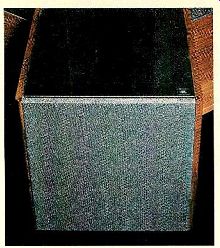
You've never heard anything like it. Not from us. Not from anyone. JBL's new L212: a totally new picture of high performance sound, from the people who wrote the book.
You hear the whole sound first.
And when you catch your breath you search for words to describe the depth, the detail, the etched precision of the music.
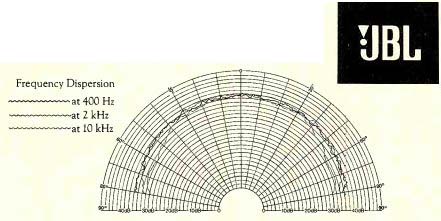
That stunning pair of three-way speakers is sending clean, undistorted sound to every corner of the room. At every frequency. At every level. Loud or soft. High or low. It doesn't matter. The energy is constant.
You're experiencing three dimensional imaging: Vocal up front. Lead guitar two steps back and one to the left. Drums further back. The piano closer, almost off the right edge of the sound.
Suddenly you're aware of a fullness in the music that you've heard before but never associated with recorded sound.
The bass! You've been hearing all of the bass, all of the funda mental tones you couldn't bring home from the concert. It's not only everything you've heard before. It's everything you haven't.
The music is rich with sound at the lowest limit of your hearing.
Frequency Dispersion at 400 Hz at 2 kHz at 10 kHz so Then you see the third speaker. The hero of the piece:
The Ultrabass.
The Ultrabass is a system in itself-woofer, amplifier, equalizer and enclosure-designed, mated, blended to do one thing perfectly: reproduce sound at the threshold of sub-sonic frequencies.
It brings all the low frequency music within audible range, balancing it perfectly with the rest of the music. Without boominess.
Without resonance. It also electronically sums left and right signals below 70 Hz-virtually eliminating turntable rumble and record warp noise. And, because of the non-directional character of the low frequency sound, the Ultrabass can be placed almost anywhere in the room. Without any loss of three-dimensional imaging.
The Ultrabass pays one final dividend: it allows the two three way speakers to be specialists, too.
They can concentrate on the top 95% of the music. (Listen to the whole system, and you'll hear what that means. Even at a rug-curling, rock concert loudness, you'll get a clarity, a smoothness, an enthusiasm for detail you've never heard before.) Finally, you look for the monster amplifier that's driving all that sound. There isn't one.
The L212 takes one fourth the power you'd need with a conventional low efficiency loudspeaker.
That's the story. What you've been reading about is, essentially, a no-trade-off loudspeaker system. Now we'll tell you the trade-off: The price is $1740. (The L212 may take a little while becoming a household word.) In the meantime we have two suggestions: If you'd like a lot more technical information, write us and we'll send you an engineering staff report on the L212. Nothing fancy except the specs.
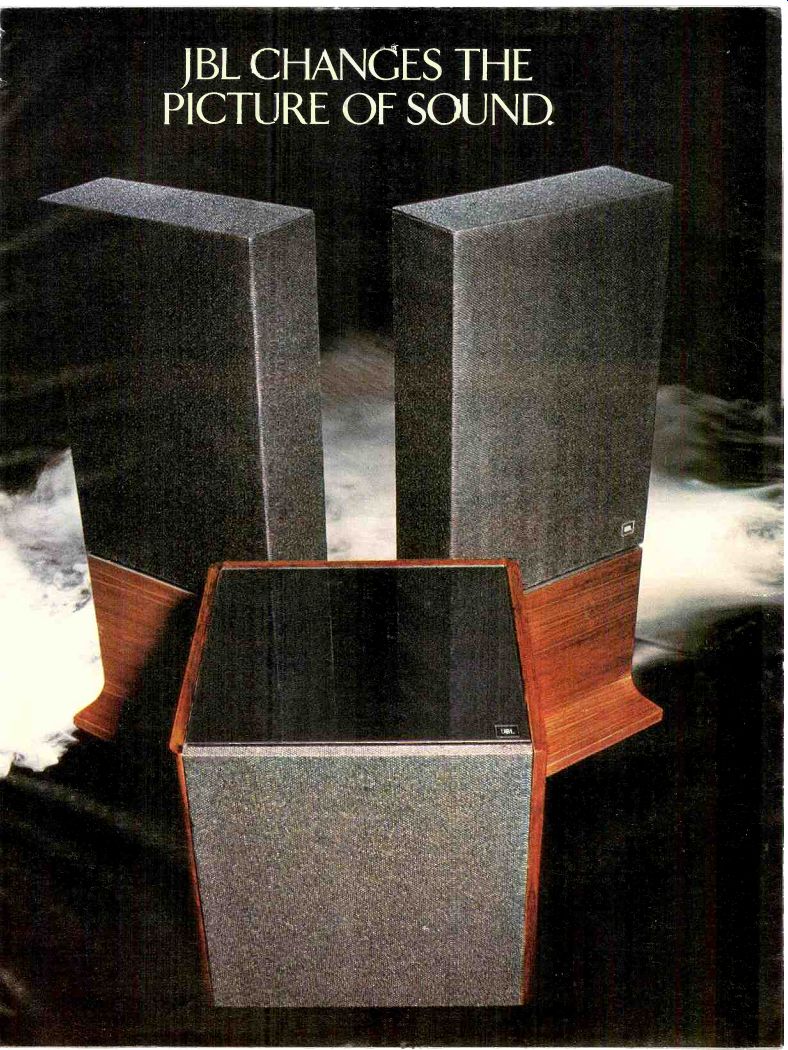
Or call your JBL dealer and ask him when you can hear the L212.
You've never heard anything like it. Not from us. Not from anyone.
JBL-- James B. Lansing Sound Inc., 8500 Balboa Blvd., Northridge, Calif. 91329.
High fidelity loudspeakers from $168 to $3510.
---------------
===========
-------------
Also see:
THE AUDIBILITY OF DISTORTION IN LOUDSPEAKERS--Surprising results when you test with music instead of sine waves, PETER FRYER [Aug. 1977]