---
Regulars and Departments (Aug. 1977)
- EDITORIALLY SPEAKING, WILLIAM ANDERSON
- LETTERS TO THE EDITOR
- TECHNICAL TALK, JULIAN D. HIRSCH
- GOING ON RECORD, JAMES GOODFRIEND
- THE POP BEAT, PAULETTE WEISS
- NEW PRODUCTS
- AUDIO QUESTIONS AND ANSWERS
- AUDIO BASICS
- TAPE TALK
===========================
EDITORIALLY SPEAKING
by WILLIAM ANDERSON
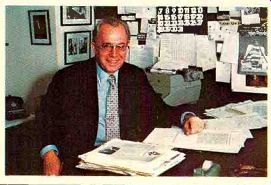
DISC QUALITY: A PROBLEM SOLVED
IF your mind is anything like as cluttered with useless information as mine is, I'm sure you won't thank me for reminding you that the German biologist Ernst Heinrich Haeckel is credited with inventing one of the all-time great conversation stoppers: "The ontogeny recapitulates the phylogeny." If you got through Freshman Bio intact you will know that that is the biological fraternity's Darwinian way of saying that the development of the individual from conception on is a kind of summary of the developmental history of the race. It is also a way of saying that first things come first, that chickens (as well as omelettes) come from eggs, and perhaps even (just watch this pirouette into relevance) that the software anticipates the hardware. Or so, at least, I had always thought.
For the past year and more we have been worrying away in these pages at the subject of disc quality. In the process we have established some fairly interesting facts. The first is that there is a large (and growing) population out there seriously disturbed about what it sees as a steady deterioration in the quality of the Great American Phonograph Record.
Quite beyond such comparatively high-flown concerns as dynamic-range compression, signal-to-noise ratios, frequency balance, and master-tape hiss, record buyers are concerned about the increase in such comparatively prosaic flaws as warps, non-electrostatic snap-crackle-and-pop, off-center pressings, stuck or otherwise un-trackable grooves, audible surface scratches, non-fill, mold-grain, and just plain dirt (few things match the disappointment of opening a "factory-fresh," shrink-wrapped disc and finding it already soiled with greasy fingerprints).
Record manufacturers, when they choose to reply to these complaints, make a few factual points of their own. There is always, for one thing, a small but vocal minority of professional carpers in any market (such as those who write me that they return eight out of ten records they buy), and post-Watergate paranoia may be creating new ones at a rate higher than usual. For another, many people do mis treat their discs, blaming the resulting damage on the manufacturer and returning the cripple for a refund. The industry has been strangely reticent, however, about the real cause of it all: the cost/price squeeze in which record producers find themselves caught (not, to be sure, without a bit of their own connivance).
The costs of labor, raw materials, and management have all gone up in the past two decades at rates that are reflected hardly at all in disc prices. Mass-production efficiencies (faster-moving production lines) and techno logical innovations (thinner discs) have made up the difference, but they have also resulted in lower quality. And so, for perhaps the first time in the history of recording, we find disc software 'that is sonically inferior to the hard ware it is meant to be played through.
THIS situation might have been let drift indefinitely had not the status of the equipment market changed radically in the past few years. For it is no longer merely the finicky audiophile minority (look at all those costly noise suppressors!) that is trying to get high-quality sound out of low-quality discs. Excel lent audio equipment is rapidly becoming the norm rather than the exception. It is trembling, in fact, on the verge of exploding enormously into the mass market, and the time has come for the software industry to reassert its traditional technological leadership. That will not be done by dabbling faddishly with regressive direct-cut gimmickry, for however lovely the results in purely electronic terms, they must still run the gauntlet of the physical pressing process which is the principal source of consumer complaints. The time has come rather to step bravely (if expensively) into the noiseless new world of the digital disc. It's that or join the dodo.
==================
LETTERS TO THE EDITOR

A Buffett Summer
The dedicated romantic is always on the lookout for the book or record that will officially inaugurate the summer's escapist fantasies. My thirty-odd summers have been thoroughly subtitled-the summers of Huck Finn and Tom Sawyer, the seasons of the Beatles and the Beachbotts, the vacation I read all those Steinbeck novels. More recently my festival excursions have been to the tropics with Peter Matthiesen and B. Traven, and it is in this later tradition of the American expatriate in warmer climes that I wish to nominate, as the soundtrack for summer 1977, Jimmy Buffett's evocative "Changes in Latitudes, Changes in Attitudes."
TOM TOLLEFSEN; Glen Ellen, Calif.
Quadracide
I would like to join the growing number of people expressing their disgust at the attempted murder of quadraphonics. I have quite a bit invested in my quad equipment and half my records are quad, but after all the initial big pushes by Columbia, Sony, RCA, Panasonic, and JVC there has been nothing new.
Since the economy has stabilized and the various formats have nearly been perfected, there is no excuse for this sorry state of affairs!
J. R. THOMAS; Towson, Md.
Larry Klein replies: The "excuse" is that people haven't been buying quadraphonic equipment and software in sufficient quantities to make it worthwhile to keep producing and innovating. What those same people would have done if there weren't all those non-compatible formats is of course moot. In any case, the whole picture may change in a year or two, or three, or . . . For the latest quad news, see the Consumer Electronics Show report coming up in the September issue.
Bette Midler
Thank you for that really marvelous story on Bette Midler by Rick Mitz in the June issue. I hadn't paid much attention to her be fore-a few TV talk-show appearances and such-but the interview really got to me, particularly (God knows why) that one line . . right now, I'm all right. I've got my little hat on. . . ." She has that sympathetic quality of vulnerability that so many of our greatest theatrical personalities-from Fanny Brice to Marilyn Monroe-had. That and a little talent, and who can resist?
Mitchell LANDAU; New York, N.Y.
Sextets
Irving Kolodin's "A Beginner's Guide to Chamber Music" in the May issue is a nice collection. However, in counting from two to eight one usually includes six! What happened to sextets? I suggest the Brahms string sextets in B-flat Major, Op. 18 (with the Amadeus Quartet, Aronowitz, and Pleeth, on Deutsche Grammophon 139 353) and G Major, Op. 36 (with the Marlboro Chamber Sextet, on Columbia MS-7445).
JEREMIAH WERHNER; Goshen, Mass.
Musical Muggers
I've read Lester Bangs' reviews for years and generally understood them if not down right agreed with them. But his review of the "Ramones Leave Home" album (in the June issue) makes me wonder if perhaps I'm no longer trendy because of my distinct lack of violent masochism.
I certainly agree with his comments on Mr. Frampton, Boston, and everyone else directly or indirectly insulted in the review, but, good Lord, must we go to extremes? I bought the first Ramones album with a sort of bemused, "What on earth is this?" attitude, and proceeded to discover it was the worst five dollars I'd ever spent. My right speaker hasn't been in a good mood since I subjected it to that relentless guitar attack. I desperately tried every tone control on my receiver to neutralize the impact of that horrid lead vocalist, but to no avail.
Since then there has been no time of the day, day of the week, week of the month, etc.
in which I've been in the mood to hear the album again, and it sits there totally ignored between Jean-Luc Ponty and Lou Reed. It's not that the Ramones have no talent, which is be side the point with most of the New York wave of musical muggers, and I can certainly appreciate their artistic integrity, but I don't understand anyone's willfully praising them.
The Ramones are really phonies (as phony as Bowie or Farrah What's-her-name, or any one else trying to sell an image), and anyone who would waste a whole page of STEREO RE VIEW on a group obsessed with "total economy" has been fooled (and probably even believes Charley's Angels is a detective show).
MIKE AUBIN; Fremont, Calif.
Listening Lesson
The letter from Charles Long in the June issue disturbed me. Some people don't talk while seriously listening to pop music! In my own case, I grew up screaming to the Beatles, dancing to the Stones, and getting stoned to the Dead. The music was enjoyable and consumable, rather like potato chips. But as I learned to be a critical listener to classical mu sic, I turned back and applied my more knowledgeable ears to the rock I already liked, and I was very impressed. I would tell Mr. Long to listen to the best bands of 1965-1970 (not the trash), to listen to Bob Dylan's vocal phrasing and ignore his harmonica playing, to listen to the guitar playing in Cream and avoid the vocals, and to pay attention to the horizontal lines and counterpoint in Traffic and let the chords be subordinate. He should try to distinguish the social phenomenon of popular music from the musical phenomenon. It's rarely ever done-by musicians, insiders, outsiders, or reviewers.
KAREN MARBURGER; Portland, Ore.
TLS
Concerning the Editor's comment in his June column that reviews in the London Times Literary Supplement "are often un signed": the TLS abandoned anonymous re views several years ago. (This has been a brief, signed, polite, and punctual letter of correction on a single subject. I dare you to print it.)
KEITH ALDRICH; Goleta, Calif.
The Editor replies: I abandoned the TLS several years ago largely because of its habit of concealing the identity of its writers; I may have to reconsider now that they have mended their ways. I thank Mr. Aldrich for bringing me up to date; perhaps he will do the same for the New York office of the TLS, who were of the same erroneous opinion when I spoke to them a few months ago! AM Fidelity
I'm delighted that Julian Hirsch is paying attention to the AM sections of receivers un der test, but I disagree with his comment in the receiver review in the May issue: "Al though the AM tuner produced a rather constricted, nasal sound, we would not hold that against [it]." His next remark, that "if AM quality were a significant factor, few stereo receivers could be considered even margin ally acceptable for quality reproduction," is absolutely right on-but surely, if an AM section is included in a receiver, it has to be a significant factor! AM is capable of high fidelity, it is possible to manufacture high-fidelity AM receiving equipment, and it is inexcusable for otherwise high-fidelity equipment to be sold to the public with terrible AM sections! Not until manufacturers are held responsible for a deficiency in this area will they upgrade, however.
ERIC G. NORBERG; Program Director, KEX Portland, Ore.
Technical Director Larry Klein replies: There is no way at the moment that a low-cost AM section in a receiver can deliver a wide audio bandwidth-assuming the AM stations are broadcasting it. AM equipment does not escape the laws of the marketplace: if enough consumers were willing to pay the extra cost for quality AM reception, I'm sure that one or more manufacturers would build the means for it into their receivers.
Hearing
After reading "A Rock Through the Window" (June "Editorially Speaking"), I couldn't help but send in the following letter of correction-trivial perhaps. In the article on distortion (also in June) Paul Milner says that the two reflex muscles in the middle ear are activated by the facial nerve. As a medical student I must point out that only the muscle to the stapes is activated by the facial nerve, the other by the trigeminal nerve.
JIM BURKHOLDER; Seattle, Wash.
Karajan
I was delighted to see your article in the June issue on Herbert von Karajan, whom I consider easily the greatest living conductor. Indeed, I find him one of the three greatest who have ever put their art on discs, ranking with Beecham and Toscanini. This feeling is very common in Europe, but very rare in the U.S., especially among the supposedly "expert" critics. However, if you'd like to try a really astounding experiment, take a few people who claim they dislike Karajan and have them compare, without knowing which is which, his Eroica finale with any other, and then the first movement of his recording of Ravel's Rapsodie Espagnol with the critically favored Boulez and Martinon versions.
In my experience thirty-one out of thirty two people have chosen the Karajan Eroica, and seventeen out of seventeen have picked his Ravel. Statistically this is an almost unbelievable unanimity-but try it for yourself !
JOHN H. CONE, Pasadena, Calif.
About Herbert von Karajan: what a stuffed shirt! He's earned my vote as the person I'd most like to see slip on a banana peel.
MAURY MOLINA, San Francisco, Calif.
Souless Soul
I was in a rush when I went into my favorite record store to buy David Soul's new album, so I grabbed a copy, paid for it, and left.
When I got home and opened the album up I found that it did not contain his hit song, Don't Give Up on Us. At first I thought my eyes were playing tricks on me, but I looked again and even played the record through: no song. The next day I was in my car and heard a DJ announce the album and mention that it contained Don't Give Up on Us. So I went to my second-choice store and found the album again; sure enough, it had the song.
It's driving me nuts! They're the same album-same cover, same code numbers, same everything-except one has Don't Give Up on Us and the other doesn't. The store manager couldn't explain it to me, but maybe you can.
Is my original album (without the song) of any special value? The label is Private Stock.
ROBERT S. YABLANS, Scarsdale, N.Y.
Popular Music Editor Paulette Weiss replies:
To save you a trip to your eye doctor or psychiatrist, I spoke with Private Stock Records and learned that there were two pressings of Soul's album. The first, without Don't Give Up on Us, was recalled from stores when the song, released as a single, became a hit. Don't Give Up was then included in the second pressing, which was identical to the first in all other respects. About two or three thousand of the first-run copies are still scattered around the country, and it was one of these you chanced upon. Private Stock will be happy to exchange albums if you write to them at 40 West 57th Street, New York, N.Y. 10019.
Rare Welsh Bit
William Anderson's editorial on "Executive Music" in the May issue left me puzzled about one thing. At the White House function for British Prime Minister Callaghan, Robert White sang the first stanza of All Through the Night "in Welsh to flatter the distinguished visitors." Mr. Callaghan, to judge by his surname, is an Anglicized Irishman; I can't think of any Welsh P.M. since David Lloyd George.
Welsh is a gorgeous language, right enough, and a linguistic cousin to Erse, but singing it to make Mr. Callaghan feel all warm and fuzzy inside is about as appropriate as serenading an American President abroad with a Cheyenne buffalo dance.
WARREN C. WETMORE, New York, N.Y.
The Editor replies: One can acquire a nationality by birth or by adoption. Prime Minister Callaghan, born near Portsmouth, is Welsh by the latter course. He first became a Member of Parliament for South Cardiff in Wales, and has represented Welsh districts since 1945; following Mr. White's performance of All Through the Night at the White House, he stepped forward, visibly moved and presumably flattered, to congratulate the singer on his Welsh pronunciation (I did not inquire whether he felt all warm and fuzzy inside!).
Griffes Again
Regarding reader Dennis Dunnett's letter in the June issue about Richard Freed's re view of a new recording of the Griffes sonata, I would like to bring to the attention of those interested the following points: the recording of the sonata and the Roman Sketches was available on Lyrichord LL 105 as early as 1961; the Lyrichord disc is not true stereo, no matter what Mr. Dennis' jacket may say or his ears may tell him; and the Lyrichord re cording was actually a rerelease of the now-defunct Walden label's LP-100, which first appeared in the early Fifties. (I have both the Walden and the Lyrichord pressings and they are identical.) Therefore, Richard Freed's statement that "there has not been a recording of the sonata in well over twenty years" is quite valid.
PAUL J. PORTNUFF; Chicago, Ill.
Audio Careers
In the April issue, Larry Klein's first "Q. and A." deals with a subject (audio careers) I was asked about frequently when I was a re cording engineer. Literally hundreds of letters of this nature prompted me to organize a school that would teach not only the basic skills of recording, but also the function and operation of the record-publishing business.
It took several years of research and the kind cooperation and participation of the select membership of the RIAA and the AES, who submitted their suggestions for a curriculum.
We started teaching in January 1974. Our classes are kept small. We have no desire to turn out a great number of knob-twirlers. We turn out a small, select group of well-trained people, and 85 percent of our diploma recipients are now working within the industry.
The American Music Conference ( 3505 East Kilgore Road, Kalamazoo, Mich., 49002) publishes a useful and informative booklet entitled Careers in Music, which discusses careers in performing arts, education, business, the recording industry, and allied fields.
LEO DE GAR KULKA, President College for Recording Arts. 665 Harrison Street. San Francisco, Calif. 94107
Larry Klein replies: On the East Coast, the journalism department of the University of Bridgeport is offering a minor in audio studies.
The twenty-one-credit sequence includes courses in audio techniques, audio production and direction, field sound recording, studio technology, and audio engineering practices.
The Institute of Audio Studies, capstone course of the program, is a nine-week summer session held in a professional recording studio doing actual production work. A certificate of achievement is awarded to students completing the minor or the summer institute. Interested students should contact Dr. Howard B. Jacobson, Department of Journalism, North Hall 214 (SR), University of Bridgeport, Bridgeport, Conn. 06602.
(STEREO REVIEW is compiling a listing of available audio schooling and would appreciate notice of current or anticipated programs.)
=================
New Products--latest audio equipment and accessories
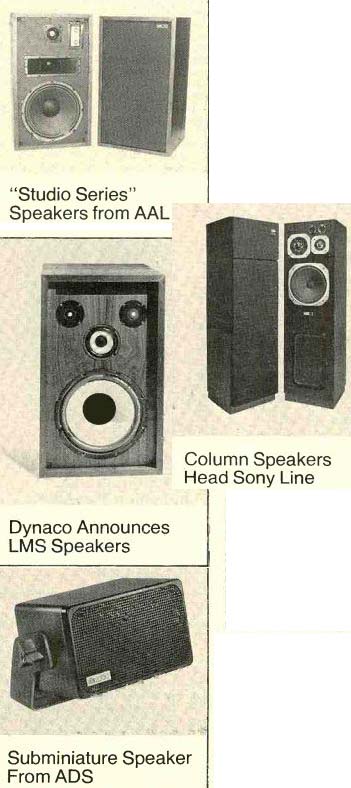
Studio Series" Speakers from AAL
American Acoustic Labs announces its new Studio Series line of loudspeaker systems. The line consists of six models, all with computer-designed crossovers and fuses for speaker protection. The Studio Series speakers are said to conform to an "acoustically correct" response curve developed by AAL.
The Studio 3, occupying the approximate middle of the line, is a three-way acoustic-suspension system utilizing a 12-inch woofer, a 4 x 10-inch horn mid-range, and a horn-loaded 1-inch dome tweeter. It has a nominal impedance of 8 ohms and a frequency range of 25 to 25,000 Hz, with crossovers at 1,000 and 5,000 Hz. Continuously variable controls are provided to adjust the mid-range and high-frequency output. The suggested minimum input power for the Studio 3 is 10 watts per channel; up to 75 watts can be handled on program peaks. The particle-board cabinet, 26 x 15 x 13 inches, is covered with imitation-walnut vinyl. Price: about $200.
Subminiature Speaker From ADS
ADS announces a new, highly compact (about 7 x 4 1/4 x 4 1/2 inches) loudspeaker system for use in automobiles and other mobile applications. The 200C is a two-way acoustic-suspension system utilizing a 4-inch woofer and a 1-inch dome tweeter. The drivers, crossing over at 2,500 Hz with a slope of 12 dB per octave, are mounted in a solid aluminum cabinet. The 200C has a frequency response of 85 to 20,000 Hz ±3 dB (50 to 22,000 Hz ±5 dB).
The nominal impedance of the unit is 4 ohms; at least 5 watts of amplifier power is recommended. The maximum continuous input power suggested for the 200C is 30 watts. At a distance of 1 meter, the unit will produce a sound-pressure level of 90 dB with a 1-watt input signal.
The satin-black cabinet of the 200C is equipped with a perforated aluminum grille.
For surface mounting the 200C comes with a swivel bracket, and for flush mounting a re cess frame and foam grille are available. The 200C weighs about 4 1/2 pounds. The speaker (plus swivel mount) is priced at $110. The flush-mounting kit is optional at $7.50.
Dynaco Announces LMS Speakers
The Laboratory Monitor Series (LMS) from Dynaco includes five loudspeaker systems ranging from bookshelf to floor-standing models. All systems in the series have ducted ports. The smallest speaker in the line, the Model 2, requires a minimum continuous in put of 5 watts per channel whereas the largest, the Model 7, requires 10 watts. The high-frequency response for all models extends to 20,000 Hz; bass response varies, extending to. 38 Hz for the Model 2 and to 20 Hz for the Model 7. Power-handling capability varies from a maximum continuous input of 35 watts for the Model 2 to 150 watts for the Model 7. Tweeter level controls are provided for the Models 2 and 3, and these are augmented by mid-range level controls on the Models 5, 6, and 7.
The Model 6, shown, is a three-way system utilizing a 12-inch woofer, a 5-inch mid-range, and two 1-inch dome tweeters. Crossover frequencies are 900 and 4,500 Hz. The system is rated for a minimum amplifier power of 9 watts continuous. Maximum recommended power is 100 watts. Dimensions are 27 x 16 x 15 inches. All systems in the Laboratory Monitor Series come in oiled-walnut-veneer cabinets with beveled-front detachable grilles. Approximate prices range from $140 to $460.
Column Speakers Head Sony Line
Two speaker systems employing columnar enclosures are the top models in a new line of loudspeakers from Sony. Both are three-way designs with identical drivers: a 10-inch woofer stiffened with a new lightweight graphite-fiber material called "Carbocon," and a 3 1/4-inch dome mid-range and 1-inch dome tweeter, both with diaphragms fabricated of titanium foil. The SSU-3000 ($300) has a ported en closure, while the larger SSU-4000 ($400, shown) employs a rectangular passive radiator with a surface area of 104 square inches.
The mid-range and tweeter radiate directly through special diffusion assemblies to control dispersion.
The two systems have rated frequency responses of 35 to 20,000 Hz (30 to 20,000 Hz for the SSU-4000) and nominal impedances of 8 ohms. Crossover frequencies are 600 and 5,500 Hz. Sony recommends amplifier powers ranging from 20 to 150 watts per channel continuous for either system. Enclosures are of particle board finished in walnut veneers. The width and depth dimensions of approximately 13 1/2 x 14 1/4 inches are the same for the SSU-3000 and SSU-4000. Approximate heights are 34 1/4 and 47 inches, respectively.
Tone-arm Damping Device from Discwasher
The DiscTraker is a pneumatic device de signed to add damping to the tone arm and hence improve tracking and increase stability on warped records. The device, which attaches to the tone-arm headshell, consists of a vertically mounted cylinder with a movable piston inside; the base of the cylinder (which is covered with cushioning material) rides on the record surface. The result is a "dashpot" mechanism that counters the effect of head shell/cartridge inertia on the stylus when there are vertical warps in the record surface. It is also said to reduce record wear. Price: under $30.
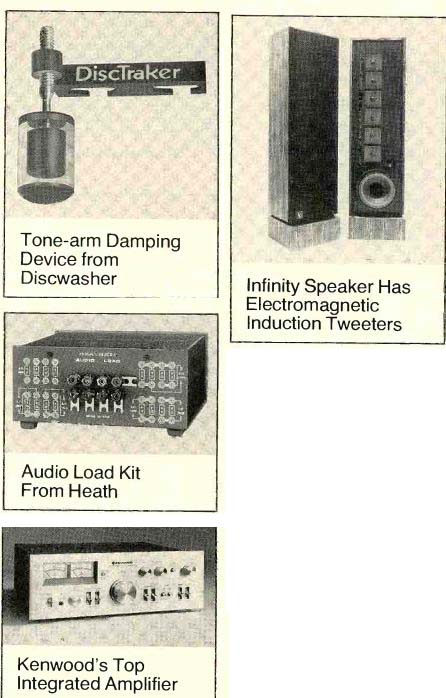
Kenwood's Top Integrated Amplifier
The KA-8300 is Kenwood's new top-of-the-line stereo amplifier. The unit features bass and treble controls with selectable turn over points of 150 or 400 Hz for the bass and 3,000 or 6,000 Hz for the treble. Two power output meters on the front panel are provided with switchable ranges from 0 to 3 or 0 to 100 watts. Two-position loudness-compensation and "presence" controls are included, along with 12-dB-per-octave high- and low-frequency filters. The KA-8300 has a "tape-through" circuit that permits dubbing from one tape machine to another while the amplifier is simultaneously being used for playing another program source. Jacks are provided for two phono and two tape sources, and the unit has provisions for three pairs of loudspeakers.
The KA-8300 is rated at 80 watts per channel continuous into 8 ohms, from 20 to 20,000 Hz. Both harmonic and intermodulation distortion are no more than 0.1 percent. The phono inputs can handle up to 260 millivolts before overload; phono-input signal-to-noise ratio is 72 dB. The amplifier's high-level in puts have a 90-dB signal-to-noise ratio. Direct-coupled circuitry is employed in the preamplifier section of the KA-8300. The met al cabinet provided for the unit has approximate dimensions of 6 x 17 x 14 3/4 inches. Rack handles are available as an option. Price: about $450.
Infinity Speaker Has Electromagnetic Induction Tweeters
Infinity's Quantum Line Source loudspeaker system has several special design features intended to increase dispersion and improve bass response. The system utilizes a vertical line (four feet in length) of eight electromagnetic, induction tweeters for the frequency range of 4,000 to 32,000 Hz. Parallel to the strip of tweeters is a vertical column of six 1 1/2-inch dome drivers for the frequencies from 600 to 4,000 Hz. This array of high- and mid-frequency drivers is intended to provide a line source of sound that fans out in the horizontal plane, so that frequency response is uniform within ±2 dB over 180 degrees in the frontal hemisphere of the speaker's radiation pattern.
A mid-bass driver near the bottom of the enclosure is provided to handle frequencies from 200 to 600 Hz. Below 200 Hz the system employs a 12-inch woofer working on what is called the "Infinity/Watkins dual-drive" principle. The driver has two voice coils of different impedances; these are connected via an electrical network. Near the resonant frequency of the system, the coil with the lower impedance is the one actually driven by the amplifier, whereas at higher frequencies the higher-impedance coil is active. This design is said by the manufacturer to smooth the frequency response of the system in the low-frequency range.
The overall frequency response of the Quantum Line Source is 18 to 32,000 Hz ±2 dB. Impedance is nominally 4 ohms. The speaker requires a minimum of 100 watts per channel of continuous input power, and may be driven by one or two amplifiers. Power-handling ability is said to exceed the output of any currently available amplifier. Separate controls adjust the output levels of the mid-bass, mid-range, and high-frequency drivers.
The Quantum Line Source's cabinet, offered in a choice of walnut or rosewood veneer on particle board, has dimensions of 66 x 15 x 18 inches; the grille consists of acoustically transparent cloth suspended on a steel frame. The unit weighs 150 pounds.Price: about $1,200. Infinity also features three smaller speaker systems employing the basic design approach of the Quantum Line Source: the Quantum 2 ($700), Quantum 3 ($485), and Quantum 4 ($385).
To provide suitable loads for the testing of audio amplifiers, Heath has introduced the ID-5252 kit, a resistance box capable of presenting resistive loads of 2, 4, 8, 16, or 32 ohms to an amplifier. Depending on how it is set up, the box can handle up to 240 watts of single-channel input or 60 watts from each of four channels, both into 8 ohms. The box contains four 8-ohm resistors accessible via five way binding posts on the front panel. Five connecting tabs are provided to interconnect the resistors in various series and parallel con figurations so that a range of resistances and power inputs is available. Jacks are provided for connecting oscilloscopes, voltmeters, or distortion analyzers across the amplifier terminals. The kit includes four 3-foot, 12-gauge leads. Price of the kit: about $45.
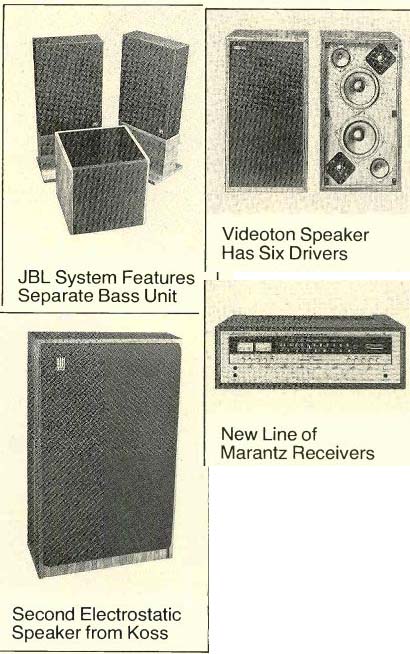
JBL System Features Separate Bass Unit
In addition to two "full-range" floor-standing units, the JBL L212 loudspeaker system employs a separate "Ultrabass" module, a woofer system for reproduction of very low frequencies. The "full-range" units (designed to respond down to 70 Hz) are three-way systems each utilizing an 8-inch woofer, 5-inch cone mid-range, and 1-inch dome tweeter; they are connected directly to the amplifier's speaker outputs. The 8-inch woofer, employing a 3-inch voice coil and a very stiff cone, operates from 70 to 800 Hz. The mid-range driver is active above 800 Hz, crossing over to the tweeter (JBL's 066 hemispherical-diaphragm unit) at 3,000 Hz.
The Ultrabass module contains a built-in 50-watt power amplifier and a 12-inch air-suspension woofer. The input signal for the module, which operates in a "common-bass" mode, is derived from the drive signals for the full-range pair, which are mixed to create a mono signal and equalized for uniform response from the woofer over the range of 25 to 70 Hz. The nondirectional character of these low frequencies permits placement of the bass module in any convenient location in the room. The module has an on-off switch for its amplifier, a phase-reversal switch, and a continuously variable level control.
The frequency response of the entire L212 system is 30 to 40,000 Hz ±2 dB, and the nominal impedance is 8 ohms. The externally powered part of the system requires a minimum amplifier power of 10 to 20 watts per channel continuous, with 75 watts being the maximum safe input on program material. A 1-milliwatt input signal produces a sound-pressure level of 37 dB at a distance of 30 feet. The "full-range" units are about 38 1/2 inches high and have bases which are 17 inches wide by 13 inches deep, tapering rapidly to an actual enclosure depth of 6 inches.
The Ultrabass module has dimensions of 19 1/5 x 18 1/2 x 18 1/2 inches; it features a smoked-glass top. All three units are finished in black walnut and fitted with black acoustically transparent grille fabric. Price of the complete system: $1,740.
Second Electrostatic Speaker from Koss
The Koss Model 2 is a "hybrid" speaker system that employs a dynamic tweeter for the high frequencies (above 2,500 Hz) and electrostatic panels for the rest of its frequency range. According to the manufacturer, the tweeter, a 1-inch dome unit, was preferred over an electrostatic driver because of its superior dispersion at high frequencies.
The Model 2 resembles the larger Koss Model 1 in its use of multiple electrostatic diaphragms operating in tandem within each electrostatic panel. Also like the Model 1, it utilizes the audio-signal step-up transformers for the low-frequency and mid-range panels as elements in the crossover network that feeds them. The panels' bias voltage is de rived from the a.c. line.
Frequencies up to 250 Hz are handled by two bass electrostatic panels that provide a total radiating area of 615 square inches. The mid-range panel, active from 250 to 2,500 Hz, provides 165 inches of radiating area. Overall, the frequency response of the Model 2 is 37 to 19,000 Hz ±3 dB. Minimum impedance is 4 ohms. An amplifier capable of at least 75 watts per channel continuous output into 8 ohms is recommended; maximum power-handling ability is 300 watts. The front surface of the cabinet, constructed of walnut veneer on particle board, is 41 x 24 inches. Depth is 11 1/2 inches at the base, tapering to 6 1/2 inches at the top. The back panel of the system is acoustically open hardboard; a brown knit-polyester grille covers almost the entire front surface. Price: $650.
Videoton Speaker Has Six Drivers
The Model D-402A "Supermax" is a new three-way loudspeaker system from the Hungarian firm Videoton. The system utilizes two 8-inch woofers, two 4-inch cone mid-ranges, and two 1-inch hemispherical dome tweeters in an acoustic-suspension enclosure. The woofers feature a special cone-suspension design patented by Videoton.
of 35 to 20,000 Hz and a nominal impedance of 6 to 8 ohms. The manufacturer suggests a maximum continuous-power input of 50 watts per channel for the system; 80 watts can be handled on program peaks. The oiled walnut cabinet has dimensions of 27 1/2 x 15 1/2 x 11 inches, and the system weighs 45 pounds. Price: about $200.
The Models 2265, 2285, and 2330 (shown are among the latest stereo receivers to be offered by Marantz. All three models feature tape-to-tape dubbing facilities permitting tape copying from one deck to another while the receiver is playing a third source. Separate controls are provided for bass, mid-range, and treble, with selectable turnover frequencies. The Models 2285 and 2330 feature a steep-slope (18 dB per octave) high-frequency filter, and the Model 2330 has Dolby noise-reduction circuitry with the 25-microsecond de-emphasis appropriate for decoding Dolbyized FM broadcasts.
The per-channel continuous power ratings (into 8 ohms) are 65 watts for the Model 2265, 85 watts for the Model 2285, and 130 watts for the Model 2330, all for any frequency from 20 to 20,000 Hz. Total harmonic and intermodulation distortion is no more than 0.08 percent for all three units.
The tuner specifications of all three receivers are almost identical. Usable sensitivity is 10.3 dBf, and the 50-dB quieting sensitivity is 36 dBf. Capture ratio is 1 dB. Image and i.f. rejection are 85 and 100 dB, respectively, and AM suppression is 55 dB for the Models 2265 and 2285, 57 dB for the Model 2330. The tuner frequency response for all three units is 30 to 15,000 Hz-±1 dB, with no more than 0.3 percent distortion in stereo and 0.15 percent in mono. Stereo separation is 45 dB at 1,000 Hz.
The ultimate signal-to-noise ratios for the Models 2265, 2285, and 2330 are 65, 67, and 67 dB, respectively, in the stereo mode, and 75, 78, and 78 dB in mono.
The Models 2265 and 2285 have approximate dimensions of 5 1/4 x 17 1/4 x 14 1/4 inches; the Model 2330 measures 5 3/4 x 19 1/2 x 15 1/4 inches. Walnut-veneer cabinets are available as an option. Prices: Model 2265, $570; Model 2285, $670; Model 2330, $790. Cabinets are $35 for the first two, $45 for the Model 2330.
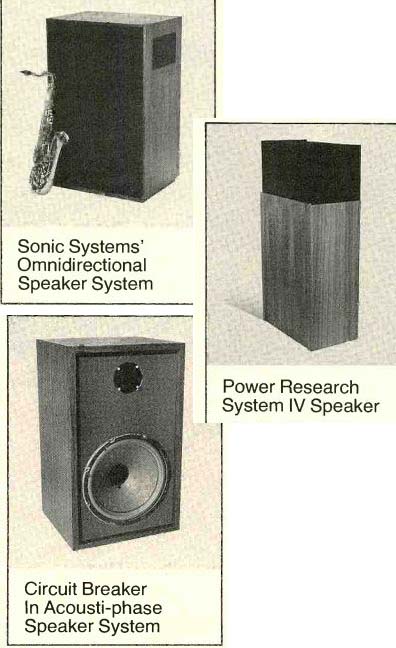
Circuit Breaker In Acousti-phase Speaker System
The Acousti-phase Phase Monitor is a two way bass-reflex loudspeaker system utilizing a 12-inch woofer and a 1-inch Mylar dome tweeter. The Phase Monitor's port is located at the rear of the cabinet, and the woofer is constructed with a special double-foam suspension. A level control is provided for the tweeter, and the entire system is protected from overload by a circuit breaker.
The Phase Monitor, with a nominal impedance of 8 ohms, has a frequency response of 32 to 20,000 Hz. The crossover frequency between the woofer and tweeter is 1,500 Hz.
The manufacturer suggests that the unit be used with amplifiers delivering between 10 and 70 watts per channel continuous power; over 150 watts can be handled on program peaks. The Phase Monitor's cabinet, constructed of particle board with simulated-walnut vinyl covering, measures 25 x 15 x 14 inches. A detachable acoustically transparent, grille is provided; the unit weighs 52 pounds. Price: about $160.
Sonic Systems' Omnidirectional Speaker System
The Sonic Systems Model One-A is a two way loudspeaker system employing a 15-inch woofer and four high-frequency compression drivers in an enclosure with a slot-loaded port. The woofer is mounted on a special internal baffle board situated behind the regular baffle. The four high-frequency drivers (which are not horn-loaded) are mounted one per side on each of the four sides of the cabinet, giving the system an omnidirectional radiation pattern in the horizontal plane.
The frequency response of the Model One-A is 32 to 18,000 Hz ±3 dB. The crossover between woofer and tweeters occurs at 800 Hz. The manufacturer suggests amplifier powers in the range of 100 to 150 watts per channel continuous to drive the speaker, which has a nominal impedance of 8 ohms. A sound-pressure level of 102 dB is produced at a distance of 1 meter when the Model One-A is driven with a 1-watt input signal; a 150-watt signal at the same distance will produce a sound-pressure level of 123 dB. The Model One-A's cabinet, of matched-grain oiled walnut, measures 45 x 28 1/2 x 21 3/4 inches, and the system weighs about 150 pounds. The non-detachable acoustically transparent grille is black. Price: $1,500.
Sonic Systems also offers a smaller speaker system, the Model Two, featuring the same types of drivers but with just two tweeters, which radiate front and back. Price: $1,100.
The Power Research Products System IV is a four-way loudspeaker system utilizing four high-efficiency drivers: a 10-inch sub-woofer, 6 1/2-inch woofer, 3-inch cone mid range, and a 1%-inch piezoelectric tweeter.
The woofers are mounted face-down on a completely sealed cabinet with a high degree of internal absorption; the backs of the woofer cones provide the bass radiation. The tweeter and mid-range are mounted one above the other on an upright metal frame that faces into the listening area. Foam pads attached to this frame reduce sound reflections and possible edge-diffraction effects.
The System IV has a frequency response of 26 to 22,000 Hz ±4 dB and a nominal impedance of 8 ohms. Crossover frequencies are at 75, 600, and 8,000 Hz. The minimum recommended amplifier power is 30 watts per channel; up to 200 watts can be handled on pro gram peaks. The system is enclosed in an 11 1/2 x 19 x 39-inch walnut-finish cabinet with an acoustically transparent black grille top. Weight is 78 pounds. Suggested price: $435.
NOTICE: All product descriptions and specifications quoted in these columns are based on materials sup plied by the manufacturer.
Recent fluctuations in the value of the dollar will have an effect on the price of merchandise imported into this country. Please be aware that the prices quoted in this issue may be subject to change.
=====================
Audio Q. and A.
By Larry Klein
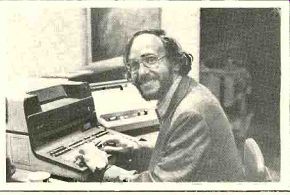
STEREO REVIEW'S Technical Director runs through a speaker-design program on a computer terminal at the Koss Corporation.
Blown Driver
I have a pair of good three-way speaker systems, and I blew out either the tweeter or the mid-range driver-or maybe even the crossover-in one of them. What is the best way to tell which component is damaged? Is something like this covered by manufacturer's warranty?
J. NORRIS Elmira, N.Y.
A. I've never come across a case where a crossover network's components were blown out, although sometimes a tweeter or mid-range level control will "open" under stress. FM interstation hiss will provide a good wide-range test signal that will let you determine by ear which of your drivers isn't working. If you put your ear close to each of the drivers in question you should be able to tell easily enough whether any noise is coming out of it. Your good system will provide a standard of comparison.
As far as warranties are concerned, you'll have to take that up with the manufacturer. In these days of super-power amplifiers and discotheque sound levels, most companies aren't as willing as they once were to believe that their tweeter or mid-range unexpectedly died trying to deliver a flute solo while being driven by a 10-watt amplifier.
Cartridge Degaussing
Q. When I demagnetize the heads on my reel-to-reel recorder, the degausser will pass within 6 to 8 inches of my turntable. Is it possible to damage the phono cartridge in any way with the demagnetizer?
BILL BARMINSKI Benton, Ill.
A. I assume that you are concerned about whether you might accidentally de gauss the magnetic assembly in your cartridge. If you were to place a cartridge on a heavy-duty bulk eraser and give it a couple of jolts, it is possible that its performance would be affected. However, the field around a hand-held tape-head degausser is so concentrated (and usually weak enough) that no damage to your cartridge could possibly occur over a 6-inch distance.
New Noiseless Diamond
Q. Recently I purchased a new four-channel cartridge with a "four-dimensional" diamond for my stereo system. The stylus size is 0.2 mil (biradial) and the frequency response is 15 Hz to 45 kHz. The thing that amazes me is that many of my records that had unbearable surface noise now sound brand new. Can you give me any explanation for this?
STEPHEN CHARLES GRIGGS; Baltimore, Md.
A. Consider the fact that a record groove has a roughly triangular cross section and the conventional spherical (conical) stylus has a gently rounded contact surface (see diagram). This means that each differently shaped stylus is likely to ride on a different area of the record-groove walls. If the surface noise is caused by damages on one "level" of the groove wall and the new stylus rides higher, lower, or covers a greater area than the original one, the noise is going to be far less obtrusive.
Line-frequency Addenda was particularly interested in the "Moving Overseas" Q & A in the May issue since our company manufactures and supplies many pieces of electronic equipment for use both in the United States and in foreign countries. Although our equipment is not in the audio field, some of the problems of different line voltages and operating frequencies are the same. We have found that even when the pro per a.c. voltage is supplied, units employing power transformers designed specifically for 60-Hz operation can run into problems when used on 50-Hz lines. At the lower line frequency, 60-Hz transformers tend to saturate or develop excessive internal power loss. Although many high-quality transformers are specifically designed for 50- and 60-Hz operation or have adequate design margins, it is best to check with the manufacturer in advance of your purchase or your move overseas.
The ferro-resonant type of regulated power supply can also cause problems on 50 Hz. I don't recall seeing any of these used in consumer hi-fi equipment, but they are found in some professional designs. Such power supplies are very sensitive to line-frequency changes, and operation on other than the de sign frequency can cause appreciable changes in output characteristics even with the proper line-voltage input.
THOMAS PERAZELLA; Berkey Marketing, Woodside, N.Y.
Thanks to Mr. Parazella for his addenda to the discussion. Most hi-fi equipment has a label on the rear apron or the chassis bottom stating its power-input requirements or options. If the label says "50-60 Hz," assume that the equipment won't run into trouble at the lower line frequency, although it may run slightly warmer than normal.
Groove Ghosts
Q. I have noticed audio ghosts on many of my discs. The ghosts seem to appear before or after the actual signal, depending on which cartridge I use. Is this problem intrinsic to the disc, or does it depend on the cartridge?
D. MAX BOONE, San Diego, Calif.
A. to everything. What you refer to as "ghosts" are known in the recording trade as "groove echo." Although such an echo can occur on a master tape as a result of "print-through" between adjacent tape layers, it usually arises somewhere in the disc recording/playback process. (You can some times tell the difference between master-tape print-through and groove echo by whether or not the material heard is from the immediately adjacent groove). As to causes and cures, the matter is more complex than appears at first glance. When the object is to get as much playing time as possible on a side, the acetate is cut with the grooves as closely spaced as possible. "Possible" in each case is deter mined by the specific character of the material to be cut into the grooves. Loud, low-frequency signals cause greater groove excursions than soft, higher-frequency signals.
Rather than space all the grooves on the disc widely in order to accommodate an infrequent loud, low passage, a variable-pitch guidance system is used to control the groove spacing laid down by the cutter head. A special "pre view" tape head on the machine playing back the master tape for the cutter is used to monitor the signal that will be cut adjacent to the groove being cut at any particular moment.
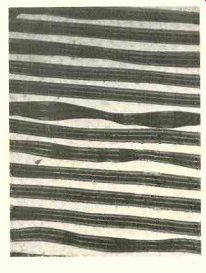
The groove spacing is then continuously adjusted on the basis of the information from the preview head to prevent any grooves from touching (which could cause stylus "sticking") or simply being too close (which could cause groove echo). The accompanying photo of a typical groove area (courtesy Sid Feldman, Mastertone Studios) shows some normal variations in groove spacing and width.
But what spacing is too close? The pre-echo effect comes about because the signal cut into the groove wall has somehow modulated the wall of the adjacent groove sufficiently to provoke a response from the phono stylus. It is evident that groove echo is most often heard when a quiet groove is next to a loud one since two equally loud grooves will usually mask each other. However, for various reasons, audio signals around 3,000 Hz are more likely to be heard in adjacent grooves than higher or lower frequencies.
There are several imponderables in the groove-echo problem. I'm told that some cut ting engineers won't use fresh blank acetates because they have not yet aged to adequate hardness, and, all other cutting factors being equal, "soft" acetates are more prone to groove echo. Acetates have another peculiar characteristic in regard to groove echo: it is possible to cut an echo-free disc, put it aside, and have groove echo show up hours later.
Since the cutting stylus also does a certain amount of "pushing" at the acetate while en graving the groove, it could be that stresses are set up that slowly equalize through acetate "flow" and appear as modulation in adjacent groove walls.
Why should different cartridges reproduce more or less groove echo? Since groove echo is actually a low-level signal modulated into the groove wall, a cartridge capable of responding to small groove undulations (which means any good cartridge) should be as sensitive to the phenomenon as any other. However, there is a factor that I've mentioned in connection with "surface-noise" sensitivity.
It may well be that the upper portion of the V shaped groove is more likely to contain groove echo than the deeper part. This could be true simply because the area that separates the groove walls (the land) gets thinner as you get closer to the record surface. Since differently shaped styli "read" different parts of the groove wall, it is likely that styli that sit lower in the groove will pick up less groove echo than wider styli.
=====================
Audio Basics
DON'T COUNT; LISTEN
ELSEWHERE in this issue George Sioles, a speaker designer, writes authoritatively about his approach to system design. I'd like to supplement his discussion with some re marks about the raw materials he works with and the reasons why they tend to be chosen.
A typical high-fidelity loudspeaker system, of which there are hundreds available, consists of a box containing two or maybe three "drivers" (the actual loudspeakers themselves) and a quantity of Fiberglas or other absorbent damping material. Also, some where within the box there will be a compact assemblage of electronic parts (the crossover network) that determines which driver(s) will receive the low-frequency signals from the amplifier and which the higher-frequency ones-and in what relative amounts. One or more controls to adjust the amount of signal fed to certain drivers may be provided as well.
These bits and pieces may seem unfamiliar at first, but there's nothing very complicated about the way they've been put together or even the general way in which they work. Of ten, all the parts of some celebrated speaker system are individually available on the open market; assembling them physically is simply a matter of woodworking and perhaps a little soldering. But if this is so, what accounts for the "magic" in loudspeakers and the sup posed superiority of some over others? The answer lies in the overall design and the repeatedly successful execution of it. A good speaker system is a combination of suitable ingredients chosen for their quality and consistency and then skillfully blended (the parallels to cooking and wine-making have frequently been pointed out, and they are apt up to a point). Although the proper blending results from the designer's special skills, the ingredients are usually out in the open where all of us can look at them. So let's do so.
ALMOST every driver has a diaphragm--the cone of a woofer or mid-range driver or the dome of a tweeter, for example-and some mechanism to move it. The mechanism is most often a simple electric motor consisting of a coil of wire in a strong magnetic field. The motion the coil imparts--to the diaphragm, which is fastened directly to it, is an in-and-out vibration. All in all, the operating principle of a speaker driver hardly differs from that of a drum, with the drum head being the diaphragm and the drum stick the energizing voice coil. However, a drum has a certain deliberate and characteristic sound resulting from the fixed frequencies at which it invariably vibrates when left to its own devices.
We'd like a speaker diaphragm to have no such "preferred" frequencies of vibration; we want it to move only in response to the voice-coil motion and not according to its own physical nature as well. It happens that this is a practical impossibility, but the degree to which a manufacturer can moderate the various "preferred" frequencies or resonances largely determines a driver's quality. And the degree to which a speaker-system designer can "get around" the resonances that remain is a measure of his skill. This is because the more a driver tends to have audible resonances, the more it will sound like itself and the less like the program material it is sup posed to be reproducing.
A speaker system employing various types of drivers does so not because this is a particularly elegant or efficient mode of design, but because of grim necessity. Intuitively we can appreciate that the large, rugged diaphragm of a woofer is best suited to the powerful bass tweeter diaphragm lends itself to the more rapid vibrations of high frequencies. Drivers that perform acceptably at all audible frequencies have been built and are available, but their cost and complexity are not, in the view of many speaker designers, sufficiently offset by their theoretical advantages.
Multi-driver design is based on the premise that almost any driver will perform well over a certain limited range of frequencies. Above and below that range it may get into resonances and other troubles, but if the cross over network is designed to limit the signals reaching it to the frequencies it reproduces best, other drivers can presumably be found to take over where the original driver cannot, with fidelity, go. The ridiculous extreme of this approach would be a speaker system containing perhaps ten mediocre drivers, from huge "sub-woofer" to tiny "super-tweeter," each handling about an octave of the ten octave audio-frequency range. For various reasons this is not a very good way to build either a low-cost or a high-performance speaker system, so the usual practice is to find two or three better drivers that can span a wider range with genuine competence.
A "two-way" speaker system (incorporating just a woofer and a tweeter) has certain very persuasive technical advantages, and there are some excellent two-way systems on the market. However, the designer's objective may be a deluxe system with exceptionally deep and/or powerful bass and exception ally extended, well-dispersed high frequencies, which will probably oblige him to use a very large, rugged woofer and a correspondingly small, delicate tweeter. In this case one or more mid-range drivers may be required as well to fill in where the large woofer and tiny tweeter cannot overlap, and the result is a three- or four-way speaker system.
RECOGNIZING that consumers are prone to associate a multi-way design with deluxe performance, there are some speaker manufacturers who throw cheap additional drivers into their designs willy-nilly in the hope of creating some consumer appeal. This is called the numbers game, and it is for suckers only.
So don't count; listen. There is more to a good speaker than you can see behind the grille or read from a specification sheet.
======================
Tape Horizons
TWO BREAKTHROUGHS THIS month I'm pleased to be able to report on two recent technological break throughs, one in tape heads, the other in tape itself. Both are developments that may fundamentally alter the future of recording.
In recent years most new developments in tape oxides have come from Japan, but the 3M Company has the honor of being the first to announce that it is ready to produce a tape that goes beyond oxides altogether. The tape will utilize as its magnetic medium extremely refined metallic particles with the trade name Metafine IV. Some idea of the magnitude of the resulting improvement can be gained by comparing the areas under the curves in the upper left-hand quadrant of Figure 1, which shows (A) an older ferric oxide, (B) chromium dioxide, and (C) the new 3M development.
When engineers look at the potential of various magnetic materials, they make use of "B-H" curves such as these to show two vital parameters: coercivity (the width of the loops where they cross the zero axis, designated H_e and measured in oersteds) and retentivity (the height at the vertical axis, called Br and measured in gauss). Roughly speaking, retentivity is an index of the maximum output level obtainable on playback, and coercivity is the key to high-frequency (or, more precisely, short-wavelength) response. One of the newer ferric oxide tapes, for example, would have a slightly higher retentivity than chromium dioxide, though its coercivity would be considerably less.
According to 3M research director Dr. John D. Holm, Metafine IV has a coercivity between 1,000 and 1,100 oersteds (compared with about 350 to 380 for a top iron oxide and about 550 for chromium dioxide), and a retentivity between 3,000 and 3,500 gauss (1,050 to 1,520 is in the ballpark for todays' ferrics, and about 1,400 is typical for chrome). While chromium dioxide represented a major step forward in achieving high-frequency response at slow speeds, it did nothing for overall output. At one step, Metafine IV has twice the output of chrome (a 6-dB jump) and twice its high-frequency potential! Coercivity is also a measure of the bias-current requirement of a tape, however, and this spells trouble if we want to use Metafine with conventional recorders. For one thing, con sumer tape decks at present do not have the bias current available to record the new tapes properly. Most pro machines don't either, but this is a simple matter to remedy electronically. More serious, probably, is the fact that most present-day consumer tape heads won't accept the amount of record-bias signal Metafine requires.
At first, 3M planned to use Metafine IV primarily for video tape, but the response from audio manufacturers was so positive that the company is now ready to roll just as soon as equipment manufacturers have produced machines to use the new tape. How soon this will take place is anyone's guess (mine is the second half of 1978), but 3M's announcement should accelerate development. (According to my sources, one manufacturer has already achieved a 60-dB signal-to-noise ratio and flat response to 15,000 Hz using metal-particle tape in a 15/16-ips microcassette.) And 3M is not entirely alone in the field. Al though Maxell and TDK have not said any thing publicly, I'm told that both have sent samples of a metal-alloy tape to various hard ware manufacturers, and BASF showed a prototype as much as two years ago. But 3M has now broken the ice, and we'll let you know how well Metafine IV fulfills its promise--as soon as someone gets me a suitable machine and a tape sample for testing.
JAPAN has also come forth with a major new development. Hitachi has just announced that its laboratories have perfected a revolutionary new tape playback head that utilizes a "Hall-element" semiconductor in place of the coil used in all regular head designs. This eliminates the need for the whole bass boost/treble-cut equalization system required by all conventional recorders, and it also reduces low-frequency phase shifts and high-frequency losses from the self-capacitance of the coil windings. Further, eliminating the coil assembly reduces the size of the head to the point where it becomes easy to include separate record and playback elements, each optimized for its own function, in the same head case.
Though discovered in 1880 by Edward H. Hall of Johns Hopkins University, the "Hall effect" used in the new Hitachi head was largely a laboratory curiosity until the development of semiconductor technology in the 1950's. To understand it, imagine that this page is made not from paper but from a very thin sheet of a semiconductor material (such as indium antinomide) to which you have connected a battery at the left and right edges.
The flow of electrons will then go from left to right, as these words do. If you now apply a magnetic field perpendicular to the paper (from your eye to the page), some of the electrons will be deflected toward the top of the page, and you could measure this deflected "Hall voltage" with a suitable meter connected to the top and bottom edges of the page.
The amount of the Hall voltage depends on the nature and thickness of the semiconductor sheet (the thinner, the better), the amount of control current (the battery, in this example), and, of course, the magnetic field strength.
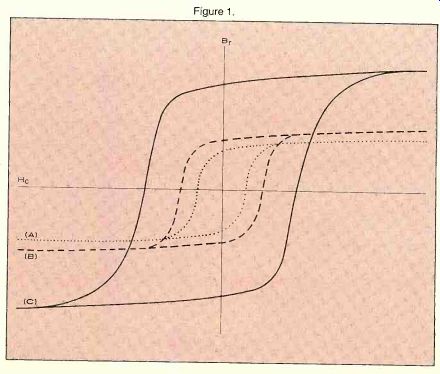
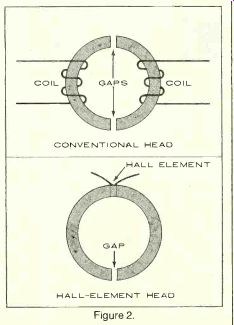
Figure 1, 2.
To make its Hall-effect tape head (see Figure 2), Hitachi starts with a yoke similar to that used for a conventional head. The head core provides the pole pieces and magnetic structure to gather and concentrate the flux from the recorded tape onto the surface of the Hall element, which can be located within the front or the rear gap. The Hall element itself is formed by first evaporating, then re-melting and re-crystallizing an extremely thin (one mi cron, or less than 40 millionths of an inch) layer of indium antinomide onto a ferrite substrate, and then connecting suitable electrodes for the control and output currents.
The inventor of the new head is Dr. Tetsu Oi, of Hitachi's Central Research Laboratory, who also perfected the special "micro-zone re-crystallizing" process that is necessary to obtain a sufficiently high signal-to noise ratio. (Ordinary Hall-element semiconductors are in use at retail checkout counters to read magnetically coded product prices and credit cards, but they don't have the signal-to noise requirements of a first-class tape head.) According to Dr. Oi, current models have about the same output from a Dolby-level tone on a tape as a conventional head does, but they offer a slightly better signal-to-noise ratio at the tape-preamplifier output.
Cassette decks using the new head will soon be available in Japan and later in this country, but it appears from my own calculations that the head's greatest potential may lie at open-reel speeds, where the greatest amount of bass-boost/treble-cut equalization is used. Further, open-reel is the format in which editing is important, and here the Hall-element head has a tremendous potential.
With ordinary heads, the tape must be in motion to produce any output at all, so to find an editing point you have to rock the tape back and forth across the heads and hope you can stop at just the right spot. A Hall-element head, however, works equally well whether the tape is moving or stopped, since it responds directly to the strength of the magnetic field rather than to the rate of change in the field. That in itself should make it a best seller for tape editors, including this one!
========================
Technical Talk
By Julian D. Hirsch
ARE SPEAKERS GETTING BETTER?
A letter from a reader comments that our recent test reports show a remarkable number of speakers having nearly flat response down to the lowest audio frequencies, seemingly without regard to their size or price. Is it really possible, he wonders, for, say, a $100 book shelf speaker to have a bass response that is only 3 dB down at 32 Hz without any significant loss of efficiency? His letter goes on to suggest that there has been either a sudden improvement in loud speaker technology or else a change in the Hirsch-Houck Labs' frequency-response measurement methods, and he asks which is the case.
First, it should be made clear that the speakers that appear in our test reports are not representative of everything good and bad-that's out there in the marketplace. Instead, the units chosen for test are selected from among the better speakers available to the consumer at various price levels. Therefore, any system reported on in our pages represents at least a reasonable value by today's speaker standards-but it is evident that those standards are considerably higher than they were several years ago.
As far as the Hirsch-Houck Labs' measurements are concerned, my low-frequency measurement technique employing a close-spaced microphone has remained unchanged for several years. Therefore, if the speakers in re cent test reports appear to have better bass response than their predecessors, it is simply because they do.
Over the years, I have given much thought to my test results and how well they do (or don't) correlate with what I hear. Could it be that my method of measuring frequency response is not sensitive enough any more to reveal the differences normally to be expected between speakers? Since we moved to a newly constructed laboratory nearly a year ago, there would seem to be the possibility that the new acoustic conditions are affecting results in spite of our best efforts to correct for them.
However, any such doubts I might have about the validity of our speaker-response measurements are dispelled by listening experiences in the same room used for the measurements. Once the levels of two speakers have been care fully matched for the particular program material, it is astonishing to hear how much alike the better systems sound.
The listening setup accommodates up to four sets of speakers that can be com pared in pairs at the touch of a button (which also simultaneously matches their sound levels). Often the only way I can tell (from a distance of 10 feet or more) which speakers are on is to look at the switch settings on the comparator panel. When I push the button, the only differences that stand out may be slight shifts in apparent source position or a change in spatial perspective related to the speakers' dispersion qualities.
ALL this certainly leads me to conclude that the better speakers are becoming more nearly alike in their important characteristics, though not necessarily in the subtleties that are stressed-perhaps overstressed-by many audiophiles. It seems clear that the essential sound ...
----Tested This Month: Onkyo A-7 Integrated Amplifier; Heath AD-1307 Control Center Koss ESP/10 Headphones Harman-Kardon Citation 16 and 16A Power Amplifiers SAE 2800 Parametric Equalizer---
... character of a system (which is basically determined by its octave-to-octave energy balance) can be as good in many $100 speakers as in others costing five or six times that much.
When making such heretical statements, one should take pains to be correctly understood. Since the sound of any speaker is radically influenced by the listening room and everything associated with it, and since not all speakers are affected in the same way by their surroundings, there are going to be many situations in which sizable differences will be heard between speakers even though my tests, or someone else's, indicate that they should sound pretty much alike. I cannot emphasize too strongly the importance of speaker placement, room dimensions, and room acoustics in determining the response one will actually hear. Just because a speaker measures nearly flat to 30 Hz in our tests, this does not mean that you or I will be able to hear a reasonably strong, clean 32-Hz note from it in our home listening rooms.
What it does mean is that, all else being equal, the speaker should deliver a deeper bass than some other whose close miked response does not extend so far downward in frequency.
I prefer to view my own--and other peoples'--tests and evaluations of speakers as general indicators of performance that should never be accepted by a reader as a guarantee that a certain speaker will sound precisely as good in his home as it did in our lab (or vice versa). Once again, I repeat my warning that the only sure way to know how a speaker will sound in your home is to listen to it in your home. The only thing you can learn with certainty from hearing it in another place is what it sounds like in that place. And, sad to say, even relative judgments between speakers can be affected by the environment, so that just because speaker A sounds somewhat better than speaker B in the showroom does not necessarily mean it will still sound better than B if you compare the two systems at home.
As to whether a small, inexpensive speaker can really have a good low-bass response without some sacrifice in performance, the laws of physics demand that some "trade-off" take place. For example, there will be wide variations between speakers (with the same bass frequency response) in their bass distortion at a given sound-pressure Revel, and also in the maximum bass level that can be produced without excessive distortion. A small cone can produce very low frequencies, but not at a very loud level.
If your aim is to "feel" the bass pressure, you should not count on doing so with one of the smaller speakers, even if its bass response at lower listening levels matches that of a larger speaker.
==============
Going on Record
THE GUARD CHANGES
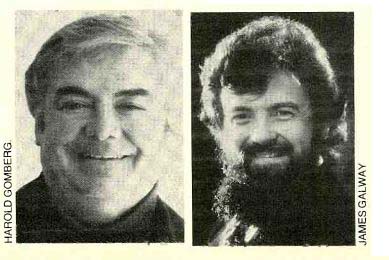
HAROLD GOMBERG, principal oboist of the New York Philharmonic, has made the orchestra season just completed his last. His decision to retire does not so much mark the close of a brilliant career (he is sure to make guest appearances and to continue recording) as it does the ending of one era and the beginning of a new one. Few men have dominated their fields, especially in the eyes of their colleagues, as Gomberg has dominated his. Other oboists had their adherents, but Gomberg was a phenomenon known to musicians everywhere, and the opportunity to hear him when the Philharmonic was on tour drew the best of his colleagues and competitors to the concert hall. He will be missed by many and dismissed by a few, the mark of not only a master, but a tough, strong-willed, and individualistic man.
Gomberg is representative of a class of musicians, those who so exemplified the mastery of their respective instruments that the mere mention of the instruments brought to mind (and still does, in some cases) the name of the instrumentalist. Jean-Pierre Rampal and Juli us Baker for the flute, Segovia for the guitar, Casals for the cello, Dennis Brain for the horn, Helmut Walcha and the late E. Power Biggs for the organ, Roger Voisin and Helmut Wobisch for the trumpet, William Primrose for the viola, and Reginald Kell-plus, in a special way, Benny Goodman--for the clarinet. Perhaps even more than the great pianists and violinists-who were, for obvious reasons, far more numerous-these men were the personifications, the virtual human equivalents of their instruments.
In their domination, though, they tended to overshadow others. The public mind, after all, is not really big enough, or interested enough, to retain the names of half a dozen flutists, hornists, clarinetists, or what have you. And so some extraordinary talents never received the approbation that was their due. I will not append a list here; every musician and music lover would have at least a handful of names to add to it. In most cases this complete possession of the spotlight was both a passive and an unintentional thing, but there are cases known where talents were deliberately covered, too-promising students held back, real competitors disparaged behind their backs. Such is the way of the world.
Many who sought a corner in the spotlight were younger than those who held it-but perhaps not enough younger. They came up during the prime of the great ones and suffered the fate of the acorn that falls too close to the tree.
But look at that list of masters now. Several are dead, some are retired, others are close to retiring. Even Rampal, whose strength "is as the strength of ten" and who is as active as ever, cannot claim to be getting any younger.
The same, needless to say, has been happening among the multifarious virtuosos of the violin and the piano. The guard is changing.
Some old-line music lovers (like myself) may have wondered about the host of new performers appearing, seemingly, every day and everywhere. I think that it is not that we are experiencing an unprecedented flowering of instrumental talent (though that may be the case in regard to certain instruments), but that the giants are starting to slip away and their shadows no longer mask the new growth.
With a place in the sun comes visibility, and that is what we are witnessing.
A few samples: James Galway is an astonishing flutist, with a sensational technique, fine musicianship, and, on the basis of his Mozart record (RCA ARL1-2159, reviewed in this issue), a powerful tone that is virtually halfway to that of a trumpet. Such attributes imply a certain style (and one might question what sort of a Faune he would make), but he is obviously someone to hear. Paula Robison is also making a considerable name for herself on the flute, Ransom Wilson will obviously be heard from more, and Franz Bruggen, who is by no means advanced in age despite his impressive list of recordings, already dominates the field of early music for flute and recorder.
These and others will obviously become the Moyses, the Kincaids, the Bareres, the Rampals, and the Bakers of a future time.
Among clarinetists, the estimable Gervase de Peyer probably holds the position once filled by Reginald Kell. But the young American Harold Wright and the young Scandinavian Kjell-Inge Stevensson, two very different kinds of players, must certainly join him and Stanley Drucker as important musicians.
As for the horn, there has probably been no one before Barry Tuckwell, at least in the modern world, who has been able to exist as a soloist without benefit of either an orchestral position or a teaching schedule. Tuckwell's solo recorded repertoire already far exceeds that of Dennis Brain, and, though no one who has heard it is likely to forget the special sound of Brain's horn, Tuckwell, together with the admirable Hermann Baumann, is ample evidence that virtuoso horn playing is far from a dying art.
Obviously an expanding field is that of the trumpet virtuoso, for the pioneering efforts of Voisin and Wobisch (among others) brought back to musical life the art and the repertoire of the Baroque trumpet, one that had lain dormant since the death of Johann Altenburg in 1801. (Those who go back twenty or twenty five years will remember recordings of the Bach Second Brandenburg Concerto with the trumpet an octave lower than written or the part played by a clarinet or soprano saxophone.) Today such young virtuosos as Ed ward Tarr and Gerard Schwarz, along with Don Smithers, John Wilbraham, and the Russian Timofey Dokschiitzer, cover the entire range of the repertoire with apparently ever increasing skill. The field is big enough now to rate more than a single giant.
SPACE limitations here allow only a sort of introductory sampling of this changing of the guard, but this will hardly be the last word on the subject. In future issues we expect to present interviews and critical assessments of many of these younger people who will be among the great musical names of their time.
You can tell the players without a scorecard, but a word even to the already wise can only make them wiser.
===========
Vintage magazine ADs:
The new Auditor Series by Koss.
Don't buy one unless your system is ready for it.
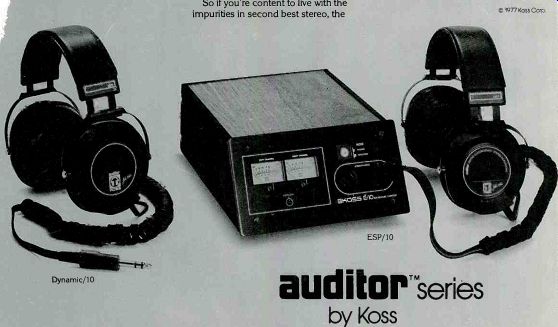
The pleasure of listening to unadulterated music is reserved for those who have carefully put together a system that delivers totally accurate reproduction. Now, for people who wish to explore and expand this realm of pure sound, Koss has designed their Auditor Stereo Headphones. Full, state of the art knowledge of perfect mechanical reproduction of music, and the psychoacoustics of the way the ear and mind respond to sound went into making these phones true to the most intense level of performance possible today.
The sound.
The Auditor Dynamic/10 features an expansive frequency response range of 10-20,000 Hz, while dazzling any ear tuned to the delicate musical balance psychoacoustically pleasing sound, a way no other dynamic phone can duplicate. They are designed to deliver the full impact of letter perfect sound reproduction characteristic of the finest equipment.
And the fury.
On the other hand, for the most carefully designed and engineered excursion into sound ever, the Koss ESP /10 Electrostatic Stereo Headphone is an unparalleled instrument of beauty. It is a perfectly articulated statement of technological and electronic genius so thoroughly sensitive it belongs in a recording studio serving as the last word in monitoring production. The ESP/10's almost boundless frequency response lays out the entire spectrum of sound for your scrutiny, bringing you every spark of timing, a deep, rich flood of bass, and a smooth, clear lake of treble, with every note balanced and defined.
So if you're content to live with the impurities in second best stereo, the Koss Auditors aren't for you. Only the high-end connoisseur who has taken all the necessary steps toward putting together a system that is true to perfection will acknowledge and appreciate these precise products as breakthroughs in scientific musical development The personal signature of John C. Koss says that these headphones are for the audiophile. So if you're ready for the best, and you think your system can measure up to the Sound of Koss, hear the headphones that are designed to put it to the test at a specialist in audio products near you.
Or write to Fred Forbes, Audiophile Products Division, for more information on the new Auditor Series by Koss.
Auditor series by Koss. 1977 Koss Corp.
KOSS Corporation, Audiophile Products Division, 4129 N Port Washington Ave., Milwaukee, Wisconsin 53212 Koss International/London, Dublin, Paris. Frankfurt Amsterdam Koss Limited/ Burlington, Ontario Koss K K./Tokyo
-----------
ONLY PIONEER COULD INTRODUCE A QUARTZ PHASE LOCKED LOOP TURNTABLE AND CALL IT A BARGAIN.
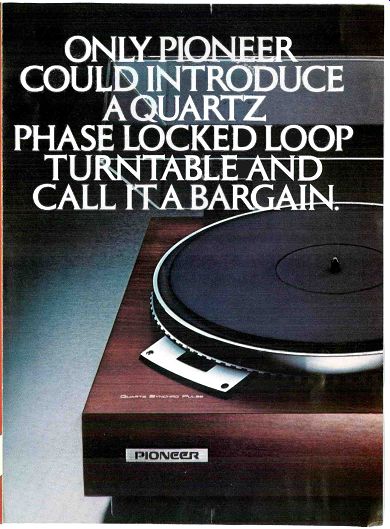
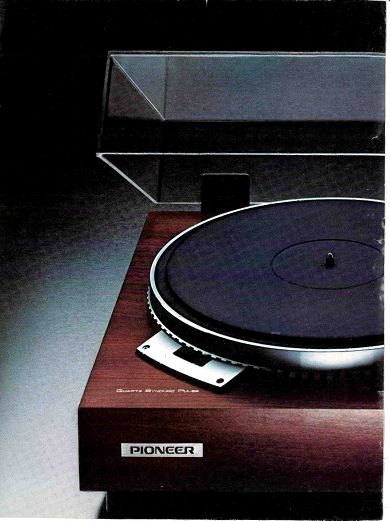
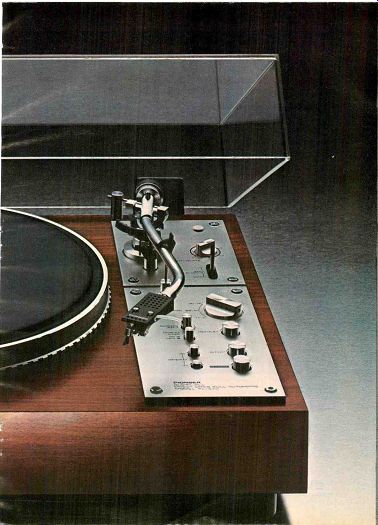
The average quartz phase locked loop turntable plays records virtually perfectly, has no audible wow or flutter, is unaffected by voltage changes, and manages to accomplish all this for slightly under $800.
The new PL 570, on the other hand, has all the same features, but with one distinct advantage: it costs less than $400. Which, you have to admit, is an awfully small price to pay for perfection.
MORE ACCURATE THAN A QUARTZ WATCH
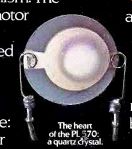
In brief, the PL 570 works by using a quartz crystal that oscillates 180 mil lion times a minute as a timing mechanism. The speed of our direct-drive platter motor is then "locked" onto that rate of oscillation-and constantly adjusted to account for things like heat, line voltage variations, and even the weight of the record on the platter.
The benefit of all this is simple: the PL 570 can run virtually forever with no variation in speed. In fact, it's so accurate, special measurements are needed to fully describe it. Something called "time drift" is a mere 0.0003%. A figure unsurpassed by the finest quartz watch that gains or loses up to ten seconds a month. And "thermal drift" is 0.00004%. Which means that while we can't guarantee just how well the PL 970 will play in your freezer, normal room and operating temperature variations shouldn't affect it at all.
In more mundane measurements, wow and flutter is 0.025%. Four times under what the human ear can hear. And even with the quartz phase locked loop off, the turntable speed is unaffected with stylus pressure of up to 120 grams. Which, by no small coincidence, is about 119 grams more than you'll ever apply, FOR THIS KIND OF MONEY YOU SHOULDN'T HAVE TO LIFT THE TONEARM.
Unlike any other quartz phase locked loop turntable, the PL 570 is automatic. So you're spared the burden of lifting our tone arm. But this isn't your average tone arm return system. Or your average tone arm, for that matter.
Where most automatic turntables use one motor for both the platter and tone arm, the PL 570 has a separate motor for each.
Which means that the action of the tone arm motor never interferes with the accuracy of the platter motor. And where most tone arms sense when to return by using cams and gears that lessen sensitivity and cause vibration, the PL 570 uses a light emitting diode that does neither.
Then there's the tone arm itself. It's fully adjustable. You can even set the vertical tracking angle of your cartridge with a height adjustment lever. And the whole unit is mounted in a 0.25 inch aluminum frame that not only looks nice, but helps your records sound nice by removing unwanted resonance.
OTHER FEATURES NOT USUALLY FOUND ON "BARGAIN" TURNTABLES.
When we set out to build the PL 570, we wanted it to be a lower cost quartz phase locked loop turntable. Not lower quality.
So like the quartz turntables that sell for hundreds of dollars more, the PL570 features an electric strobe rim lit that eliminates normal voltage frequency variations so you can adjust the PL 570 perfectly. Plus a "quick down" circuit that lets you go from 45 to 33 1/3 almost instantly. And one piece monocoque construction that ci its howling caused by vibration.
At Pioneer, we've become number one today with people who care about music simply because we've always managed to take state of the art technology, and offer it with some consideration of the state of your wallet.
If the PL 570 is any indication, it looks like we're getting better High fidelity Components at it all the time.
PIONEER' WE BRING IT BACK ALIVE.
1977. U.S. Pioneer Electronics, 85 Oxford Drive Moonachie, New Jersey 07074
The value shown in this ad is for informational purposes only Actual resale prices will beset by the individual Pioneer dealer at his option.
--------------------
The designers of the state-of-the-art DDX 1000 present a direct-drive turntable at less than a third the price: The DD 20.
The Micro Seiki DDX 1000 with its three tonearm capability and its optional highly-acclaimed MA 505 tonearms has taken turn table engineering in a new direction with its styling and audiophile convenience features.
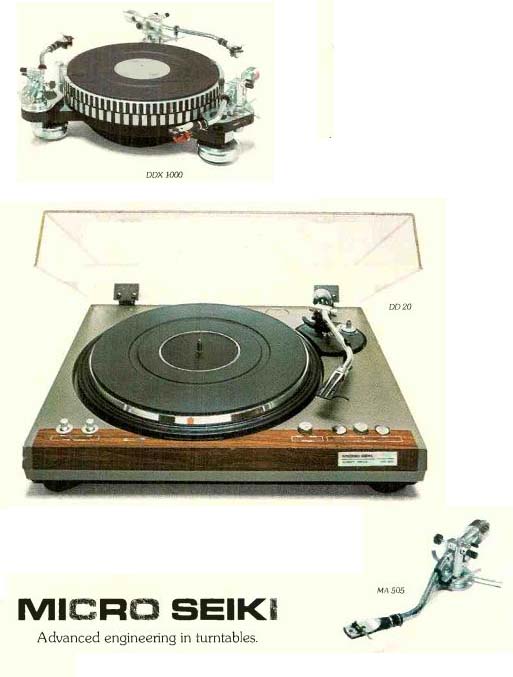
And now these same minds have engineered a superb direct-drive turntable for $200 (nationally advertised value)
Like the DDX 1000, the DD 20 has a servo-controlled motor; changes in line voltage have no effect upon rotation speed. A floating suspension system protects the turntable assembly and tonearm base, eliminating acoustic feed back and providing isolation from outside vibration.
Wow and flutter is less than 0.03 and signal-to-noise ratio is greater than 60 db.
Its precision-machined high mass platter has an engraved stroboscope pattern to attain absolute accuracy at 33 1/3 and 45.
The clean-lined base has an acoustic as well as an aesthetic function: formulated of a special compound of plastic and iron particles, it provides extremely high density. Result: 'a unique low resonance base.
Its specifications and engineering precision translate into a faithfulness of reproduction that will give you even greater enjoyment out of your favorite records.
Isn't it time to upgrade your pleasure?
MICRO SEIKI
Advanced engineering in turntables.
DDX 1000 Distributed by TEAC Corporation of America. 7733 Telegraph Road. Montebello. California 90640.
TEAC 1977.
Actual resale prices will be determined individually and at the sole discretion of authorized Micro Seiki dealers.
----------------------
5 LED peak level indicators help eliminate distortion.
Long life Sen-Alloy head Automatic recording Dolby reduces tape hiss. Bias and BO switches for all improves performance. when you're not there, types of tape, reduces distortion.
No cassette deck can give you better performance without all these recording ingredients.
Most quality cassette decks look pretty much alike on the outside.
So at first glance you might take the new JVC KD-35 for granted.
But take a second look.
You'll see something no other make of cassette deck has five peak-reading LED indicators.
With a faster response than VU meters, or even peak-indicating meters, they help you avoid under-recording and they eliminate tape saturation and distortion. It's as close as you can come to goof-proof recording.
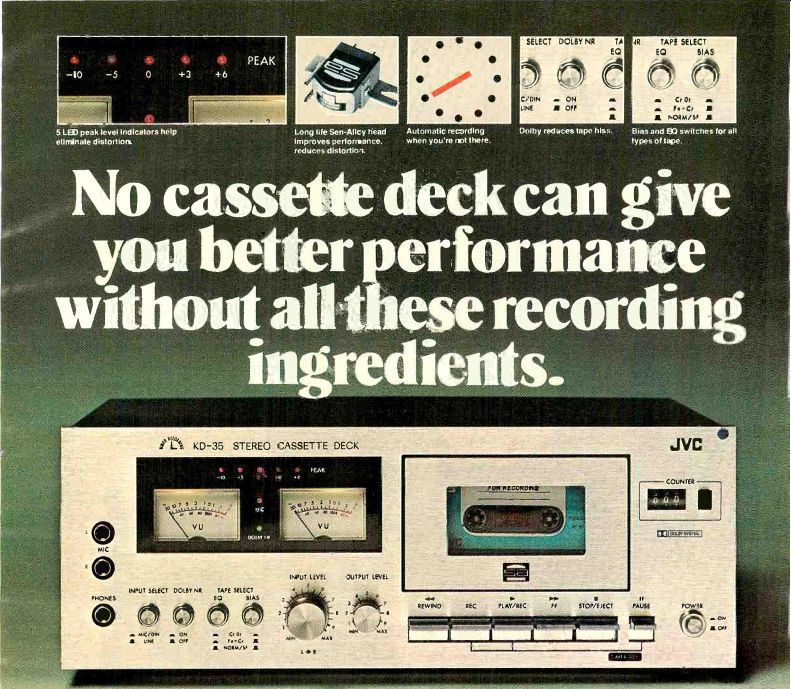
Then there's JVC's exclusive Sen-Alloy head for record and playback. Designed to give you the best of two worlds, it combines the truly sensitive performance of permalloy with the ultra long life of ferrite.
Of course, the KD-35 has many other features like Dolby, bias and equalization switches, and automatic tape-end stop in all modes. It's also possible to go from one operating mode to another without going through Stop. What's more, you'll never have to miss taping a favorite broadcast because you're not We build in what the others leave out there: just connect trip 14:0-35 to a timer and switch to automatic record.
And yet, with all this built-in capability, at $260, a the KD-35 is priced just above the least expensive model in JVC's new cassette deck lineup. Just imagine what our top model is like.
JVC America Company – a div. of US JVC Corp., 58-75 Queens Midtown Expressway, Maspeth, New York 11378. (212) 476-8300.
For nearest JVC dealer call toll-free (outside N.Y.) 800-221-7502. Canada: JVC Electronics of Canada, Ltd., Scarborough, Ont.
Approximate retail value. Dolby Is a trademark of Dolby Labs. Inc
-------------------------
Introducing New Quantum by Memorex.

Four Reasons It Sounds So Good.
1. Quantum offers low distortion. You get a true record mg of any type of music at high output, with virtually no distortion.
2. Quantum has very high sensitivity. This maximizes output and allows you to effectively capture all signal at a greater level.
3. Quantum provides an excellent signal-to-noise ratio' because its high sensitivity is obtained with no increase in noise level. This means a pure, brilliant sound.
4. Quantum gives you high saturation, resulting in a wide dynamic range and broad recording flexibility:
Quantum achieves improved recording performance while maintaining a high degree mechanical excellence. With long life, durability, precision edge quality and excellent oxide adhesion.
The best way to hear tie Quantum difference is to try it out for yourself. Available in 7" x 800', 7" x 2400' and 10 1/2" x 3600' reels.
MEMOREX Recording Tape.
Is it live or is it Memorex? 1977, Memorex Corporation, Santa Clara, California 95052, S.A.
----------------------
It's magic.
The accutrac 4000.
It thinks.
It remembers.
It sees.
It performs.
It takes the experience of listening to music into another dimension, another century.
Its the only instrument in the world that lets you hear the selections on a record in the order you like, as often as you like, and skip the ones you don’t like.
Even by remote control.
It sets a new standard of technical sophistication that will satisfy the most demanding purist.
Computer circuitry instead of mechanical functions.
We replaced hundreds of mechanical parts with advanced computer circuitry.
The latest mosaic chips combine the functions of thousands of transistors, diodes and other.
Components to control and program all automatic functions.
As easy as 5, 2, 6, 6.
The sleek control panel is something out of the 21st century.
Yet it's incredibly simple to operate.
Say you want to hear the fifth cut first, then the second cut, then the sixth cut twice.
Just push the buttons marked 5, 2, 6, and 6 again.
Then sit back and let accutrac do the rest.
It accepts up to 24 different commands.
The tonearm with eyes.
How does the accutrac know which track is which? Engineered into the cartridge is a solid-state infra-red generator which focuses a tiny beam of light onto the record.
The closely spaced grooves of each cut scatter the light, but the smooth surfaces between the cuts send the light back id the infra-red detector in the cartridge.
The information is instantaneously relayed to the brain in the turntable, which counts the tracks.
And your wish is its command, yes, master.
A small, cordless remote transmitter with a duplicate set of controls nestles in the palm of your hand as you relax in the comfort of your easy chair.
Point it towards the silver sphere across the room and the blinking red light on the remote receiver will let you know it has received your commands.
The arm your fingers never touch.
Because of Accutrac's unique programming capability, you never have to touch the tonearm.
And the controls are outside the dustcover, so you never risk accidentally damaging a record.
The tonearm has its own servo-motor which is decoupled the instant the stylus touches the record, so horizontal and vertical friction are virtually eliminated "wow", indeed.
The only "wow” you'll hear is from your friends. Accutrac's wow and flutter are a completely inaudible 0.03% wrms.
Rumble is -70db (din b).
The tracking force is a mere 1/4 gram tonearm resonance is only 8-10hz.
And a direct drive motor turns the record at the exact speed, while electronic speed monitoring sensors keep it there.
Magic & science.
The integration of computer circuitry, infra-red optics and audio technical excellence lets you hear the tracks you like, in the order you like, as often as you like, and even skip the ones you don’t like.
That's the genius of Accutrac.
ADC professional products a division of bsr consumer products group route. 303, Blauvelt, New York, 10913
----------------
Shure
The Test of Time.
Critics were most generous in their praise when the Shure V-15 Type III phono cartridge was first introduced. The ultimate test, however, has been time. The engineering innovations, the uniform quality and superb performance of the V-15 Type III have made it the audiophile's choice as the source of sound for the finest music systems both here and abroad.
Consider making the relatively modest investment of a new cartridge to upgrade the performance of your entire hi-fi system. It will make a difference you can hear! The original manuscript by I. S. Bach shown is reproduced by kind permission of the British Library.
Shure Brothers Inc. 222 Hartrey Ave. Evanston, IL 60204
In Canada: A. C. Simmonds & Sons Limited
TECHNI-CORNER, MODEL V-15 TYPE III
Tracking Force Range: 3/4 to 1 1/4 grams
Frequency Response: 10 to 25,000 Hz
Typical Tracking (in cm/sec peak recorded velocity at 1 gram:) 400 Hz . 26 cm/sec L000 Hz. 38 cm/sec 5,000 Hz . 35 cm /sec 10,000 Hz. 26 cm/sec
Channel Separation (Minimum): 25 dB at 1 KHz; 15 dB at 10 KHz
Stylus: Model VN35E Biradial Elliptical, 5 x 18 microns (.0002 x .0007 inches)
Also available: Model V-15 III G with the VN3-G Spherical stylus, 15 microns (.0006 inches) Model VN78E Biradial Elliptical stylus, 13 x 63 microns (.0005 x .0025 inches) for mono 78 rpm.
MANUFACTURERS OF HIGH FIDELITY COMPONENTS, MICROPHONES, SOUND SYSTEMS AND RELATED CIRCUITRY.
---------------------
Take a close look at a better record cleaner.
Audio-Technica AT6002 (84x enlargement) This is an A-T scanning electron microscope photo of the dirt that must be removed if your records are to sound clean. It's dirt that is falling on your records even as you listen.
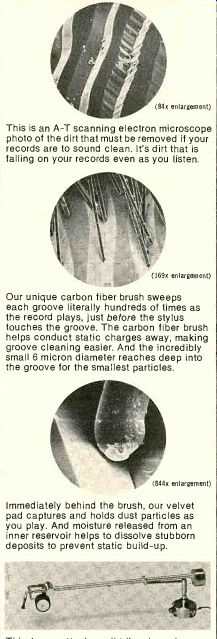
Our unique carbon fiber brush sweeps each groove literally hundreds of times as the record plays, just before the stylus touches the groove. The carbon fiber brush helps conduct static charges away, making groove cleaning easier. And the incredibly small 6 micron diameter reaches deep into the groove for the smallest particles.
(844x enlargement) Immediately behind the brush, our velvet pad captures and holds dust particles as you play. And moisture released from an inner reservoir helps to dissolve stubborn deposits to prevent static build-up.
This 4-way attack on dirt (brush, pad, liquid, and conductive path to ground) is uniquely effective. For proof, clean a record with any other system. Then "play" it with the AT6002. You'll find dirt removed by the AT6002 that was left behind by other cleaners. Try it today. Just $9.95 at all Audio-Technica dealers.
INNOVATION--PRECISION--INTEGRITY-- AUDIO-TECHNICA U.S., INC.
Dept. 87F/1, 33 Shiawassee Ave. Fairlawn, Ohio 44313
In Canada: Superior Electronics, Inc.
audio-technica.
-------------------
If you've been thinking Realistic is great only in the middleweight division, the STA-2000 is going to take you by surprise. We designed and manufactured it in our own factory to deliver quality beyond reproach, and judging from critical acclaim, we succeeded. The fine styling and precision controls are obvious. But the heart of this receiver is in its circuitry , the extra-low – noise phono stage . . the sensitive dual-gate MOSFET tuner with PLL. Come by your nearby Radio Shack for a free copy of the reviews. And hear for yourself what all the excitement's about.
You'll be amazed at just how far $499.95* can go. The Realistic 2000 75-watts per channel, min. RMS at 8 ohms from 20-20,000 Hz, with no more than 0.25% total harmonic distortion.
----- -
"noise figures rivaling those of many a separate (preamp) If any part approaches over-achiever status, it is the power amplifier . . . The controls are unusually flexible" High Fidelity Magazine, March 1977
----
"separation at mid-frequencies was an incredibly high 54 dB ... usable (FM stereo) sensitivity point was reached with a signal of only 5.0µV.
... excellent basic circuit design" Audio Magazine, March 1977
---
Rave-Reviewed Realistic 2000. SOLD ONLY WHERE YOU SEE THIS SIGN: A TANDY COMPANY FORT WORTH, TX 7610. 5000 LOCATIONS IN 9 COUNTRIES. These two credit-cards honored at most Radio Shacks. Price may vary at individual stores and dealers.
-----------------------
New Phase Linear III's restore the missing third dimension.
The third dimension of a live performance, that open airy feeling of "being there:' has been missing from recorded music. Until now. The new Phase III Loudspeakers create a sense of acoustic space never before achieved in a home stereo system.
Phase III is a four-way, four–piece system consisting of 20 drivers. The twin five foot panels utilize a precise geometric arrangement of the mid-range and high-frequency drivers designed to generate an ideal relationship between direct and reflected sound. The bass module, with its two 12" subwoofers, provides an awesome bass response. A separate Electronic Motion Control System provides spatial imaging circuitry, frequency tailoring and equalization. It in stalls easily in your amplifier or receiver. Phase Linear III can add an entirely new dimension to your listening enjoyment.
See your dealer and ask for an audition.The Powerful Difference. Manufactured in the USA. Distributed in Canada by H. Roy Gray, LTD.
-------------------
Technics knows there's more to Linear Phase than staggered speakers.
If staggered speakers were took to achieve phase linearity, other staggered speaker systems would sound like ours. But Technics knows it takes more. Much more.
Like a phase-controlled crossover network that takes into account the phase characteristics of each driver. Like extremely wide-range drivers, each with a frequency response that's as flat as it is wide. And finally, aligning the acoustic center of each for the optimum acoustic position.
But just as important, Technics knows that to achieve phase linearity as well as a wide and flat frequency response is also to achieve the ultimate m high fidelity: waveform fidelity. With it the output waveform of any component or speaker will be a mirror image of the waveform put into it. And that sounds better than good. It sounds live.
And if seeing is believing, look at the waveforms. On top is the oscilloscope reading (the fingerprint) of a live piano wave form. The other, the piano as reproduced by Technics Linear Phase SB-7000A. That's wave form fidelity you can see, as well as hear.
How did we do it? By designing a cross over network that would provide an overall linear phase characteristic for the entire …
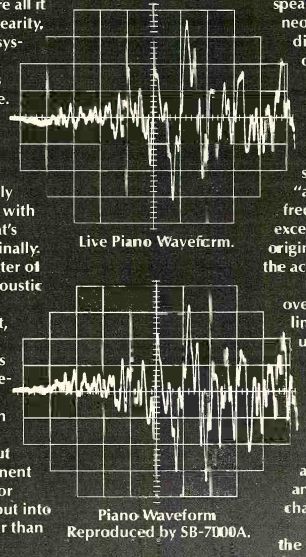
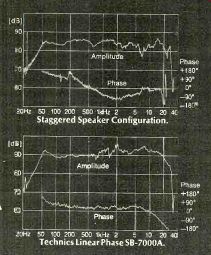
--Live Piano Waveform.--
…speaker system, while simultaneously compensating for the different acoustic pressures of the individual drivers.
When we finished we ended up with a unique phase-controlled crossover network consisting of 6 dB and 18 dB/octave cut-off slopes. It not only eliminates "audible clip" at the crossover frequencies, but also assures excellent localization of the original sound source within the acoustic field.
But as important as the cross over network is in achieving linear phase, so are the individual driver units. That's why we designed and manufactured Piano Waveform Reproduced by SB-71300A.
the speaker drivers with the flattest amplitude, widest frequency response and lowest distortion possible.
A goal we achieved only after exhaustive amplitude and phase studies in anechoic chambers.
Our final step was aligning the acoustic center of each driver in precisely the same vertical plane. But it took more than anechoic chambers. Technics had to develop a new time-delay system using BBD (Bucket Brigace Device).
Only then could we locate the optimum acoustic position for each driver. In addition, each unit is positioned vertically for the best horizontal dispersion and then spaced as
closely as possible for the best vertical dispersion of all audio frequencies. What's more, after alignment each unit is fine-tuned to assure precise linearity.
The result, with the SB 7000A for example, is an overall phase response, linear between 0° ±45° between 100Hz and 15kHz. A figure that's virtually flat and definitely unsurpassed by any other multi-range speaker system.
As the graphs prove, even staggered speaker systems with seemingly "linear phase" characteristics show moderate to severe phase shifts at different frequencies.. But as you can see, the Technics SB-7000A has an unprecedented flat amplitude/frequency response and linear phase response But we don't expect you to buy any speaker system based on how good it sounds on paper.
Audition the world's most linear phase speaker systems: the Technics SB-7000A, SB-6000A, SB-5000A.. You'll find out gust how much more there is to Technics
Technics by Panasonic
----------------
Empire
In the graph frequency response was measured using the CBS 100 Test Record, which sweeps from 20-20,000 Hz. The vertical tracking force was set at one gram. Nominal system capacitance was calibrated to be 300 picofarads and the standard 47K-ohm resistance was maintained throughout testing. The upper curves represent the frequency response of the right ( black land left (grey) channels. The distance between the upper and lower curves represents separation between the channels in decibels. The inset oscilloscope photo exhibits the cartridge's response to a recorded 1000 Hz square wave indicating its resonant and transient response.
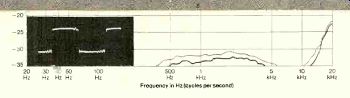
For more information on the Empire 2000Z, and our free brochure "How to Get the Most Out of Your Records: write: Empire Scientific Corp., Department 1055 Stewart Avenue, Garden City, N.Y. 11530. Empire
-----------------
WHY MOST CRITICS USE MAXELL TAPE TO EVALUATE TAPE RECORDERS.
Any critic who wants to do a completely fair and impartial test of a tape recorder is very fussy about the tape he uses.
Because a flawed tape can lead to some very misleading results.
A tape that can't cover the full audio spectrum can keen a recorder from ever reaching its full potential.
A tape that's noisy makes it hard to measure how quiet the recorder is.
A tape that doesn't have a wide enough bias latitude can make you question the bias settings.
And a tape that doesn't sound consistently the same, from end to end, from tape to tape, can make you question the stability of the electronics.
If a cassette or 8-track jams, it can suggest some nasty, but erroneous comments about the drive mechanism.
And if a cassette or 8-track introduces wow and flutter, it's apt to produce some test results that anyone can argue with.
Fortunately, we test Maxell cassette, 8-track and reel-to-reel tape to make sure it doesn't have the problems that plague other tapes.
So it's not surprising that most critics end up with our tape in their tape recorders, It's one way to guarantee the equipment will get a fair hearing.
MAXELL. THE TAPE THAT'S TOO GOOD FOR MOST EQUPMENT.
Maxell Corporation of America, 130 West Commercial Ave., Moonachie, N.J. 07074
-------------------
BE SURE YOU CHOOSE THE ONE YOU LIKE.
One of the reasons is that we've been making them for a long, long time. In 1955, TEAC came on the scene with the firs: in a long line of fine open reel tape recorders.
Since then, of course, we have developed a sister line of cassette decks. But our first love remains open reel tape recording equipment:
the truest method of sound reproduction available today.
Consider the alternatives. If you want top-of-the-line quality, but only need bottom-of-the-line features, the A-2300SX is the buy of the year.
From there, you can add DOLBY, larger 10 1/2" reels, four heads, auto reverse, four-in/ two-out mixer, memory stop, 15 ips, four channel Simul-Sync, and variations thereof.
Dolby is a trademark of Dolby Laboratories, Inc.
In short, as long as you're getting a tape deck, can you conjure up a single reason it shouldn't be a TEAC-- The leader. Always has been.
TEAC Corporation of America 7733 Telegraph Road Montebello, California 90640 In Canada TEAC is distributed by White Electronic Development Corporation (1966) Ltd.
TEAC 1977
-------------------
HITACHI R&P head.
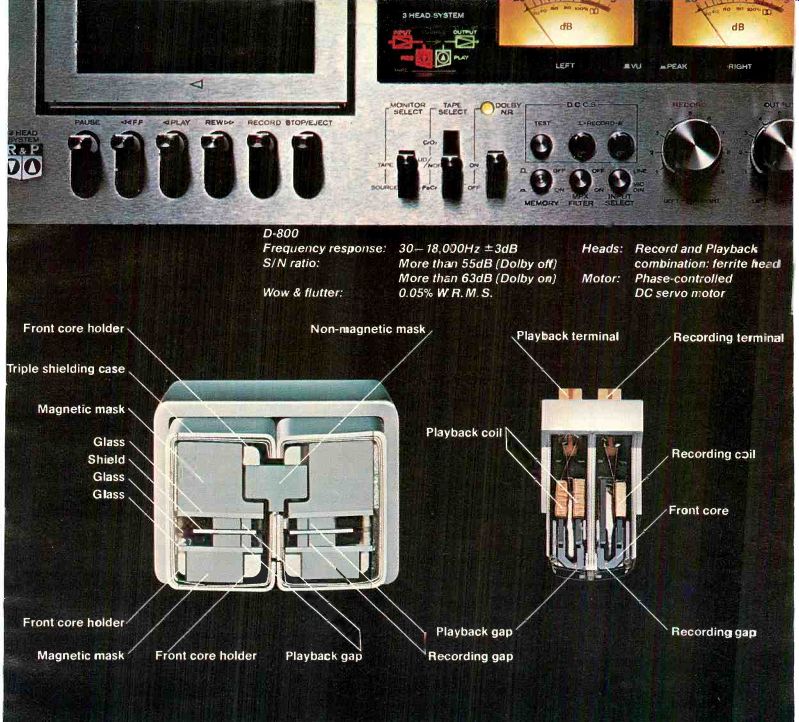
Three heads above other cassette decks.
Front core holder
Triple shielding case
Magnetic mask Glass Shield
Glass Front core holder
Magnetic mask
Front core holder D-800 Frequency response:
S/N ratio:
Wow & flutter: 30-18,000 Hz ±3dB
More than 55dB (Dolby off)
More than 63dB (Dolby on)
0.05% W R. M.S.
Playback coil Heads: Record and Playback combination: ferrite heed Motor: Phase-controlled DC servo 'rotor Playback terminal Playback gap / Playback gap Recording gap /Recording terminal Recording coil Front core Recording gap Three heads above other cassette decks.
Hitachi's R&P Head.
Two-head decks are compromise performers, because they use a single head for both record and playback.
To insure no-compromise performance, Hitachi developed the R&P 3-Head system. It uses 3 heads, like professional reel-to-reel decks. And these unique record/playback heads have separate and optimum gap widths extending both dynamic range and frequency range significantly.
The Hitachi R&P head is capable of play back monitoring, so you can compare the original source with your tape, a moment after it's recorded. And as an added benefit, its single housing eliminates height and azimuth adjustment problems.
Add up the benefits. You'll agree that Hitachi's decks are three heads above other cassette decks.
HITACHI When a company cares, it shows.
Audio Component Division, Hitachi Sales Corp. of America, 401 West Artesia Boulevard, Compton, CA 90220, (213) 537-8383, Extension 228
---------------
It's time for everybody else to start playing catch-up. Again.
From the very beginning, experts have acclaimed the performance and feature innovations of Yamaha receivers as nothing less than spectacular.
But now, we've outdone ourselves.
Yamaha is introducing a new line of receivers with such unprecedented performance, it's already changing the course of audio history.

Real Life Rated
While traditional laboratory measurements provide a good relative indication of receiver performance, they simply don't tell you how a receiver will sound in your living room in actual operation. So Yamaha developed a new standard for evaluating overall receiver performance under real life conditions. It's called Noise-Distortion Clearance Range (NDCR).
No other manufacturer specifies anything like it, because no other manufacturer can measure up to it.
We connect our test equipment to the phono input and speaker output terminals, so we can measure the performance of the entire receiver, not just individual component sections like others do. We set the volume control at-20dB, a level you're more likely to listen to than full volume. We measure noise and distortion together, the way you hear them.
On each of our new receivers, Yamaha's Noise-Distortion Clearance Range assures no more than a mere 0.1% combined noise and distortion from 20Hz to 20kHz at any power output from 1/10th watt to full-rated power.
Four receivers, one standard. On each of our four new receivers, Yamaha reduces both THD and IM distortion to new lows-a mere 0.05% from 20Hz to 20kHz into 8 ohms. This is the kind of performance that's hard to come by in even the finest separate components. But it's a single standard of quality that you'll find in each and every new Yamaha receiver. From our CR-620 and CR-820 up to our CR-1020 and CR-2020.
What's more, we challenge you to compare the performance and features of our least expensive model, the CR-620, with anybody else's most CR-620 H7183/71LI OTS CR-1020 expensive receiver. You'll discover that nobody but Yamaha gives you our incredibly low 0.05% distortion and-92dB phono S/N ratio (from moving magnet phono input to speaker output).
You'll also discover that nobody else starts out with such a variety of unique features. Independent Input and Output Selectors that let you record one source while listening to another. A Signal Quality Meter that indicates both signal strength and multipath. The extra convenience of Twin Headphone Jacks. Or the accurate tonal balance provided at all listening levels by Yamaha's special Variable Loudness Control.
More flexibility. It's consistent with Yamaha's design philosophy that you'll find the same low distortion throughout our new receiver line. Of course, as you look at Yamaha's more expensive models, it's only logical that you'll find the additional flexibility of more power, more functions, and more exclusive Yamaha features.
For example, there's a sophisticated tuner, with unique negative feedback and pilot signal cancellation circuits (patents pending), that makes FM reception up to 18kHz possible for the first time on a receiver. Plus other refinements like a Built-In Moving Coil Head Amp, Fast-Rise/ Slow-Decay Power Meters, and Yamaha's own Optimum Tuning System.
Now's the time to give us a listen. Our new receiver line is another example of the technical innovation and product integrity that is uniquely Yamaha. And your Yamaha Audio Specialty Dealer is an example of uncommon dedication to faithful music reproduction and genuine customer service. It's time you heard them both.
If your Yamaha Audio Specialty Dealer is not listed in the local Yellow Pages, just drop us a line.
YAMAHA Audio Division. P.O. Box 6600, Buena Park, CA 90622
1977 YAMAHA INTERNATIONAL CORP MC HEAD AMP CR-820
-------------------
Dual
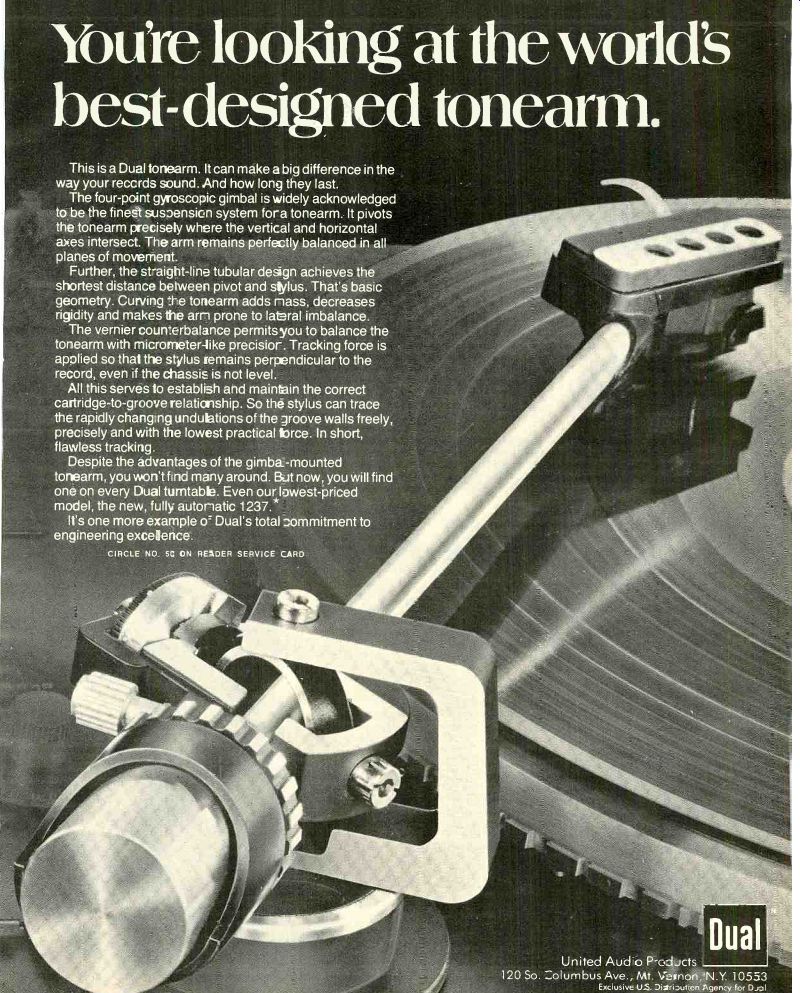
You're looking at the world's best-designed tonearm.
This is a Dual tonearm. It can make a big difference in the way your records sound. And how long they last.
The four-point gyroscopic gimbal is widely acknowledged to be the finest suspension system for a tonearm. It pivots the tonearm precisely where the vertical and horizontal axes intersect. The arm remains perfectly balanced in all planes of movement.
Further, the straight-line tubular design achieves the shortest distance between pivot and stylus. That's basic geometry.
Curving the tonearm adds mass, decreases rigidity and makes the am prone to lateral imbalance.
The vernier counterbalance permits you to balance the tonearm with micrometer-like precision. . Tracking force is applied so that the stylus remains perpendicular to the record, even if the chassis is not level.
All this serves to establish and maintain the correct cartridge-to-groove relationship. So the stylus can trace the rapidly changing undulations of the groove walls freely, precisely and with the lowest practical force. In short, flawless tracking.
Despite the advantages of the gimbal-mounted tonearm, you won't find many around. But now, you will find one on every Dual turntable. Even our lowest-priced model, the new, fully automatic 1237. It's one more example o: Dual's total commitment to engineering excellence.
------------------
AKAI
Choosing a tuner and an integrated amplifier is a lot like choosing a mate. You look for things like compatibility, performance, appearance and, of course, fidelity.
AKAI just made the process of matching component separates foolproof with a new line of tuners and integrated amplifiers. Paired on the grounds of total compatibility.
And priced to be affordable.
Take the AT-2600 and the big AM-2800 amp, with a solid 80 watts, RMS per channel, 8 ohms, 20-20,000 Hz at .08% Total Harmonic Distortion.
Or the AM-2600 amp at 60 watts, RMS per channel, 8 ohms, 20-20,000 Hz at 0.1% Total Harmonic Distortion. And match it with the AT-2600 tuner.
Or maybe the AM-2400 amp at 40 watts, RNIS per channel, 8 ohms, 20-20,000 Hz at .15% Total Harmonic Distortion. And the AT-2400 tuner.
No matter which of the perfect AKAI couples you choose, you get specs and features not found on all-in-one receivers in the same price category. Improvements you can hear.
With clean, clear power per channel.
To hear the new separates, see your AKAI dealer. And live in perfect harmony.
For a 18 "x 24" poster of this Charles Bragg etching, send $2 to AKA1, Dept. SR, 2139 E. Del Amo Blvd., P.O. Box 6010, Compton. CA 90224, ATTN: Couples.
AKAI INTRODUCES THE PERFECT COUPLES.
------------------------------
Yours to examine FREE for 15 days.
25 FACT-FILLED CHAPTERS ARRANGED IN "EASY-TO-FIND" QUESTION AND ANSWER FORM.

Basic Principles of Sound
Acoustics, Studio techniques, and Equipment
Constant-Speed Devices, Motors, and Generators
Microphones
Attenuators
Equalizers
Wave Filters Transformers and Coils
Sound Mixers
VU and Volume Indicator Meters
Vacuum Tubes, Transistors, and Diodes
Audio Amplifiers
Disc Recording
Cutting Heads
Recording and Reproducing Styli
Pickups
Magnetic Recording
Optical Film Recording
Motion Picture Projection Equipment
Loudspeakers, Enclosures, Headphones, and Hearing Aids
Power Supplies
Test Equipment
Audio-Frequency Measurements
Installation Techniques
General Information, Charts and Tables
Be our guest. Examine the AUDIO CYCLOPEDIA free for 15 days. You'll find out why it is considered the most comprehensive and authoritative book ever written on the subject. And you'll get a FREE $3.50 bonus book to keep no matter what! The AUDIO CYCLOPEDIA is literally a one-book audio library. It has long been considered ''the bible" by amateur stereo buffs as well as professional technicians. That's why you'll find it in constant use not only in home workshops and at stereo centers, but also in recording studios, broadcast booths and concert halls.
This giant reference book is over 3" thick, and packed with 1,757 illustrated pages. It features 3,645 questions and answers and a 50 page "instant-find" index for subject identification. It is truly the big one in audio electronics and it puts all the information you'll ever need right at your fingertips, chapter by chapter.
Send for the AUDIO CYCLOPEDIA today.
If you don't agree that it's the most important piece of audio equipment you own, just return it within 15 days. You won't owe a cent. And no matter what you decide, you'll get a free $3.50 copy of The ABC's of Tape Recording to keep just for mailing the coupon.
FREE-BOOK FREE-TRIAL COUPON
Save postage & handling costs. Full payment enclosed (plus tax where applicable). 15-day return privilege still applies.
Yes, please rush me the AUDIO CYCLOPEDIA (#21455) for my free trial. I understand if not completely satisfied, I may return it within 15 days, and owe nothing. Otherwise, it's mine to keep for only $34.00 plus postage and handling and local taxes (where applicable).
And, whatever I decide, a copy of "The ABC's of Tape Recording" (valued at $3.50) is mine free! Name Address City State Zip Mail to Audel 4300 W. 62nd Street Indianapolis, Indiana 46206 A Division of Howard W Sams & Co., Inc.
----------------
Lux
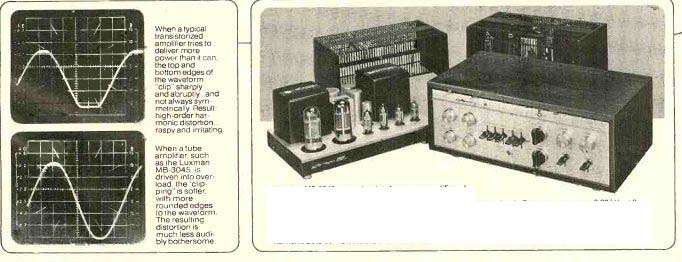
If you're surprised to learn that tubes solve some amplifier problems best, you have something to learn about amplifiers.
And about LUX.
It may seem courageously retrogressive for a company to introduce a tube amplifier-even a highly advanced type-to the semiconductor audio world of 1976. Especially for a company only recently established in the market with a comprehensive line of solid-state amplifiers and tuners.
But for LUX, it is simply consistent with our philosophy:
whatever path may lead to improvement in the accuracy of music reproduction will be explored by our audiophile/ engineers. Whether it leads to transistors or tubes.
Certainly, transistors are not about to be obsoleted by tubes. However, there are some amplifier problems that tubes still handle better than transistors. Overloading is one such problem.
When a solid-state amplifier is driven beyond its rated power, it clips abruptly. Engineers call it "hard" clipping. The term is apt, as the sound from the spurious high-order odd harmonics is raspy and irritating. Further, if the overall circuitry is not stable, and the protective circuits not very well-designed, the distortion is extended in time beyond the moment of overload. Drive a tube amplifier beyond its rated power and it too clips the waveform, but gently and smoothly. This "soft" clipping introduces much smaller amounts of odd harmonics. The distortion is far less irritating, hence less noticeable.
Notch (or crossover) distortion, present in many transistor amplifiers, is another source of spurious high-order odd harmonics. It occurs when the transistor output circuits are notable to follow the musical waveform accurately at the points where it changes from positive to negative and back again. Since notch distortion, unlike clipping, is at a constant level regardless of the power the amplifier is delivering, the ratio of this distortion to signal is worse at lower power. The gritty quality heard from many transistor amplifiers, particularly when they are playing at low levels, is usually due to crossover distortion.
Of course, tubes also have their limitations. Especially When a typical transistorized amplifier tries to deliver more power than it can.
the top and bottom edges of the waveform "clip" sharply and abruptly ... and not always symmetrically. Result:
high-order harmonic distortion... raspy and irritating.
When a tube amplifier, such as the Luxman MB-3045, is driven into over load, the "clipping" is softer, with more rounded edges to the waveform.
The resulting distortion is much less audibly bothersome.
Conventional tubes. The only tube previously capable of high-power amplification-the pentode-has inherently higher levels of distortion than the triode. Existing lower-distortion triode tubes cannot deliver sufficiently high power as a simple push-pull pair. But LUX, together with NEC engineers, has developed the first of a new breed of triode tube, the 8045G, which with other related technological advances, makes possible a high-power, low-distortion triode amplifier-the Luxman MB-3045. Among the differences in this new triode: the plate-electrode uses a special bonded metal with high heat-radiation characteristics. Also, the fin structure further aids heat dissipation.
LUX also developed a low-distortion high-voltage driver tube, the 6240G, capable of delivering over 200 volts of audio signal to the output triodes. Also, a new output transformer (LUX's, long-time special area of expertise) has been designed to take optimal advantage of the triode configuration feeding it. The quadrafilar winding and core technology of this transformer represents another break through. Overall, from input to output, the use of advanced design direct-coupled and self-balancing differential amplifier stages ensures stability and minimum phase shift.
The MB-3045 produces a minimum of 50 watts continuous power into 4, 8, or 16 ohms, at any frequency from 20 to 20,000 Hz, with total harmonic distortion no more than 0.3%. As the MB-3045 is monophonic, a pair of them connected to a stereophonic preamplifier will not be subject to stereo power-supply interaction.
Now, we didn't expect the MB-3045 to become the world's best-selling amplifier, any more than Our highest-power solid state power amplifier, the M-6000 priced at nearly $3000.
You'll find both at our carefully selected LUX dealers who will be pleased to demonstrate them for you. And any of the other dozen or so LUX models. It's why they're LUX dealers in the first place.
Luxman MB-3045 monophonic tube power amplifier.
50 watts minimum continuous power into 4, 8, or 16 ohms, 20-20 kHz; total harmonic distortion no more than 0.3%. Frequency response: 10 to 40 kHz, ± 1 dB.
Signal to noise ratio: 95 dB. Variable sensitivity, control for matching gain to any preamplifier. $495,00 each.
Luxman L-35111C stereo tube preamplifier. Total harmonic distortion: 0.06% at 2.0 V, 20-20 kHz. all output signals. Frequency response: 2-80 kHz, +0 -0.5 dB. RIAA equalization: ±0.3 dB. Features include: tape monitoring and dubbing, 6 selectable turnover frequencies, twin high and low noise filters, switchable phono-input impedance (30. 50, 100 k-ohms). variable input sensitivities. $795.00.
LUX Audio of America Ltd.
-------------
Also see:
THE AUDIBILITY OF DISTORTION IN LOUDSPEAKERS--Surprising results when you test with music instead of sine waves, PETER FRYER [Aug. 1977]
EQUIPMENT TEST REPORTS: Hirsch-Houck Laboratory test results on the Onkyo A-7 integrated stereo amplifier, Heath AD-1307 audio control center, Koss ESP/10 electrostatic headphones, Harman-Kardon Citation 16 and 16A stereo power amplifiers, and SAE Mode12800 stereo parametric equalizer, by JULIAN D. HIRSCH