EQUIPMENT TEST REPORTS: Hirsch-Houck Laboratory test results on the Onkyo A-7 integrated stereo amplifier, Heath AD-1307 audio control center, Koss ESP/10 electrostatic headphones, Harman-Kardon Citation 16 and 16A stereo power amplifiers, and SAE Mode12800 stereo parametric equalizer. By Hirsch-Houck Laboratories
------------
Onkyo A-7 Integrated Stereo Amplifier
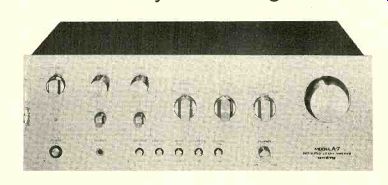
ONKYO'S Model A-7 is that company's finest integrated stereo amplifier, rated to deliver 65 watts per channel to 8-ohm loads from 20 to 20,000 Hz with less than 0.1 percent total harmonic distortion. Its frequency response is specified well beyond the audio range, with a ±1 dB rating from 2 to 80,000 Hz. This accounts for its excellent low-frequency square-wave response. (A 50-Hz square wave is said to emerge from the amplifier with less than 5 percent tilt on its top and bottom, indicating flat response with out significant phase shift to well below 5 Hz.) The Onkyo A-7 has a thick brushed-satin aluminum panel and machined metal knobs that give it an exceptionally rugged appearance-which is more than skin deep, we might add. Volume is adjusted by a large, heavy knob that operates a true thirty-two step switch attenuator (as opposed to the more common potentiometer control with mechanical detents). The upper eighteen steps adjust the volume in 1-dB increments, in creasing to 2-dB and larger steps as the volume is further reduced.
Three bar knobs in the center of the panel select the program source and control the two tape decks that can be connected to the A-7.
The input selector has positions for two magnetic phono cartridges, tuner, and a high-level (Aux) input. The MONITOR switch connects either the selected source or the playback output from tape deck 1 or tape deck 2 to the amplifier. The DUBBING switch cross-connects the two tape decks so that tapes can be copied from either machine to the other.
To the left of these controls are the bass and treble tone controls. Each is an eleven-position selector switch, boosting or cutting the response in 2-dB steps. Below each control is a smaller knob that serves to bypass the tone-control circuits entirely or change the turnover frequency. The bass-turnover frequencies are 125 and 400 Hz, and the treble frequencies are 2,000 and 8,000 Hz. The SPEAKERS switch connects either, both, or neither of two pairs of speakers to the amplifier outputs.
The other controls, principally pushbut tons, include the power switch (with a nearby pilot light), SUBSONIC and high-frequency filters, the mono/stereo MODE switch, LOUD NESS compensation, and a 20-dB audio MUT ING switch. The balance control and a stereo-headphone jack complete the front-panel features. At the amplifier's rear, in addition to the signal inputs and outputs, there are separate preamplifier outputs and power amplifier inputs joined by jumper links. Insulated binding posts are used for the speaker connections, and one of the three a.c. outlets is switched. The Onkyo A-7 is 17 1/2 inches wide, 15 inches deep, and 6 1/4 inches high. It weighs about 30 pounds, including the furnished black metal protective cabinet. Price: $350.
Laboratory Measurements. Probably be cause the Onkyo A-7 carries a modest power rating for an amplifier of its size and weight, it became only slightly warm during the one-hour FTC preconditioning period. The output, with both channels driven at 1,000 Hz into 8-ohm loads, clipped at about 76 watts per channel. The 4- and 16-ohm outputs were 105 and 48 watts. The total harmonic distortion (THD) at 1,000 Hz was essentially the residual of our test instruments (0.002 to 0.0025 percent) from 0.1 to more than 20 watts output. It increased to 0.0045 percent at 50 watts and to 0.007 percent at 70 watts. The inter-modulation distortion (IM) was 0.05 percent at 0.1 watt; it decreased to 0.006 percent in the vicinity of 10 watts and rose to 0.028 percent at 70 watts. It also rose at extremely low power levels, to 0.19 percent at 6 milliwatts output.
The Onkyo A-7 was driven to a reference output of 10 watts by a high-level input of 62 millivolts or a phono input of 1 millivolt. The respective unweighted noise levels, referred to 10 watts, were-78 and-74 dB, both excellent figures. The phono preamplifier stage overloaded at a high and safe 235-millivolt in put. The manufacturer points out that precision components are used for the RIAA equalization circuits of the A-7, so that its equalization accuracy is rated at ±0.3 dB from 30 to 15,000 Hz. That is exactly what we measured, and the same tolerance applied in fact to the extended phono response from 20 to 20,000 Hz. There was virtually no interaction with phono-cartridge inductance, which increased the output by only about 0.8 dB at 20,000 Hz.
The selectable tone-control turnover frequencies of the A-7 give it considerable flexibility in meeting specific response needs.
However, we noted that the maximum range of the bass control, in particular, was far larger than it needed to be. With the 400-Hz turn over, about 23 dB of boost was available at 20 Hz, and with the 125-Hz turnover the maximum boost was almost 20 dB at 20 Hz and still increasing at lower frequencies. These controls should be used with caution, since it would be easy to overdrive a speaker (or the amplifier itself) at very low or high frequencies by indiscriminate use of bass boost.
The loudness compensation, which boosted both low and high frequencies, was very mild in its action and therefore more listenable than most such systems (especially if the audio muting is used so that the volume control can be operated in the upper half of its range).
The SUBSONIC filter is rated to take effect be low 10 Hz with a 6-dB-per-octave slope. It affected the output at 20 Hz by less than 1 dB.
The HIGH filter also had a 6-dB-per-octave slope, with the-3-dB response point at 5,500 Hz. It was about as effective as such a gradual filter can be since the cut-off frequency is well chosen for reduction of noise with minimum effect on the program.
Comment. The Onkyo A-7 is a smooth amplifier whose virtues are best appreciated in use rather than by reading its specifications. From the beginning, we sensed the care that had gone into providing exactly the right tactile response in the controls. Although the volume detents are distinct, they are so light that one might turn the knob without really being aware that it is a stepped control. This sensation is enhanced by the unobtrusive way in which the level changes as the control is turned, with no sudden or unexpected changes in volume (even the steps themselves are rarely audible as such).
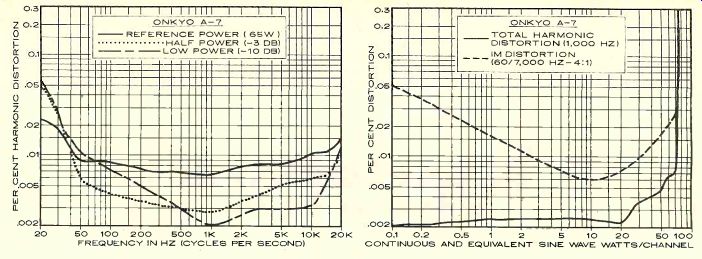
----------- FREQUENCY IN HZ (CYCLES PER SECOND) CONTINUOUS AND EQUIVALENT
SINE WAVE WATTS/CHANNEL
All the other controls operated as effectively, without noise but with a positive "feel" that complements the A-7's overall air of precision. We are well aware that other makes of amplifiers have many of the same qualities, but in few of them have all these virtues been put together without slipping up somewhere.
If Onkyo "goofed" anywhere, we didn't find any evidence of it.
As for how the A-7 sounds, we can say simply that nothing we have heard sounds any better. This is only to be expected from an amplifier whose performance is so much better than that of any other part of a music system. It doesn't distort; it doesn't add hum or noise (subjectively, it is even quieter than the unweighted measurements would suggest); it doesn't emit clicks or thumps, no matter how the controls are handled; it can perform just about any normal system-control function; it is powerful enough for almost everyone; it looks good; and its price is not unreasonable.
To us, all of this adds up to a very successful product.
==================
Heath AD-1307 Audio Control Center
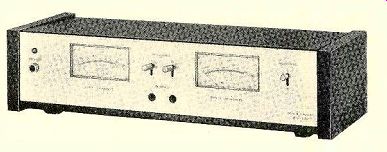
IN our reviews of Heath's most powerful amplifier, the excellent AA-1640 (STEREO REVIEW, May 1975 and October 1976) we commented on its meters, which displayed the true instantaneous power-output level of the amplifier. At the time, we were so impressed that we expressed the wish that these meters be made available as an accessory for use with other amplifiers.
Perhaps somebody at Heath was listening, for they have now made available the Model AD-1307, an audio control center based on these meters and their electronic circuits. The unit can also serve as a system control center for both a.c. power and speaker switching.
Styled to match other recent Heath audio components, the AD-1307 is supplied with walnut end panels that contrast with its brushed-aluminum front panel and black-finished metal cabinet. The POWER pushbutton at the left of the panel (with a LED pilot lamp above it) energizes the internal meter circuits and also applies power to the four switched a.c. outlets in the rear of the unit.
This is a boon to the audiophile who has (or plans to have) a super-power amplifier but whose preamplifier (like most) cannot safely switch hundreds of watts of primary power.
The Heath AD-1307 power switch can control up to 1,500 watts through its accessory out lets, enough for a pair of AA-1640 power amplifiers (or their equivalents) plus all the other components likely to be used in a high-quality music system. It also has four more unswitched outlets, also able to handle up to 1,500 watts. When power is on, the meter scales are illuminated, leaving no doubt as to the status of the system.
The meters have logarithmic scales covering a range of more than 33 dB. They are also calibrated in watts (to 8-ohm loads) from 0.2 to 200 watts (the upper portion of the scale, from 0 to +3 dB, extends the range to 400 watts).
The AD-1307 has inputs for two separate stereo amplifiers and two pairs of speakers. A MONITOR level switch connects the meters to either the A or the B amplifier's speaker terminals. Normally, the A and the B pairs of speakers can be connected only to their respective amplifiers (by moving the corresponding SPEAKERS lever switch to its up position) or shut off (by moving the switch down).
With a quadraphonic system, connections can be made that will allow the meters to display power levels in all four channels. An alternative connection for stereo systems is to wire jumpers externally between the corresponding terminals of the A and B amplifier connections so that either the A or the B speakers (or both) can be connected to the amplifier with the front-panel switches.
In addition, there are separate conventional headphone jacks on the front panel for both A and B amplifier outputs. Resistive L-pads isolate the phone jacks from the amplifier outputs so that phones can be used safely with amplifiers of any power rating. Additional terminals are provided in the rear of the unit for connecting electrostatic headphones directly to the amplifier speaker-terminal outputs. The speaker connections are made with the polarized screw-head plugs introduced by Heath in their Modulus series of components. Standard screw-type barrier strips are used for the amplifier's speaker connections and electro static headphone connections.
The specifications of the Heath AD-1307, though brief, are impressive. The peak-responding meters have a rated response time of less than 50 microseconds and a decay time than (1 5 seer-nd The overall dimen […] dicated transient power levels. So long as the interval between bursts did not exceed 10 milliseconds, the meters exactly indicated the steady-state level with bursts as short as 10 microseconds! Longer "off" times between bursts caused the meters to read less than the steady-state power. For example, a 100-millisecond "off- time gave a-3-dB error when the burst duration was between 1 and 10 milliseconds. In the standard test for VU meter ballistics (applying a 0.3-second burst at a rate of once per second) the meters read 1.5 dB low, nearly as fast as LED displays, the meters gave at all times a running account of the maximum power that the amplifier was called upon to deliver. We would have appreciated more intermediate calibration marks on the meters (the major markings are at 0.2, 2, 20, and 200 watts), but this can surely be assigned to the category of "nit-picking." The price of the unit might seem a bit high for a pair of meters and some switches. however, the AD-1307 is much more complicated than that. No unassisted mechanical meter movement can respond in microseconds, and the performance of the Heath unit is made [missing content].
=================
[missing pages]
Koss ESP/10
[...] extended, flat bass response of the ESP/10 (like that of the ESP/9) is perhaps less obvious, but it is just as remarkable as its mid- and high-frequency response. These are the only headphones through which we have been able to hear consistently whatever turntable rumble exists either on records themselves or on FM broadcasts using them.
Earlier in this report we wondered how one goes about improving a product that is already a leader in its field. Clearly, one does this by making it more reliable, more comfortable, and generally more convenient to use without in any way degrading its sound quality. That is what Koss did, and the result is a head phone we are quite sure will enjoy the same reputation its predecessor did.
=============
Harman-Kardon Citation 16 and 16A Stereo Power Amplifiers
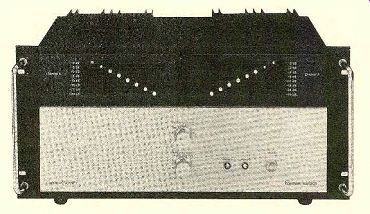
THE Harman-Kardon Citation 16 power amplifier, which has been on the market for several years, has undergone some changes and is now designated the Citation 16A. Externally, the only differences are mi nor cosmetic ones in knob styling and panel lettering. Almost all the published specifications for the 16A are identical to those for the 16. The principal change seems to be a slight reduction in the power bandwidth--from 110 kHz to either 45 or 70 kHz (the figure is given differently in the operating and service manuals). With the bandwidth rating reduction, however, comes a lower distortion rating, between 0.1 to 0.05 percent at 75 watts output into 8-ohm loads over the specified frequency range.
The basic specifications of the H-K Citation 16/16A are quite impressive in themselves.
The FTC power rating is 150 watts per channel into 8-ohm loads, from 20 to 20,000 Hz, with less than 0.05 percent total harmonic distortion (THD). The square-wave rise time is rated at less than 3 microseconds, and the slew rate at greater than 30 volts per microsecond. The noise level is rated at better than 100 dB below 150 watts, the input impedance is 22,000 ohms, and a signal input of 1.25 volts is required for full output.
The H-K Citation 16A is large and heavy compared with some other similarly rated amplifiers. This results, in part, from the fact that each channel has a completely separate power supply. Each output stage uses ten power transistors whose massive heat sinks occupy most of the rear of the amplifier. Between the two sets of heat sinks are the signal-input phono jacks and the speaker outputs, which use insulated binding posts on standard 3/4-inch centers. The heavy-duty power cord is fitted with a three-prong molded plug.
The most distinctive features of the H-K Citation 16A, viewed from the front, are the two slanting rows of LED lights, extending upward and outward from the center of the panel. Each channel has eight lights, which come on progressively at power levels from -30 to 0 dB (the amplifier's rated maximum output). The 0 and-3-dB lights are red, warning of possible overload, the -6- and -9-dB lights are amber, and the others are green. A rotary switch on the panel increases the display sensitivity in three steps (at maximum sensitivity as little as 4 milliwatts will light the -30-dB LED). It will also turn all the lights on (the so-called TEST position) or shut them all off if desired. Another knob changes the calibration to match operation into either 4- or 8-ohm speaker loads. The amplifier itself is turned on and off by a pushbutton switch, and two red pilot lights glow when the primaries of the two power transformers are energized (so that an extinguished light signifies a blown fuse for that channel).
With the minor exceptions noted, every thing we have said applies equally to the original Citation 16. Curious about the differences between the two, we obtained a sample of each. A careful comparison of their schematic diagrams revealed several circuit differences.
The Citation 16 used integrated-circuit "op-amps" in its input section, while in the 16A this function has been taken over by a number of discrete transistors and associated components. Also, in several places in the amplifier a single transistor has been replaced by a Darlington pair (a higher-gain component), and there have been a few minor changes of component values. We also found a change in the amplifier's protective-relay circuit, which disconnects the speakers instantly if any d.c. component appears in the amplifier's output (it also provides a turn-on delay of several seconds). Here we found an added IC op-amp, presumably to increase the sensitivity of the protective circuit.
Harman-Kardon notes that the 16A output stages are operated in Class A up to about 2.5 watts output, where the transition to Class AB occurs. The practical effect of this is to cause the transistors to operate at a higher quiescent temperature than would exist with normal Class AB bias (which apparently was used in the original Model 16). In the service manual for the 16A it is stated that the heat sinks will reach 60 degrees Celsius (140 degrees Fahrenheit) during sustained idling, and at the one-third-of-rated-power level used in the FTC preconditioning period the tempera ture will reach 80° C (176° F). A thermal protective device cuts off the amplifier's power if the temperature reaches 90° C (194° F).
The Harman-Kardon Citation 16A is 19 1/8 inches wide, 9 1/2 inches high, and about 13.5 inches deep. It is equipped with handles on the front panel, and the panel is drilled for rack mounting. The amplifier weighs 55 pounds. Price: $795.
Laboratory Measurements. We subjected both amplifiers to the same tests. After the preconditioning period, the heat sinks of both amplifiers were too hot to touch comfortably for more than a second or two. The outputs clipped at about 200 watts per channel into 8 ohms at 1,000 Hz. The output into 4 ohms was 240 watts for the Model 16 and 277 watts for the 16A. The respective 16-ohm outputs were 127 and 121 watts.
The 16's total harmonic distortion at 1,000 Hz was about 0.002 percent or less from 0.1 to almost 180 watts output, reaching 0.05 percent at 190 watts. The 16A was fairly similar, with distortion measuring between 0.002 and 0.003 percent up to 100 watts and 0.007 percent at 190 watts. The intermodulation (IM) distortion of the 16 was virtually unmeasurable, reading about 0.001 percent from 10 to 150 watts and 0.012 percent at 190 watts. The 16A's IM distortion was about 0.003 percent up to 20 watts, increasing to 0.016 percent at 150 watts and 0.02 percent at 190 watts. Both amplifiers had harmonic distortion levels well below 0.02 percent from about 50 to 20,000 Hz at full power and lower output levels; the 16A measured 0.02 percent or less over the full 20- to 20,000-Hz range.
The two amplifiers had approximately the same sensitivity, developing 10 watts output with inputs of 0.31 and 0.33 volt. The unweighted noise levels measured -85 to -87 dB referred to a 10-watt output-which is consistent with the amplifier's full-power noise ratings.
The only respect in which we measured a distinct difference between the two amplifiers...
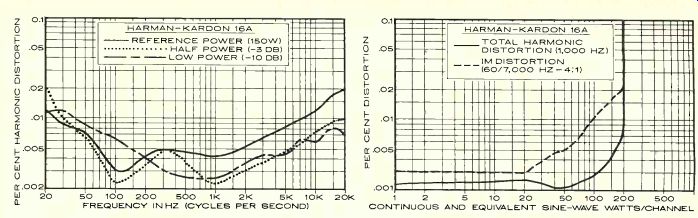
--- FREQUENCY IN HZ (CYCLES PER SECOND) CONTINUOUS AND EQUIVALENT SINE-WAVE WATTS/CHANNEL
...was in their transient response. The rise time of the 16 was 2 microseconds, while the I 6A measured 1 microsecond (both are rated at 3 microseconds). In like manner, the slew rate measured 24 volts per microsecond on the 16 and 30 volts per microsecond on the 16A (again, both amplifiers are rated at 30 volts per microsecond).
No measurements were needed to reveal the difference in operating bias between the two units, however. The 16 ran quite cool under normal listening conditions, while the heat sinks of the 16A became uncomfortably hot to the touch. Our rough guess, based on touching the two amplifiers, would be that the 16A runs hotter with no signal than the 16 does under normal signal drive conditions. However, both amplifiers withstood testing without mis hap and, no matter how hard they were over driven, never did more than cut off the outputs occasionally with their protective relays.
The power-indicator lights were only approximately accurate, though certainly good enough for their purpose. Their instantaneous response makes it easy to see how an amplifier can often be driven to a 150-watt output on ordinary program material, even with speakers of reasonably high efficiency.
Comment. The bench tests of the Harman Kardon Citation 16 and I6A do not reveal any differences between them that we judge to be significant. Perhaps the redesign was in the interests of reducing transient intermodulation distortion (TIM), for which certain IC op amps are notorious. This is not the place to go into a discussion of that matter, other than to say that, to us, the entire TIM phenomenon, as it applies to audible effects with well-designed amplifiers under real-world (not lab oratory or contrived) conditions, falls into the same category as belief in the Easter bunny.
We set up the two amplifiers for an A-B listening comparison. They were driven from the same preamplifier, using the best records and ancillary record-playing equipment we could muster, as well as FM radio. Several types of speakers were used, all of good quality though quite different in their characteristics. Our listening levels ranged from full output from the amplifiers down to background-music levels. The switching was instantaneous, and of course there was no need to ad just the gain when switching, since the two amplifiers were closely matched in their sensitivity. For a cross-check, we also switched to a fine 200-watt-per-channel power amplifier of another make.
The results? It should come as no surprise to anyone who has performed similar tests carefully and objectively that no difference could be heard between the two H-K amplifiers (or the third amplifier, for that matter) on any speaker, with any program material, at any listening level. In short, our tests did not reveal any improvements in the performance of the H-K Citation 16A. We weren't disappointed, however, since we had never found that the Model 16 needed improvement; in either version it is one of the cleanest and most rugged power amplifiers one can buy.
================
SAE Model 2800 Stereo Parametric Equalizer
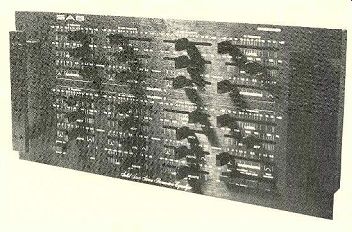
ONCE upon a time, before there was such a thing as high fidelity, the tone control provided on radios and consoles merely rolled the high frequencies down from a "flat" condition (which was usually none too flat to be gin with). One of the hallmarks of early high fidelity components was their use of a special tone-control system that not only provided separate adjustments for bass and treble frequencies but even permitted their levels to be boosted as well as attenuated. This arrangement, though better than the simple treble roll-off system, was quite limited as a means of enhancing or correcting the program. On occasion it might make a really bad record sound tolerable, but more subtle tonal variations were beyond its capabilities.
This basic tone-control system was improved considerably over the years, first by feedback circuits that made it possible to vary the response at the extremes of the audible spectrum with little effect on the mid-range, and more recently by providing a choice of "turnover" frequencies, which further extended that capability. On the assumption that the mid-range, too, might require correction, a third tone control for that frequency band appears on some amplifiers and receivers.
The next step-a giant one in terms of added utility-was the graphic equalizer, which ...
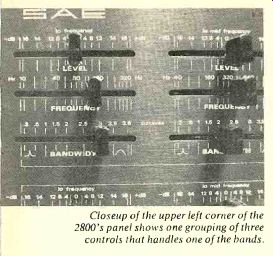
------ Closeup of the upper left corner of the 2800's panel shows one
grouping of three controls that handles one of the bands.
... permitted independent adjustment of level in five to ten separate frequency bands. Now, however, there is an equalizer available whose capabilities transcend those of the old fashioned octave-band graphic equalizer by about the same degree that the latter outperformed conventional tone controls. The SAE Model 2800 parametric equalizer is so versatile that there is literally no way to describe the variety of response curves it offers.
In the sense that SAE uses the term "parametric, it means that the Model 2800 can be adjusted to boost or cut the response at selectable frequencies (instead of relying on the preset center frequencies of ordinary graphic equalizers). Also, "Q" of each equalizer response is adjustable over a wide range. The latter feature permits the width of the band of frequencies affected by each control to be varied from 0.3 octave to 3.6 octaves.
The control functions of the SAE Model 2800 are divided into four broad (and overlap ping) frequency bands, identified as Lo, Lo- MID, HI-MID, and HI frequencies. Within each band, there is a continuously variable frequency adjustment, giving coverage of the 10-to 320-Hz, 40- to 1,200-Hz, 240- to 7,600-Hz, and 1,200- to 15,000-Hz ranges. Since these bands overlap, it is even possible to concentrate the action of two or three filters at one frequency (for example, 1,200 Hz from the LO-MID, HI-MID, and HI bands). Each band also has a slider control that adjusts its gain over a ±.16-dB range, with a detent at the center (0-dB) setting. The bandwidth adjustment for each range is a slider control calibrated in octaves from 0.3 to 3.6.
The dozen controls are fully duplicated for the second channel. In addition, each channel has a master-level slider, providing up to 70 dB of attenuation from the 0-dB (normal) set ting. LED's monitor the peak levels in the two channels and flash if they exceed permissible limits.
The remaining controls are pushbutton switches for power (there is a LED pilot light) and the operating mode of the equalizer. The Model 2800 is normally inserted in the tape-monitor loop of an amplifier or receiver, and the tape input and output jacks are duplicated on its rear panel. A button on the front panel bypasses the equalizer circuits when it is re leased. Normally, the tape outputs carry an unequalized program, but two of the control buttons permit the equalizer to be inserted in the signal path going to the recorder or coming from its playback amplifier. There is also a monitor button for listening to the tape.
The SAE Model 2800 has an insertion loss, with all controls centered, of less than 1 dB, and the maximum output before clipping is rated at 9 volts into a 10,000-ohm load. The in put impedance is 100,000 ohms, the output impedance is 500 ohms, and the equalizer can drive any load impedance greater than 600 ohms. Nominal rated output is 2.5 volts.
The styling of the Model 2800 conforms to the "professional" look of the other SAE components. Its front panel, 8 3/4 x 19 inches, is slotted for rack mounting, fitted with rugged handles, and finished in semi-gloss black. The chassis, also finished in black, is 3 1/2 inches deep. The unit weighs about 10 1/4 pounds. The only connectors on its rear panel are the line and tape-recording input and output jacks (standard phono jacks). The equalizer can be operated either vertically or horizontally, and it has rubber feet on its bottom for vertical installation. An optional walnut cabinet is available. Price: $550. The Model 1800, a scaled-down version with two bands, is also available for $300.
Laboratory Measurements. Since it would not be possible to measure more than a few of the frequency-response curves made possible by the Model 2800, we plotted several families of curves to verify the calibration accuracy of the center-frequency and bandwidth controls. All were acceptably close to the markings on the panel.
With the controls set to "flat," the response of the equalizer was within ±0.25 dB from 20 to 12,000 Hz, dropping to-1.5 dB at 20,000 Hz. The clipping level at 1,000 Hz was 8.5 volts. Total harmonic distortion (THD) was about 0.01 percent at all outputs up to 2.5 volts, and only 0.028 percent at 8.5 volts, just before the onset of clipping. The gain of the unit was-0.9 dB. The wideband (unweighted) noise in the output was 76.6 dB below 2.5 volts, and power-line hum was 86 dB below that level.
All the controls of the SAE Model 2800 operated smoothly, and the device produced neither audible noise nor switching transients (there is a delay of several seconds after power is applied before the outputs are connected to prevent turn-on transients from reaching the amplifier and speakers).
Comment. If you know what you want to hear, can recognize it when you do hear it, and have a good deal of patience, the chances are that the SAE Model 2800 will be able to produce exactly the sound you want from just about any set of audio components. If it can not, it is unlikely that you can buy anything else that can. However, we suspect that the real forte of this intriguing product is in re cording. For producing special effects, emphasizing or de-emphasizing any particular instrumental sound and the like, it should be hard to beat.
The applications of the Model 2800 are sure to be limited more by the user's patience and know-how than by its own capabilities. however, it would be a mistake to think of it as just another "super tone control." It is far more than that.
-------------
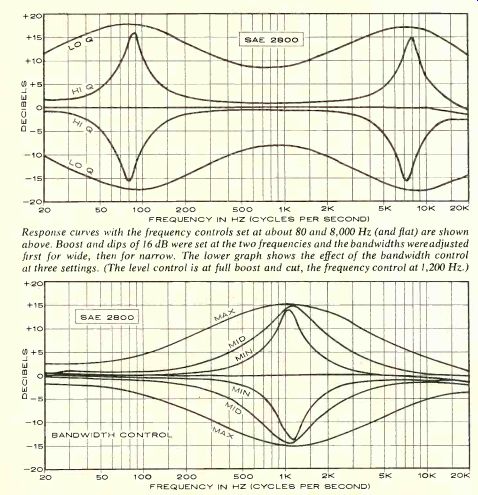
Response curves with the frequency controls set at about 80 and 8,000 Hz (and flat) are shown above. Boost and dips of 16 dB were set at the two frequencies and the bandwidths were adjusted first for wide, then for narrow. The lower graph shows the effect of the bandwidth control at three settings. (The level control is at full boost and cut, the frequency control at 1,200 Hz.)
========
------------
Also see:
THE AUDIBILITY OF DISTORTION IN LOUDSPEAKERS--Surprising results when you test with music instead of sine waves, PETER FRYER [Aug. 1977]