THE SPEAKER KIT--There's plenty to do for those who can't resist the urge to do it themselves. by WILLIAM KANNER.
As speaker systems improve overall, the quality and performance of kits goes up too.
By William Kanner
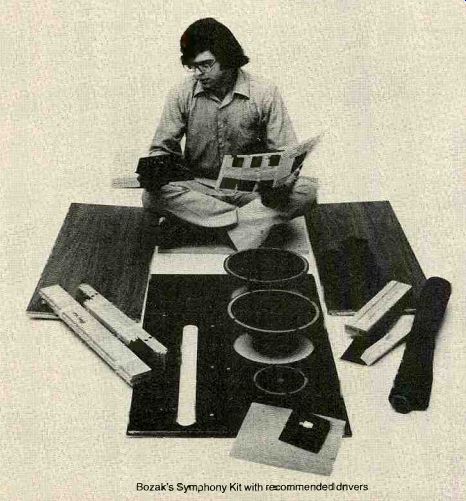
--- Bozak's Symphony Kit with recommended dryers .
ONCE upon a time, back in the early days of high fidelity if you wanted a good amplifier you probably built your own. And, of course, you also built your own speaker. Life was rather simple then: you bought a full-range driver (preferably the largest one you could find or afford), built a box that would suit it (usually the largest one that would fit into your living room), and-voila! you had a speaker system. If you were a really sophisticated audiophile, you might have added a carefully chosen mid-range and tweeter and bought or built a crossover network. And, of course, you had to deal with only one box, because those were the good old days of mono.
As commercial speakers became smaller and somewhat more scientifically designed, the appeal of do-it yourself systems declined correspondingly. No longer could the average home-built system compete effectively in cost or performance with the creations of a technically competent company geared to high-volume production. But this development certainly did not eliminate the desire of some audio enthusiasts to get involved in the construction of speaker systems. It did, however, change the nature of the involvement somewhat. Today, in place of hit-or-miss matings of drivers and enclosures, there is substantial activity centered on a newly revived kind of do-it-yourself project: the speaker-system kit.
WHAT makes one of the new kits different is its more consistent performance. Whether it comes ready to assemble with pre-cut and finished en closure panels or simply as a set of cabinet plans with a list of drivers and crossover components, it is essentially a final design that does not require (or invite) further experimentation and modification by the builder. If the instructions are followed faithfully, the result will be a known quantity-a functional replica of the original design as engineered and "fine-tuned" by the manufacturer. This means that many kits can and do offer performance that conforms to rather tight and ambitious specifications. Many also benefit from the recently developed mathematical models for speaker performance and computer-assisted design techniques.
All this is fine, but why build your own speakers in this day and age? For several reasons: the satisfaction of working with your hands, the sense of accomplishment when the job is finished, even the knowledge that you have made a personal contribution to your system. But if you approach a speaker kit with the idea of saving big money, you will likely be disappointed. The cash you save is more than made up for by the time spent and the possible hassles encountered in the building itself. Kit-building can be fun and marvelous therapy for idle hand or mind, but only if you enjoy the activity as well as the end product. And the activity, needless to say, will call more upon whatever woodworking skills you have than any electronic experience you may have acquired in building audio components from kits.
IF we accept the notion that building a speaker kit looks like an interesting project, then what kind of kits are there out there? Perhaps the easiest to build are the ones from Heath, which supply loose drivers and an assembled cabinet. Your task is to put together a crossover network, wire the connections between the components, and in stall all the parts in the cabinet. One large advantage of Heath's speaker kits is that the company has retail dealers across the country, and at these Heath kit Electronic Centers you can frequently audition any of the company's speaker systems before you build.
Since Bozak's B-4000A speaker system is available assembled (as well as in kit form), it too can be auditioned in advance. As a kit it comes either as a pre-cut but unassembled cabinet that you have to put together or as a free set of plans for constructing your own en closure. The drivers and crossover are sold separately in either case. The full price of the B-4000A's component parts is a rather steep $590, but the company says that the B-4000A is planned around what it calls the "growth system." Thus you can start out with fewer than the full complement of drivers, use the system in that form, and build up to the final ten-driver B-4000A in stages.
If you'd like a somewhat more ad venturous carpentry project, England's KEF Company supplies drivers and crossovers. It also supplies plans for suggested enclosures, but all the cabinet work is up to you.
Some of the long-established famous names in loudspeaker systems still sell drivers and plans for their products. If you should crave Altec's "Voice of the Theatre" system or one of Electro Voice's new computer-optimized kit systems, all you need do is buy the drivers and the appropriate crossover networks (if necessary) and go to it (you'll have to buy the wood independently). Company-supplied plans are: usually adequate for someone who has a background of experience with wood working tools, but if you should find yourself in need of assistance, the companies will help.
---------------------------------
Speaker kit--- Manufacturers and Suppliers
Accurate Sound, 1213 "M" Street, Lincoln, Nebraska 68508
Altec Corporation, 1515 South Manchester Avenue, Anaheim, California 92803
Bozak, Inc., Box 1166, Darien, Connecticut 06820
Electro-Voice, Inc., 600 Cecil Street, Buchanan, Michigan 49107
Heath Company, Dept. 40-325, Benton Harbor, Michigan 49022
James B. Lansing Sound, Inc., 8500 Balboa Boulevard, Northridge, California 91329
-------------------------
While most people are still more interested in going to their local audio dealer and buying a set of ready-built speaker systems, there is clearly a resurgence of interest in kit building. And as speaker systems improve overall, the quality and performance of kits goes up too. The old stand-bys are known quantities, and if you buy the Altec or Tannoy systems you know, by and large, what kind of sound you will end up with. However, one of the problems with many of the speaker kits on the market is that they are from relatively new companies, and because of their limited distribution, auditioning them is difficult. Your friend down the block is not likely to have just bought a pair, and tests on them in audio magazines are few and far between. This dearth of information leaves the kit market somewhat less accessible to the audiophile than it might be, but a willingness to invest some extra effort in pre-purchase research will usually get you answers to many of the important questions about the product.
The table on the following page will give you an idea about what speaker kits are available and where. Any questions you have should, of course, be directed to the manufacturers involved.
And for those who want to plunge even more deeply into speaker design, we include a bibliography that will take you as far as you care to go into the world of crossover design, response curves, sawdust-and acoustics.
-----------------------------
KEF Electronics, Intratec, 399 Jefferson Davis Highway, Arlington, Virginia 22202
Peerless Audio, Burwen Re search, Inc., 40 Jytek Drive, Leominster, Massachusetts 01453
Speaker Kit, Box 12, Menomonie, Wisconsin 54751
Speakerlab, Inc., 5500 35th Avenue N.E., Seattle, Washington, 98105
Tannoy-Ortofon, Inc., 122 Dupont Street, Plainview, New York 11803
---------------------------
Speakers and Acoustics--A Bibliography
How To Build Speaker Enclosures, by Alexis Badmaieff and Don Davis. Howard W. Sams & Co., Inc., Indianapolis (1966), $4.95.
The World of Sound, by Sir William Bragg, Dover Publications, Inc., New York (1942), $2.00.
The Cabinet Handbook, by G. A. Briggs, Herman Publishing, Boston (1962), $4.95 paperback; $7.95 hard cover.
Loudspeakers, by G. A. Briggs, Herman Publishing, Boston (1958), $11.95.
Hi-Fi Loudspeakers and Enclosures, by Abraham B. Cohen, Hayden Book Co., Inc., Rochelle Park, N.J. (1968), $6.85.
A Guide to Musical Acoustics, by H. Lowery, Dover Publications, Inc., New York (1956), $2.00.
Building Speaker Enclosures, by Robert G. Middleton, Radio Shack, Fort Worth, Texas (1972), $1.25.
Music, Physics, and Engineering (formerly titled Musical Engineering), by Harry F. Olson, Dover Publications, Inc., New York (1967), $4.50.
The Audio Encyclopedia (2nd Edition), by Howard M. Tremaine Howard W. Sams & Co., Inc., Indianapolis (1969), $34.00.
Reproduction of Sound, by Edgar Villchur, Dover Publications, Inc., New York (1965), $2.00.
-----------------------
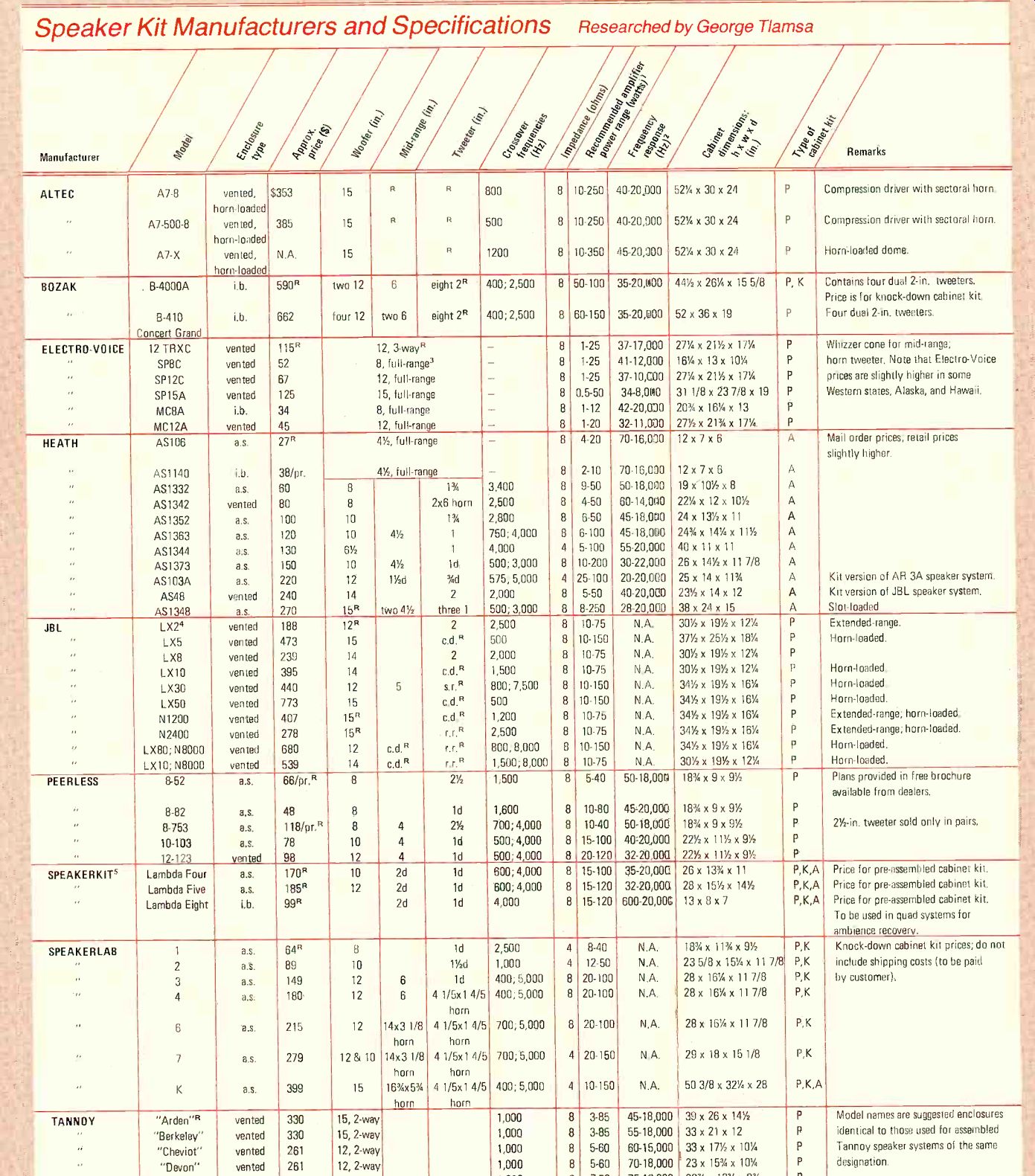
Speaker Kit-- Manufacturers and Specifications
Researched by George Tlamsa
Explanation of Symbols:
A-kit contains a preassembled cabinet.
K-Knock-down cabinet included in kit; materials necessary to put cabinet together (such as glue and caulk) are often included.
N.A.-not available.
P-manufacturer supplies only plans for cabinet.
R-see Remarks column.
a.s.-acoustic suspension.
c.d.-compression driver.
d.-dome.
i.b.-infinite baffle.
r.r.-ring radiator.
s.r.-slot radiator.
Footnotes:
The input power ranges given for Altec, Bozak, Heath, JBL, Speakerk it, and Speakerlab represent the range of output power per channel suggested by these manufacturers for the amplifier driving the speakers. The figures given for Electro-Voice, Peerless, and Tannoy represent the maximum continuous power input (per channel) these speakers can withstand. In general, one may safely use an amplifier with a continuous power rating considerably above the speaker's; however, it is wise to protect the speakers with fuses or circuit breakers if this is done.
Frequency response data for kits is highly approximate and can't be guaranteed; therefore, a number of manufacturers prefer to omit it (as indicated by "N.A." on the chart). In addition, dispute over the correlation between frequency response data and audible performance in an average listening room results in some manufacturers' not publicizing this specification.
Although these drivers are listed as "full-range," the high frequency response of systems utilizing them may be augmented through the use of Electra-Voice's High-Frequency Building Block Kits.
The JBL model "names" actually refer to the model numbers of the crossovers used in the systems.
At this writing, Speakerkit's product line is not complete. Five more kits should be available in September.
Also see:
SOME STRAIGHT TALK ON SPEAKER DESIGN--It has to do largely with the art of manipulating trade-offs, GEORGE SIOLES