STEREO REVIEW'S SELECTION OF RECORDINGS OF SPECIAL MERIT--BEST OF THE MONTH
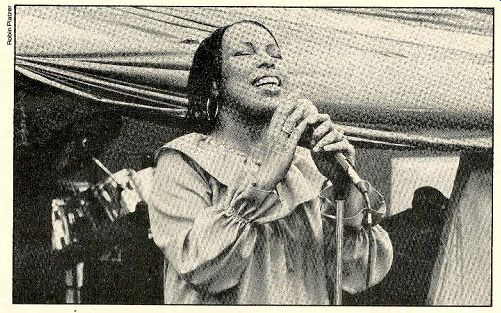
(above) The New Roberta Flack: Polished, Popular, and Somewhat Aloof--but Still Indisputably a Star.
WHEN Roberta Flack is in peak form, she can slip into her songs as though they were delicate garments of notes, custom-designed to fit the contours of her musical style. At such times, she moves through the winding passages of lyrics and melody with such exquisite grace that the song-no matter who may have claimed it previously--is indelibly stamped as her very own. She can achieve this alchemy be cause she is gifted with a remarkable sense of phrase and a voice that is immediately recognizable for its light clarity, surety of tone, and agility. The results can be truly memorable: sensitive tonal pictures and soothing aesthetic experiences.
Happily, the perfect, controlled fusion of artist and material is apparent in her latest album in proportion generous enough to counteract entirely the disappointment of her long-awaited previous set, the smoggy, bewilderingly indifferent "Blue Lights in the Basement" (Atlantic SD 19149). Her new al bum, titled simply "Roberta Flack," generally does not trigger the sort of deep emotional response evoked by her very earliest efforts, but it has the sort of quiet, commercial class common to the best-selling sets that have been her staple product for the past seven years.
If her career were to be divided into two parts, the first would date from 1969 and the release of "First Take" (Atlantic SD 8230), perhaps her best record to date. This period, devoted to subtle social commentary and a probing of the inner self, extended through "Chapter Two" (Atlantic SD 1569) and ended with her third album, "Quiet Fire" (Atlantic SD 1594). Then, for better or worse, she became a star and moved into the musical mainstream. Simultaneously, she became more reticent about tapping the soulful roots of the music she sang, omitting the touching traces of contemporary gospel, the moving whispers of the blues. And, to the regret of her first fans, who still hunger for "the old Roberta," she has never looked back.
What we have now is Roberta Part Two, polished, popular, and somewhat aloof. But that in itself is no small package. Her flawless delivery quickly leads the listener to understand that no clinkers are to be found here. Though it is somewhat glossy, this is music superior to most of what pours out of the pop tune-mill each day. The jacket credits give full indication that something special awaits inside. The opening se lection, What a Woman Really Means, has a pleasantly rocking, reggae-laced flavor; it was written by Ralph Mac Donald and William Salter, who have contributed heavily to the Flack repertoire, most notably the hit Where Is the Love? that she recorded with long-silent Donny Hathaway back in 1972.
The lead-off track on the second side, And the Feeling's Good, is the creation of Norman Gimble and Charles Fox, who wrote Killing Me Softly with His Song (originally Lori Lieberman's song, it nonetheless became Flack's best-seller for 1973). Independent Man simply sounds as if it should be a hit, with a catchy melody that lingers in the mind to inspire sporadic humming.
And, yes, there are a few tracks that are less than memorable, but they are not all that bad, and When It's Over borders tantalizingly on the open-heartedness of Roberta Part One. All in all, this album is a welcome proof that "Roberta of the Spirits" is still amongst us, still singing.
-Phyl Garland
ROBERTA FLACK. Roberta Flack (vocals and keyboards); Leon Pendarvis, Monty Alexander (keyboards); Reggie Lucas, Hugh McCracken, Jeff Mironov (guitars); Ronnie Foster (synthesizer); Mtume, Larry Alexander (percussion); other musicians. What a Woman Really Means; You Are Everything; Independent Man; If Ever I See You Again; And the Feeling's Good; Come Share My Love; When It's Over; Baby I Love You So; Knowing That We're Made for Each Other. ATLANTIC SD 19186 $7.98, TP 19186 $7.98, CS 19186 $7.98.
------------------
Joselson and Mata: Laying Down New Standards for Prokofiev and Ravel
THERE must have been four or five discs that paired the Ravel Piano Concerto with Prokofiev's Third within the last ten years or so, and the earliest of them, the one by Martha Argerich with the Berlin Philharmonic under Claudio Abbado (Deutsche Grammophon 139 349), has more than held its own, not only among such couplings, but among individual recordings of the respective works (except, perhaps, Michelangeli's Ravel on Angel S-35567).
But I think it must at last yield pride of place to Tedd Joselson's new entry for RCA.
Having heard and admired Joselson's earlier Prokofiev releases--the Second Concerto with Ormandy (RCA ARL1-0751), the Sonatas Nos. 2 and 8 (ARL1-1570) and Nos. 7 and 9 (ARL1-2753), and the Visions Fugitives (ARL1-2158)-I approached this latest extension of his series with the highest expectations, but I did not expect to be quite so swept away by it. This is simply dazzling playing-extremely brilliant, powerful, and thoroughly attuned to the essence of both works. Further more, conductor Eduardo Mata is a first-rate collaborator, by no means a mere accompanist, and he keeps his orchestra on its toes everywhere. Indeed, the thoroughness of the mesh and the spontaneous-sounding interplay be tween soloist and orchestra is one of the particular delights of this release, and the stunningly realistic sound pro vided by RCA gives it an additional edge over the current competition.
There are other fine recordings of these works in the catalog, of course, but the happy combination of musical and sonic factors in this new one seems to call for no other position than the very top of the list for both sides.
-Richard Freed
PROKOFIEV: Piano Concerto No. 3, in C Major, Op. 26. RAVEL: Piano Concerto in G Major. Tedd Joselson (piano); Dallas Symphony Orchestra, Eduardo Mata cond. RCA ARL1-2910 $7.98, ARK1-2910 $7.98.
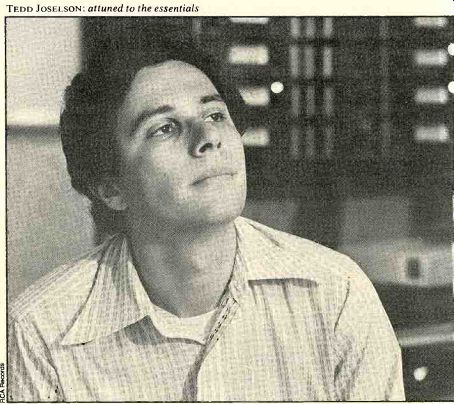
TEDD JOSELSON : attuned to the essentials
-----------------
The Joy of Singing Together Is What Peter, Paul & Mary Are All About
DON'T bother with candy or flowers any of those idiotic paper-lace cards this February fourteenth. Just hurry on over to your Valentine's house with a copy of the Peter, Paul & Mary album "Reunion," new on the Warner Bros. label, and you've got it made. So do Peter, Paul & Mary: even after all the years, all the taste changes, and all the other singing groups that have come along, they've never sound ed better, not even in the by now legendary days of Blowin' in the Wind.
The only noticeable change is a slight darkening in Mary Travers' voice, but since it adds to the drama of her delivery it can scarcely be thought a minus.
You don't remember Peter, Paul & Mary? Well, then, you're just going to have to hear what all the shouting about them from times past boils down to: listen to a single band here called The Unicorn Song. It is the kind of thing that the Carpenters always tried to do but never quite could, that Donny and Marie would give a few extra eyeteeth to find for themselves, and ...
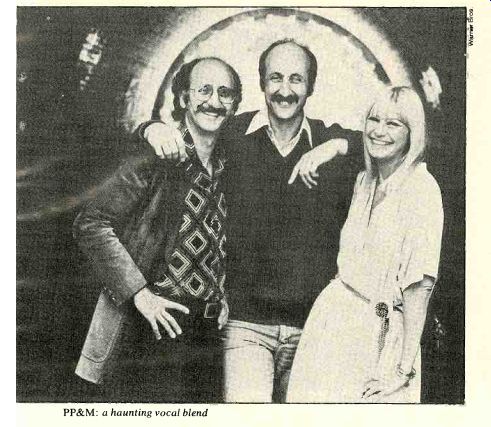
---------- PP&M: a haunting vocal blend
... that Ashford and Simpson can probably only admire. First off, there is the musicianship, which is remarkable on all levels. Then there is the haunting quality of the vocal blend, so individual that no other group has ever been able to graft it onto their performances no matter how mightily they struggled (the Sixties flood of computerese imitations of PP&M, none of them successful, has now blessedly subsided). Finally, there is the synergistic high they can create for the listener again and again as they number the petals of their songs. Billy Joel's Summer Highland Falls, Dylan's Forever Young, and even the sly and ironic Ms. Rheingold by Peter Yarrow-all have that silvery, ozone sharpness that pours from the speakers like fresh air sweeping into an overheated room. The production by David Rubinson (with Peter Yarrow second-billed) is exemplary; no contorted arrangements to give the group a phony "now" sound, just plenty of space to let them do what they do best.
At its worst, Valentine's Day is a commercial abomination. In its true spirit, however, it is a bright and happy way to express a little love and affection. Love and affection for their work and for the joy of singing together is what Peter, Paul & Mary are expressing in " Reunion," so maybe it's their Valentine to us.
-Peter Reilly
PETER, PAUL & MARY: Reunion. Peter, Paul & Mary (vocals, guitars); orchestra. Summer Highland Falls; Best of Friends; Sweet Survivor; The Unicorn Song; I Need Me to Be for Me; Like the First Time; Ms. Rheingold; By Surprise; Forever Young. WARNER BROS. BSK 3231 $7.98, (D M8 3231 $7.97, MS 3231 $7.97.
-----------------------
Chico Freeman's "Kings of Mali": One of the Jazz Events of the Year
As things stand right now, Chico Freeman needs an introduction, but if the twenty-nine-year-old son of near-legendary Chicago saxophonist Von Freeman keeps it up, it won't be long before the mere mention of his name will suffice. Chico played piano and trumpet before switching to the saxophone, and though his father didn't determine- his choice of career, he did a great deal to encourage and educate Chico as a musician. Another decisive influence has been pianist Mu-hal Richard Abrams, a co-founder of Chicago's musical wellspring, the Association for the Advancement of Creative Musicians. Freeman spent a fruitful period playing first tenor in Abrams' big band, but the association went far beyond that. He has also had extensive experience in the rhythm and-blues field, backing up such groups as the Dells, the Isley Brothers, the Four Tops, and the Chi-lites. Most recently he has been a member of drummer Elvin Jones' group. This varied practical background, combined with Freeman's evident wide listening experience, has made his own music fascinatingly eclectic. His playing, to use a description he once aptly applied to his father's music, is "free, but with knowledge." Chico Freeman has made only two albums so far, both for the small, poorly distributed India Navigation label.
The second of these, "Kings of Mali," would not have to contain more than its first cut, Look Up, to rate as one of the most significant releases of the past year; written by Freeman (whose importance as a composer also demands recognition), it plunges from his opening soprano soliloquy into a seething, emotion-charged collective effort from which individual voices emerge with statements of the most profound kind.
The rhythmic excitement generated by vibist Jay Hoggard, pianist Anthony Davis, bassist Cecil McBee, and drummer Famoudou Don Moye on Look Up is approached but not quite matched on Minstrels' Sun Dance, another interesting Freeman composition that serves well to show his command of the tenor. Illas, more subdued and conventional, features Freeman on flute, an instrument he seems to approach too cautiously. Finally, there is Kings of Mali, a largely percussive piece on which Freeman, Hoggard, and Moye play what I presume to be the African ballo-phone listed by their names in the credits. I am not familiar with the instrument, nor do I know why it is consistently capitalized on the album, but it is obviously a mallet instrument, and it has a rather pleasant sound over which McBee's bass and Freeman's flutes (obviously by way of double tracking) are heard. Kings of Mali is not a particularly exciting track, but it does have a certain charm.
The liner notes are a run-down of the history of the African Empire of Mali, which-notwithstanding the album's title and that ten-minute selection seems to be quite irrelevant in this con text. A bit of background on Chico Freeman would have been more to the point, for he is an important up-and coming artist from whose creative ...
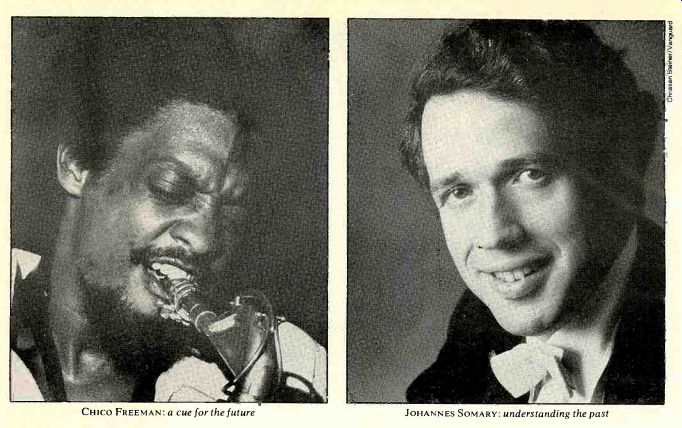
--------------- CHICO FREEMAN: a cue for the futur; JOHANNES SOMARY: understanding
the past mind jazz
... might conceivably take its cue for the future.
-Chris Albertson
CHICO FREEMAN: Kings of Mali. Chico Freeman (flutes, soprano and tenor saxo phones, African ballophone); Jay Hoggard (vibraphone, African ballophone); Anthony Davis (piano); Cecil McBee (bass); Famouduo Don Moye (drums, percussion, African ballophone, gongs, whistles). Look Up; Minstrels' Sun Dance; Kings of Mali; Illas. INDIA NAVIGATION IN 1035 $7.98 (from India Navigation Company, P.O. Box 559, Nyack, N.Y. 10960).
------------
Bach's Matthew Passion --- In an Admirably Paced New Reading For Vanguard
SPECIALIZING in the performance of large-scale Baroque vocal compositions, conductor Johannes Somary has displayed a gratifyingly consistent growth in his work. His latest album, of Bach's Passion According to St. Matthew, reveals that the growth continues. Perhaps the most striking aspects of his reading are his choices of tempos and the overall pacing of the performance. Conductors frequently equate religious music with slow tempos: the more religious the work, the slower the tempos. Which explains why the St. Matthew Passion has been played slower than perhaps any music ever written, Parsifal being the possible exception. But such sluggish tempos make it impossible to sustain Bach's long phrases-singers simply do not have the breath, and instrumentalists, if they have the breath, lose their concentration. Thus, phrases are broken, the long line is fragmented, and the stately measure becomes more boring than cosmic.
Somary realizes all this, and al though he does not quite achieve the ultimate grandeur, by moving the work along he sustains the line without sacrificing dignity. In the chorales, for example, he does not make the usual halt at each fermata, but moves through them according to the harmonic structure. He also understands how to pace the chorale melodies in the enormous double choruses. The final chorus of Part I, "O Mensch, bewein' dein' Siinde gross," at first seems needlessly rushed during the instrumental prelude, the ubiquitous-two-note weeping figures rather too pushed to serve as symbols of a contemplation of the Betrayal in the Garden of Gethsemane.
But the minute the sopranos intone their first phrase, one realizes that all of Bach's intricate figuration is mere commentary, that the true essence of the piece is the traditional chorale melody.
The balance of the sound is, for the most part, beautifully managed. The real test is in the opening chorus where Somary has evoked two different timbres from the two choruses so that they bring out the question-and-answer structure of the text. The contrasting timbre of the boys' chorale melody is deftly underlined by the use of judicious organ doubling, but the balance between the singers and the obbligato instruments is not so well handled.
Lessening the volume of an instrumental solo when the singer enters turns obbligato writing into accompaniment and destroys the sense of equal partnership inherent in Bach's contrapuntal writing.
That Somary understands Baroque articulation is manifest in his modified application of it to modern instruments. Without proper articulation, the texture of the final chorus of Part I can turn to mush. The two-note articulations here are kept intact by the instrumentalists and create a shimmering halo around the legato lines of the chorus. In the final chorus, the articulation of the weeping figure is beautifully matched by both the choruses and the orchestra.
The soloists are, for the most part, excellent, and, except for a few minor details, they go along with Somary's pacing of the work. Ernst Haefliger's intense voice gives the Evangelist's lengthy text every possible emotional nuance, but I find Barry McDaniel's voice rather too hard and forced for the delicate balance of contemplation and strength required by the role of Jesus.
Elly Ameling sings with her usual sensitivity and offers some effective ornamentation in the aria "Ich will dir mein Herze schenken." (It is, incidentally, the only ornamentation offered in the entire performance, but it is not at all out of place.) Birgit Finnilae's approach is rather cold and impersonal but nonetheless impressive, and Benjamin Luxon brings extraordinary tenderness to his final aria. It is Seth McCoy, however, who stands out as the real Bach singer. His perfectly placed voice brings warmth to each phrase and restrained passion to each aria.
Though Somary's tempos work most of the time, there are a few instances when the soloists might have used more time to stretch a phrase. This is especially apparent in Miss Ameling's aria "Blute nur, du liebes Herz!" She is not given leeway to dwell on the feminine endings, and as a consequence one feels that she and the conductor are at odds about the tempo. McCoy also seems pushed at times, while Finnilae and Luxon, on the other hand, apparently feel no pressure at all.
One of the most admirable qualities of this performance is the careful pacing of the drama as a whole. Each part is brought to a single climax: Part I moves steadily toward the Betrayal in the Garden and Part II moves inexorably toward the Crucifixion and terminates with exalted repose after emotional exhaustion. All in all, and despite the nits picked, there is a great deal to recommend in this recording. Certainly it is among the best available today of one of the most important musical works in the entire repertoire.
-Stoddard Lincoln
J. S. BACH: The Passion According to St. Matthew. Ernst Haefliger (tenor), Evangel ist; Barry McDaniel (baritone), Jesus; Elly Ameling (soprano); Birgit Finnilae (alto); Seth McCoy (tenor); Benjamin Luxon (baritone); Ambrosian Singers; Desborough School Boys' Choir; English Chamber Orchestra, Johannes Somary cond. VANGUARD VSD 71231/4 four discs $31.92.
-------------
Bruckner's Fifth by Karajan: a Truly Magnificent Recorded Performance
LIKE its counterpart in the Mahler canon, the Fifth Symphony of Bruckner is a work singularly difficult to bring off with complete success, and for the same reason: a finale that is decidedly lengthy for its substance. Only the most skillful and experienced conductor, one with a profound feeling for Bruckner's musical language, can command an orchestra of unlimited endurance and lung power to do justice to the Bruckner Fifth. So far as I am concerned, Bernard Haitink and the Amsterdam Councertgebouw have had the field pretty much to themselves since 1972. Now, however, despite one small reservation, I feel that Herbert von Karajan and his Berlin Philharmonic have moved into the top spot.
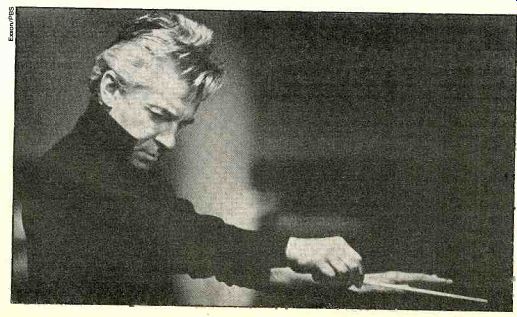
HERBERT VON KARAJAN: skill, experience, and a profound feeling for the musical language of Bruckner.
Though Karajan's pacing is consistently more deliberate than Haitink's, he manages for at least three-fourths of the time to convince me that this is how the music should go. The reading of the first movement is staggeringly dramatic, with playing and sound to match.
The first full orchestral outburst-a brass fanfare that follows the stalking, low pizzicato introduction-will simply knock you across the room, assuming you have the equipment to do it justice.
The slow movement is stately and in tense under Karajan's baton, with the echo effects superbly handled. The scherzo is no less fine, and the slow introductory pages of the finale with its passing-in-review of earlier thematic material promises much, especially with the nuances and dynamic shadings that Karajan provides.
In terms of the last movement as a whole, however, and particularly with regard to sustaining the momentum of the fugal textures, I find that Haitink still holds the edge. By keeping things moving, he makes us less aware of the painfully awkward sectioning of the music (some would call it jerry-built), and, further, the playing of the Berliners here sounds decidedly less fresh than it does in the first movement. But this is my one reservation about what is otherwise a truly magnificent recorded performance, one that stands up to Karajan's other remarkable Deutsche Grammophon recordings of Bruckner's Fourth, Seventh, Eighth, and Ninth Symphonies.
-David Hall
BRUCKNER: Symphony No. 5, in B-flat Major. Berlin Philharmonic Orchestra, Herbert von Karajan cond. DEUTSCHE GRAMMOPHON 2707 101 two discs $17.96, 2 MC 3370 025 $17.96.
--------
======
Also see:
CLASSICAL LPs and Tapes: A Wind Band Spectacular; Zimerman's Elegant Mozart; Tao "Archdukes"; A Goossens Sampler; Vivaldi's "Orlando Furioso"; Through the Opera Glasses; New Sounds from the Avant-Garde; Vivaldi's Sacred 'Choral Music
Source: Stereo Review (USA magazine)