EQUIPMENT TEST REPORTS: Hirsch-Houck Laboratory test results on the BGW Model 210 stereo power amplifier, Ultralinear Model 228 speaker system, J. C. Penney Model 3275 AM/FM stereo receiver, Koss Pro/4 AAA stereo headphones, and Realistic SCT-30 stereo cassette deck.
--------------
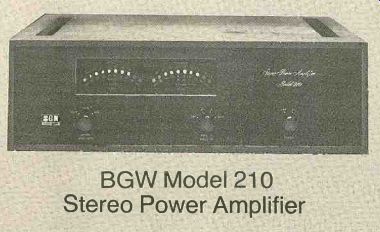
BGW Model 210 Stereo Power Amplifier
THE BGW Model 210 is a basic stereo power amplifier rated to deliver 100 watts per channel to 8-ohm loads from 20 to 20,000 Hz with no more than 0.07 percent harmonic distortion. Instead of output meters, the BGW 210 has two groups of colored LED indicators, formed in arcs to simulate conventional meter scales. Each "meter" has ten LED's calibrated in decibels at 3-dB intervals from 0 dB (the rated 100-watt output into 8 ohms) to- 15 dB (about a 3-watt output). From -15 to - 33 dB they are in 6-dB steps, and the -33-dB light corresponds to about a 50-milliwatt output. The last LED is marked IDLE and is on, serving as a pilot light, even without a signal present. The 0 and -3-dB lights are red to warn of possible overload, and the -6- to -15-dB lights are amber. Below -15 dB they are green.
Underneath the LED arrays is a knob-operated switch that increases the display sensitivity by either 10 or 20 dB. In the most sensitive condition, the-33-dB light will glow at only 5 milliwatts output. Another knob connects either, both, or neither of two sets of speaker-output terminals to the amplifier out puts, and a third knob is the power switch. On the rear apron of the amplifier are the phono jack inputs and two sets of speaker outputs that use insulated spring connectors. The heavy-duty line cord has a three-wire molded plug. The BGW 210 is finished in black throughout. Its front panel has standard rack-mount dimensions of 19 x 5 1/4 inches but is not slotted for rack mounting. The depth of the amplifier is 11 3/4 inches, and its weight is 33 1/2 pounds. Price: $599. A cabinet is available for $36.
Laboratory Measurements. Our test sample of the BGW 210 came with neither an instruction manual nor specifications, and the one-page preliminary manual had no information on any special design or operating features of the amplifier. Therefore, all we knew of it at the time of our tests was what we managed to measure for ourselves.
The one-hour preconditioning period at a 33.3-watt output left the amplifier only slight ly warm. With both channels driven at 1,000 Hz into 8-ohm loads, the outputs clipped at 114 watts per channel (IHF clipping head room = 0.57 dB). The IHF dynamic head room was 1.02 dB. An input of 0.14 volt was needed to drive the amplifier to a reference output of 1 watt, and the A-weighted noise in the output was less than our 100-microvolt minimum measuring capability, or more than 90 dB below 1 watt.
When the amplifier was driven to rated power at 1,000 Hz and the frequency was in creased at constant input level, the distortion did not reach 1 percent below the 50-kHz up per measurement limit of our Radford distortion analyzer. Thus, we can only say that the IHF slew factor exceeded 2.5 (the ratio of 50,000 Hz to 20,000 Hz).
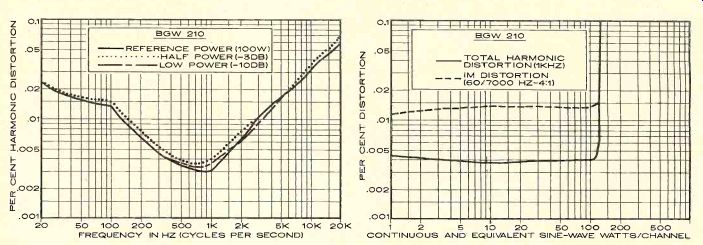
At 1,000 Hz, the harmonic distortion of the amplifier was almost constant at about 0.004 percent from 0.1 to 110 watts output. The IM distortion was about 0.014 percent from 0.1 to 120 watts. Even at only 3 milliwatts output, the IM was only 0.06 percent, attesting to the relative absence of crossover distortion in the amplifier.
At rated power, one-half power, and one-tenth power, the distortion curves were virtually identical over the full 20- to 20,000-Hz audio band. Below 100 Hz, our readings were essentially the residual distortion of the Rad ford oscillator, which was in the range of 0.014 to 0.025 percent between 100 and 20 Hz. At higher frequencies, the distortion dropped to a minimum of about 0.003 to 0.004 percent at 1,000 Hz and then increased smoothly at higher frequencies to a maximum of about 0.06 percent at 20,000 Hz. Not only was the LED power-output display reason ably accurate, but we felt that it was some what easier to read and interpret than a conventional meter pointer.
Comment. Judging from the cool operation of the BGW 210, the conservative approach ...
------------
FREQUENCY IN HZ (CYCLES PER SECOND) CONTINUOUS AND EQUIVALENT SINE-WAVE WATTS/CHANNEL
----------
... of using a full-size, fairly heavy amplifier to deliver a rated power of only 100 watts can generate worthwhile dividends in potential longevity (heat is the greatest enemy of electronic components). We noted with interest that the BGW 210 is identical in size (and very similar in appearance) to its 200-watt-per-channel relative, the 410.
The amplifier was quiet (electrically) and did not generate any audible turn-on or turn off transients. Indeed, its measured performance could hardly be improved upon from any practical standpoint. As 100-watt amplifiers go, it is not cheap, but it appears to be as solid and well constructed a unit as anyone could desire.
--------------
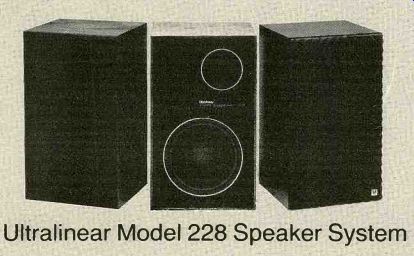
Ultralinear Model 228 Speaker System
THE Ultralinear Model 228 is a compact, three-way speaker system suitable for shelf or floor mounting. Its 12-inch-diameter acoustic-suspension woofer crosses over at 700 Hz to a 6-inch cone driver, with a compliant foam-edge surround, that is mounted in its own separately sealed sub-enclosure. At 4,500 Hz, there is a second crossover to a 1-inch Mylar-dome tweeter. Front-panel controls (behind the grille) provide level adjustment of the mid-range and high-frequency drivers from maximum to fully off. Next to the level controls is the reset button for the circuit breaker that protects the drivers against damage from excessive input levels.
The input connectors, recessed into the rear of the cabinet, are spring-loaded.
The Model 228 is available with a choice of several finishes, including simulated walnut grain with a protective Melamine coating and oak or walnut veneers. The grille, which is retained by Velcro fasteners, is available with a choice of open-mesh black fabric (which Ultralinear calls "Transparacoustic"), a brown double-knit fabric, and a herringbone-pattern acoustic foam in black or brown.
The nominal impedance of the Ultralinear Model 228 system is 8 ohms, and it has a rated frequency response of 27 to 22,000 Hz (with no tolerance stated). It is recommended for use with amplifiers from 10 to 65 watts per channel. The Model 228 is 24 3/8 inches high, 14 1/2 inches wide, and 12 inches deep; it weighs about 40 pounds. Price: $189.95 in simulated walnut finish.
Laboratory Measurements. In the absence of other information, we set both level controls to maximum for our measurements. The smoothed and corrected frequency response from 100 to 20,000 Hz, measured in the reverberant field of the test room, was spliced to the close-miked woofer-response curve from 20 to 100 Hz to form a single composite frequency-response curve.
Although the woofer is stated to be an acoustic-suspension design, it appears to have a rather stiff suspension, giving it a resonance at 75 Hz in the relatively large cabinet. A bass-response peak also occurred at 75 Hz, falling off at 12 dB per octave below that frequency. There was a moderate amount of mid-range unevenness, with a maximum over all variation of about 7 dB between 100 and 1,000 Hz. At higher frequencies the output was smooth and strong, rising slightly to a maximum of +2.5 dB between 12,000 and 17,000 Hz and with a variation of only ±3 dB from 900 to 20,000 Hz. The overall frequency response of the speaker was ±5 dB from 53 to 20,000 Hz. Its high-frequency dispersion was very good, with less than 5 dB difference in the 10,000- to 20,000 Hz range between measurements made on axis and up to 30 degrees off axis.
The tweeter level control affected the out put above 4,500 Hz, with a steep cutoff when it was set to its minimum. The mid-range control had a much less obvious effect because the woofer and tweeter tended to "fill in" the gap left in the mid-range when it was turned down.
The impedance of the system was remark ably uniform (a constant 8 to 10 ohms from 20 to 20,000 Hz) except for the rise to 20 ohms at the 75-Hz bass resonance. The tone-burst response of the system was good at all frequencies. The system sensitivity (efficiency) was fairly low, as would be expected from an acoustic-suspension design. Driven by 1 watt of random noise in an octave centered at 1,000 Hz, the system produced an 85-dB sound-pressure level at a distance of 1 meter.
The woofer distortion was measured with close microphone spacing and with the sys tem driven at a constant input level corresponding to either 1 or 10 watts. The 1-watt distortion was very low from 100 Hz down to 65 Hz (under 1 percent and typically about 0.5 percent). It rose smoothly at lower frequencies to a maximum of about 8 percent at 40 Hz, and that level of distortion was maintained down to 30 Hz. The 10-watt distortion characteristic was similar in shape, measuring 1.5 to 2.5 percent down to 65 Hz and 20 percent at 40 Hz before dropping back slightly to 16 percent at 30 Hz.
Comment. Compared with some other speakers known to have an essentially flat high-frequency response, the Ultralinear Model 228 tended to sound a little bright, al though we found its crispness very easy to listen to and soon preferred its sound to the more subdued high ends of the other systems with which we compared it. The lack of deep bass was not as noticeable as one might have expected from the measurements, probably because the 75-Hz peak gave an impression of bass output that was believable even if not "true." Nevertheless, we consider the speaker's rated low-frequency limit of 27 Hz to be unrealistic.
We preferred to operate both level controls at maximum, because our listening room is fairly "dead" and a strong high end does not produce an overbearing sound at the listening position. There was a slight accentuation of background hiss with this speaker compared with flatter systems, but on quiet program material the effect was minimal. In a more "live" room (which would require a lower tweeter setting), it would be easy to adjust the high end to suit almost any taste.
We did not trip the protective circuit breakers at any time, although we made no deliberate attempt to do so. These speakers can be played at a considerable level without damage to them or to the sensibilities of the listeners, but we preferred to listen to them for our enjoyment at reasonable levels.
We found the sound to be best with the speakers on stands that elevated them about 7 inches from the carpeted floor. Any bass reinforcement that might be achieved by floor or corner mounting brought with it an increase in the bass-resonance peak that we felt negated any other benefits. In the final listening position, male voices were reproduced with clarity and without undue emphasis of the mid-bass, something not achieved by many speakers with greater pretensions to extended bass response.
-----------
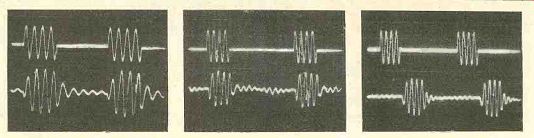
The fine tone-burst response of the Ultralinear 228 is illustrated at (left to right) 100, 1,000, and 15,000 Hz. The upper trace is the input signal.-----
The Ultralinear 228 is a very attractive looking and sounding system at a correspondingly attractive price. So far as we can deter mine, its design is completely conventional, but its fine sound testifies that its designers knew what they were doing. One of our two test units had the simulated walnut finish, the other the genuine walnut. Both were very at tractive, with the unadorned black grille revealing the circular metal rims of the mid range and bass drivers in the front view.
--------------
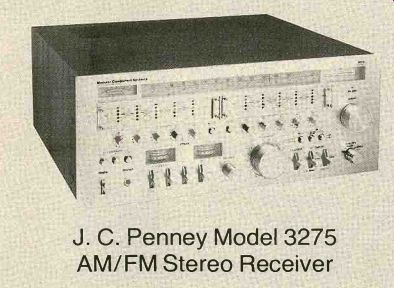
J. C. Penney Model 3275 AM/FM Stereo Receiver
THE J. C. Penney name is well known to American consumers, but not in connection with hi-fi components. That is about to change, however, for the giant retail chain has recently introduced a complete line of audio components marketed as the MCS (Modular Component Systems) Series. Their finest receiver is the Model 3275, which is distinctively different from its competitors in styling and control features.
Although the Penney 3275 is a large, heavy receiver, it is rated conservatively at 75 (or 80) watts per channel into 8-ohm loads from 20 to 20,000 Hz with no more than 0.25 percent total harmonic distortion. Both power figures appear in the literature accompanying the receiver; we tested it to the higher rating.
The tuning-dial scales across the top of the panel are flanked by a small meter and a row of red LED's that form a segmented horizontal line. The meter reads either FM deviation (modulation percentage on a scale of 0 to 120 percent) or multipath-distortion effects, as selected by a pushbutton on the front panel.
The row of LED's is the receiver's only tuning aid, and it functions as a relative-signal-strength indicator for both FM and AM.
Its twelve segments are illuminated sequentially, beginning at the left, in proportion to signal strength. Below them is a small red FM MPX light that indicates reception of a stereo broadcast.
Instead of the usual two or three tone controls, the Penney 3275 has a five-band graphic equalizer with separate controls for each channel. The centers of the controlled frequency bands are at 60, 240, 1,000, 4,000, and 16,000 Hz. Unlike most graphic equalizers, the Penney system does not use slider controls. Instead, each control is a small knob with eleven detented positions: center flat, plus five positions each of boost or cut over a ±10-dB nominal range. To show the response shape, there is a vertical row of five red LED's above each knob. When the knobs are centered (or when the DEFEAT button for that channel is engaged) the center LED's are lit.
Advancing or turning back a knob setting by two steps causes the center light to extinguish and the one above or below it to glow, and so on. Thus, the approximate shape of the response curve is outlined by the glowing LED's, which are joined by black lines on the panel to suggest a frequency-response curve.
There is some ambiguity in the display, since shifting a knob by one step does not necessarily change the lights. This could lead one to think that the response had not been modified (or that it was the same on both channels) when in fact this was not so. In any case, this sort of adjustment should really be done by ear and not by eye.
The lower half of the panel contains a number of operating controls. Near the center is a large, stepped volume-control knob, marked ATTENUATOR, with a smaller BALANCE knob to its left. At the lower right, under the tuning knob, is the receiver's only remaining knob control, the FUNCTION switch. It has positions for FM, AM, PHONO 1, PHONO 2, and AUX inputs.
Pushbutton switches control the two pairs of speaker outputs, the FM-multipath/deviation meter function, FM MUTING, and an external FM Dolby adaptor (through input/out put jacks similar to the tape-monitoring circuits). The FM de-emphasis is changed automatically from 75 to 25 microseconds when the Dolby button is pressed.
Power meters monitor the audio outputs of the two channels. Though small, they have logarithmic scales calibrated from 0.005 to 150 watts. Across the bottom of the panel are several toggle switches, including two for the low and high filters. These provide cutoffs at 20 or 60 Hz and at 8 or 12 kHz, and each has a center "flat" position. The AF MUTE switch drops the audio level by 20 dB for temporary interruptions, and a MODE switch selects either stereo or mono operation from any source. To the left of these controls are the headphone jack and the power switch.
In the lower-right portion of the panel are the remaining three toggle switches, for the LOUDNESS, TAPE MONITOR, and TAPE DUB BING functions. Two tape decks can be con trolled from the receiver, including dubbing from either machine to the other and monitoring from either one.
On the rear apron of the receiver, screw-type binding posts are used for the speaker and antenna connections, and there is a hinged ferrite-rod AM antenna. Two of the three a.c. convenience outlets are switched. The Penney 3275 receiver is 19 1/4 inches wide, 7 3/4 inches high, and 15 3/8 inches deep. It weighs about 38 1/2 pounds. Price: $600.
Laboratory Measurements. Because of its considerable size, the Penney 3275 did not be come hot during the one hour preconditioning period at one-third rated power, except on the metal grille directly over the output transistors. The power output at clipping into 8-ohm loads at 1,000 Hz was 90 watts per channel, and IHE clipping headroom was 0.5 dB. The IHE dynamic headroom was also 0.5 dB, indicating that the power supply of the receiver had tight regulation (since it delivered the same maximum power on either a short-term or a continuous basis). Although the receiver does not carry a 4-ohm rating, we measured clipping at 132 watts per channel output into 4 ohms. This did not trip its protective circuits (a relay cuts off the outputs of the receiver in the event of overdriving or an internal circuit failure).
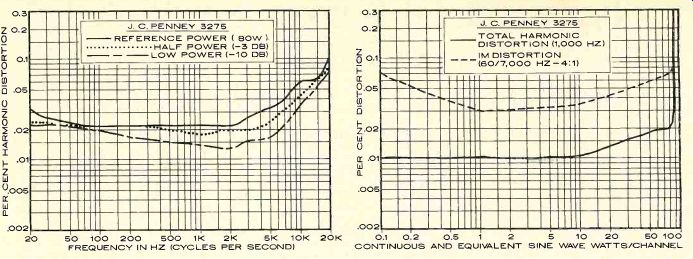
FREQUENCY IN HZ (CYCLES PER SECOND); CONTINUOUS AND EQUIVALENT SINE WAVE WATTS/CHANNEL.
A reference power output of 1 watt required an input of 17 millivolts (mV) through the AUX inputs or 0.235 mV through the pho no inputs. The signal-to-noise ratio (SIN) was nearly the same through both inputs, respectively 69.5 and 68.6 dB referred to 1 watt (with A-weighting). The phono preamplifier overloaded at the rated 200 mV at 1,000 Hz, and at 20,000 Hz it overloaded at 1,600 mV, which is equivalent to 168 mV at 1,000 Hz.
Both figures represent excellent phono dynamic range. We measured the phono-input impedance as 50,000 ohms in parallel with 150 picofarads.
In view of the amplifier section's official distortion rating of 0.25 percent, we were pleasantly surprised to find the distortion far lower than that under any measurement condition (it never approached 0.25 percent unless it was clipping). At 1,000 Hz, the THD was typically about 0.01 percent, reaching 0.02 percent in the 70- to 80-watt output range. The IM distortion was about 0.03 percent at most power levels and less than 0.07 percent from 0.1 to 85 watts output (it did rise at very low power levels, reaching 0.45 percent at about 3 milliwatts output).
The excellent performance of the power amplifier was maintained across the full audio band. At rated power (80 watts), the distortion was between 0.02 and 0.03 percent from 20 to 4,000 Hz, reaching its maximum of 0.1 percent at 20,000 Hz. At lower power levels the distortion curve was similar but with slightly lower magnitudes. The IHE slew factor exceeded 2.5, which is our measurement limit.
The graphic equalizer had the expected response, with considerable overlap between adjacent controls. As we confirmed by use tests, they can do a most effective job of correcting for broad-response characteristics of speakers, listening room, or program material. They are far more effective than conventional tone controls for this purpose.
The filters were of little value, having 6-dB-per-octave slopes. The response curves of the 8-kHz and 12-kHz filters were down 3 dB at those frequencies, the 20-Hz filter was down 3 dB at 25 Hz, and, for some reason, the 60-Hz filter was down 3 dB at 200 Hz. The loudness compensation boosted both low and high frequencies, but moderately enough so that it was at least listenable, in contrast to many loudness circuits that provide excessive frequency compensation.
The RIAA phono equalization (extended) was accurate within ±0.5 dB from 20 to 20,000 Hz. It was affected by no more than 0.5 dB at any frequency when measured through the inductance of a typical phono cartridge winding.
The calibration of the power meters was surprisingly accurate considering their small size. At most points they read within 20 percent of the actual power delivered to 8-ohm loads, which is as accurate as any of the full size meters we have seen.
The FM-tuner section of the Penney 3275 had an IHE sensitivity of 11.8 dBf (2.15 1.LV) in mono and 17 dBf (41.1..V) in stereo. The muting and stereo-switching thresholds were respectively 13.5 and 14.3 dBf. The 50-dB quieting level was reached at 15 dBf in mono (with 0.6 percent THD + N) and at 37.8 dBf in stereo (0.35 percent THD + N). The ultimate quieting at a 65-dBf input was 74.5 dB in mono and 69 dB in stereo. The distortion at that level was respectively 0.15 and 0.2 percent in the two modes.
The stereo-FM frequency response was within +1.6,-0.6 dB from 30 to 15,000 Hz.
The channel separation was quite uniform, measuring about 30 dB over most of the audio range and a minimum of 22.5 dB at 30 Hz.
-----
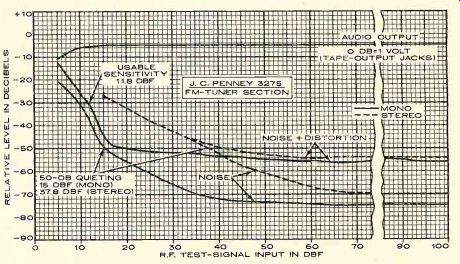
R.F. TEST-SIGNAL INPUT IN DBF.
The capture ratio of the 3275 was an extraordinary 0.7 dB at both 45 and 65 dBf in put. On the other hand, its AM rejection (which together with capture ratio is a factor in rejecting multipath interference) was mediocre (47 to 51 dB), as was the 53-dB image rejection. The alternate-channel selectivity was highly asymmetrical, measuring 49 dB on one side of the signal and 75 dB on the other, for an average of 62 dB. Adjacent-channel selectivity was a low 3.5 dB on the average. The 19-kHz pilot-carrier leakage into the audio was 65 dB below 100 percent modulation, and the tuner hum level was-64 dB.
We checked the calibration of the DEVIATION meter and found it to be in error by a consistent 10 to 15 percent (which is certainly satisfactory for its intended function of pro viding a level reference for tape recording FM programs). On the other hand, we got no indication from the meter in the MU LTIPATH mode, despite the fact that a number of signals in our area show considerable multipath distortion when viewed on a tuner or receiver fitted with an oscilloscope display. The signal-
strength LED indicator began to glow with in put signals of 10 microvolts, and only 2,000 microvolts were needed to light its eleventh segment. The twelfth segment never lit, even at levels exceeding 30,000 microvolts. The AM-tuner frequency response was flat within ±.1.5 dB from 35 to 2,000 Hz, down 6 dB at 3,700 Hz.
Comment. Judging from its appearance and our experience in testing and using the Penney 3275 receiver it seems to be designed to be an amalgam of high-fidelity performance and mass-market appeal.
The audio performance of the 3275 is excellent, and we could hardly fault it in any respect except for its filters (and here Penney is not alone, since effective audio filters are about as common as molars on a turkey).
Aside from their unusual physical packaging, which will probably appeal to some people more than the usual graphic-equalizer control layout, the equalizers of the 3275 proved to be very effective (especially when one does not look at the lights and merely adjusts the knobs by ear for the desired effect).
The FM-tuner section of the receiver is another story. Not that it is bad: it happens to sound excellent, with a slight "edge" to the extreme top end that is noticeable in comparison to some other tuners that have a perfectly flat high-frequency response-and easily explained by the slight high-frequency boost from the MPX filter. It is sensitive enough for almost anyone except the unfortunate soul who lives 100 miles or so from the nearest FM station, and its capture ratio was so remark ably good that we rechecked it several times, doubting our measurements (the results were consistent, which is in itself unusual in a cap ture-ratio measurement).
The audio section of the Penney 3275, though slightly less powerful than some in competitively priced receivers, is of excellent quality and provides what most of us expect from a top-of-the-line $600 receiver. But the FM-tuner performance, on the other hand, is typical of receivers of much lower price.
We found the tuning indicator of little value in assuring minimum distortion in FM reception. Fortunately this is not likely to be an audible defect, since anyone hearing distortion would naturally retune for better sound.
The AM sound quality of the receiver was surprisingly good. Although its upper frequency limit is not much different from that of most other AM tuners, it is flat in its response over most of the useful audio range up to several thousand hertz, and it has a much more pleasing sound than most AM tuners. It is not hi-fi by any means, but it is quite listenable, which is far more than can be said for most of its competition.
Summarizing, the J. C. Penney 3275 suggests that their MCS line is off to a good start and heading in the right direction. Many of our technical criticisms of the 3275 will not matter one whit to the general public at whom the unit is presumably directed. The fact that it has come so close to meeting true audiophile standards of performance and operation bodes very well for the future of the Penney hi-fi effort and its subsequent products.
----------------
Koss Pro/4 AAA Stereo Headphones
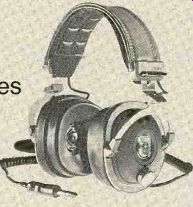
THE Koss Pro/4 series of stereo head phones has been in that company's product line for some years. Having progressed through the stages of the Pro/4 A and Pro/4 AA, in its latest version it is called the Pro/4 AAA. The phones have circumaural earpieces whose cushions fully enclose the outer ear and provide an airtight seal against the wearer's head. The cushions are trade-named "Pneumalite," and although the soft vinyl material appears to be loosely filled with a viscous fluid, they are actually filled with air.
The steel headband, covered in tan vinyl, has an inner, removable band containing several Pneumalite cells. The Pneumalite cushions are normally the only part of the head band that touches the top of the wearer's head. The steel band serves only to support the earpieces and carry the signal cable be tween them.
Like their predecessors in the Pro/4 series, the Triple-A phones have a knurled locking nut on the left earpiece that can be used to mount a short boom microphone to be positioned in front of the wearer's mouth. This is the basis for the phones' "pro" designation, since boom-mike/headphone combinations are used in many broadcast and even recording applications.
Each earpiece contains a dynamic driver with a 1-inch-diameter voice coil and a 2.5-square-inch diaphragm. Since the earpieces are completely sealed, all the sound is direct ed into the ear and little is radiated into the room. The nominal impedance of the phones is 220 ohms per channel at 1,000 Hz. According to Koss, the Pro/4 AAA phones give a 100-dB sound-pressure level (SPL) with 0.7 volt of sine-wave input at 1,000 Hz or 0.24 volt of pink-noise input. The nominal frequency response is 10 to 22,000 Hz, with no tolerance given. The Koss Pro/4 AAA, less cord, weighs 15.5 ounces. The coiled cord, which has a molded plug, extends to 10 feet in length. Price: $75.
Laboratory Measurements. The frequency response of the Koss Pro/4 AAA phones was measured on a standard headphone coupler, or "artificial ear." The response was strong and smooth from 20 to 300 Hz and sloped downward by about 5 to 10 dB between that frequency and 1,000 Hz. The high frequencies were reproduced with reasonable smoothness and good strength up to beyond 15,000 Hz (the coupler irregularities make it difficult to assess the actual response of the phones at high frequencies, if indeed there is any such thing as "a" specific response when one speaks of a headphone). Our curve agreed closely with the curve run by Koss on the same set of phones.
The 1,000-Hz output was 90 dB with a 0.2-volt input (100 dB was reached at 0.62 volt).
The distortion at 1,000 Hz, with a 100-dB SPL, was only 0.13 percent, equally divided between second and third harmonics. The impedance was 200 ohms from 70 to 5,000 Hz, dropping slightly to 150 ohms at 20 Hz and rising to 300 ohms at 20,000 Hz.

Comment. The Koss Pro/4 AAA shares with its predecessors the ability to deliver a high SPL with low distortion and a reasonably smooth frequency response through the audio range. Our recollection of the older Pro/4 models is that they sealed very tightly to the wearer's head and hence were somewhat un comfortable to wear for any extended length of time. The Pro/4 AAA represents a substantial improvement in wearing comfort, and we would rate it among the most comfortable sealing-type headphone sets we have worn.
Having a tight ear seal is important when one is recording live performers and wishes to monitor the program as it is being taped. For such an application, one could hardly ask for a more comfortable set of headphones.
Insofar as the sound of headphones can be characterized verbally, we would describe the Pro/4 AAA as having a slightly soft, warm tonal color. They are not at all dull-the highs are "all there," but de-emphasized compared with the lower middles and bass. Like most good phones, these can create a louder SPL than anyone will be able to tolerate, with no signs of overload or distortion and without requiring any unusual amount of drive from the amplifier.
--------------------
Realistic SCT-30 Stereo Cassette Deck
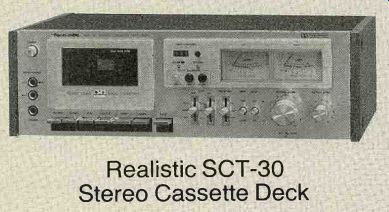
THE Realistic SCT-30 front-loading cassette deck is a three-head machine with full double-Dolby monitoring facilities and a dual-capstan servomotor drive system. The separate ,record and playback heads are contained in a single housing, which eliminates the need to adjust the head alignment every time a cassette is recorded. (In three-head decks in which the record and playback heads are separated, the azimuth, or perpendicularity, of the record head must, for optimum results, be realigned before each new recording. This is done in order to compensate for physical imperfections in cassette housings that result in tape skewing. In a design such as that of the SCT-30, the record and playback head gaps are so close to each other in their common housing that no significant skewing in the tape path between them can take place.) Along the left front edge of the SCT-30 are the power switch, a pair of jacks for medium-impedance (500- to 5,000-ohm) microphones, and a headphone jack providing comfortable listening levels for phones with rated impedances in the 8- to 600-ohm range. When the EJECT lever is pressed, the cassette-well cover opens forward at a slight angle. Cassettes are loaded, with the tape openings downward, into clips on the back of this cover, which is then pushed back into place, seating the cassette. A window in the cover allows the full label of the cassette to be read, and an illuminated orange panel in the rear of the well provides some indication of the amount of tape remaining on a side. The cover itself is removable, facilitating cleaning and demagnetizing of the heads.
Below the cassette opening is a row of typical "piano key" transport-control levers labeled RECORD, REWIND, PLAY, FAST-F, STOP, PAUSE, and EJECT. These are all mechanical in their operation and worked smoothly and positively in our tests. While it is possible to go directly from rewind to fast-forward, the manufacturer rightly recommends that the STOP lever be depressed first to prevent any possible tape jamming. The EJECT and PAUSE levers can be operated only in the STOP mode.
A three-position bias switch, used in con junction with a similar but separate equalization switch, sets the recorder up for ferric, chromium-dioxide, or ferrichrome formulations. Another switch is used to turn the Dolby system on and off or to set the deck up for proper dubbing of Dolby FM broadcasts.
Above the TAPE switches is a pushbutton that activates an internal generator used together with separate left- and right-channel knobs to adjust the Dolby system to match the sensitivity of the tape in use. A green LED lights up when the Dolby system is on, and an adjacent red LED indicates that the deck is in the RECORD mode. There is a three-digit tape counter with reset, but no memory function.
A pair of pushbuttons set the SCT-30 out put (and its meters) to monitor either the in coming (source) or the playback (tape) signals and to select between microphone and line-level inputs. The recording level is deter mined by clutched, concentric knobs that allow the user to accommodate differences in channel levels yet adjust both channels simultaneously. In addition, behind the split knob is a rotatable plastic disc with an orange marker that can be set to a desired position and provides a slight detent to allow a return to a previously established level. The output-control knob has a similar-looking marker disc (though without the detent) and controls both channels together. Two illuminated meters, calibrated as peak-level indicators from-20 to +5 dB (the Dolby marking is at +3 dB) complete the front panel.
The rear panel of the SCT-30 contains the usual phono-type jacks for inputs and out puts, a DIN connector with a switch to accommodate either of two DIN sensitivity levels, separate left- and right-channel Dolby-FM calibration adjustments, and a BIAS FINE control that permits the user to optimize the recorder bias for a particular tape. The SCT-30 measures approximately 18 inches wide, 10 inches deep, and 53/4 inches high and weighs 16 1/2 pounds. Price: $379.95.
Laboratory Measurements. The material supplied with our sample of the SCT-30 indicated that its ferric switch positions had been factory-adjusted for Realistic Supertape Gold, so we used this as our reference. Since this particular tape may be unfamiliar to many readers, we also made measurements using Maxell UDXL-I, TDK AD, and 3M Master I.
The performance of the SCT-30 with all four of these tapes was very similar-indeed, the responses differed by only about 0.5 to 1 dB.
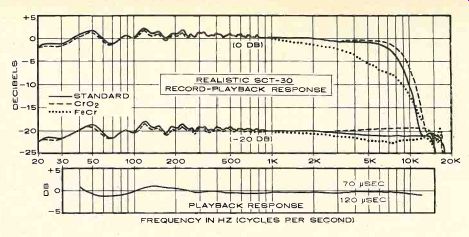
The SCT-30 comes adjusted for a "genuine chrome" formulation rather than for some of the popular cobalt-treated "70-microsecond ferrics," but the range of the BIAS FINE control is more than adequate for the very slight reduction in bias required to optimize the deck for the latter. The flattest response was obtained using Sony CRO, though the very slight (1.5 dB) rise in response at approximately 13 kHz obtained by using BASF Professional II extended its upper frequency limit by perhaps 500 Hz beyond that shown in the graph. On the other hand, the high-frequency response with TDK SA was very nearly as wide, despite being somewhat over-biased, and the distortion and signal-to-noise figures were a little better than we obtained with the chromium-dioxide tapes. The Maxell UDXL II showed some treble loss from overbias by the SCT-30, though, again, this was correctable with the BIAS FINE control.
Three ferrichrome formulations were checked, with BASF Professional III providing the flattest response, closely followed by Sony Ferrichrome. A pronounced dip of 5 dB or more in the region of 6 to 11 kHz was shown by 3M Master III, indicating the need for a somewhat different recording equalization than the SCT-30 employs.
We checked the accuracy of the playback equalization of the SCT-30 with our TDK AC-337 test tape, which covers the range from 40 to 12,500 Hz. In the ferric switch position (120 microseconds) response can be read directly, and it did not vary more than ±1 dB between the limits of the test tape.
When we applied the correction factors based on the mathematical difference between standard ferric equalization and the 70-microsecond characteristic used for CrO2 tapes, we found that the CrO2 and ferric playback curves overlaid exactly.
Comparing the overall record-playback frequency-response curves, it is clear that both at the indicated 0-dB level and at the -20-dB level the Sony CRO had the flattest response and the greatest amount of high-frequency headroom, followed by the ferric Realistic Supertape Gold and then by the BASF Professional III ferrichrome. In all cases the-3-dB point was reached (on the -20-dB graph) between 15,000 and 15,500 Hz; the low-frequency undulations ("head bumps") appear to be about average for this type of head construction and would certainly not be audible in any practical circumstances.
Using a 1,000-Hz tone at the meter's 0-dB input, TDK SA yielded an extraordinarily low 0.3 percent third-harmonic distortion and did not reach the reference 3 percent until an in put signal of +10 dB (far off the meter scale) was applied. Compared at the reference 3 percent point, unweighted, A-weighted, and CCIR-weighted signal-to-noise ratios (S/N) were 57, 62, and 60.2 dB, respectively, with out Dolby, and 59.5, 67.4, and 69.4 dB with Dolby. Our chrome sample had 1.1 percent distortion at 0 dB and an overload margin of 6 dB before the 3 percent point was reached; the unweighted, A-weighted, and CCIR weighted pre-Dolby S/N's were 53.8, 59.5, and 58.8 dB, which improved to 56.5, 64.5, and 67.5 dB with Dolby circuits.
The ferric Realistic Supertape Gold did nearly as well, producing only 0.6 percent distortion at a 0-dB input and requiring a +8-dB input level to reach the 3 percent distortion point. Using the same order, the S/N's were 53.7, 58.4, and 56.6 dB without Dolby and 56.5, 65.4, and 66 dB with Dolby. While the frequency-response figures with the BASF Professional III ferrichrome formulation were not quite as good as with the other tape types, its S/N figures were outstanding: 54.5, 61.2, and 60.8 dB non-Dolbyized, and 56, 65.7, and 69.5 dB Dolbyized.
Wow and flutter measurements made on the Realistic SCT-30 showed 0.058 percent wrms (0.075 DIN peak) figures when using a TDK test tape and 0.07 percent wrms and 0.1 percent DIN peak wow and flutter when recording and playing back a regular cassette. An-input level of 84 millivolts at the Aux inputs was required to produce a 0-dB meter indication; 0.29 mV was required for the same level at the microphone input. (In our tests the meters tended to under-read true peak levels, but they approximated the ballistic characteristics of true VU meters very closely.) Microphone overload did not occur until 28.5 mV, which should be adequate for all uses except close miking with high-output microphones.
The Dolby-level readings on the meters were within 0.2 dB, measured with a standard tape, and the adjustments for Dolby tracking with tapes of different sensitivities were easy to make. If we have a criticism on this score, it is that the exposed Dolby adjustment controls are too easy to turn by accident rather than design. Properly adjusted, the Dolby system showed no more than ±1 dB deviation from the non-Dolby frequency response curves at levels of-30 and-40 dB, and only a very slight loss (2.5 dB) in the highest frequencies at a-20-dB level. Fast-forward and rewind times were 95 seconds for a C-60 cassette, considerably bettering the 135-second specification.
Comment. We expected from our measurements that we would be pleased with the sonic performance of the Realistic SCT-30, and we were. The machine looks good, it handles well, and, especially with ferric and chromium-dioxide tapes, it sounds fine. When we subjected it to the stringent original vs. re cording comparison of which only a three-head design is fully capable, we could detect a slight dulling of the highest audio frequencies using the ferrichrome formulations. With ordinary FM and disc dubbing, reproduction was virtually perfect, and with top-quality ferric and CrO2 tapes only an insignificant difference could be detected even with so notoriously difficult a test signal as interstation FM hiss. The mechanical controls handled well, and if the meters were slightly slower in their response than we might have expected, the overload margins were more than adequate. At the price, a three-head cassette deck with all these assets and overall quality is a rarity indeed.
-------- FREQUENCY IN HZ (CYCLES PER SECOND)
-----------
====================
Also see:
Digital Mastering--A Progress Report (Jan. 1979)
Turntables -- What Are Your Options (Jan. 1985)
Source: Stereo Review (USA magazine)