Reviewed by RICHARD FREED DAVID HALL GEORGE JELLINEK PAUL KRESH STODDARD LINCOLN ERIC SALZMAN
J. S. BACH: Christmas Oratorio (BWV 248).
Hubertus Baumann, Frank Sahesch-Pur (boy sopranos); Michael Hoffmann (boy alto); Heiner Hopfner (tenor); Nikolaus Hillebrand (bass); Regensburger Domspatzen; Collegium St. Emmeram, Hanns-Martin Schneidt cond. ARCHIV 2710 024 three discs $29.94, 02276 012 $29.94.
Performance: Spotty
Recording: Excellent
There are many good things about this performance as well as, alas, many bad things.
The problems are apparent at the very beginning. The sound of the period instruments is thrilling as the kettle drums thud, the oboes squall, the recorders twitter, and the violins scurry like mad. Then the chorus barks its message of joy. The sound is there, the enthusiasm is there, but the effect is scruffy.
And so it goes for the rest of the performance: wonderful sound and enthusiasm, technical bloops and stiff phrasing.
In an effort to keep the chorales moving, the tempos are often too fast and the phrases clipped. The recitatives lack rhythmic flexibility and, despite some fine nuances, are too measured. Ritards are banished, and many movements simply stop rather than coming to a cadence. All too often conductor Hanns Martin Schneidt sets a rigid tempo that stifles a singer's vocal instincts. A case in point is the bass aria "Grosse Herr and starker Konig."
Explanation of symbols:
= open-reel stereo tape
= eight-track stereo cartridge
= stereo cassette
= quadraphonic disc
= digital-master recording
= direct-to-disc recording
Monophonic recordings are indicated by the symbol.
The first listing is the one reviewed; other formats, if available, follow it.
The vocal line is fierce with leaps and coloratura, but Nikolaus Hille brand is never allowed to turn a phrase, prepare a leap, or linger on a high note. And despite this rigidity, the syncopations are flabby and ensemble problems abound. Hille brand's voice is splendid, the trumpet hits all the notes, but nobody sounds happy.
Exceptions to this overall half heartedness are the strong interpretations of tenor Heiner Hopfner. Although he is a bit rigid in the narrations, his aria singing is exquisite. In "Frohe Hirten, eilt, ach eilet," each phrase is beautifully molded and the ensemble of voice and flute is perfect; his final ritard and the takeover for the final ritornelle by the flute are masterly.
The most objectionable aspect of this album is the solo singing of the boy sopranos and alto. (Frankly, 1 don't care whether Bach actually used boys as soloists or not.) Their voices here are too weak, often wobbly, old-sounding (!), and out of tune. Nor are their musical instincts sufficiently mature to express Bach's profundity. Of the thirteen arias and ensemble numbers, eight involve boy soloists and are accordingly sabotaged. I find it ridiculous to have a bass croon his part of a duet at half voice in the hope that his boy partner can be heard. Why not use women singers and let us enjoy the music rather than make us suffer like this in the name of "authentic performance practice"? Basically, I find this release more frustrating than rewarding. S.L.
RECORDING OF SPECIAL MERIT
J. S. BACH: Sonatas and Partitas for Solo Violin (BWV 1001-1006). Oscar Shumsky (violin). MUSICAL HERITAGE SOCIETY MHS 4032/3/4 three discs $15.60 (plus $1.25 for ,postage and handling from the Musical Heritage Society, Inc., 14 Park Road, Tinton Falls, N.J. 07724).
Performance: First-rate
Recording: Very good
The solo sonatas and partitas of Bach represent an arena where Oscar Shumsky--a highly respected if lowly touted violinist-must not only take on the fierce musical challenge but also contend with competitive achievements of such gladiators as Heifetz, Milstein, Szeryng, Grumiaux, and Menuhin, who have preceded him. But he comes through most impressively.
Shumsky's playing is admirable in its tonal firmness and musical logic. He does not match the classic poise and silken elegance of Milstein or the Heifetz way of sailing through phenomenal difficulties as if they did not exist. This is not a seamless performance, but neither is it labored or heavy-handed. It is warm in tone, incisive, technically assured, and sensitive to dynamic shadings. The rhythm is steady but not inflexible, and the complexities of such fiendishly written sections as the adagio and fuga of the Sonata No. 3 are clearly defined. The celebrated chaconne in the D Minor Partita is also impressive in its clarity of structure.
There are some unconventional touches: Shumsky alters the prevailing dotted pattern in the fifth measure of the allemande in the Partita No. 1; he repeats the second section of the same movement (a procedure that, to my knowledge, is not generally followed), and he adds a few unwritten trills in the grave of the Sonata No. 2, in A Minor. Let us remember, however, that the number of differently an notated editions in this literature is, in Joseph Szigeti's phrase, "bewildering." The same word may be applied to the available record ed versions as well. And yet Shumsky's holds its own among them, and it has been cleanly and resonantly recorded. G.J.
RECORDING OF SPECIAL MERIT
BERLIOZ: Symphonic Funibre et Triom phale, Op. 15. Musique des Gardiens de la Paix de Paris, Desire Dondeyne cond. NONE SUCH H-71368 $4.96.
Performance: Poignant and powerful
Recording: Excellent
In France the year 1840 marked the tenth anniversary of the July Revolution that in stalled King Louis Philippe, and his government decided to transfer the remains of the 1830 combatants from the Colonnade du Louvre to the Place de la Bastille, where a commemorative column was to be dedicated.
The Minister of the Interior invited Hector Berlioz to compose a work for the occasion, and the result was the Symphonie Funebre et Triomphale, a noble and stirring piece of mu sic conceived on the grand scale for which the composer was famous. The performance on the occasion suffered a number of mishaps, but later that year, when 450 performers, including a chorus the composer had added, offered the work at the Opera, it was a huge success. Wagner thought it was the best thing Berlioz had ever written. This new Nonesuch release (it is not the old Erato recording), acquired from Calliope in France, sticks to the original scoring without chorus, but an overpoweringly persuasive offering it is, hypnotic in its effect as each of the movements builds majestically in great sweeps of sound, punctuated by exclamations from the drums and brasses in the opening movement and by arresting passages for clarinets and flutes in the final Apotheose.
As in any big Berlioz work, there are over blown, inflated, and static stretches, but by and large the score is an especially moving one. The performance by the Band of the Paris Municipal Guard under Desire Dondeyne is stunning-absolutely hair-raising, in fact.-and magnificently recorded. It lacks only the element of surprise and variety sup plied by the chorus, which is included in the Philips album with the London Symphony under Colin Davis, a recording that in all other respects seems inordinately tame after hearing the one on Nonesuch. P.K.
BRUCKNER: Symphony No. 9, in D Minor.
Leipzig Gewandhaus Orchestra, Kurt Masur cond. VANGUARD VSD-71245 $7.98.
Performance: Level-headed
Recording: Very spacious
BRUCKNER: Symphony No. 9, in D Minor.
Berlin Philharmonic Orchestra, Eugen Jochum cond.
PRIVILEGE 2535 173 $6.98, 3335 173 $6.98.
Performance: Passionate
Recording: Good 1966 vintage
Those searching for a recorded performance of Bruckner's Ninth that is less imposing and granitic in mien than those of Karajan or Haitink will find two contrasting alternatives here. Kurt Masur adopts the more classical approach and achieves unusually transparent textures in the first movement; the sound is very spacious with a somewhat distant micro phone placement. Some of the impact of the gigantic climaxes is thereby dissipated, but, fortunately, the line and chord structure is not muddied. Masur and the production staff are most successful in the always affecting final adagio, which here emerges as a series of grandiose tonal vistas stretching into a seemingly infinite horizon.
As those familiar with the original Deutsche Grammophon issue of the Bruckner symphonies under Eugen Jochum well know, his way with the music is personal and romantic, with the kind of tempo modifications one would expect. In essence, Jochum judiciously compromises the structural element in order to bring into relief the passionately lyrical content. The result in this instance is movingly eloquent, particularly the slow movement. The conics are excellent, even by today's standards. D.H.
BYRD: Lute Music (see Collections-Paul O'Dette)
RECORDING OF SPECIAL MERIT
DEBUSSY: Images (1894); Estampes; Im ages, Series I & II. Paul Jacobs (piano).
NONESUCH H-71365 $4.96, N5-1365 $4.96.
Performance: Sensitive and exquisite
Recording: Nice sound
There is a group of pianists who came up in the 1950s and who were associated with new works and a supposedly intellectual approach to music. It's good to see that some of these people-Charles Rosen, Russell Sherman, Paul Jacobs-long ignored by the musical establishment, are finally getting their due. Jacobs, who spent a great deal of time in France in his younger days (he was more or less the official pianist of the old avant-garde), has not surprisingly turned out to be an excellent Debussy pianist. Logically, for a pianist known for twentieth-century music, Jacobs has worked his way backward through the Debussy repertoire: from the late, more abstract Etudes to a two-volume set of the Preludes to the earlier and vivid Estampes and Images, Debussy's musical equivalents of sketches or prints. These include an early set dated 1894 (the same year as the Afternoon of a Faun) and apparently written for a young lady by the name of Yvonne Le Rolle.
The manuscript somehow passed into the hands of Yvonne's piano teacher, Alfred Cortot, who put it in his library and did nothing with it. The collection later came to this country, and the set of three pieces was published only in 1978. Debussy had formed his personal style quite completely by 1894, and even the connections with later works (a revised version of the second movement appears in Pour le Piano and the third is based on a nursery rhyme used in one of the later Im ages) do not prevent us from regarding this as a major independent work and an important addition to the repertoire.
Jacobs plays this work and the others with great finesse. Small distinctions and great precision count for a lot. This is not a colorful or flashy Debussy-Jacobs would obviously prefer that the visual and literary imagery re main subordinate to the purely musical-but it is sensitive and exquisite. Nice sound from the Baldwin SD-10. E.S.
DONIZETTI: Lucrezia Borgia. Joan Sutherland (soprano), Lucrezia Borgia; Giacomo Aragall (tenor), Gennaro; Marilyn Horne (mezzo-soprano), Maffio Orsini; Ingvar Wix ell (baritone), Don Alfonso; Graeme Ewer (tenor), Rustighello; Nicola Zaccaria (bass), Astolfo; Richard Van Allan (bass), Gubetta; Graham Clark (tenor), Liverotto; Lieuwe Visser (bass), Gazella; John Brocheler (bass), Petrucci; Piero de Palma (tenor), Vitellozzo; others. London Opera Chorus; National Philharmonic Orchestra, Richard Bonynge cond.
LONDON OSA 13129 three discs $26.94, CI OSA5 13129 $26.94.
Performance: Good to not so good
Recording: Very good
Donizetti's Lucrezia Borgia comes close to being a good opera. The prevailing dark coloration of its music captures the sombre, intrigue-laden atmosphere of Renaissance Italy the way Verdi's Rigoletto (another opera based on a Victor Hugo horror drama) was to do several years later. Lucrezia has several arias and ensembles of first-class inspiration and even orchestral writing of intermittent beauty. But against all this weighs a preposterous plot, characters torn by unconvincing contradictions, and music that tends to wind down after a promising first act, descending all too often to predictable formulas. About ten years ago, RCA released a quite distinguished version of the opera (LSC 6176, with Monserrat Caballe, Alfredo Kraus, and Ezio Flagello, Jonel Perlea conducting) which, one would have thought, should have satisfied the public need. Well, "one" was wrong, or at least Joan Sutherland and Richard Bonynge feel that the time has come for Lucrezia to stir things up again.
Sutherland can no more make a credible or compelling character of Donizetti's Lucrezia than Caballe could. She is also hampered by the occasionally low tessitura, but her singing, in general, is secure and accomplished, and she can still rise to an impressive high E-flat. The Caballe of 1967 exhibited more tonal freshness than the Sutherland of 1977 (the year of this recording), but Sutherland can manage the embellishments more fluently. Both versions are fortunate in their inter preters of Gennaro: Giacomo Aragall offers the richer sound, Alfredo Kraus the more elegant style. Aragall has more to sing, however, because in London's version the role is enhanced by the two arias (one at the beginning of Act Ill, the other near the end, as death approaches) that Donizetti added to the score after the 1833 premiere.
Marilyn Horne's sound is unique and her artistry treasurable even when, as here, she is not in her best vocal form and even though she applies too much sound to the lightly drawn role of Orsini. Ingvar Wixell is suit ably furious as Lucrezia's irate husband, but his tones are ill-focused and his style vigorously anti–bel canto. The veteran Piero de Palma emerges like an Italian oasis in the desert of unidiomatic-sounding comprimari.
But even in their ranks Graeme Ewer calls attention to himself with his unique approach to the Italian language and a tone that recalls the late-period Alessio de Paolis. Cannot these overworked Englishmen be given a lengthy rest from Italian opera? Although he augments the tenor part, Bonynge omits Lucrezia's first-act cabaletta, "Si voli it prima a cogliere," added to the score for the Milan revival of 1840 (it is retained in the RCA version). Both versions offer Lucrezia's final aria di bravura, which Donizetti wrote with great reluctance to accommodate the original interpreter, the fading but still demanding Meric-Lalande. An effective vocal display, it is also a coup de grace for this dramatically incoherent opera.
Richard Bonynge conducts with an obvious understanding and affection for this uneven score, and the orchestral playing is first-rate.
Some of the ensembles could be cleaner and better clarified in terms of balances, but the recorded sound is impressively rich. The background essay by Jeremy Commons is un usually informative. G.J.
DOWLAND: Lute Music (see Collections Paul O'Dette)
RECORDING OF SPECIAL MERIT
DUFAY: Missa Ecce Ancilla Domini; Je Me Complains; Navre Je Suy; Anima Mea Lique facta Est; Gloria Resurrexit Dominus; Ave Regina Celorum; Ecclesie Militantis. Pomeri um Musices, Alexander Blachly cond. NONESUCH H-7I367 $4.96.
Performance: Beautiful
Recording: Fine
Alexander Blachly and the Pomerium Musices have evolved a perfect sound and style for the delicately etched lines of Guillaume Dufay's music. The ten members of the chorus produce a clear, light sound and sing with a rhythmic vitality that brings life to each of the intricately wrought parts of the music.
The a cappella performance of the Missa Ecce Ancilla Domini is a model of vocal chamber music in which the linear aspects of Dufay's art are beautifully displayed.
Joined by vielles, sackbuts, and a lute on side two, the group offers several motets and two secular works. Here again, rhythmic clarity and subtle articulation propel Dufay's mosaic-like structures. This record is impressive for both its content and its performance, and the recording is fine too. S.L.
--------------------
139
Britten's "Ceremony of Carols"
----------------139 The Vienna Choir Boys
IF you are a connoisseur of boys' choirs i (there must be three or four of us anyway), you are aware that there are considerable national differences among them. English choirs tend to be very pure and a little hooty; French ones nasal, sometimes insecure in pitch, but still somehow lovely; Danish ones secure, musical, a little bland; Spanish, utterly striking, as if their throats were made of bronze. The Vienna Choir Boys also have a sound of their own, and it is perhaps the most simply beautiful of all.
Devotees of Christmas music (there are more of them) know that there are really comparatively few crossovers from country to country in Christmas repertoire. So it is rather unusual to find the late Benjamin Britten's A Ceremony of Carols performed here by the Viennese group, albeit with the assistance of one of the composer's close friends, the Welsh harpist Osian Ellis. Ellis has also arranged a group of English carols for the second side, and, make no mistake, these are no mere run-throughs with newly composed-harp accompaniment, but inventive, in places rather Brittenish, elaborations of the traditional tunes, with such interesting small adjuncts as bells, whistles, and occasional rather threateningly modern sounds.
Still, they are a joy and a definite asset to the record.
The Vienna Choir Boys' performance of the Britten is, as one might expect, a most beautiful one in terms of sheer sound, and Ellis' harp is given more prominence than usual-to the advantage, I think, of the work.
The boys sing with excellent diction, mispronouncing only occasionally (and then rather charmingly); they swallow a syllable once in a while in the faster sections, but they are almost always right on pitch. There is really little one can find wrong in their musical idiom, but some of the subtleties of inflection to be found in English performances are not tried for here. The soloists strike me as both better and more secure than usual.
Britten's own recordings of Ceremony seem to be gone from the catalog, so if you need a performance of this striking work, the present one is well worth getting. Taking into account the Ellis arrangements on side two, I can't think of a more Christmassy-sounding record this year. Excellent recording (barring a few blasts from the pressing-presumably incurred in the cutting), but, unfortunately, highly incomplete texts for the Britten and none whatever for the Ellis. Not, in other words, the most intelligent production job.
Christmas rush?-James Goodfriend
BRITTEN: A Ceremony of Carols, Op. 28.
TRAD. (arr. Ellis): Seven English Christmas Carols. Ding Dong! Merrily on High; Away in a Manger; We've Been Awhile A-Wandering; Coventry Carol; I Saw Three Ships; Once in Royal David's City; Deck the Hall.
Osian Ellis (harp); Vienna Choir Boys, Uwe Christian Harrer cond. RCA ARLI-3437
$8.98, ARKI-3437 $8.98.
----------------------
Franz Berwald: The Orchestral Works Complete on Seraphim
Conductor: Ulf Bjorlin
IN 1957 American Decca, with the release of Igor Markevitch's mono recording, with the Berlin Philharmonic, of two symphonies by Franz Berwald (1796-1868), introduced into the record market a composer until then unknown to most of us. Here was a fascinating discovery: a Swedish symphonist of real stature who was born a year before Schubert, died a year before Berlioz, and was productively influenced by the latter (and Mendelssohn) in developing a language and style utterly and uniquely his own.
Over the years there have been a few recordings of Berwald's other symphonies and much of his chamber music, but some of the best versions of the symphonies have followed Decca's old DL-9853 out of the catalog. Sixten Ehrling's splendid performances of the Sinfonie Singuliere and the Symphony in E-flat (the same two Markevitch had done), recorded with the London Symphony Orchestra in observance of the centenary of the composer's death and avail able here all too briefly on London CS 6602, and Antal Dorati's Stockholm Philharmonic recording of the Sinfonie Capricieuse, formerly on Victrola V ICS- 1319, may still be available as Swedish Discofil imports, but the only Berwald symphonies listed in Schwann the last few years have been the Singuliere and the Serieuse, both performed by the Stockholm Philharmonic under Hans Schmidt-Isserstedt on Nonesuch H-71087.
Although Schwann formerly made reference to six Berwald symphonies, there are actually only four. The numerical confusion is clarified by Robert Layton, the author of the only English biography of the composer ( London, 1959), in his comprehensive annotation for a new four-disc Seraphim set of all of Berwald's orchestral works performed by the Royal Philharmonic Orchestra under the young Swedish conductor Ulf Bjorlin. In his capacity as a record reviewer, Layton greeted these recordings when they were released in England two years ago as "a welcome and self-recommending issue." And so it is, if perhaps more for simply making all this music so conveniently and economically available than for performances one might regard as consistently distinguished.
To suggest a lack of distinction is not to say that Bjorlin's performances are not pleasing.
His handling of the Sinfonie Serieuse in particular is extremely convincing, and, while the slow movements of the other symphonies are unfolded rather prosaically and there are
moments of shaky ensemble in several of the works, the orchestral playing is for the most part up to the level one associates with the RPO. Bjorlin shows both good understanding of the material and a competent, un-self-conscious manner in presenting it.
Indeed, the two concertos do come off with a good deal of distinction, and they are both eminently attractive works, if less striking than the symphonies. The Violin Concerto, the slighter of the two, was composed in 1820 and is more or less in the style of Mendelssohn-who was then eleven years old. (As Layton remarks in his general comments on Berwald, "when one is reminded of other composers, one usually discovers that they are much later." Both the Symphony in E-flat and the Singuliere seem to "pre-echo" parts of Dvorak's Fourth and Fifth Symphonies.) The Piano Concerto, composed in 1855, is Schumannesque in its contours and general feeling; what is "different" about it is that the piano plays constantly, with the orchestra so much in an accompanying role that the score advises that the work may be performed without orchestra. (The Piano Concerto was not heard in any form until 1904; like the symphonies of Schubert, several of Berwald's works waited until long after the composer's death for their premieres.) Soloists Arve Tellefsen and Marian Migdal show consummate skill and commitment in their respective assignments, and Bjorlin and the orchestra are at their best on these two sides. I have not heard Greta Erikson's recording of the Piano Concerto (Genesis GS- 1011), but Migdal's playing makes me very eager to hear him again.
Berwald was, as we used to say, a man of many parts. In addition to composing and conducting, he founded an orthopedic institute in Berlin, managed a glass works in northern Sweden, and established a sawmill, His orchestral writing was concentrated in a short but remarkably productive period: all five of the tone poems were composed between December 1841 and August 1842, two of the symphonies in the latter year, and the other two in 1845. In his recording of two tone poems and two overtures (Nonesuch H-71218), Ehrling shows more subtlety, more skill in the shaping of some phrases, and more than Bjorlin does, but in these pieces Bjorlin's exuberance serves him well, and so does the superior sound of his newer recording. I would question only the juxtaposition of the Festival of the Bayaderes and the Queen of Golconda Overture on side six, since both pieces make use of the same material.
CONSIDERING previously available records, some collectors might be grateful if Seraphim were to make the disc of the two concertos available on its own. But many Berwald enthusiasts, I suspect, will not mind duplicating some of the titles for the convenience and comprehensiveness of this economical, well-recorded, and well-documented set. Surely those coming to Berwald's music for the first time will find this a boxful of the most delightful discoveries, and in that light the importance of the shortcomings I have noted tends to diminish appreciably.
-Richard Freed
BERWALD: Symphony in C Major ("Singu Here"); Symphony in G Minor ("Serieuse"); Symphony in D Major ("Capricieuse"); Sym phony in E-flat Major; Piano Concerto in D Major; Violin Concerto in C-sharp Minor, Op. 2; The Queen of Golconda, Overture; Estrella di Soria, Tragic Overture; Play of the Elves; Serious and Joyful Fancies; Festival of the Bayaderes; Memories of the Norwegian Mountains; Racing. Marian Migdal (piano, in concerto); Arve Tellefsen (violin, in concerto); Royal Philharmonic Orchestra, Ulf Bjorlin cond. SERAPHIM SID-6113 four discs $19.98.
------------------
--------------- 144
A.Welcome New “Faust"
--------------144 Mephistopheles (Ghiaurov) and Marguerite (Freni) at playback
IT is a safe premise that a performance of Gounod's Faust-a large-scale grand op era-needs the best possible singers for its success. This does not necessarily mean the singers stylistically best qualified to fill the roles. For example, a strong case could be made nowadays for casting Alain Vanzo, lleana Cotrubas, and Roger Soyer as the principals. But would such a cast attract any where near as much interest on records as the formidable trio of Placid° Domingo, Mirella Freni, and Nicolai Ghiaurov? Of course not.
So let us be realistic and accept the casting on the new Angel recording as eminently logical.
Actually, though not very French, this performance is very good, the best on records since Angel's last attempt about twenty years ago (S-3622). If the three stars are not shining examples of the great Gallic tradition, they serve Gounod's imperishable and accommodating music with distinction. Domingo sings the title role in his usual committed, passionate, yet tasteful fashion. Freni's tones may have lost some of their erstwhile fresh ness and gleaming purity, but hers remains a lovely voice, and she uses it with particular delicacy in the seldom-heard Spinning Wheel aria, "Il ne revient pas." Ghiaurov, too, is not as overwhelming as he was in his previous re cording on London (OSA 1433) ten years ago, but he is still a commanding presence, and I doubt that there is anyone who can surpass his Mephistopheles.
The rest of the cast is uniformly excellent.
The English baritone Thomas Allen commands the best diction among the non-French principals. His youthful, vibrant voice easily encompasses the role's high tessitura, though it is somewhat wanting in forward projection.
Michele Command is a gentle, velvety sounding Siebel, Marc Vento an uncommonly strong Wagner, Jocelynne Taillon an expert Marthe. Georges Pretre, an old hand with this score, at times holds the singers on too tight a rein (Valentin's Cavatina and the Serenade of Mephistopheles could stand more" flexible shaping), but overall his work is brisk, sensible, and well organized. The chorus and orchestra are good, though the violin solo at the end of "Salut, demeure" is not perfect in intonation.
The new Angel version offers a great deal more of Faust than is usually heard in the theater (though not quite as much as the London set). In addition to the scene contain ing Marguerite's "Il ne revient pas," Siebers second aria ("Si le bonheur") is retained. We are also treated to Faust's Drinking Song in place of the Walpurgis ballet (Act V), with the ballet given as a bonus on side eight.
Technically, the recording makes surprisingly little of the stereo possibilities, but it is entirely satisfactory.
There are now four stereo Fausts in the catalog, but the RCA version is not really in the competition. London OSA 1433 offers completeness and Ghiaurov in superlative form (also Sutherland and Corelli, however miscast they are), and Angel S-3622 should be treasured for the unequaled Marguerite of Victoria de los Angeles. I welcome the new set for its balance and for its all-around high standards.-George Jellinek
GOUNOD: Faust. Mirella Freni (soprano), Marguerite; Placido Domingo (tenor), Faust; Nicolai Ghiaurov (bass), Mephistopheles; Thomas Allen (baritone), Valentin; Marc Vento (baritone), Wagner; Michele Command (soprano), Siebel; Jocelyn Taillon (mezzo-soprano), Marthe. Paris Opera Chorus and Orchestra, Georges Pretre cond. AN GEL SZDX-3868 four discs $24.98, C) 4Z4X-3868 $24.98.
--------------------
GLAZOUNOV: The King of the Jews, Op. 95. Stuttgart Philharmonic Orchestra, Siegfried Kohler cond. TURNABOUT QTV 34739
$4.98.
Performance: Very good
Recording: Very good
In 1905, the year in which he turned forty, Glazounov became the director of the St. Petersburg Conservatory. He had by then produced virtually all of his really important works-the three ballets, the two adorable valses de concert, the eight symphonies, five of the seven string quartets, and the violin concerto (whose opus number, 82, indicates how productive he had been). After 1905 he was more conspicuously active as pedagogue than as composer, and little of the music he wrote in his last thirty years has anything like the freshness or appeal of what he produced earlier. Here, for the first time on records, is a case in point, a marvelously orchestrated but substantially empty set of pieces composed in 1913 for a "mystery play" by the Grand Duke Konstantin Romanov. The play was produced in 1914, with choreography by Michel Fokine, the Grand Duke himself in the role of Joseph, and other roles taken by officers of the Ismailov regiment, who took up the Resurrection Chorus from the score as their own in the war that broke out in the summer of that year. The chorus is not included in the sequence recorded here, which is presumably what Glazounov himself used to conduct on his concert tours. Other listeners may find themselves responding more sympathetically than I have been able to do.
The performance itself seems to be a good one (Siegfried Kohler has recorded some more interesting Russian music for Turn about), and the sound is very good. R.F.
" HAIEFF: Symphony No. 2. Boston Symphony Orchestra, Charles Munch cond. Piano Concerto. Leo Smit (piano); Vienna Symphony Orchestra, Walter Hendl cond. SEREN US SRS 12086 $6.98.
Performance: Splendid
Recording: Well-preserved
Charles Munch's recording of Alexei Haieff's Second Symphony, one of the few he made of any American music, originally appeared about twenty years ago on RCA paired with Easley Blackwood's Symphony No. 1, but it did not stay in the active catalog very long. It was very much worth rescuing from the vaults, for it is a splendid performance of an intriguing and highly accessible work, and the early stereo sound, while in no way out standing, carries its years well. The overside performance of Haieff's perhaps even more interesting piano concerto was recorded as part of the Ditson-funded American Recording Society project in the early Fifties, and for the last dozen years or more it has been available in artificial stereo on Desto DST-6420; it seems to be offered in undoctored mono here, and the restoration is first rate. There was a somewhat later recording of the concerto on MGM, but this performance, by the pianist for whom the work was written and one of the finest conductors this country has produced, is definitely the one to have.
Altogether an attractive package. R.F.
RECORDING OF SPECIAL MERIT
HAYDN: Six Flute Quartets, Op. 5. Jean Pierre Rampal (flute); Trio a Cordes Francais. SERAPHIM S-60327 $4.98.
Performance: Sparkling
Recording: Beautiful
There is no genre, at least in my opinion, that so combines the qualities of wit and elegance as the late eighteenth-century divertissement.
Whether they scored for strings, winds, chamber orchestra, or, as in this case, flute quartet, composers of the era sought a perfect balance to delight both the amateur and connoisseur of music. Haydn was a master of this art, and the Op. 5 flute quartets demonstrate how early in his career he could charm all the senses in beautifully balanced structures.
With the Trio a Cordes Frangais, Jean Pierre Rampal is at his best. He is a brilliant soloist, and these pieces tend to feature the flute, but all the parts are played to perfection. This is chamber-music playing at its finest: the ensemble is excellent, and yet there is that interplay of sonority and phrasing that is the essence of this high art form. A delightful record.
S.L.
HAYDN: Mass No. 1, in F Major (Missa Brevis); Salve Regina in E-flat Major; Mass No. 2, in E-flat Major ("Great Organ Mass"); Stabat Mater. Krisztina Laki (soprano); Julia Hamari, Hildegard Laurich (altos); Claes Haaken Ahnsjo, Aldo Baldin (tenors); Richard Anlauf (bass); Stuttgart Chamber Choir; Christof Roos (organ); Wurttemberg Chamber Orchestra, Heilbronn, Frieder Bernius cond. Vox SVBX 5216 three discs $11.95.
Performance: Adequate to excellent
Recording: Adequate to good
This first volume of a projected complete re cording of Haydn's church music is somewhat uneven; fortunately, the most important item here, the Stabat Mater, is the one definite success. Other than a Dutch recording on Musical Heritage Society, this appears to be the only stereo version of the Stabat Mater.
H. C. Robbins Landon dates the piece 1767 (not 1770-1771 as the album notes have it), and, like the C Major Mass (Saint Cecilia) written the previous year, it is very elaborate in layout and lasts over an hour in performance. Stylistically, the music seems both to look back to the late-Baroque Italian manner and to look forward to the "storm and stress" expressiveness of Haydn's 1771 symphonies.
It is a fascinating and substantial work with a key place in Haydn's creative development.
The performance here is good on the whole.
The female soloists are heard to especially fine advantage. Bass Richard Anlauf also does very well with his two major arias, and tenor Claes-Haaken Ahnsjo not only displays topnotch musicianship but has a voice of singular sweetness and body. The entire stand ard of performance is audibly higher than in the three earlier works; conductor Frieder Bernius clearly had his heart in this task.
The Missa Brevis is the work of a seven teen-year-old just learning his craft. Its twelve and a half minutes shows a fresh, naïve charm, especially in the intertwined lines for alto and soprano (Krisztina Laki and Julia Hamari, respectively), who are in splen did form throughout. The orchestra sounds a bit tentative, the chorus spirited if not very clear in terms of diction. The three-minute Salve Regina, again a work of sweetness and naivete, is performed somewhat better.
The E-flat Mass is more ambitious. The prominent episodes for organ obbligato and the treatment of the solo lines give something of a concerto grosso feel to the work, and the frequent fugal textures foreshadow the fugues in the soon-forthcoming Op. 20 string quartets. The "Great Organ Mass" is a vital work, if not as stylistically cohesive as Haydn's more mature essays in the genre.
This Vox Box contains the only currently available recordings of the first two Masses, and we should be grateful to Vox for giving us such music at such a modest price. None theless, I have some gripes about the packaging as well as the uneven performance qual ity. No texts are supplied for the Stabat Mater, the Salve Regina, or the Missa Brevis, and the labels and annotation do not make it clear which soloists are participating in which work. D.H.
RECORDING OF SPECIAL MERIT
HOLST: The Planets, Op. 32. London Phil harmonic Orchestra, Georg Solti cond. LON DON CS 7110 $8.98, CS5 7110 $8.98.
Performance: Toscaninian
Recording: Very good
Had Toscanini ever chosen to include Hoist's Planets in his active repertoire, I imagine that his reading of it would have sounded very much like this remarkable one by Sir Georg Solti. In contrast to most other recorded performances of The Planets, Solti's is taut and volatile, and except for the mystical Neptune finale it is wholly convincing. Mars is relent less brutality incarnate. Venus is handled with a superbly sustained line and boasts exceptionally fine solo work from the London Philharmonic woodwinds. Mercury is super-mercurial here: the orchestral playing constitutes a virtuosic tour de force, with marvelous articulation of tricky rhythmic figurations and utter clarity of textural detail. In keeping with Solti's general interpretive approach, Jupiter is taut and festive-there's none of the beefiness that one sometimes encounters in this piece, especially with the entrance of the "big tune." Saturn is for me the high point of The Planets, and so it seems to be for Solti also.
He lavishes care on this music, bringing its sad procession to a mighty outcry and then making the most of the serene final pages.
Uranus, a first cousin to Dukas' Sorcerer's Apprentice, provides a feast of magical high jinks presented here with momentum and utter clarity of rhythmic articulation. Only in the otherworldly Neptune music does Solti's performance let down. It is all very nicely done, but there's little of the special nuance that Sir Adrian Boult in his top form has brought to these same pages.
If you want your Planets ultra-brilliant, Solti's is the one for you. Otherwise, of the more than a dozen alternative recordings, Boult on Angel and Haitink on Philips are my choices. London's recording for Solti, by the way, matches the performance point for point in clarity and power. D.H.
HUMPERDINCK: Hansel and Gretel (see Best of the Month, page 92) RECORDING OF SPECIAL MERIT JANACEK: String Quartet No. 1 ("Kreutzer Sonata"); String Quartet No. 2 ("Intimate Pages"). Gabrieli Quartet. LONDON STS 15432 $4.98.
Performance: Stunning
Recording: Superb
It was not so long ago that virtually all Czech music was regarded as properly performable only by Czech musicians. While this notion
( Continued on page 147)
has been largely corrected in the case of Dvorak and Smetana, it has held on more firmly in that of Leo Janacek, perhaps with more justification since so much of Janacek’s music is based on the speech patterns of his native Moravia. It is really only in the last few years that a few recordings have demonstrated conclusively that "you don't have to be Czech" (to paraphrase the Levy's Jewish Rye ads) to perform Janacek’s music. The latest case in point is an absolutely stunning disc of the two string quartets played by the Gabrieli Quar tet in London's Stereo Treasury Series.
There is a unique authority in the Janacek Quartet's old recording of these works (originally on Crossroads, now available on Supra phon SUAST-50556), and a more recent version by the Smetana Quartet (Denon OX-7066-ND, Supraphon 4 11 1995) is magnificently recorded and elegantly impassioned, though the refinement of the playing occasionally clashes with the earthiness of the material. The Gabrieli Quartet, it seems to me, plays with every bit as much refinement as the Smetana and an intensity almost equal to that of the Janacek, and they miss none of the musical points of the two works. Indeed, I don't think even the Janacek Quartet realized more fully or more poignantly the personal emotion the composer put into the final movement of Intimate Pages, a work produced in the last year of his life as a by no means "autumnal" love letter (the original subtitle, in fact, was Love Letters) to Kamilla Stoesslova, a woman half his age who had been his inspiration for a dozen years and his companion for several.
In Janaeek's case, as in Vaughan Williams' or Nielsen's or Shostakovich's, it is perhaps the taking up of his music by performers other than his own compatriots that can most forcefully demonstrate that its intensity and appeal rest not solely on nationalism but at least as much on a personal style that makes national and language barriers meaningless.
In any event, it would be hard to imagine more persuasive performances than these either in terms of personal drama or in the more pertinent context of exalted chamber music. London has provided superb sound, Hugh Ottaway's succinct notes tell us all we need to know about the music and its back ground, and the presentation of this disc on a budget label is a final benefaction that should leave hardly anyone who loves chamber music with a valid reason for not buying it. R.F.
RECORDING OF SPECIAL MERIT
LISZT: Piano Sonata in B Minor; Au Bord d'une Source; Sonetto 104 del Petrarca; Transcendental Etude No. 10, in F Minor; Mephisto Waltz No. 1. Horacio Gutierrez (piano). ANGEL SZ-37477 $8.98.
Performance: Impassioned
Recording: Very good
Cuba-born Horacio Gutierrez, who was a Tchaikovsky Competition silver medalist, here follows his two concerto albums for Angel with an impressive solo debut in a Liszt program. The B Minor Sonata has not lacked for superb recorded performances, and this one will not put out of court those by Horowitz, De Larrocha, or Fialkowska, to name just three of the half-dozen top ones. Still, Gutierrez not only has extraordinary technical command of the music, he brings to it his own special brand of youthful flamboyance and concept of Lisztian rhetoric without traducing its substance. There is also a finely developed lyrical flair displayed throughout the sonata, with an impressive display of dynamic gradation and detail of voicing in the big fugal episode.
Gutierrez's reading of Au Bord d'une Source struck me as of more than usual inter est by virtue of its emphasis on the songlike melodic line. The feverishly passionate F Mi nor Etude is carried off in splendidly fiery fashion, and the restlessness of the Petrarch sonnet evocation (originally intended as a song) is convincingly conveyed. The familiar Mephisto Waltz gets a super-brilliant treat ment. Angel's recording is unusually good throughout, though the pressing is somewhat noisy at times. D.H.
MOZART: The Marriage of Figaro (see Best of the Month, page 87) MOZART: Violin Concertos Nos. 2 and 5 (see Best of the Month, page 88) RECORDING OF SPECIAL MERIT OFFENBACH: Orpheus in the Underworld.
Jane Rhodes (soprano), Public Opinion;
Mady Mesple (soprano), Eurydice; Michel Senechal (tenor), Orpheus; Charles Buries (tenor), Aristeus-Pluto; Michele Command (soprano), Venus; Jane Berbie (mezzo soprano), Cupid; Michel Trempont (bari tone), Jupiter; Michele Pena (soprano), Diana; Andre Mallabrera (tenor), Mercury;
Bruce Brewer (tenor), John Styx; others.
Chorus and Orchestra of the Capitole de Toulouse, Michel Plasson cond. ANGEL SZCX-3886 three discs $27.98, 4Z3X 3886 $27.98.
Performance: Most enjoyable
Recording: Excellent
Orpheus in the Underworld, Offenbach's first full-length operetta, was a rousing success when it shattered the musical sensibilities of 1855. Both the book (by Cremieux and Hale vy) and the music were daringly parodistic in intent and devilishly clever. Among the tar gets: Gluck's noble Orphoe et Eurydice, the force of Public Opinion (which compels this Orpheus to reclaim the shrewish Eurydice even though he is happy to be rid of her), and the mythological deities. Even Verdi's II Trovatore (which was contemporary then, since its Paris premiere was in late 1854) comes in for a bit of good-natured ribbing.
Angel's new set, the first "complete" re cording of the operetta, reveals occasional weaknesses here and there, but the Concerto Duet in the first act is a brilliant invention, most of the second act-with its rebellious gods on Mount Olympus-is delicious, and, though invention sags momentarily in the third act, the familiar Cancan sweeps every thing before it. There is an aura of total right ness about this performance, and Michel Plasson's spirited conducting and the zestful orchestral playing make it nearly irresistible.
The singers are not only good, they seem to be enjoying themselves thoroughly. Michele Command (Venus), Charles Buries (Pluto), and Michel Trempont (Jupiter) are the vocal standouts, and only the Diana is not quite up to her task. As Eurydice, Mady Mesple can still fearlessly ascend into the vocal strato sphere, but the excessive vibrato she has acquired is heavy ballast, and her tone is not always pleasant. Neither is Jane Rhodes, another veteran, in her best voice, but she can still project a formidable Public Opinion. The violin solos are seductively played by Yan Pascal Tortelier.
The recorded sound deserves special praise, for it is wonderfully rich, natural-sounding, and spaciously deployed for stereo. The liner notes are interesting but fail to explain why we get a brief (though appropriately theatrical) curtain raiser instead of the familiar potpourri-type overture.
RECORDING OF SPECIAL MERIT
PERLE: Thirteen Dickinson Songs; Two Rilke Songs. Bethany Beardslee (soprano);
Morey Ritt, George Perle (piano). COMPOSERS RECORDINGS, INC CRI SD 403 $7.95.
Performance: Beautiful
Recording: Close and effective
George Perle is probably best known as the Alban Berg man. It was he who uncovered so much about the complete version of Berg's opera Lulu and campaigned tirelessly for its production. He is also the author of some very well-regarded material on twelve-tone music and for many years has been professor of mu sic at Queens College in New York City. But it would be a mistake to think of him as primarily a theoretician, musicologist, or pedagogue. He is and always was basically a com poser with a singular view: a tonal composer who uses the techniques of twelve-tone music.
Given the lyric/tonal bent of much of Perle's instrumental music, the art song would seem to be a perfect outlet for him. Yet the Two Rilke Songs of 1941 and the Thirteen Dickinson Songs of 1977-1978 are, as he says, "my total output in the genre." As a matter of fact, these songs are not especially lyrical-at least in the conventional sense but they are highly expressive. Perle is reticent about these matters, but the Dickinson cycle is devoted to the memory of his wife, the English artist Barbara Phillips, and the motifs of remembrance, autumn, and death are used as the organizing principle.
Not the least of the impact of this music stems from the performance by Bethany Beardslee, for whom the Dickinson cycle was written, and Morey Ritt, her accompanist in it. Ms. Beardslee is, of course, a pioneer of modern vocal music in this country, and she is a performer of great vocal beauty and depth.
She is recorded here very close-and, remarkably, without any balance problems with the piano. Such a plain, merciless acoustic spotlight might have shown up another, weaker singer. With Ms. Beardslee the impact is tremendous. Best of all, her diction, the recording itself, and the setting make it possible for once to understand the English language in a few of its finest manifestations (texts are provided, but they are virtually unnecessary). E.S.
RECORDING OF SPECIAL MERIT D. SCARLATTI: Keyboard Sonatas in G Major (K. 146), F Minor (K. 204a), F Minor (K. 2046), F Minor (K. 205), C Major (K. 513), B Minor (K. 87), A Major (K. 322), A Major (K. 323), G Major (K. 337), G Major (K. 338), D Major (K. 443), and D Minor-Major (K.
444). Igor Kipnis (clavichord, harpsichord).
ANGEL SZ-37310 $8.98.
Performance: Dazzling
Recording: First-rate
In his vastly productive exploration of music for his instrument(s), Igor Kipnis has not, un less I'm mistaken, given us a recording devoted entirely to Domenico Scarlatti until now.
The omission, if such there was, is grandly rectified with the appearance of what Angel must surely intend to be the first of many such discs. The program itself is a most imaginative one, built on some of the very meatiest, if not exclusively the most familiar, of Scarlatti's hundreds of sonatas. As may be inferred from the juxtapositions of Kirkpatrick numbers, there are three pairs of related sonatas and a stupendous triptych of animated works in F Minor, as well as three exceptionally intriguing independent sonatas. From dancelike glitter to ruminative expansiveness, the individual character of each of the dozen sonatas is realized in full. This is achieved in part by Kipnis' brilliant embellishments of re peats, in part by his alternating between two different harpsichords and a clavichord to suit the contrasting moods and textures of the respective works, but most of all through a dazzling combination of insight and dexterity that makes it all seem a tour de force on the composer's own part rather than a mere over lay of virtuosity.
R.F.
( Continued on page 152)
-------
We Other "Otello"
Otello (Jose Carreras) at the bedside of the sleeping Desdemona (Frederica von Stade) AL too often when a company decides to record a seldom-performed opera, the result is disappointing. Either the recording reveals weaknesses in the work that make quite clear why it is not in the standard repertoire, or because of insufficient rehears al the singers are capable of little more than a soulless run-through in the studio, turning pages as they sight-read from the score. This is absolutely not the case with Philips' splen did first recording of Rossini's Otello. The conducting by Jesus Lopez Cobos is impressive, and the excellent group of singing actors headed by Jose Carreras (Otello) and Frederica von Stade (Desdemona) bring a great deal of involvement and conviction to the interpretation of their roles. What Lopez Cobos elicits from the singers, chorus, and orchestra is something that has become rare in operatic recordings; a real performance.
Rossini's nineteenth opera, Otello was first staged in Naples in 1816, and it had considerable success during his lifetime. Since the premiere of Verdi's Otello in 1887, however, Rossini's has rarely been performed, and I have seen it on stage only once. Desdemona's Willow Song turns up occasionally on recital albums by bel canto specialists, but aside from that you will find the rest of the music unfamiliar.
Verdi's Otello, of course, is generally regarded as the greatest Italian tragic opera ever written, but there is no reason to let respect for that towering masterpiece keep you from enjoying the wealth of beautiful music that is so beautifully performed on this recording. The two Otellos are as different as Massenet's Manon and Puccini's Manon Les caut, and there is no need to choose between them.
A great deal happened to Italian opera in the more than seventy years that separate Rossini's Otello from Verdi's. Operatic structure evolved, and the methods composers used to express emotion changed. Also, late-nineteenth-century audiences would accept more passion and violence on stage than was permissible earlier. Rossini's Otello was daring in that it was one of the first nineteenth century operas to end tragically. This was so unusual that when Otello was produced in Rome after the Naples premiere, Rossini had to concoct a happy ending to substitute for the murder of Desdemona. For this recording Lopez Cobos used Rossini's autograph score with the original ending.
Rossini's libretto is typical of the early-nineteenth-century opera seria, and it has very little to do with Shakespeare. Desde mona doesn't even have a handkerchief. The music of the first two acts is composed within the strict opera seria forms, but in Rossini's hands this style never becomes arid or tedious. In addition to the classic elegance of his vocal and orchestral writing there is always expressiveness and excitement, and the ensembles are particularly fine. I must confess, however, that it is occasionally start ling to hear delightful, almost cheery, orchestral accompaniments to some rather tense scenes in the drama.
The wonderful third act, however, is com posed in a different style that is more person al and "modern." In the essay included with the libretto, Rossini scholar Philip Gossett points out that the dividing line between eighteenth- and nineteenth-century Italian opera is the third act of Otello.
ROSSINI composed this opera for the singers available to him in Naples, and consequently he made three of the principal characters tenors. Few modern tenors are comfortable with the amount of coloratura singing required in bel canto operas, but all three on this set manage surprisingly well, and their different vocal timbres suit the way Rossini characterized their roles in the music.
Jose Carreras' voice has grown somewhat darker and heavier since he recorded Rossini's La Pietra del Paragone for Vanguard in 1972, but it has retained its sweetness and inherent beauty of tone. Salvatore Fisichella, an interesting new singer I had not heard before, has a lighter voice that is capable of handling the higher, more florid role of Rodrigo, and Gianfranco Pastine sounds suit ably villainous as Jago. Variety is added by the sonorous bass of Samuel Ramey as Elmiro, Desdemona's father.
The versatile Frederica von Stade is so convincing as Desdemona that it is difficult to believe she has never performed this role on stage. It does not call for as much dazzling coloratura singing as her roles in Rossini's comic operas; instead, Desdemona has many long-lined plaintive melodies to sing. Miss von Stade spins them out beautifully, always with full attention to the meaning of the words and with excellent diction. If she tends to overshadow the men in the cast, it is because Rossini gave her so much gorgeous music to sing and she sings it so well.
A darker-voiced mezzo, Nucci Condo, is good as Emilia, and the smaller roles are performed more than adequately. The recording quality is excellent, with what I found an ideal balance between singers and orchestra. Stereo effects are used well to suggest some movement on stage, but not enough to be distracting.
IT has always seemed to me that in the bel canto revival of the last thirty years, Rossini has gotten somewhat less attention than Donizetti and Bellini. I am pleased that such scholars as Professor Gossett are preparing accurate editions of all his work. Of his three dozen operas, the Schwann catalog now lists stereo recordings of only nine besides this one. The new Otello is a most welcome addition to the list. Philips also gave us an excellent Elisabetta, Regina d'Inghilterra two years ago, and I hope they have more Rossini in store. I would like to hear, for example, what Lopez Cobos and the singers of his choice could do with La Donna del Lago.
-William Livingstone
ROSSINI: Otello. Jose Carreras (tenor), Otello; Frederica von Stade (mezzo-soprano), Desdemona; Gianfranco Pastine (tenor), Jago; Salvatore Fisichella (tenor), Rodrigo; Nucci Condo (mezzo-soprano), Emilia; Samuel Ramey (bass), Elmiro; Keith Lewis (ten or), Lucio; Alfonso Leoz (tenor), Doge, Gon doliere. Ambrosian Opera Chorus; Philhar monia Orchestra, Jesus Lopez Cobos cond.
PHILIPS 6769 023 three discs $29.94, 7699 110 two cassettes $19.96.
------------------
SCHUBERT: Songs. Sei Mir Gegrusst; Dass Sie Hier Gewesen; Lachen und Weinen; Du Bist die Ruh; Greisengesang; Die Liebe Hat Gelogen; Du Liebst Mich Nicht; Der Zwerg; Lebensmut; Herbst; Auf dem Strom. Peter Schreier (tenor); Walter Olbertz (piano); Pe ter Damm (horn). MUSICAL HERITAGE SO CIETY MHS 3915 $5.20 (plus $1.25 for post age and handling from the Musical Heritage Society, 14 Park Road, Tinton Falls, N.J. 07724).
SCHUBERT: Songs. Des Sangers Habe; Wehmut; Der Strom; Das ZugenglOcklein; Abendbilder; Auf der Donau; Der Schiffer; Totengrdbers Heimweh; Am Fenster; Die Sterne; Liebeslauschen; Fischerweise; Der Wanderer; Auf der Bruck; Im FriThling; Aus Heliopolis II. Dietrich Fischer-Dieskau (bar itone); Sviatoslav Richter (piano).
DEUTSCHE GRAMMOPHON 2530 988 $9.98.
Performances: Both good Recordings: Both good There are eleven songs on Peter Schreier's program, sixteen on Dietrich Fischer-Dies kau's, and not a single title is duplicated.
Such a happy circumstance ought to please lieder fanciers, to whom I recommend both recitals, though not without reservations.
Schreier has chosen settings of four poets:
Ruckert, Rellstab, Platen, and Collin. The first two inspired some wonderful Schubert songs, including Sei Mir Gegrusst, Lachen und Weinen, and Du Bist die Ruh, which enhance the present recital. Other noteworthy choices here are Der Zwerg--a macabre story set to amazingly adventurous, not to say mod ern, music, and Auf dem Strom, with a horn obbligato that makes it a forerunner of the superior and better-known Der Hirt auf dem Felsen. All of these are well suited for Schrei er's performing style, which is unfailingly musical, unmannered, and sensitive without being particularly penetrating. His voice lacks sensuous warmth, but it copes with the musical needs expertly, and Walter Olbertz's accompaniments are first-rate.
Except for the applause at the end, one would never guess that the Fischer-Dieskau recital was taped at a concert in Touraine the audience and the engineering are both en titled to our compliments. The poetic representation here is wider ranging and the material generally less well known. In fact, only two songs (Im Frahling and Fischerweise) have had regular currency on records. Both are irresistible, and I would apply the same description to the relatively unfamiliar Zu genglocklein and Die Sterne as well. In general, this seems to be a sequence of songs of philosophical content, dealing in many in stances with the transitoriness of life (Auf der Donau, Wehmut, Totengrdbers Heimweh, Abendbilder). 'Many call for virtuosic pianism, which Sviatoslav Richter supplies with out unduly calling attention to it. Fischer Dieskau is in his characteristic autumnal form: exquisite at moderate volumes and in comfortable ranges, impressive in his control of dynamics and textural illumination, both compensating for certain interpretive mannerisms as well as a tendency to make passionate songs (Auf der Bruck, for one.) nearly toneless in their expressive vehemence.
Both discs come with texts. The Deutsche Grammophon has no annotation, the MHS passable but atrociously edited notes. The DG sound has more presence. G.J.
RECORDING OF SPECIAL MERIT
SCHUBERT: Waltzes for Piano. Paolo Bordoni (piano). SERAPHIM SIC-6112 three discs
$14.94.
Performance: Delightful
Recording: Very good
Waltzes, which were (and are) all the rage in Austria, flowed by the dozens from Schubert's pen in freshets of ravishing melody, and they are all here-in one of your more unusual integral recordings-in this three-record set from Seraphim. There's the popular second waltz from the "Thirty-six Original Dances" of Op. 9, the Valses Nobles and the Valses Sentimentales with their shifting rhythms and ingratiating melodies, and the "Gratz Waltzes" written during a two-week holiday the composer spent in southern Austria in 1827--the last holiday he would ever enjoy, for a year later he was dead, after a life that spanned scarcely more than thirty years. Here are cotillions, too, and the "Last Waltzes," published posthumously in 1828.
You can make a melodic night of it if you want to hear them all at once at your own Schubertiad, or you can spread the pleasure out over as many sessions as you please. Pianist Paolo Bordoni is a young Italian who brings a sunny warmth to this splendid con cert, making up in verve whatever he might lack in reserve, although he is capable of the subtlest shading when the music calls for it.
A sustained delight. P.K.
RECORDING OF SPECIAL MERIT
SHOSTAKOVICH: Violin Sonata, Op. 134. Gidon Kremer (violin); Andre Gavrilov (piano). Viola Sonata, Op. 147. Fedor Druzhinin (viola); Mikhail Muntyan (piano). COLUMBIA M 35109 $8.98.
Performance: Superb
Recording: Excellent
Shostakovich turned increasingly to chamber music in the latter part of his life, and these two sonatas are outstanding examples of his work in that genre. The Violin Sonata, writ ten in 1969 for David Oistrakh and played here by one of Oistrakh's best pupils, is a work that radiates mystery. I am not talking about the circumstances of the composition of the work-about which I know little-but of its aura, at once appealing and elusive. Gidon Kremer's performance is superb and fully supported by Andre Gavrilov.
If the Violin Sonata is turned inward, the Viola Sonata, the composer's last work, is painfully introverted. Like the Violin Sonata, it has three movements, a fast one surrounded by two slow ones. Here, the final adagio, with its extraordinarily moving reference to the Moonlight Sonata, is the focus. It has been called the composer's farewell, and perhaps it is. But it is also, in its inwardness and calm, a kind of heroic rebellion and affirmation from a man who lived a tortured life as the musical hero of a society that constantly put him down and oppressed him. This is an impressive performance as well, but it is marred by the recording of the viola, which is set too far back and in an unpleasant boomy acoustic.
Both works were recorded at low levels. E.S.
JOHANN STRAUSS II: Kaiser Walzer, Op. 437 (arr. Schoenberg); Rosen aus dem Suden, Op. 388 (arr. Schoenberg); Wein, Weib und
---------------------------
153
Conductor Lamberto Gardelli "La Boutique Fantasque" SUITES to the suite-lovers, but I prefer my ballets complete, especially when they're as full of delicate delights as La Boutique Fantasque. It's fun to trace the route a dance score takes from one highlight to the next, to enjoy the valleys as well as the peaks along the journey, and in the case of Rossini how could there ever be too much of a good thing? Late in Rossini's life, with all his operatic successes long behind him, he started writing the marvelous miniatures from which Respighi assembled La Boutique Fantasque for the Diaghilev Ballet Company in 1919. How thrilling it must have been to attend that opening with Leonide Massine dancing his own choreography, scenery and costumes by Andre Derain, and all that high-hearted music bursting on the ears for the first time! The action of La Boutique Fantasque takes place in a toy shop. After two cancan-dancer dolls are separated for the sake of a sale, the other dolls revolt and drive the customers out of the store. But the music, from cancan to tarantella ("Give me a laundry list and 1 will set it to music," Rossini once said, and I'm sure he could have), more than stands up by itself, and Angel's new disc of the complete original version is one of the most dazzling ever. Every nuance of the brightly colored Respighi orchestration, so danceably brought to life by the London Symphony under Lamberto Gardelli, is captured in an exceptionally alive recording.
There are excellent albums of the suite drawn from the ballet, notably Fiedler's and Dorati's, but for those of us who like it whole well, Solti does well enough by the score on his London disc, but Gardelli does it even better.
-Paul Kresh
ROSSINI/RESPIGHI: La Boutique Fantasque. London Symphony Orchestra, Lamberto Gardelli cond. ANGEL SZ-37570 $8.98.
------------------------------
153
Gesang, Op. 333 (arr. Berg); Schatz-Walzer, Op. 418 (arr. Webern). Boston Symphony Chamber Players. DEUTSCHE GRAMMOPHON 2530 977 $9.98, © 3300 977 $9.98.
Performance: Sweet but straight
Recording: Accurate
Oh, are we going to have fights about this one-just separating out what is Strauss from what is Berg, Schoenberg, or Webern, what is (or is not) proper Viennese style from the character of these performances. The back ground is interesting. Schoenberg, with the assistance of Berg and Webern, organized a Society for Private Musical Performances (mostly, of course, contemporary music) in Vienna in 1918. Three years later, to help stabilize the precarious fiscal condition of the society, Schoenberg came up with the idea of a popular concert of Strauss waltzes as arranged for chamber forces by the three com posers, the manuscripts to be sold at the end of the concert to the highest bidders. The works were transcribed for string quartet, piano, and harmonium (Berg chimed in on the latter), some very fine musicians took part, and twenty-five hours of rehearsal preceded the performance. Twenty-five hours! For four Strauss waltzes! Three of the four waltzes from that occasion are performed on this record (Schoen-
berg's version of the Lagunen Walzer is absent), and they are joined here by Schoen-
berg's 1925 transcription of the Emperor Waltz (for flute, clarinet, strings, and piano).
Of the original three, Berg's transcription (and these are transcriptions, faithful to the originals) is the least adventurous-actually, slightly amateurish in spots-but it does have some lovely sounds. Webern's is perfectly professional, but nothing like what he did with the Bach Ricercar some years later.
Schoenberg's is a gem, in contrast to the later Emperor Waltz in which he could not resist the temptation to keep everybody busy all the time by adding little flourishes here and there and disrupting the internal balance.
The performances here are all very smooth
--------------------
154
Irish flutist Galway with Spanish composer Rodrigo II Unexpected Galway As one might infer from the listings below, James Galway's two new RCA recordings share something besides the presence of conductor Eduardo Mata and Ireland's flute-playing household word: each of them contains one legitimate flute piece together with a Galway-arranged flute version of a work originally written for something else. Apart from that, the records are different even in their conformity to expectations.
One would expect the Mozart Flute and Harp Concerto to come off well, and it unquestionably does. Galway, of course, unlike some other great flutists, is basically a romantic player, and so the listener must expect a certain expressive milking of the lines, particularly in the cadenzas, where conductor Mata cannot very well sit on his soloists' anachronistic urges. Robles may have romantic tendencies too, or she may simply be following Galway's lead, but she is, if you didn't know it, one superb harpist.
Given the bias, the performance is really quite fine, and, though the recording irritatingly highlights the flute, it can be corrected by a small adjustment of the balance control to the right.
One might not expect too much from a flute transcription of the great Clarinet Concerto ( Galway's is based on one by A.D.
Muller published in 1801), and one doesn't get it. Galway tries, but the insinuating attack and expressive capabilities of a well-played clarinet are simply not available to him. The work is an object lesson in Mozart's sensitivity to instrumental idiom; it remains prime clarinet music.
The Rodrigo record reverses the situation.
The Spanish composer's Concierto Pastoral, written for Galway, bears all the marks of a potboiler: it is mechanical, melodically uninspired, derivative, sectionalized, and too virtuosic by half. Galway does everything with the flute but stand on it, but to no musically satisfying end. On the other hand, his transmogrification of Rodrigo's Fantasia para un Gentilhombre is pure serendipity. The Fantasia, in its original guitar and orchestra scoring, is a rather reticent work which, though it has a large share of memorable passages, seems too shy for its own good.
Galway's restoring (much more was done than simply adapting the guitar line for flute) brings the charm of the work to full flower, showing it off as everything that the flute concerto isn't, and may inadvertently garner for the piece a popularity of its own comparable to that of the famous Concierto de Aran juez. The orchestra plays with idiomatic feeling, and the recording is not bad.
-James Goodfriend
JAMES GALWAY PLAYS MOZART. Concerto in C Major for Flute and Harp (K. 299), Concerto in C Major for Flute and Orchestra (arr. Midler/Galway after the Clarinet Concerto in A Major, K. 622). James Galway (flute); Marisa Robles (harp, in K. 299); London Symphony Orchestra, Eduardo Mata cond. RCA ARL I-3353 $8.98.
JAMES GALWAY PLAYS RODRIGO.
Concierto Pastoral; Fantasia para un Gentil hombre (arr. Galway). James Galway (flute);
Philharmonia Orchestra, Eduardo Mata cond. RCA ARLI-34I6 $8.98, ARK1 3416 $8.98.
-------------------------
154
and elegant, but they seem to me incredibly strait-laced. Surely Schoenberg and company could not have expended twenty-five hours of rehearsal time to achieve this kind of result.
A clue to the apparent mystery lies in the recently released 1932 recording of Webern conducting his own orchestration of Schubert dances (Webern: Complete Works, Vol. 1, Columbia M4 35193), for Webern's way with the music was filled with the most delicate rhythmic and dynamic inflections, precisely the sort of thing that would take hours of rehearsal to establish, and precisely the sort of thing that is absent on this record. The evidence may be circumstantial, but it, together with my ears, forces me to the conclusion that these otherwise very fine Boston performances are simply unidiomatic. But listen yourself; you might like them that way.
-James Goodfriend
VAUGHAN WILLIAMS: Hugh the Drover.
Robert Tear (tenor), Hugh the Drover; Rob ert Lloyd (bass), the Constable; Sheila Arm strong (soprano), Mary; Helen Watts (con tralto), Aunt Jane; Michael Rippon (bass), John the Butcher; Terence Sharpe (baritone), a Showman; John Fryatt (tenor), the Turn key; others. Choristers of St. Paul's Cathedral Choir; Ambrosian Opera Chorus; Royal Philharmonic Orchestra, Sir Charles Groves cond. ANGEL SZBX-3879 two discs $18.96.
Performance: Good
Recording: Orchestra understated
Hugh the Drover, composed between 1910 and 1914 but not staged until 1924, was the first of Ralph Vaughan Williams' five operas.
It is, to quote the composer, "folk-song-y in character, with a certain amount of real bal lad stuff thrown in." The story takes place in the English countryside during the Napoleon ic War, and, though the libretto is not with out some awkward turns and artificiality, the music is quite endearing in its natural "Englishness." It may not be an opera to cause much excitement, but it is tuneful, concisely written, and quite enjoyable.
There is nothing seriously amiss in this performance, but the prominence of voices over the orchestra and the generally low level of sound give me the impression that the music has not come to life with all the buoyancy and incisiveness implicit in the score. The singing is generally good, with particularly fine contributions from Sheila Armstrong and Helen Watts. There are no glaring weaknesses in the cast, but the overall effort would have benefited from a protagonist with a tone more ingratiating than Robert Tear's. G.J.
COLLECTIONS RECORDING OF SPECIAL MERIT
AMERICAN CHORAL MUSIC OF THE TWENTIETH CENTURY. Carter: Musicians Wrestle Everywhere. Ives: Psalms 24, 67, and 90. Druckman: Antiphonies. Copland: In the Beginning. Beverly Morgan (mezzo soprano, in Copland); Tanglewood Festival Chorus, John Oliver cond.
DEUTSCHE GRAMMOPHON 2530 912 $9.98.
Performance: Stunning
Recording: First-rate
In programming, in execution, and in terms of recorded sound, this is a simply stunning album-by all odds the best of its kind since
the Gregg Smith Singers' 1965 Everest disc of William Schuman's Carols of Death. I have never heard the amazing Ives Psalms from the 1890s done more tellingly; Psalm 90, with organ and bells, is a masterpiece that makes an awesome dramatic impact. Elliott Carter's Musicians Wrestle Everywhere speaks movingly and delectably for itself in this performance, which has far more rhythmic vitality than the one by the Gregg Smith Singers on Vox. Jacob Druckman's Antiphonies are highly expressionistic a cappella set tings of poems by Gerard Manley Hopkins that match the nervous energy and tension of the texts. Aaron Copland's In the Beginning is for me one of his less convincing works, yet it is understandably very popular and has fared well on discs in the past; mezzo Beverly Morgan and the Tanglewood choristers do splendidly with it here. I hope this release is only the first in an extended series from conductor John Oliver and his singers. D.H.
CHRISTESMAS IN ANGLIA: Early English Music for Christmastide (see Best of the Month, page 88) RECORDING OF SPECIAL MERIT
PAUL O'DETTE: The English Lute-Music by John Dowland and William Byrd. Dowland: The Most High and Mighty Christianus the Fourth, King of Denmark, His Galliard; Forlorn Hope Fancy; Sir Henry Guilforde, His Almaine; Mignarda; My Lady Hunsdons Puffe; Pavana; The Right Honourable Robert, Earl of Essex, His Galliard; A Fancy. Byrd: Will Yow Walk the Woods Soe Wylde; Pavana Bray; Galiarda; Lullaby; Wolseys Wilde; Pavane; My Lord Willoughbies Welcome Home. Paul O'Dette (lute). NONESUCH H-71363 $4.96, (1) N5 1363 $4.96.
Performance: Skilled
Recording: Engaging
Paul O'Dette, a classical guitar pupil of Christopher Parkening and Michael Lorimer, has turned his full attention to that most fascinating, glamorous, and elusive of instruments, the lute. Every age has its plucked-string favorite. In the Renaissance it was the lute, and nowhere was it more in favor and more inspirational than in England. Dowland, a lutenist himself, created a whole gorgeous repertoire for the instrument. Byrd was a key board player and composer of keyboard mu sic par excellence, but much of his music lends itself very well to the lute-indeed, some of it was already being arranged for lute in his lifetime. O'Dette makes clear what the great historical reputation of the lute was all about. It was not an inferior sort of guitar but a distinctive instrument with a character all its own. In the hands of a composer like Dowland, its potential reaches a peak of musical fulfillment. O'Dette's playing is sensitive and moving. If you love the Renaissance, don't miss this record. E.S.
RECORDING OF SPECIAL MERIT
LUCIANO PAVAROTTI: Favorite Neapoli tan Songs. Di Capua: 0 Sole Mio; Maria Mari'. Tosti: 'A Vucchella; Marechiare.
Cannio: 'o Surdato 'Nnammurato. Gambar della: 'o Marenariello. De Curtis: Torna a Surriento; Tu, Ca Nun Chiagne! Pennino: Pecche? D'Annibale: 'o Paese d' 'o Sole. Tagliaferri: Piscatore 'e Pusilleco. Denza: Funi cult Funicula. Anon.: Fenesta Vascia. Lucia no Pavarotti (tenor); Orchestra of the' Teatro Comunale, Bologna, Anton Guadagno cond.; National Philharmonic Orchestra, Gian Carlo Chiaramello cond.
LONDON OS 26560; $8.98, OS 5 26560 $8.98.
Performance: Prime Pavarotti
Recording: Very good
The songs of Naples are among Italy's cultural treasures, and in perpetuating them on records Luciano Pavarotti continues in the path of his great tenor predecessors. Twelve of his choices are sure-fire old favorites; the one un familiar item, Fenesta Vascia, is a lovely example of the early (mid-nineteenth-century) Neapolitan song. An individual stylist, Pavarotti manages to impart to these songs his own brand of fervor and conviction. His tone is bright and generous, and the innate elegance of his singing successfully resists over statement. In the second verses of 0 Sole Mio and a few others he scales his voice to a pianissimo, which is a nice touch, and the languorous approach he brings to 'A Vucchella is quite effective.
There are a few instances where the overall rendition becomes too operatic, and Mare chiare sounds under-rehearsed. Gian Carlo Chiaramello's arrangements are modern, but not too intrusive, though he seems to be addicted to thunderous closing chords. But there's no question about it: everything here points to another Pavarotti best seller. G.J.
MAGGIE TEYTE: Songs and Arias. Hahn: Si Mes Vers Avaient des Ailes. Faure: En Sourdine. Messager: Monsieur Beaucaire: Philo mel. Massenet: Manon: Adieu, notre petite table; Duet from Act I. Berlioz: Nuits d'Ete: Absence. Duparc: L'Invitation au Voyage.
Chausson: Les Temps des Lilas. Trad.: Greensleeves; Oft in the Stilly Night. Puc cini: La Boheme: Mi Chiamano Mimi. Mag gie Teyte (soprano); Heddle Nash (tenor, in Manon duet); orchestra. GLENDALE CI GL 8002 $7.98 (from Glendale Records, P.O. Box 1941, Glendale, Calif. 91209).
Performance: Appealing and individual
Recording: Fair to poor
Maggie Teyte, a highly individual singer, had an endearing style that combined utter naturalness with a few lovable mannerisms. This recital, put together from radio air checks (mostly of Bell Telephone Hour performances during Teyte's 1948 American tour), shows her in a remarkably fresh vocal state for her age (sixty) and in full mastery of the French song. There, was still an unaffected charm in her singing, and the vividness and mystery she imparts to L'Invitation au Voyage sets her rendition apart from any other.
Her intonation, too, was remarkable, as in the difficult intervals in Absence; only a certain shortness of breath-artfully concealed most of the time-betrays her advanced age.
On the debit side I must cite the recorded sound, which is acceptable most of the time but quite dreadful in the Manon duet (from a 1938 BBC broadcast), unfortunately damaging an otherwise elegant performance. The two traditional British songs are beautifully sung, but "Michiamano Mimi" is too mannered and quite unidiomatic. Nevertheless, Teyte's studio recordings are not easy to come by, and her admirers will find much to treasure in this memento of her art. G.J.
++++++++++++++++++++++
STEREO REVIEW'S SELECTION OF RECORDINGS OF SPECIAL MERIT--- BEST OF THE MONTH
London's Gloriously Stylish New Marriage of Figaro
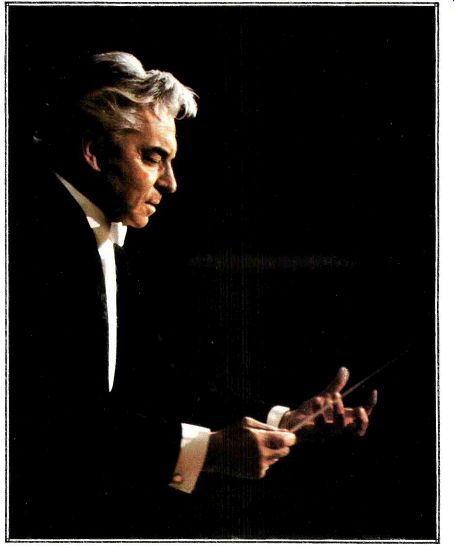
------------ Herbert von Karajan (photo courtesy Deutsche Grammophon)
THERE are operas one listens to for the sake of a couple of great singers and some great music for them to sing, and never mind that the stuff that surrounds them is an insult to one's musical digestion. The Mozart operas, and particularly Le Nozze di Figaro, are not among these. For Mozart, what one wants is style, and it does my heart good to find that in London's just-released Figaro what one gets is style.
It will take less than a minute of the overture to convince you that some thing pretty glorious is pen, and each succeeding moment will further enforce your conviction that you have bought the right recording.
The cast is, of course, international, but this is Viennese Mozart. The Vienna Philharmonic plays as though they really mean it, and when they do that (which they don't all the time), they are, for me, the world's greatest orchestra. Herbert von Karajan conducts like the Karajan of old. There is al ways something to admire in any Karajan recording, but many of his greatest achievements date from long before he attained the exalted position he now occupies. This recording is a great musical achievement, and the very consistency and elegance of its musical style tell us unmistakably that it is Karajan's achievement.
Of course, one needs fine singers in Figaro, but one or two of them will not do; they all have to be good, and here all of them are. I still have some magi cal past performances in my head (and many of the records from which they came on my shelves): Erich Kunz's Figaro and particularly an old 78 of "Non pad andrai," a "Voi the sapete" that the young Irmgard Seefried seemed to sing in one effortless breath, Elisabeth Schumann's teasing "Venite, inginocchiatevi," the overture by Bruno Walter, plus complete performances led by Erich Kleiber and, fascinatingly, Herbert von Karajan.
I don't want to say that the individual achievements in this set equal or surpass those old ones. I would not like to say that I like Jose van Dam quite as much as Kunz, Cotrubas as much as Seefried, Tomowa-Sintow as much as Schwarzkopf or Della Casa, and so on.
But I certainly have no compunctions about mentioning them in the same breath. My, what elegant singing and from so many different quarters! "This recording is a great musical achievement, and the very consistency and elegance of its musical style tell us unmistakably that it is Karajan's achievement." Karajan, I'm sure, had a great deal to do with that.
Jose van Dam is really a splendid Figaro, and Ileana Cotrubas' Susanna is certainly the best thing I've heard her MOZART: The Marriage of Figaro. Ileana Cotrubas (soprano), Susanna; Anna Tomo wa-Sintow (soprano), Contess Almaviva; Frederica von Stade (mezzo-soprano), Cherubino; Jane Berbie (mezzo-soprano), Mar cellina; Jose van Dam (bass), Figaro; Tom Krause (baritone), Count Almaviva; Heinz Zednik (tenor), Don Basilio; Jules Bastin (bass), Dr. Bartolo; others. Vienna State Opera Chorus; Vienna Philharmonic Or chestra, Herbert von Karajan cond. LONDON OSA 1443 four discs $35.92.
do on records. Frederica von Stade is already very nearly famous for her Cherubino; she not only has the voice for the part, and the musical intelli gence, but the very character aligns perfectly with her temperament. She is infinitely more convincing here than in the Jennie Tourel repertoire. Similar ly, Torn Krause's slight inherent musical stiffness characterizes the part of the Count here rather than detracting from it. This, of course, is one of the miracles of the opera itself: the music to be sung by each of the characters is no neutral lingua franca but, within the ample boundaries of the Classical style, expressive and representative of the personality of the character. No singer can truly portray every operatic personality that happens to lie within his or her vocal range, and the real basis for the success of this performance is the casting-which is brilliant. Only the Countess (for my taste) could be a bit more regal than Anna Tomowa Sintow manages. Still, she is both musically lovely and believable. The lesser roles are handled to near perfection (what a handsome voice Heinz Zednik has for Don Basilio!), and certainly a nod is due Konrad Leitner for continuo work that seems much more inventive than usual.
No faults are to be found with the recording, although the pressings that I received leave a bit to be desired. A full libretto, is, of course, included with the set, with a brief but very interesting essay by Stanley Sadie and some notes on the rearrangement of the order of numbers in Act III (quite logical) that is followed in this recording. The Kleiber-led recording of Figaro, brilliant achievement that it is, is still in the catalog ( London 1402). But on points, recording quality being one of them, I think this new set can be said to surpass it.-James Goodfriend
The Christmas Album For the Year 1979: Nonesuch's Enchanting "Christesmas in Anglia" COMEONE at Nonesuch had the dandy a idea to invite Frederick Renz and his Ensemble for Early Music, a group that traces its origins back to Noah Greenberg's much-esteemed New York Pro Musica, to the St. James Chapel in New York's Cathedral of St. John the Divine to record a pro gram of "Early English Music for Christmastide." The result is one of the best and most unusual Christmas records ever issued. Johana Arnold employs her light, clear, supple soprano and Daniel Collins his crystal line countertenor in a program of largely unfamiliar but totally captivating airs drawn from the Coventry mystery plays, from Scottish and Irish as well as English sources, the whole sung partly in old English, partly in Latin.
There's a New Year's text to the familiar tune of Greensleeves taken from the Pepusch arrangement for John Gay's Beggar's Opera of 1728, but most of the other melodies came to this listener as a complete-and enchant ing-surprise: the lullaby Qui Creavit Celum, for example, traced to a Benedictine nunnery in Chester, where it was popular in the 1400's; a Tander nacken attributed to Henry the Eighth himself; a monophonic carol from the late fifteenth century; carols about an gels-and others that sound as though angels had written them. All of these are performed with clarity, delicacy, musicianship, and excellent diction.
Interspersed with the vocal portions are lovely instrumental miniatures, in cluding a dance from fourteenth-century Britain and old Scottish airs for the violin. A complete text, including felicitous translations into modern English, is supplied. Simply wonderful.
-Paul Kresh
-----------
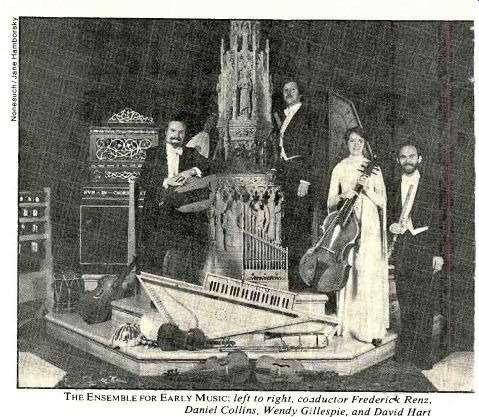
THE ENSEMBLE FOR EARLY MUSIC: left to right, conductor Frederick Renz, Daniel Collins, Wendy Gillespie, and David Hart
CHRISTESMAS IN ANGLIA: Early English Music for Christmastide. Rex Virginum Amator; Edi Beo Thu; Alleluya Psallat; Angelus ad Virginem; Qui Creavit Celum; Estampie; Nowell, Nowell! This Is the Salutacion; Nowel, Owt of Your Slepe; Ther Is No Rose of Swych Vertu; Lully, Lulla, Thou Little Tiny Child; Tander nacken; All Sons of Adam; Irish Air; Balu lalow (I Come from Hevin); Sueit Smylling Katie Loves Me; Now Blessed Be Thou; Kathren Oggie; Come, My Children Dere; Green Grows the Rushes; Greensleeves (The Old Year Now Away Is Fled). Ensem ble for Early Music, Frederick Renz cond.
NONESUCH H-71369 $4.96. Vladimir Spivakov: Setting a Standard of Exquisite Perfection For the Violin
ANGEL'S album of Mozart concerto performances by the Soviet violinist Vladimir Spivakov sets some kind of standard for exquisite perfection.
Every note, every phrase, is placed with such otherworldly musical precision that one can only listen in awe and wonder. True, if one pulls resolutely back from the hypnotic spell, one can see that there are some few levels of drama and passion in this music that Spivakov does not touch, but in the enchantment of these performances such considerations are irrelevant. By what ever means, Spivakov has also persuaded the English Chamber Orchestra to play at his exalted level and with his refined stylistic consciousness.
Curious. Just at the time when Western performance practice is veering away from the Awful, Grandly Noble Style of the earlier part of the century, the Russians, after generations of gypsy fiddling, have perfected a Neo-Noble style that is for the gods.
This must certainly be the way they play in heaven to keep themselves fittingly amused. In fact, I think Spivakov ought to play a wrong note or a rough tone just once in a while to escape incurring the jealous wrath of the gods. As it is, he's taking big chances.
-Eric Salzman
MOZART: Violin Concertos No. 5, in A Major (K. 219, "Turkish"), and No. 2, in D Major (K. 211). Vladimir Spivakov (violin); English Chamber Orchestra, Vladimir Spivakov cond. ANGEL SZ-3751 I $8.98.
---------------- SPIVAKOV: re-fired Russian
Worth Waiting For: A New Duet Album From Gary Burton And Chick Corea
VIBRAPHONIST Gary Burton and pianist Chick Corea recorded their first set of duets in 1972. The album, "Crystal Silence" (ECM 1024, re leased in this country in 1974), received such impressive-and, I might add, highly deserved-critical acclaim that it seemed reasonable to expect an encore release within a year or so.
Well, it took seven years, but the new "Duet" proves to be well worth the wait. Burton and Corea express them selves with stylistic individuality, but their musical languages are cognate, both having jazz roots. What they play here often falls outside the jazz category, but it never strays beyond the boundaries of musical excellence.
---------------- AXTON: unregenerate folkie
----------
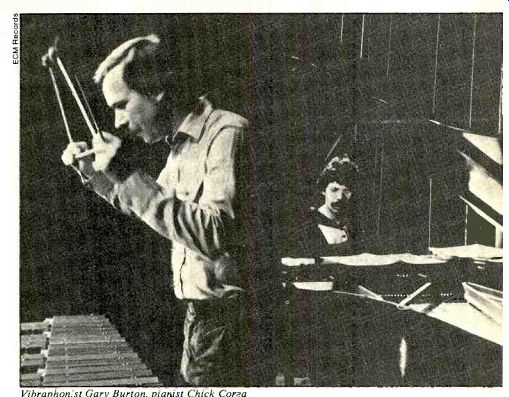
Vibraphonist Gary Burton, pianist Chick Corea
What a contrast to the sounds of Corea's Return to Forever! The compositions featured in "Duet" are mostly by Corea, but they include two-Never and Radio-by bassist Steve Swallow, who also contributed material to "Crystal Silence." includes four beautiful short pieces-Corea's Children's Songs Nos. 2, 5, 6, and 15 (ranging in length from fifty-five seconds to just over two minutes)-it is in the longer pieces that the two players get the opportunity to demonstrate a really wonderful compatibility, building up breathtaking patterns and interacting in a way Corea and Herbie Hancock never could. My favorite right now is Corea's La Fiesta, but that might change the next time I play the record, for the walls of preference are mighty thin when an album is as uniformly exquisite as "Duet." Incidentally, I can still recommend "Crystal Silence," which remains in the catalog; being a product of ECM's former Polydor affiliation, it even lists for a dollar less.
-Chris Albertson
GARY BURTON/CHICK COREA: Duet. Gary Burton (vibraphone); Chick Corea (acoustic piano). Duet Suite; Song to Gayle; Never; La Fiesta; Radio; Children's Songs Nos. 2,5, 6, and 15. ECM EC-1-1140 $8.98, M5E M8E 1140 $8.98, 1140 $8.98.
Bread and Roses: Old Folkies Never Die--They May Even Be Coming Back "Vou old folkniks, you!" Joan Baez i says to the audience at her sister Mimi Farina's shindig, the Bread & Roses Festival of Acoustic Music, and indeed one can listen to the ensuing al bum, "Bread & Roses," and wonder if the folkie consciousness and its acoustic instruments aren't actually lurking around somewhere working up to a comeback. If you've been listening to New York gossip, you've already heard "folk movement" talk, most of it based upon the Big Apple's reaction to the Roches and Steve Forbert. The Bread & Roses Festival, a fund-raiser for Mimi's organization (it takes free live music into hospitals, nursing homes, and prisons), tends to look back, however, being a muster of some of the actual folkies of the early Sixties scene-and I can't help noticing that several of them are still my favorite people. Fantasy's live-album documentary will show you they can still cut it musically.
It's a bit dated, of course; it actually happened in October 1977, and Malvina Reynolds has since died. But it is still a whopper of a collection of the music and the musicians that helped shape many of our current pop attitudes. The musicians, all donating their time, seem to be enjoying them selves a lot more than in "normal" re cording situations, and it is one of the best recordings of the subtleties of acoustic music in a festival setting you could hope to hear. There isn't really a single weak performance or any prima donna self-indulgence anywhere, al though they could have cut out some of Hoyt Axton's drunker-than-thou monologue. His musical performance, however, is one of the highlights. Two more are Richie Havens' What You Gonna Do About Me? and (especially) Jackson Browne's For Everyman.
Not much singing is heard from Mimi Farifia herself, and one does tend to wonder how it would be if a few other voices were here-the presence of Freebo, the bass man in the "house band," for example, suggests the name Bonnie Raitt-but if you like acoustic music or if you're an old folk nik, there's enough here to hold you half the night. It's pretty rich stuff; try not to OD.-Noel Coppage
BREAD & ROSES. Jesse Colin Young, Sugar Babe; Dave Van Ronk, Swinging on a Star; Malvina Reynolds, Little Boxes; Pete Seeger, Sailing Down My Golden River; John Herald Band, Ramblin' Jack Elliott; Ramblin' Jack Elliott, San Francisco Bay Blues; Hoyt Axton, Boney Fingers and Evangelina; Arlo Guthrie, Al the Goose; Boys of the Lough, General Guinness/Irish Reel; Mickey Newbury, Mabel Joy; Dan Hicks, I Got Mine; the Persuasions, Just Another Night with the Boys; Richie Havens, What You Gonna Do About Me?; Buffy Sainte-Marie, Universal Soldier; Joe McDonald, Save the Whales!; Joan Baez, There but for Fortune; Toni Brown and Terry Garthwaite, Beginning Tomorrow; Maria Muldaur, Walkin' One and Only; Jackson Browne and David Lindley, For Everyman; Finale (all), Just a Closer Walk with Thee.
FANTASY F-79009 two discs $9.98. Hansel and Gretel: A Triumph of Musical Craftsmanship, and Too Good for the Kids
THE musical public's consciousness about Humperdinck's Hansel and Gretel has been raised almost solely through recordings. Most opera houses treat the work as family entertainment for Christmastime; they cast it in a utilitarian fashion and make of it a pleasant but decidedly unexciting pas time. But a series of recordings that capture its remarkable blend of innocence, magic, and sophistication in richly sparkling performances by first class singers has proved that Hansel and Gretel is not only a triumph of musical craftsmanship, but an inspired operatic masterpiece as well. A long-deleted mono set under Karajan (An gel 3506) was the first jolt to our consciousness, RCA's marvelous 1975 re lease (ARL2-0637) was the second, and now Columbia has come up with another superb version.
I don't recall hearing such an ear-caressing concord of female voices in one opera since Elisabeth Schwarzkopf, Rita Streich, and Irmgard See fried cast their combined vocal spell over Richard Strauss' Ariadne auf Naxos (Angel 3532) more than twenty years ago. In an admirable blend of timbres, Frederica von Stade and Ilea na Cotrubas are the Hansel and Gretel here, both youthful sounding, both lively, believable, and enchanting. The Sandman has only a brief moment, but Kiri Te Kanawa makes a ravishing experience out of it, and Ruth Welting treats us to another impressive display of the high-flying, ethereal "fairy mu sic" that seems to be her specialty.
-------------- Hansel and Gretel principals: top to bottom, Frederica von Stade (Hansel), Ileana Cotrubas (Crete!), Siegmund Nimsgern (Father), and Elisabeth Saderstrom (Witch).
Can you imagine such luxuriant casting ever being offered in a mere opera house? But that's not all. That remarkable artist Elisabeth Soderstrom is the Witch, and she is simply ... well, be witching. With a calculated bit of nasality here, a sudden--but slight-nasty inflection there, she sings all the notes without any really grotesque distortion. All her effects are carefully measured and skillfully brought off, and she is obviously enjoying every minute of her virtuosic performance.
Christa Ludwig, the superb Witch in the RCA set, sings the Mother here. It is not a grateful role, and even Miss Ludwig (not in her best voice on this occasion) can do no wonders with it.
But Siegmund Nimsgern is a hearty, energetic Father, and his full, firm, and wide-ranging tones fill all needs completely.
Conductor John Pritchard supports the singers well and keeps good control-though he applies too much restraint in some big orchestral moments, and I cannot say that he brings out all the strands of Humperdinck's convoluted counterpoint in the over ture with maximum transparency. The orchestra itself is good, if perhaps slightly below virtuoso caliber, and the same is true of the children's chorus. I find the miking somewhat distant for my taste, and balances are at times less than perfect (Soderstrom's delightful antics, for example, surely de serve more prominence). But these are minor reservations about a very satisfying whole. I am happy to note that the disc surfaces are excellent, perhaps some indication that Columbia is on the way to solving its problems in that area.-George Jellinek HUMPERDINCK: Hansel and Greta Frederica von Stade (mezzo-soprano), Hansel; Ileana Cotrubas (soprano), Gretel; Siegmund Nimsgern (baritone), Father; Christa Ludwig (mezzo-soprano), Mother; Elisabeth Soderstrom (soprano), Witch; Kiri Te Kanawa (soprano), Sandman; Ruth Welting (soprano), Dew Fairy. Children's Chorus of the Cologne Opera; Gurzenich Orchestra, John Pritchard cond. COLUMBIA M2 35898 two discs $17.98.
AUDIO ACCESSORIES for Christmas---How to make Christmas merrier for your hi-fi system, IVAN BERGER; BOOKS FOR XMAS
Source: Stereo Review (USA magazine)