
EDWARD TATNALL CANBY
ON THE WINDS OF SONG
Music for Winds, Vol. II. Music of Darius Milhaud, Percy Grainger, and Francis Poulenc. The London Wind Orchestra, Denis Wick.
Nonesuch 78026, $8.98.
Those in the band biz can probably explain to you why a British wind band sounds different from its American counterpart-I can't. But I hear it and so will you in this band disc, featuring all-English music on one side, all French music on the other.
The first side is all Grainger. That precocious musical dandy of the early part of the century (who was married in the Hollywood Bowl in front of a paying audience of 15,000) is more likely to annoy than to please Americans. He is skillful enough, but his sound is dated (a better man would last longer); his harmonies are by turns cloying, cute, syrupy-why say more? Even a late work, from 1937, merely adds a few stylized dissonances to the same old sound.
If you love Grainger and disagree, it's okay with me. To give credit, he did actually "collect" some of these tunes from the country folk back around the turn of the century, using an Edison cylinder machine to take musical field notes.
Side two has the work of a younger generation of composers, Milhaud and Poulenc. Both came to notice in the snazzy, nose-thumbing '20s, and their music is thus free of cloying sound, more modern and--for our ears--much easier listening. They are as determinedly French, of course, as Grainger is English/Irish-more folk music for you! Both men compose beautifully for band, to better effect on records than Grainger. Those brittle, icy shards of casual dissonance that were Milhaud's genial trademark are plenty audible in his "French Suite" and will try your pickup like the sound of broken glass.
As for Poulenc, his "French Suite," somewhat earlier in composition (1937), is spare, where Milhaud tends to be overblown and at times dynamically corpulent, like the man Milhaud himself. The Poulenc winds are beautifully treated, with a casual stroke of genius, a single harpsichord contrasted against the wind forces. The music, originally attached to a stage comedy, evokes 16th-century French dance music, neatly done in modern style with modern instruments. If you have heard any of the Renaissance dance music on old instruments that has recently proliferated on hundreds of recordings, you will appreciate Poulenc's skill, at a time well before that revival had begun.
Interesting note: Poulenc's harpsichord always speaks alone, whether in short passages or quite long ones; its very small tone is thus entirely audible along with the much louder wind sound. The English recording people, thank heavens, have understood this.
The harpsichord is unamplified, its sound balanced against the base silence (non-digital, but quiet enough) exactly as it should be. Good job. A twist of a knob could have wholly ruined what is a delicate and pleasing sonic effect.
Calliope Festival: An Italian Renaissance Revel.
Nonesuch 79069, digital, $11.98.
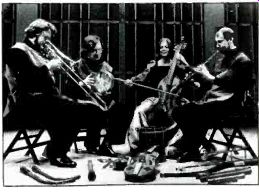
If you have not yet sampled the sonic colorfulness of the old Renaissance instruments, now so expertly revived, this is an excellent recording to start with. Calliope-the group's official name-is extremely professional, its members totally fluent and accurate in all the many instruments they play. (As is the tradition, each member plays a whole series of different instruments, not merely one.) You will not find yourself thinking that, after all, the usual modern instruments at least play in tune! More important, these players, though crisp and no-nonsense in the contemporary manner, still have an excellent sense for phrasing and style.
This adds immensely to the impact, even of the little dance pieces that are, inevitably, most of the content of such recordings.
There is lots of good rhythm, plenty of contrast in tonal color (as between the differing families of instruments), and a sprightly sense of humor that makes the recording anything but dull.
The span of music runs from the 13th all the way into the 17th century, and it has been nicely recorded in a church in Brooklyn, N.Y.-though you are at liberty to imagine yourself somewhere in Romantic Italy. Who would suppose the Italian Renaissance could blossom on Flatbush Avenue?
Spring Night on a Moonlit River: Music of the Chinese Zither (Gu Zhang). Chen Lei-shi.
Nonesuch Explorer 72089, $5.98.
Fascinating but cryptic, here is a Chinese stringed instrument with a 2,000-year-old history, used for nominally popular Chinese entertainment during all these 20 centuries and up to the present. Also, a Chinese professor who plays the instrument with wonderful expertise, song after song for two LP sides, some dating from as recently as 1920, others going casually back to an origin in the Tang or Ming Dynasty.
They all sound remarkably alike, at least in their present traditional form, and all make pleasurable listening. But what do we Westerners hear? An interesting question.
The zither is somewhat like the Japanese koto, with high-raised individual bridges under each string. The basic tones come from a few open strings; the rest of the highly decorative detail work-a fascinating tissue of little slides and slithers, out-of-tune blues notes, quavers and wobbles, and kitten-like sounds-seems to be played on the other side of the bridges. The instrument's sound is very delicate, and quite mind-bending.
But beware of the liner notes! They are both comprehensive and lucid, with much detail as to the sense and background of every piece; dozens of Chinese characters are interspersed with English, in case you can follow them. I enjoyed these accounts, but, alas, I could not hear anything they described. I floundered.
For a moment I thought I heard the playful crow, as described in one song, but it turned out I was in the wrong piece. The fanciful titles, such as "Hungry Horse/Jingling Bells," "Thinking of an Old Friend," " High Mountains and Running Water" and "Autumn Moon ...," are lovely, but the music doesn't relate to an untrained ear. All the melodies sound the same to me, four or five simple tones, over and over again, in one song after another. Neither horses, crows, old friends, nor running water seemed to have much to do with it.
Knowledgeable scholarly types, of course, will find this a priceless recording, with so much useful information attached. On the other hand, most listeners will just enjoy the music without a worry as to what it may signify to a Chinese listener. That's the best approach.
Paul Creston: Suite for String Orchestra, Op. 109, Chant of 1942, Op.
33; Norman Dello Joio: Air for Strings; Alan Hovhaness: Celestial Fantasy, Op. 44. The Israel Philharmonic Orchestra, David Amos. Crystal S508, $8.98.
A superb recording of string music, almost: Too bad that one short work, the "Chant of 1942," brings in other sounds such as horns and drums! For a moment, as I listened, these seemed almost a desecration of the purity of strings alone.
It takes many factors of perfection to achieve a really fine string recording.
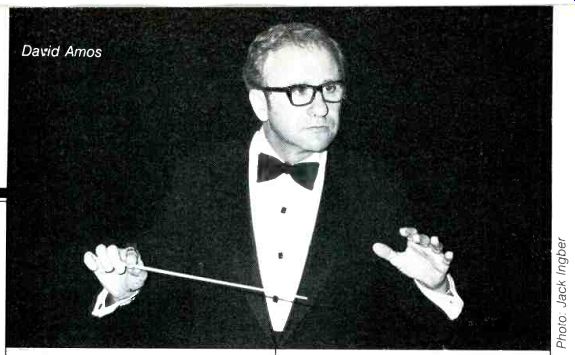
First in order is a top group of string musicians, intelligent, sensitive, not in a rush to get to the next date, not sight-reading the music. Second is a conductor who is outstandingly sensitive and intelligent in his musical direction, as is David Amos. No matter that you have never heard of him; he doesn't operate in the mainstream of big-time, music-biz publicity. He is excellent, nevertheless. You do know of the Israel Philharmonic, of course. It is among the very best, too.
And then we must have intelligent recording, to put the strings, and the music, in the right acoustic space and to set up the microphones where they have to be-not for the "beautiful sound" of supermarket strings, a handful of them blown up and time-delayed into the familiar unctuousness! This is quite something else. I note that it was done in Tel Aviv by Pedro Carin, listed as recording engineer and Tonmeister.
That means that he has had the modern training that links the art of music and audio engineering into one discipline, equally rigorous in both directions. It is a splendid idea for those who have the talent to follow through.
More and more American audio enthusiasts find themselves interested.
Paul Creston has been around since 1906, out of New York. He has done just about everything, though wholly self-taught-like Georg Philipp Telemann or, for that matter, Beethoven.
These types, far from showing amateurism, tend to be the most tightly disciplined of all in their music. The major string piece here is the quite recent (1978) "Suite," composed by Creston in his 70s, which I found both very listenable and, as aforesaid, really beautifully played. Creston has ranged as widely as, say, Shostakovich; here he has settled for a kind of gentle "neoclassicism" long after the fact, that somewhat Bach-like, slightly jazzy rhythmic style that was all the rage in the '40s, and persists among the academic composers today. But Creston is not one of those. His sound is unlike anybody else's in that, though the rhythms and counterpoints are "Baroquey," the harmonies are sweet and fruity in a good sense, with echoes of Grieg and Dvorák and others of Creston's contemporaries. A curious and interesting combination.
The "Chant of 1942," written a lifetime earlier in the year of its title, was briefly famous in that dreadful war year; those who are younger and can merely recall Vietnam will not really get its message, the marching sounds of a world war impinging on every side of us.
The remaining two short items are pleasant fillers for strings, with the same lovely playing if not with as much significance. Dello Joio writes a simple ABA song. And that strange mystical product of Somerville, Mass., Alan Hovhaness (the Armenian who found out how to stop Western music in its tracks and make it contemplate its Oriental navel while still going right on like Western music), here presents one of
his earlier minor works. It's all fugue and counterpoint for strings, full of activity and yet standing quite still and going absolutely nowhere. Quite a trick, and to be admired.
Music of Buxtehude, Dandrieu, Zipoli, Mozart and Dubois. Richard Heschke, organ, at the Cathedral of the Holy Trinity, New Ulm, Minn.
Euterpe EAR 39701, $10. (Available from Euterpe, P.O. Box 29, Briarcliff, N.Y. 10510.)
Here's another brand-new classical label, rather defiantly "analog" by its own account, put together by a group of musicians and engineers. This is its first release.
I'd like to enthuse, being partial to any new enterprise in the small-label area, but in this case it isn't easy.
There are deficiencies, as I hear things, in both the engineering and the musical performance.
This is indeed an interesting new baroque-type, all-mechanical organ (there are a number of these in Minnesota already) with some really lovely sounds for an appreciative organist. In its rather large and resonant acoustic space it should be eminently recordable. But this player is the wrong choice and the acoustics do not come through well.
The pair of omni mikes, AKG, are "optimally placed," it says, to capture this organ in its big space. On listening, I find the mike placement much less than optimal. In the opening Buxtehude work, for instance, I was jolted by the loud, acid, edgy sound of the pedal stop-here used in a literal way as a musical "pedal point," a bass tone held down by one toe while the hands play figurations above. It seemed far too close and too loud in relation to the upper work-almost too much for the pickup, in fact. (Is there out-of-phase material, due to the two mike setup?) I have to doubt that this is the "optimum" sound of the organ's bass department in the live space itself. Moreover, for a big cathedral with a 5-S reverb, the recorded sound is smallish and not expansive, a so-so balance between the direct and reverberant elements.
As for the music, Richard Heschke has all the right qualifications for an American, all-purpose traveling recital organist, and that is, somehow, the way he sounds. Most of our professionals in this area tend to distrust the baroque organ and many hate it. I do not sense any affection in these performances, which seem to me to do their best to make the old-type instrument sound the way it "ought" to, rather than the way it does-so sweet, under the right fingers and toes. The Buxtehude is not warm. Where they could be full of jollity, the pair of little 18th-century tidbits, French and Italian, are just so many notes. The man plays all this music in an un-phrased, staccato fashion, picking the fingers off the keys as one learns to do in the big Romantic organs in order to penetrate the huge blur of sound. On this sort of instrument, the effect is merely disconnected and ugly.
Side two features the big, very late Mozart "Fantasia in F Minor," K. 608, composed curiously for a mechanical clock but now played on the organ where its astonishing beauty and intensity can be realized. Things are better here-even that gravelly pedal stop sounds better, thanks to louder music in the upper areas. But again, the details of the lovely, quiet interludes are minus subtlety and played in a pedestrian fashion; some organists can make this music ravishingly beautiful. And there are plenty of inaccuracies, too. A new and unfamiliar instrument for the player? His problem, not ours.
By the way, this is a "live recital," straight through in the current fashion, minus editing. Might account for some of the inaccuracies. But oddly enough, editing was necessary where there was a change of registration via the mechanical pull stops! Organist could not play and change stops, too. In some recitals on this type of organ, there is a handy assistant who provides the extra hands to do this job; I saw one last summer, a statuesque woman who stood motionless behind the organist throughout the entire evening except when she deftly reached out to pull one knob or push in another.
She got deserved applause at the end.
Perhaps one or another of old Bach's 21 children helped him out in this fashion? Better try the idea next time, Euterpe. And better change players, too.
===================
ADs:
ORTOPHASE.

And listening can never be the same again.
"Breathtaking ...", say the U.S. critics. "Habit forming ...", say the Swedes. "Heavenly ...", say the Danes. "... Cannot fail to delight ...", say the British. "Wonderbar ...", say the Germans. That's how the world responded to the Ortophase concept and to the spectacular Ortofon MC2000. Now the Ortophase principle has been incorporated into a full range of moving coil cartridges. This means that every music lover, regardless of budget, can take advantage of this "breathtaking" development. Write for full information.
ortofon
122 Dupont Street, Plainview, New York 11803 Send $1 for beautiful, Ortofon poster.
--------------
At home with serious music lovers.
Masterworks Portrait.
Every Masterworks Portrait is a masterpiece of program, performance and even processing.
Digitally re-mastered from original session tapes, these landmark recordings, from the distinguished CBS. Masterworks catalog, have never sounded better.
Whatever your musical passion, you're sure to find yourself in a Masterworks Portrait. Selections range from Baroque to 20th Century works... from symphonic staples to esoteric chamber pieces. The artists are the finest in the world. The performances are internationally acclaimed.
There are close to 100 programs from which to choose, including a new series of boxed-sets with records and cassettes imported from Europe. All are reasonably priced.

Serious music lovers will find many Portraits just right for their homes.
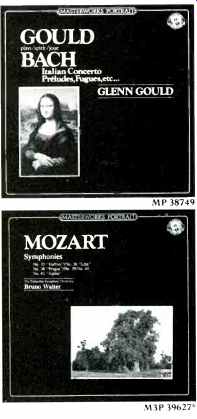
(MASTERWORKS PORTRAITS GOULD BACH Italian Concerto, Fugue R, etc... GLENN GOULD MP 38749
MASTERWORKS PORTRAIT. MOZART Symphonies
M3P 39627
Fine Reproductions At A Price You Can Live With.
3P 39639
Masterworks Portrait Records And Cassettes.
-------------------
Hear all 3 kinds before you buy speakers
WE INVITE YOU to hear the best conventional "cones in a box" speakers you can find. Plus the "reflecting" kind.
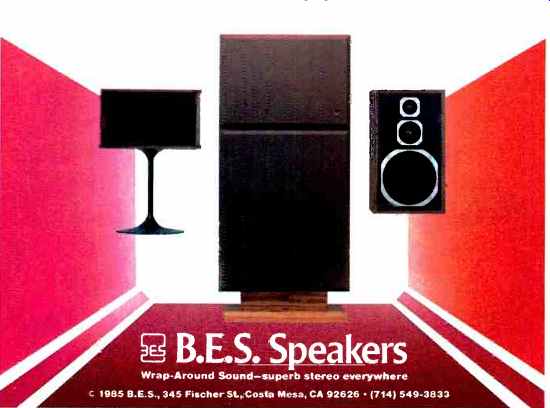
Then-when you hear the unique Wrap Around Sound of B.E.S.-you'll appreciate the remarkable difference. B.E.S. stereo imaging follows you everywhere.
Don't settle for ordinary stereo. Call toll-free 1-800-592-4644 for your B.E.S. dealer's address. See and hear slim and sculptured, warm and wide-ranging B.E.S.
B.E.S. Speakers
Wrap-Around Sound-superb stereo everywhere
1985 B.E.S., 345 Fischer St. Costa Mesa, CA 92626
------------------
Bryston announces... a substantial advancement to the technology of audio power amplification.
Bryston has been researching the science and the art of amplification for over ten years. Recently, a breakthrough of sorts at Bryston in the application of complementary Bipolar power-delivery systems has almost perfectly optimized the output transfer-function, resulting in an amplifier more linear, less sensitive to loading, with smaller amounts of upper order harmonic content than previously possible without class-A biasing, or other special compensation techniques.
We feel that another veil has been lifted from the amplifier's contribution to the overall audio picture. We believe you will think so too. Write to Bryston at the appropriate address (below) for a technical paper on Bryston's newest advancement on the state of the art, and a list of dealers where you can listen to the optimal amplifier(and, of course, our matching preamplifier).
------------------------
"A Revelation"
Sound News Journal
"Flawless Reproduction"
Audio Magazine
"Absolutely Superb Sound"
High Fidelity
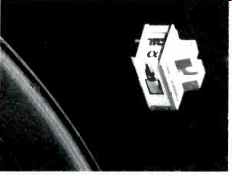
The Alpha 1'" moving coil by Monster Cable Finally, A moving coil cartridge that all the experts agree on! It's no surprise that critics, manufacturers, and audiophiles alike have given unanimous critical acclaim to the Alpha 1. Our unique "magnetic feedback control""' circuit reduces phase and intermodulation distortion for dramatically improved music reproduction that will keep you up nights re listening to your entire record collection.
The Alpha 1 recreates the original musical event with unprecedented realism.
Hear every instrument clearly placed across the concert hall soundstage in the finale of Berlioz's "Symphonie Fantastique"; feel the gut shaking bass of the Sheffield "Tracks" album, or listen to just how delicate and natural an instrument can sound in any of the Windham Hill recordings. You will agree with the experts. The Alpha 1 is an exceptional sounding cartridge with few peers.
So meet the digital challenge. Put new life into your analog records by adding the Monster Alpha 1 to your sound system.
Call us for the Monster Cable Alpha 1 dealer nearest you. Suggested retail 5475.
Monster Cable' Products, Inc.
101 Townsend, San Francisco, CA 94107 415 777.1355 Telex: 470584 MCSYt11
----------------------
SYSTEMDEK IIX
The SYSTEMDEK IIX represents the ultimate value/performance combination in turntables available today. This is accomplished by including such features as; oil-pump bearing, glass platter, lamb's wool record mat, 24 pole synchronous motor, belt drive, interchangeable arm board, real-wood base built about a steel frame and a unique 3-point hung suspension which allows quick and easy adjustment, even while a record is playing ! All this at a surprisingly affordable price.

The SYSTEMDEK IIX is available; without tonearm, fitted with a Profile II (as shown); or Profile IIS
-----------------
dw
THE UNSPEAKER

No artificial sweeteners, artificial flavors or colorants added.
The First Minimum Periodicity Loudspeaker System.
Minimum Periodicity is a new measurement and design technique from Dayton Wright Research.
LCM I DAYTON WRIGHT; THE DAYTON WRIGHT GROUP LIMITED
97 NewKirk Road North, Richmond Hill, Ont. M4C 3G4 (416) 884-8586
-----------------------
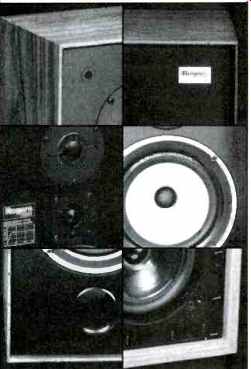
MUSICALLY ARTICULATE LOUDSPEAKERS FOR OVER A DECADE
........ Rogers HIGH FIDELITY BRITISH
----------------
TANDBERG
Tandberg's advanced engineering offers less.

Tandberg's dedicated staff of audiophile engineers long ago decided that ideally there should be nothing between the listener and the music .. . no IM, no THD, no TID ... no audible distortion of any kind.
However, in the real world of audio electronics. "nothing" wasn't easy to come by; virtually every aspect of the signal path, and the circuitry that supports it, required reevaluation.
Tandberg embarked on a 5-year research project to systematically localize and eliminate every source of audible distortion, however subtle.
In Pursuit of Nothing
The practical result of our concentrated research effort is the remarkable TPA 3006A Power Amplifier. Breaking new ground, and old rules, the TPA 3006A employs unique zero feedback MOSFET output stages. This is a difficult design topology, but the only one guaranteed to eliminate the audible time domain distortions undetected by conventional test methods. Available power output is 150 watts per channel into 8 ohms and 235 watts per channel into 4 ohms, with less than 0.02% THD/IM. And, although MOSFETs have been used before, our constant-source impedance driver stage design is specifically engineered, for the first time, to take full advantage of these remarkable output devices.
The voltage and current limiting protection circuits of conventional amplifier designs also proved to be major obstacles to full fidelity.
Tandberg's MOSFET configuration eliminates the need for all such circuit limitations; the MOSFET stages themselves are maintained at full linearity by a unique Voltage Comparator Circuit. The TPA 3006A, therefore, has an output-current capacity exceeding 25 amperes per channel, supported by a massive, tightly regulated toroidal transformer power supply with over 30,000 microfarads of filter/storage capacitance.
Damaging DC is kept from the output signal path via our (patented) Thermic Servo Loop system that monitors the amplifier's output, automatically and instantaneously rebiasing the amplifier as necessary ... but, unlike other designs, with no connection whatsoever to the musical signal.
Once the major areas of power amplifier distortion were eliminated, Tandberg engineers were free to pursue the much more subtle, less definable sources of sound degradation.
Further technical nuances Tandberg's pursuit of absolute fidelity led to the use of carefully chosen, costly high tolerance components: 1% metal-film resistors for their stability and low noise; plus sonically superior polypropylene capacitors (instead of electrolytic and ceramic types) are used in all audio stages. And, all audio stages employ discrete (no ICs!)
circuitry for maximum headroom and minimum distortion.
Tandberg has even reevaluated circuit board design. The lowest possible noise levels and totally identical performance between channels could be realized only when there is symmetrical parts layout and the reverse side of the circuit boards copper-plated to form a shielding ground plane; all housed in an unusually compact, nonmagnetic, anodized extruded aluminum chassis.
Compact & Cost Effective
Never before has a power amplifier of this degree of performance been compact enough to match our TCA 3002A Preamplifier and the world-famous TPT 3001A Programmable Tuner.
It should be evident that in the TPA 3006A, Tandberg has mounted an all out assault on audible distortion, breaking new ground in those areas that elude conventional measurements ... and designers.
The final proof, of course, is in the sound. Audition the TPA 3006A at your Tandberg dealer ... and hear why our engineers feel that they have achieved a quality of music reproduction comparable to the most costly esoteric units, in a compact, cost-effective design that is unobtrusive in any room setting.
For a Technical Paper on the remarkable TPA 3006A Power Amplifier and a beautiful color poster showing the complete Tandberg family of purist audio components, send $2 for postage and handling to:
---------------------
SFI
WE DEVELOPED A NEW TECHNOLOGY FOR THE DIGITAL AGE.
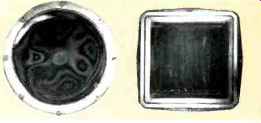
Hologram accurately displays cone driver distortion (near right). The uniform diaphragm of the Dynapleats showing no distortion (far right). Tested at 1.5 kHz.
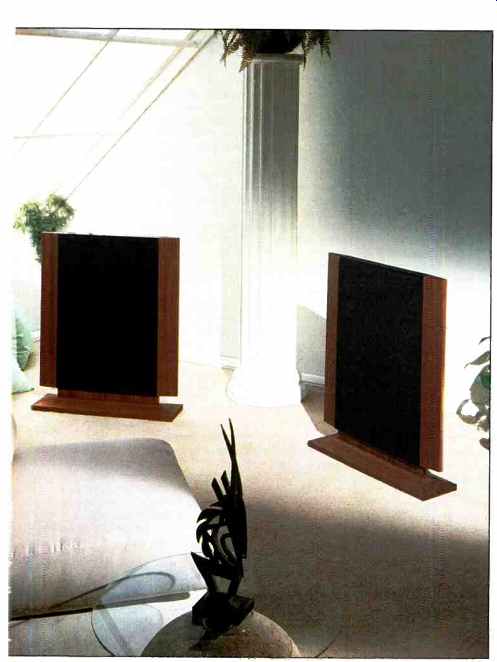
SFI's Digital 20 loudspeaker system is a culmination of technologies developed by Sawafuji, a brother company established in Japan in 1922.
The SFI Digital 20 loudspeaker system has evolved out of SFI's extensive research, development and experience with high performance, high quality transducers.
Instead of conventional cone drivers, the SFI Digital 20 employs a completely new transducer technology to accurately reproduce sound. These revolutionary new dynamic drivers, called Dynapleats, allow sound to emit evenly and simultaneously from their entire surface, thereby avoiding the deformation and uneven flexing characteristics of a conventional cone driver.
The sound has improved transient and linear response with a full frequency response, extended bass, wide dynamic range and virtually no distortion.
Because of the unique Dynapleats, sound is radiated equally from both the front and back sides of the SFI Digital 20. Aside from simplifying the problem of placement for proper stereo imaging, the bipolar pattern contributes to an openness of sound, increased definition, localization and realism. And, listening to the SFI Digital 20 over many hours is never fatiguing.
The real benefit of SFI's revolutionary technology is in the listening. The SFI Digital 20's natural spacious sound and superb imaging is unsurpassed. So are the aesthetics of the unique, ultra-thin loudspeaker system which harmonizes with any environment.
The digital age is here. Enjoy it more with a SFI Digital 20. Contact SFI for complete details and information.
SFI
-Sawafuji America Corp.
1984
SPI 23440 Hawthorne Boulevard, Suite 130, Torrance, CA 90505
(213) 373-0620, Telex: 756921
----------------------
Dual
The new Dual 505-2.
Rated "best buy" by Britain's prestigious publication Hi Fi CHOICE. Write for details.
Cheers!
-------------------
ROTEL

ROTEL introduces a refreshing new range of audio equipment designed exclusively to appeal to hi fi enthusiasts. Its acceptance in the UK, where Rotel was designed and conceived, is overwhelming.
HI FI TODAY says "Rotel have engineered some outstanding products which offer amazing sound and remarkable value". NEW HI FI SOUND says "The sound was open, lively, detailed and enjoyable to listen to, and as for the RA820B amplifier, well, it was a real gem". WHAT HI FI says "The most obvious ability of Rotel is the way it allows music to live and breathe". HI FI CHOICE says "The Rotel system stands out in its ability to play records properly. The stereo soundstage is well defined, and with a good cartridge there is clarity, precision. and evenness of reproduction that allows the music to sound lively and vivid...Quite clearly, its performance is something special". Listen to Rotel yourself and let's hear what YOU have to say.
--------------------
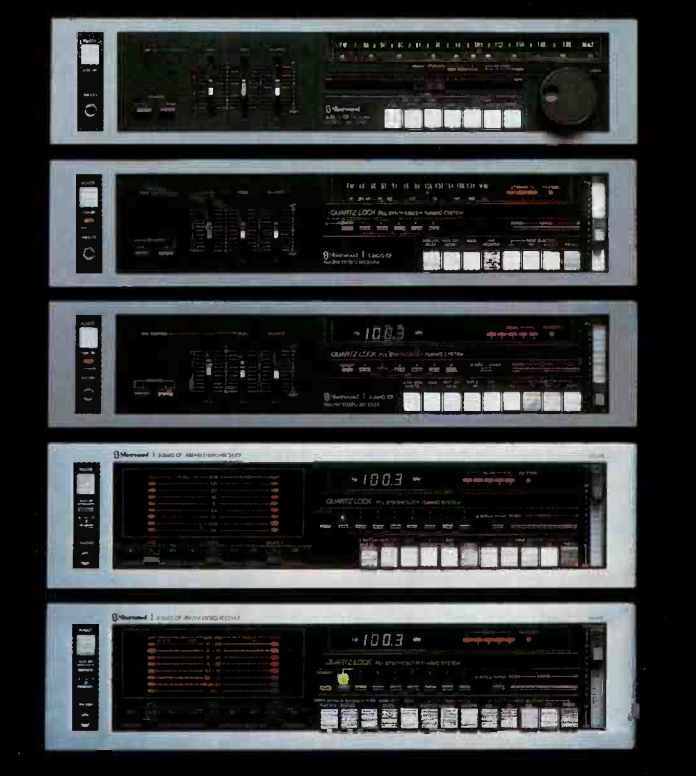
"Sherwood products offer excellent performance at very reasonable prices.”
Leonard Feldman, Audio Magazine
The occasion of Mr. Feldman's comment was his review of our S2680-CP top-of-the-line receiver. His statement was sparked by the fact that, while quite affordable, the S2680-CP, like all Sherwood receivers, is designed' and built with the care, precision and innovation which have become Sherwood trademarks.
A tradition of affordable quality. More than three decades ago Sherwood was founded on this philosophy: Through innovation, make quality audio equipment more affordable. That philosophy has been nurtured throughout Sherwood's history and is the foundation of our newest line of receivers.
We never cut corners on sound. All five Sherwood receivers deliver true high-fidelity performance. Even our budget-priced S2610-CP sounds better than many separate components. And the entire group s laced with features that can make significant differences in your listening enjoyment. Ultra-low-bass EQ, multi-deck dubbing, auto-scan digital tuning and discrete phono preamp circuitry are standard on several Sherwood models, yet missing from many other brands, regardless of price.
Certified Performance. Sherwood is the only manufacturer to test and certify the performance of each individual receiver. On the outside of every carton you will find a certificate showing the measurement details of the power amp, phono preamp and FM tuner sections of each receiver. These are not just the rated specs; these are the actual measured performance data of the individual unit, so you know exactly what you're buying.
Find out what the experts say. Get the whole story on why Sherwood receivers-in Mr. Feldman's words-" ` ... offer excellent performance at very reasonable prices:' To get your own copy of his review of the S2680-CP and to find out just how much quality and innovation you can afford, visit your nearest Sherwood audio specialist today. To find him, call (800) 841-1412 during west coast business hours.
Sherwood Quality
------------------
FOB THE SHEER LOVE OF MUSIC
There's a big difference between real music and "hi-fi". Unfortunately, as you spend more and more on your stereo system, all you usually end up with is more spectacular "hi-fi". This doesn't have to be the case. With a Linn/Naim system, every additional dollar spent actually results in a musical improvement.
This doesn't mean that a system that can provide music in your home must cost a fortune. While the Linn/Naim "Six Pack" system pictured above sells for nearly $20,000, other Linn/Naim systems start at well under $2,000. And, for less than thousand, substantial improvements can be made to your existing system.
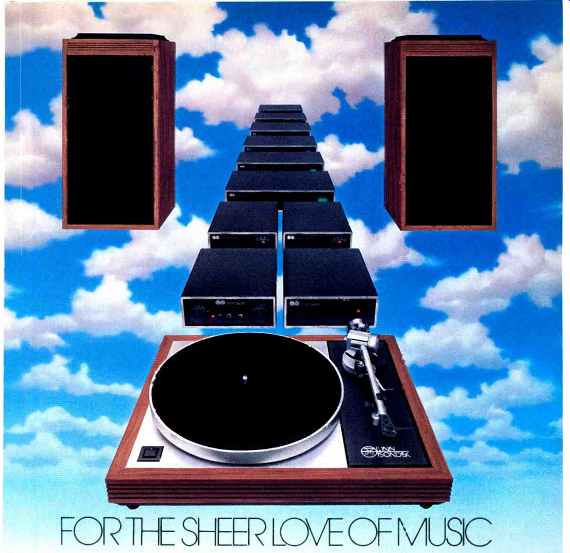
Whether you choose to improve your current system, or start with a complete Linn/Naim system, your Linn dealer, because he fully understands that there is a hierarchy to the system, can see to it that each purchase does indeed bring you more enjoyable music, rather than simply more spectacular "hi-fi". For additional information on Linn and Naim components and the hierarchy of a hi-fi system, contact your Linn/Naim dealer.
Distributed in the United States and Canada by:
AUDIOPHILE SYSTEMS, LTD., 6842 HAWTHORN PARK DRIVE, INDIANAPOLIS, INDIANA, 46220, USA.
ALDBURN ELECTRONICS, LTD., 50 ROLARK DRIVE, SCARBOROUGH, ONTARIO MIR 4G2, Canada
-----------------------
CAN YOU SEE THE MUSIC?

VIDEO ACOUSTIC MONITORS SUPERB SOUND WITHOUT PICTURE DISTORTION OR MOVEMENT
B&W's newest star is in the spotlight.
To celebrate the marriage of Audio and Video. B&W of England commissioned its world renowned research team to design a loudspeaker dedicated to the audio/video environment. A new star was born! Until recently, TV was meant to capture the eye rather than the ear, a one-experience medium. But now, with the availability of Beta and VHS Hi Fi and the advent of Stereo TV, it has become a two-experience medium. Yes, you can expect theatre quality sound in your own living room. B&W video acoustic monitors reproduce the whole eight octaves of sound, an astounding improvement over the four to five octaves reproduced by ordinary TV speakers.
The television picture tube and associated components are seriously affected by stray magnetic fields. The magnets employed in TV loudspeakers are shielded to prevent magnetic interference but if large magnets required to produce true high fidelity are used, then shielding is only partially effective.
-----------------------
Ohm
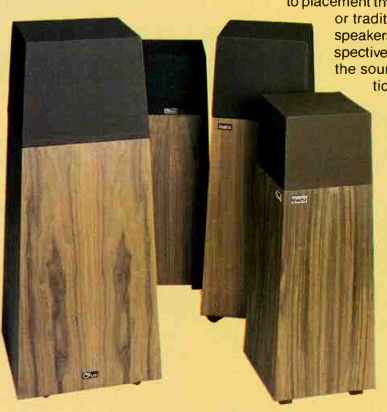

Now You Have a Choice Four Ways to Get the Best Value in Stereo Imaging
Walsh Value
If you compare speakers capable of equal sound quality with Ohm Walsh speakers, you'll find that you have to pay much more for sound as good, and that equal quality in stereo imaging is hard to get at any price. One Walsh owner concluded that his Walsh speakers are "head and shoulders above the other higher priced systems I compared them to" and Audio magazine judged them a "best buy"
Walsh Stereo Imaging
Walsh speakers create an exceptionally effective stereo image because of the unique patented design. It's an inverted cone with sound radiating from it in a single coherent wavefront designed to cover the entire listening area. This means there are no hot spots from the narrow dispersion common to most speakers, and you get the full sound of both speakers as you move around the room.
The New York Times described the result as "A spacious acoustic ambiance linked with precise stereo imaging creating a 'reach-out-and-touch-it' realism that this listener has experienced rarely and only with the very best speakers. What's more, the effect is maintained over a broad listening area, so you are not confined to a particular listening position for best results." And since the wavefront is coherent it is devoid of phase distortion so the sound is crisp and clean. This along with an extremely even frequency response is responsible for the sound that Norman Eisenburg said makes "you sense you are listening to a performance rather than to one being reproduced by machinery; this impression which one may get from a few other top quality speakers does not lessen with prolonged listening. The full musical spectrum is easily spanned with authority and fine tonal balance. Detailing of inner instrumental choirs is excellent and so too are the fuller splashes of massed ensemble effects. Titanic dynamic impact comes across when required, yet there is no tonal dropout of the subtler nuances of chamber music.
Walsh Choice
You can choose to put your Ohm Walsh speakers in places where other speakers would sound dreadful because our dispersion is designed to be less sensitive to placement than either omnidirectional or traditional speakers. And our speakers with frequency and perspective controls let you balance the sound to your room's acoustics and choose your position in the audience from the front row to the back of the house. With most of our speakers you have a choice of finishes so you can match their look to your home. And now you have the choices of price, performance and features from a whole family of speakers devoted to value. Get information on Ohm Walsh speakers and details on buying directly from Ohm by calling today, toll free.
Ohm (800) 221-6984)
Ohm Acoustics Corp.
241 Taaffe Place Brooklyn, NY 11205
Ohm -- We make loudspeakers correctly.
-----------------
SONEX looks as good as it sounds.
SONEX traps sound four times better than rich, thick carpeting, so just a few squares can tune your room like recording engineers tune their studios. It's easy to hang, and it looks good. Write for our color brochure, or try a box today. Four 24" squares per box.
Send $39.95 plus $3 shipping/ handling to 3800 Washington Ave. No., Minneapolis, MN 55412.'
illbruck
----------------------
BASF Chrome.
The world's quietest tape.
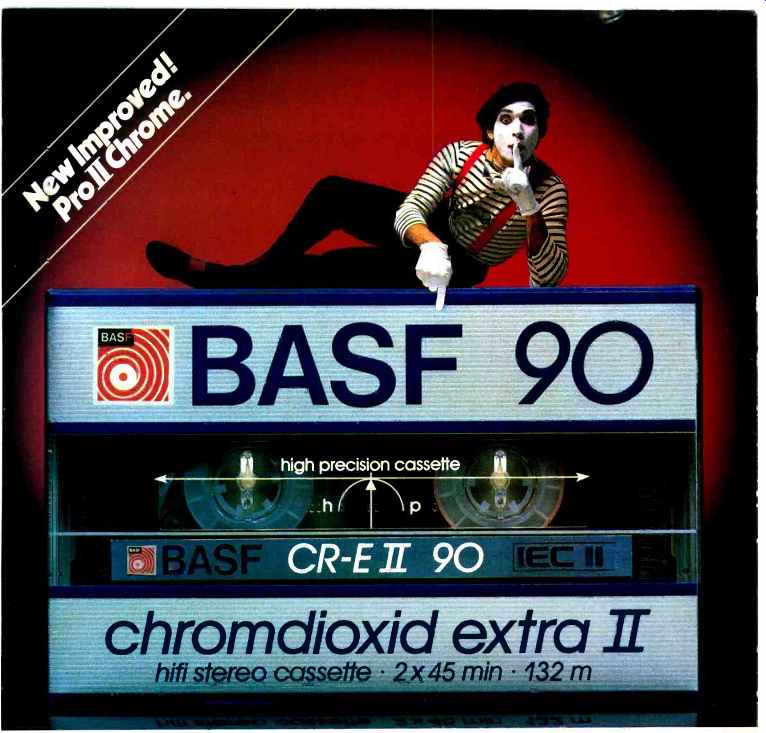
When you buy most audio tapes, you get a little something extra whether you like it or not.
It sounds like thisssssss.
Unless the tape is BASF Chrome. Because unlike ferric oxide tapes, BASF Pure Chrome is made of perfectly shaped chromium dioxide particles in an exclusive formulation that delivers the lowest background noise of any tape in the world. It also delivers outstanding sensitivity in the critical high-frequency range. In fact, +t's designed especially for the Type II Chrome Bias position on your tape machine. And it's guaranteed for a lifetime.
BASF So, if all you want to hear is the music you record, this little message should be music to your ears. BASF Chrome. The world's quietest tape.
Chrome Audio & Video Tapes --The quality never fades.
----------------------
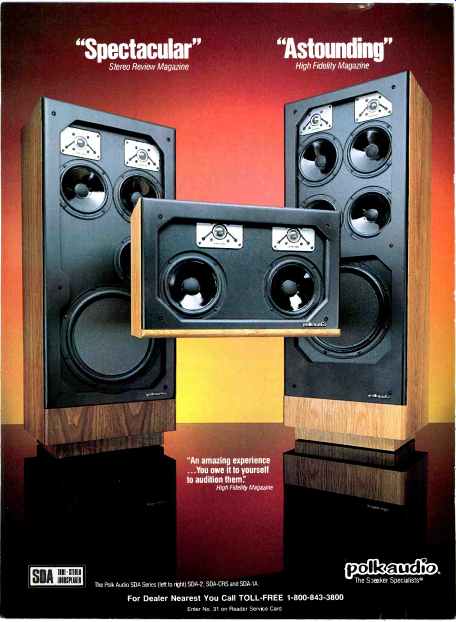
Polk's Revolutionary True Stereo SDAs Always Sound Better Than Conventional Speakers
"They truly represent a breakthrough"---Rolling Stone Magazine
"Polk Reinvents the Loudspeaker."---High Fidelity Magazine
Polk's critically acclaimed, Audio Video Grand Prix Award winning SDA (patented) technology has been called the most important fundamental advance in loudspeaker technology since stereo itself.
Listener's jaws drop in amazement when they hear the huge, lifelike, three-dimensional sonic image produced by Polk's SDA speakers. The nation's top audio experts agree that Polk SDA loudspeakers always sound better then conventional loudspeakers. Stereo Review said, "Spectacular...the result is always better then would be achieved by conventional speakers." High Fidelity said, "Astounding...We have yet to hear any stereo program that doesn't benefit." Now the dramatic audible benefits of Polk's exclusive true stereo SDA technology are available in 3 uniquely superb loudspeaker systems, the SDA-1A, the SDA-2 and the SDA Compact Reference System.
The First True Stereo Speakers Without exaggeration, the design principals embodied in the SDAs could be said to make them the world's first true stereo speakers. When the big switch was made from mono to stereo about 25 years ago, the basic concept of loudspeaker design was never modified to take into account the fundamental difference between a mono and stereo signal.
What is the difference between a mono and stereo loudspeaker? It's quite simple.
The fundamental and basic concept of mono is that you have one signal (and speaker) meant to be heard by both ears at once. However, the fundamental and basic concept of stereo is that a much more lifelike three-dimensional sound is achieved by having 2 different signals, each played back through a separate speaker and each meant to be heard by only one ear apiece (L or R). So quite simply, a mono loudspeaker is designed to be heard by two ears at once while true stereo loudspeakers should each be heard by only one ear apiece (like headphones). The revolutionary Polk SDAs are the first true stereo speakers engineered to accomplish this and fully realize the astonishingly lifelike three-dimensional imaging capabilities of the stereophonic sound medium.
"A new dimension in the sound”---Stereo Review Magazine
Words alone cannot fully describe how much more lifelike true stereo reproduction is. Reviewers, critical listeners and novices alike are usually overwhelmed by the magnitude of the sonic improvement achieved by Polk's Stereo/Dimensional Technology.
You will hear a huge sound stage which extends not only beyond the speakers, but beyond the walls of your listening room itself. The lifelike ambience revealed by the SDAs makes it sound as though you have been transported to the acoustic environment of the original sonic event. Every instrument, vocalist and sound becomes tangible, distinct, alive and firmly placed in its own natural spatial position. You will hear instruments, ambience, subtle musical nuances and other information, (which is normally masked by conventional speakers), revealed for your enjoyment by the SDAs. This benefit is accurately described by Julian Hirsch in Stereo Review, "...the sense of discovery experienced when playing an old favorite stereo record and hearing, quite literally, a new dimension in the sound is a most attractive bonus..." Records, CD's, tapes, video and FM all benefit equally as dramatically. SDAs allow you to experience the spine tingling excitement, majesty and pleasure of live music in your own home. You must hear the remarkable sonic benefits of SDA technology for yourself. You too will agree with Stereo Review's dramatic conclusion: "the result is always better than would be achieved by conventional speakers... it does indeed add a new dimension to reproduced sound."
The SDA-1A ($850) is a beautifully styled, full-sized floor-standing system combining Polk state-of-the-art components with our exclusive true stereo technology for the most lifelike sound possible. It has tremendous dynamic range (120 db output), high efficiency and truly awesome bass performance. While efficient enough to be driven by a small receiver, it will handle a 500 watt per channel super amp.
The SDA-2 ($599.95) is very similar in construction and performance to the top of the line SDA-1A, but is scaled down in size and price. High Fidelity said listening to the SDA-2, is "an amazing experience." The New SDA Compact Reference System ($395) is the world's best sounding bookshelf loudspeaker. It combines the exceptionally lifelike sonic performance achieved by Polk's exclusive true stereo technology with a strikingly handsome enclosure of modest proportions, which can be easily and unobtrusively located in any room. A built-in rear mounted 10" subwoofer allows he CRS to achieve remarkably dynamic bass performance, normally impossible for a speaker of its size. They can be placed right up against the back wall, on a stand or on a shelf without compromising the ability of these amazing compact speakers o project a huge sonic image throughout your room.
polk audio -- The Speaker Specialists
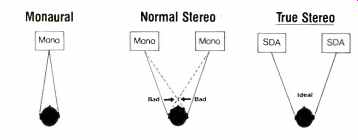
Monaural
Conventional loudspeakers are designed for monaural operation where one speaker is heard by both ears at once.
Normal Stereo Mono Bad Mono
When conventional speakers reproduce stereo, stereo separation is reduced because each speaker is heard by both ears.
True Stereo
SDA
Polk SDA loudspeakers maintain full stereo separation because each ear hears only the one proper speaker
Polk's True Stereo SDAs Maintain Full Stereo Separation
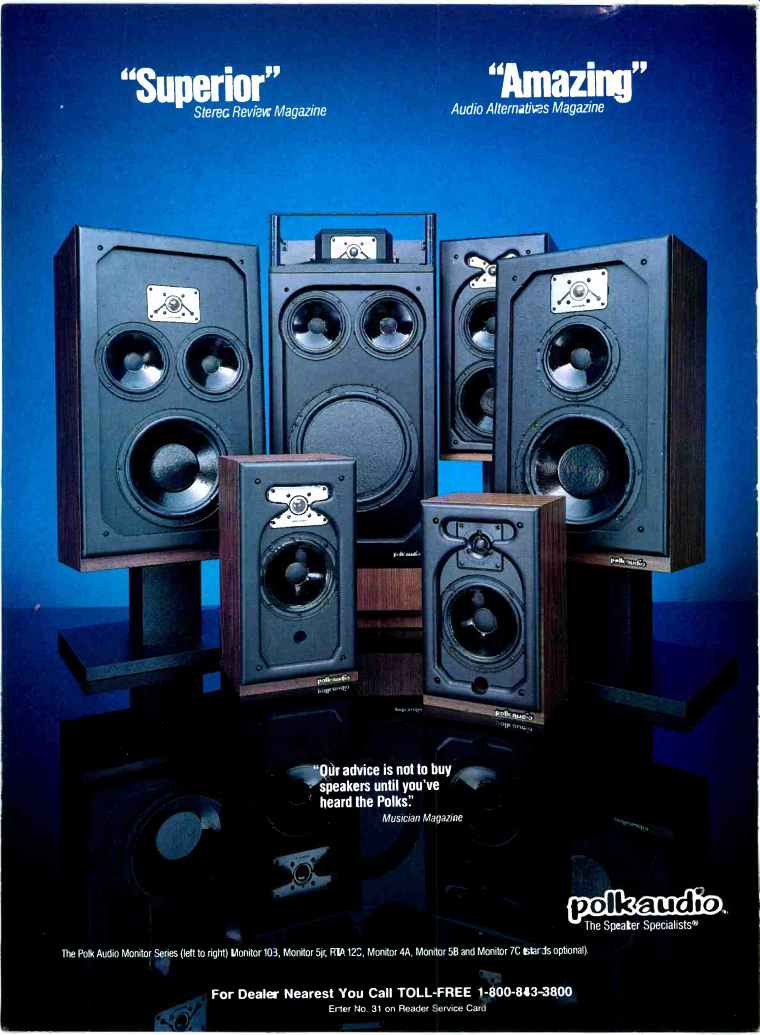
Polk's Remarkable Monitors Redefine Incredible Sound/Affordable Price
"Vastly superior to the competition" Musician Magazine
"At the price, they're simply a steal.' Audiogram Magazine A new generation of Polk Monitors is now available which incorporate the same high definition polymer tweeter and Optimized Flux Density drivers developed for the SDAs. Polk Monitor Series loudspeakers have always had a well deserved reputation for offering state-of-the-art performance and technology usually found only in systems which sell for many times their modest cost. In fact, many knowledgeable listeners consider that outside of the SDAs, the Polk Monitors are the finest imaging conventional speakers in the world regardless of price. They have been compared in performance with loudspeakers which sell for up to $10,000 a pair and are absolutely the best sounding loudspeakers for the money available on the market. Now they sound even better than ever.
"Open, uncolored, perfectly imaged sound”.--- Musician Magazine
All the Polk Monitors regardless of price offer consistently superb construction and sonic performance. They achieve open boxless, three dimensional imaging surpassed only by the SDAs. The Monitor's silky smooth frequency response assures natural, non-fatiguing, easy to listen to sound; while their instantaneous transient response results in music that is crisply reproduced with lifelike clarity and detail.
In addition, dynamic bass performance, ultra wide dispersion, high efficiency and high power handling are all much appreciated hallmarks of Monitor Series performance.
The consistently superb performance of the Polk Monitors is in large part due to the fact that they all utilize very similar components and design features. However, more importantly, it is the elegant integration of concepts and components which results in the superior sonic performance and value which sets the Monitor Series apart. Audiogram magazine said, "How does Polk do it? We think it is mostly execution. They hear very well and they care." Audiogram is absolutely right. At Polk we take the same care with each and every product we build, whether it is our most or least expensive.
We lavish the same lengthy amount of critical listening and tuning on every single Polk speaker because we know that having a limited budget does not necessarily indicate that you have a limited ability to appreciate true musical quality.
" Superior sound at a moderate price” ---- Stereo Review Magazine
There are six Polk Monitor Series loudspeakers (Plus the LF 14 Add on Subwoofer). As you move up the Monitor Series, the speakers get larger and more efficient, handle higher power, have greater dynamic range and better bass response.
They are designed so that a smaller Polk played in a small room will sound nearly identical to a larger Polk in a large room.
And, of course, a larger Polk in a smaller room will play that much louder and have even more bass. The RTA 12C also incorporates unique technology which results in improved imaging and clarity. There is a Polk Monitor which is perfect to fulfill your sonic dreams, at a price you can afford.
The RTA 12C ($459.95) is the finest conventional (non SDA) speaker system that Polk manufactures. Its extremely high power handling (500 watts) and efficiency (92 db 1 meter 1 watt) result in remarkable dynamic range from large or small amplifiers. It utilizes phase-coherent open air driver mounting in a mirror imaged full-sized floor-standing configuration for superior sonic imaging and clarity. In addition to receiving many rave reviews, the RTA 12C has won the Audio-Video Grand Prix Speaker of the Year Award and was selected for the prestigious CES Design and Engineering Exhibition was one of the industry's most innovative products! The Monitor 10B ($324.95) is considered one of the world's best sounding loudspeakers and in the words of Audiogram Magazine, "At the price, they are simply a steal." The 10B offers sonic performance almost equal to the 12 at a lower cost in a more compact enclosure.
Like the 12, the 10 utilizes dual Polk tri-laminate-polymer bass midrange drivers coupled to a built-in subwoofer for an outstanding bass response and dynamic range.
The Monitor 7C ($239.95) is basically a smaller, less expensive version of the Monitor 10, utilizing the same 10" subwoofer and one less bass midrange driver. It can be either shelf or stand mounted with excellent results. How good? Audio Alternatives Magazine said, "It is amazing' The Monitor 5B ($179.95 ) Similar in design and performance to the Monitor 7, however, it utilizes an 8" sub woofer (rather than 10"). It is more compact, allowing even more placement options.
The Monitor 5jr. ($124.95) has been called the best sounding speaker of its size in the world (regardless of price). It has also been called the best sounding speaker of its price in the world (regardless of size). It incorporates the same components as the top of the line SDA 1A, and achieves lifelike three dimensional musical imaging which 10 years ago was not available in any bookshelf speaker at any price! The Monitor 4A ($79.95 ea.) Even though the 4A is Polk's least expensive home loudspeaker, one quick look and listen will demonstrate that it shares many of the same high technology components and rewarding musical performance of the more expensive Polks. Audio critic, Lawrence Johnson called it, "an all around star of great magnitude." The 4A's uniquely affordable price means that no matter how small your budget, you can afford the incredible sound of Polk! The experts agree: Polk speakers sound better. Hear them for yourself! Contact us for full information and the name of your nearest Polk dealer.
Polk Audio, Inc.
1915 Annapolis Road Baltimore, Maryland 21230 (301) 837-4300 In Baltimore Soundscape In Canada Evolution Audio The Speaker Specialists
----------------
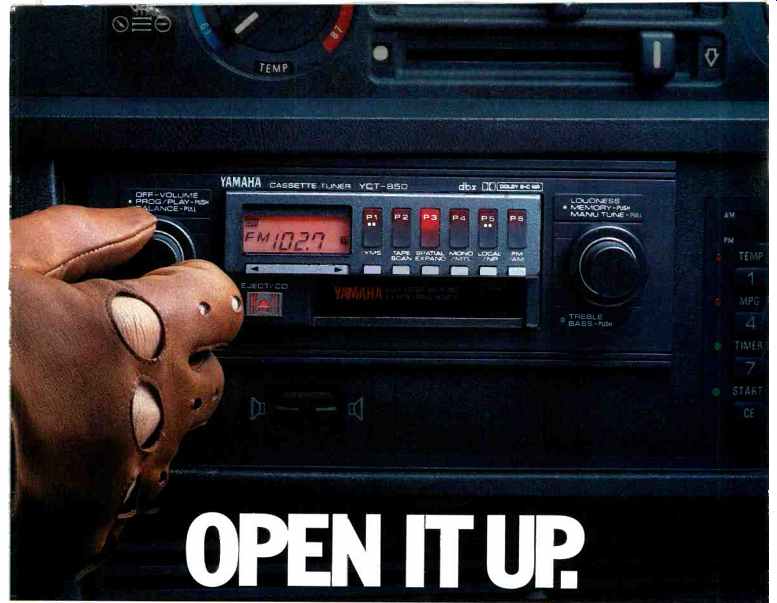
Open it Up
YAMAHA
Most car audio systems can deliver :he sound of performance. Enough sound to exceed the human ear's threshold of pain.
But if your taste in music runs the gamut, from the smash of Heavy Metal to the intricate passages of Mozart, volume alone isn't enough. Without sonic excellence, loud sound is just so much musical mush.
PLAY IT GOOD AND LOUD. Now you can have it both ways with Yamaha car audio. The system that takes some of the world's finest home component; performance and puts it on the road.
Yamaha cassette-receivers utilize independent dual microprocessors with over 6K of memory. One precisely controls tape handling.
The second fine-tunes signals in difficult reception areas.
Yamaha fully digital power amps provide superior, virtually distortion-free amplification.
And easily cope with such road hazards as voltage, impedance and temperature variations.
Yamaha car speaker systems use titanium carbide in the tweeters and carbon fiber in the woofers. Resulting in unrivaled accuracy.
And unequaled performance.
ALL TOGETHER, A GREAT PERFORMANCE. Just as important, Yamaha car audio is a total system with no weak links. Because every Yamaha component is designed to complement and enhance the performance of the system as a whole.
The result is sound that's clean and natural, reproduced with full clarity and resonance. Sound that makes the music.
No matter how loud it's played.
YAMAHA
Yamaha Electronics Corporation, USA, P.O. Box 6660, Buena Park, CA 90622
(Audio magazine, Edward Tatnall Canby)
More music articles and reviews from AUDIO magazine.
Also see:
Classical Record Reviews (Jul. 1990)
= = = =