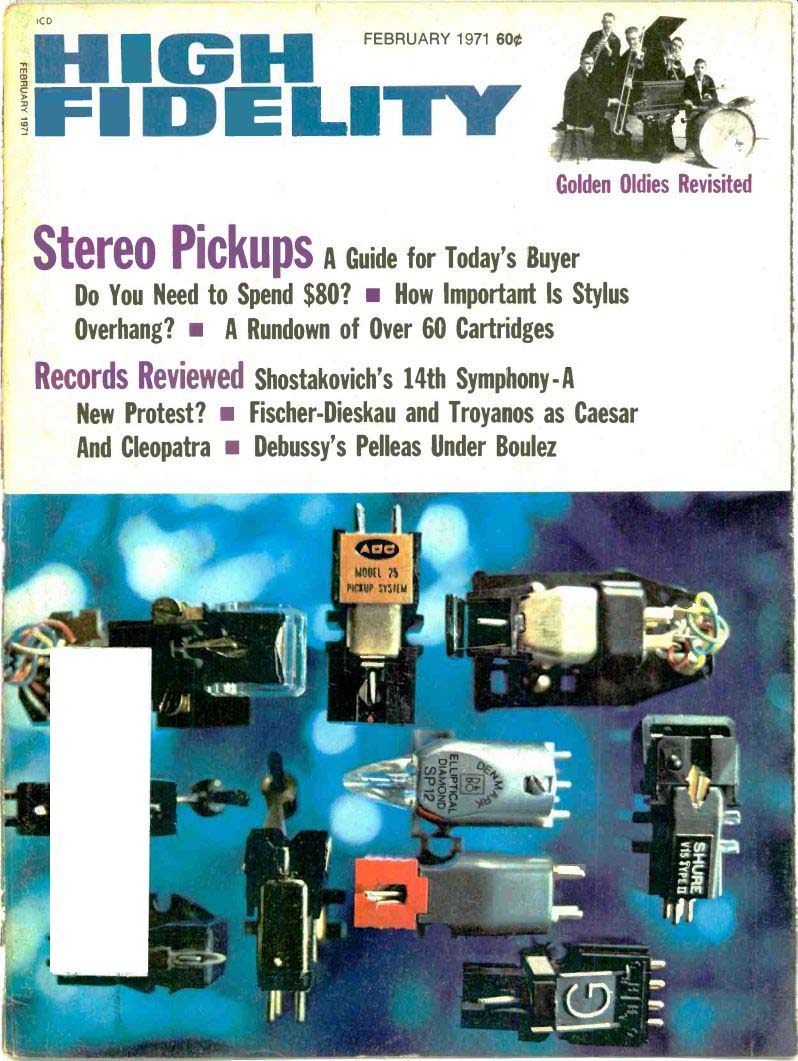
 .
.
by Leonard Feldman
What Makes a Good Stereo Cartridge?
Guidelines for today's buyer.
CONSIDERING ITS SMALL SIZE, and relatively simple appearance, the modern stereophonic phono cartridge seems to command an extraordinary degree of attention from the experts-especially at a time when the latest fad is to predict the impending de mise of phonograph records. Like its complementary transducer-the loudspeaker at the other end of the sound-reproducing chain-the phono cartridge often has been surrounded by empirical rather than scientific design philosophy. The calming influence of stability in format which predominated during the heyday of the long-playing monophonic record in the 1950s (which might have given time for a thorough amassing of design criteria) was abruptly shattered by the introduction of the stereo disc at the close of that decade. A whole new set of rules suddenly prevailed and the scientific approach was again temporarily abandoned in favor of expediency and commercial necessity.
Today a measure of stability exists once more, and a good deal of serious analysis has been expanded on the complex factors involved in translating vertical and lateral undulations of a minute record groove into accurate signals. Many of the elusive parameters involved have been clearly de fined and studied. As with all such research, opinion remains divided as to the relative importance of the factors that define a "good" phono cartridge, but there is, at least, agreement on what those parameters are. Consider the areas of agreement first.
Frequency Response
Every manufacturer I queried recently agrees that the frequency response of a phono cartridge should be as linear or "flat" within the audible range as is possible. The top-of-the-line Empire models, for instance, claim response to 30 kHz and beyond.
Many companies pointed to the possibility of some form of multiplexed four-channel disc which might well require response to 30 and even 40 kHz. Frequency response, however (like so many other cartridge parameters), is intricately related to many other factors, including the record used to measure the response and even the room temperature.
Jon Kelly of Electro-Voice (which has just introduced a quality line of magnetic cartridges manufactured for them by Audio Technica in Japan) stresses the importance of frequency response and indicates another factor affecting it: signal cable lengths. "We are particularly concerned," he told me, "that customers become aware of frequency response when buying a phono cartridge. The emphasis in the past couple of years on tracking ability and some other nebulous concepts has, in many cases, confused the customer by leading him away from some of the basics." He goes on to say that "the frequency response of most popular magnetic cartridges is far from ideal, and then, of course, the high-end response can be changed considerably depending upon the capacity of the connecting cables. Many who have taken pains to purchase a phono cartridge which has been well reviewed in the various magazines are probably not enjoying the kind of response they saw in the printed curves, since the record changer or turntable they are using does not come equipped with leads long enough to smooth out the high-frequency peaks most cartridges have ... " Of course, excessively long cartridge leads can go beyond smoothing the highs and can cause a loss of high-frequency signals and add hum. Therefore, lead length becomes a critical consideration for the serious listener who wants to realize maximum performance from his equipment. Unfortunately, it can be given only for a particular cartridge and must be based on its internal design parameters known as a rule only to its manufacturer. E-V plans to advise buyers of its new cartridges on this point.
[Future cartridge test reports will include information on optimum loading for best response.-Ed.]
The Stylus Tip and Distortion
The distortion produced by a phono cartridge is closely related to its stylus-tip mass and shape, not to mention its compliance. To discuss any one of these factors without relating it to the others would be almost meaningless.
It is universally agreed that, all other things being equal, stylus-tip mass should be as low as possible; for instance, loud passages in records may contain acceleration forces of up to 1,500 G. With a stylus-tip mass of 1 milligram, the accelerating force on the stylus would then be 1.5 grams. To insure good con tact between stylus and groove walls, the stylus tracking force would have to be higher than the accelerating force, say 2 grams. But if the stylus-tip mass could be reduced to 0.5 milligrams, a stylus force of only 1 gram would be sufficient.
Because it is difficult to measure accurately dynamic stylus masses that are substantially below 1 milligram, manufacturers resort to indirect methods, such as studying a pickup while it traces heavily modulated records. It also is generally conceded that stylus mass resonance, in conjunction with the vinyl material of which the disc is made, accounts in part for the high-frequency peak so common in cartridge response curves. Again, lowering the stylus tip mass will, of itself, move the peak higher in frequency, hopefully outside the audible frequency limits.
Grado's F series of cartridges, for instance, em ploy styli whose tip mass has been so reduced that the pickup's resonance is said to occur at 56 kHz, well outside the audible range. Damping, rather than being dependent upon the rubber material coupled to the stylus assembly, is accomplished by magneto motive action. The tiny rubber pad itself is now used only for centering of the stylus assembly. The pivot section (the critical junction of the stylus cantilever to the internal movement) is designed to prevent any decoupling between the stylus itself and the internal four-magnetic-gap generator. The results claimed for this redesign are extended high-end response without resonances and peaking, in addition to balanced output from both stereo channels.
The Ortofon moving-coil SL-15 series of cartridges has an effective stylus-tip mass of only 0.9 milligrams (one of the lowest in the magnetic category) and its over-all weight is only 7 grams. However, the moving-coil design produces an extremely low output (0.02 millivolts/cm/sec), so the SL-15 has been sold with the model 2-15K plug-in transformer, the resultant combination being called the SL-15T. The transformer, while it did raise the impedance and the output of the SL-15 to acceptable levels for use with today's stereo receivers and amplifiers, was somewhat susceptible to hum-field pickup. It also suffered from the expected effects of the introduction of inductance (in parallel with the normal capacitance of connecting cables).
Elpa, which markets the Ortofon in the U.S., has now introduced an all-electronic substitute for this transformer, known as the MP-230 Cartridge Amplifier. Its frequency response goes well beyond that of the cartridge itself (which already extends from 10 Hz to 40,000 Hz). Moreover, the use of an electronic device eliminates the hum and noise problems associated with a transformer. Since the new preamplifier sells for $60, Elpa gives its customers a lower-cost alternative in the form of a totally redesigned trans former, known as the STR-70, which sells for $20, the same price as the old transformer. The newer unit, however, is said to have considerably better shielding and would therefore be less critical of physical placement. Frequency response is also improved, according to the manufacturer. Thus, the consumer considering either of these arrangements would be expected to pay $80 for the SL-15 with transformer (the SL-15 alone is $60) or, if the new preamplifier is substituted for the transformer, a total of $120.
A rather unique tribute, by the way, to the importance of stylus tip shape and size is seen in ADC's offering of three different styli (one spherical and two ellipticals) with its Model 25 cartridge. Each stylus, says ADC, is optimally suited for tracing the grooves of records cut in slightly different ways, or of records whose grooves have been worn in greater or lesser degree.
Today's cartridge designers seem to be paying less attention to the high-frequency peaking problem than they did in former years, since many feel that correct "loading" of the cartridge by suitable resistances (in preamplifier inputs) and proper roll-off capacitances (in connecting cables) takes care of the problem adequately. In this regard some manufacturers, such as Stanton and Shure, are recommending specific amounts of capacitance in addition to the usual 47 K-ohm resistive load requirement.
The inherent nonlinearities of response in cartridges are now conceded to be the least important factors in over-all judgment of performance. The real culprits-though difficult to measure accurately--in the fight against harmonic and intermodulation distortion are such factors as poor tracking and/or tracing pinch effect, and insufficient compliance. It has been fairly common practice to compare distortion in different cartridges by observing their sine-wave patterns, traced from a test record on an oscilloscope. Many experts now feel that this technique reveals less important data than originally thought.
Their reasoning: a stylus tracing a record groove produces distortion that consists mainly of second and third harmonics. This distortion will increase as the frequency of the fundamental tone rises (since tracking becomes more difficult with closer-spaced groove undulations). Distortions above 20 percent are easily reached using the "oscilloscope observation" method, and under these circumstances it seems miraculous that phonograph-reproduced music can sound as good as it does! One explanation offered for this apparent contra diction is that harmonic overtones do not disturb the musical signal nearly as much as would unrelated tones. Another explanation holds that the frequencies of the highly distorted overtones are beyond the audible range and/or are not normally reproduced by the rest of the playback system. In other words, al though we can see this distortion on the oscilloscope we don't hear it from the loudspeakers. The conclusion, from a design standpoint, is that the distortion is not fundamentally a function of a pickup's response as such, but rather depends on the size and shape of its stylus.
The trend to the elliptical stylus is clearly a recognition of the distortion-contributing factors inherent in stylus size and shape. Admittedly, most manufacturers agree that the use of an elliptical stylus requires more critical adjustment of tone-arm parameters (such as the 15-degree tracking angle and the various tangential relationships to the record groove, including antiskating). A misaligned or incorrectly installed elliptical stylus can cause more mis-tracing (and, in the extreme, more record wear) than a conical stylus similarly misaligned. The relationship of stylus shape to tracking force and use is further underscored by many designers who offer specific stylus tips, each intended for a different tracking force and type of installation. For example, Pickering suggests that a tip size of .0002 by .0009 be used only in the very best manual turntables and at a tracking force of between 0.75 and 1.5 grams; at the other extreme, they recommend a tip size of .0004 by .0009 for automatic changers with a tracking force of 3 to 5 grams. Such careful matings of cartridge and record player are believed to be highly significant in minimizing audible distortion due to mis-tracing, regardless of what a specific cartridge may exhibit as "distortion" by the conventional sine-wave test. It is thus entirely possible for a low-cost cartridge to sound cleaner than a high-priced model installed in the same record player.
Tracking Force
There is still no universal agreement on how much tracking force, within a given recommended range, should be used. Most manufacturers maintain that, it anything, slightly greater tracking force will re duce tracing distortion, and that attendant "hugging" of the groove walls will result in less over-all record wear after a given number of playings. Some manufacturers, though, still strive for fractions of a gram of tracking force, arguing that such minute forces are bound to result in less record wear if the stylus tip can at the same time be designed to trace the groove reasonably well. The main thrust, for in stance. of Elac cartridge development-reports Joseph Benjamin, head of Benjamin Electronic Sound Corporation which handles Elac products in the U.S.-"is in the direction of controlling those parameters which govern the lower limit of tracking force. By achieving lower stiffness and tip mass, cartridges can be produced that track satisfactorily at forces lower than one-half gram."
But Benjamin also points out: "In order to use such cartridges in a changer, it is necessary that certain characteristics of the changer be carefully controlled. These are: arm mass, bearing friction, and trip mechanism loading." No known changer, says Benjamin, can handle such a cartridge although Elac is "currently designing the only combination of automatic player and cartridge that will track well at less than one-half gram. This can be accomplished only by designing the cartridge and arm mechanism as an integrated assembly." Ultralow tracking force also is prominently espoused as a feature of a radically different kind of cartridge, the type based on the modulation of a light beam. In the new model from A. Bernard Smith Laboratories, the stylus tip is in no way coupled magnetically or mechanically to other structural elements of the cartridge. As a result, tracking forces of as little as 0.25 to 0.75 grams are claimed as a feature of this pickup. Continuing work along these lines is in progress, according to company spokesmen, and a new version of the cartridge will be announced shortly which, it is claimed, "will make obsolete all the cartridges now in existence." Many manufacturers have come to realize the non-universality of application inherent in phono cartridge use. Since cartridges are used in the very best manual turntables as well as in mass-produced record changers, cartridge manufacturers generally have broadened their lines to include a wide range of stylus types and recommended tracking forces, as will be evident from an examination of the ac companying survey. While some companies, such as Pickering, ADC, and Empire, tabulate specific makes and models of turntables for their various pickups, others prefer to generalize in this regard.
Compliance and Trackability
Compliance no longer seems to be regarded as the major specification for cartridges. In fact, many engineers now indicate an interest in what they feel is a more meaningful specification-that of "track-ability" originally espoused by Shure. The compliance specification, stated as 10^-6 cm/dyne, indicates the amount of force (lateral or vertical) required to move the stylus tip by a given amount. It might he thought of as the reciprocal of "resistance." Thus, a compliance of 30 x 10^-6 cm/dyne means that the stylus tip would move 0.000030 centimeters when a force of I dyne was applied to it. Obviously, this figure represents a more compliant (or nonresistant) condition than a compliance of only 20 x 10-6 cm/dyne. (Often, by the way. the "10^-6 cm/dyne" phrase is omitted from the specifications, so that the two figures referred to appear simply as "30" and "20" respectively.)
Proponents of the new "trackability" specification point out-correctly, in my opinion-that a compliance figure, when unaccompanied by stylus-tip mass information and some insight into the direct relationship between these two specifications, is somewhat meaningless and often confusing. Track-ability, on the other hand, offers a direct measure of tracking performance. It is stated as so many centimeters per second for a given tracking force.
As an example, the trackability of the Shure V-15 Type II Improved cartridge for a tracking force of 1 gram is given as: 28 cm/sec at 400 Hz, 35 at 1,000 Hz, 30 at 5.000 Hz, and 22 at 10,000 Hz.
This merely indicates the velocity with which the stylus tip can be expected to move while maintaining accurate groove tracing at 1 gram. The higher this velocity capability, the greater the groove modulation (or recorded dynamic range) which the given cartridge may be expected to trace successfully.
It should he noted that even this specification depends in part upon stylus-tip shape and size, just as the older compliance specifications did. Thus, if the new spec is to have valid meaning it must be related to a specific cartridge equipped with a specific stylus and-in the extreme-used in a given tone arm which is perhaps as great an over-all performance criterion (particularly at low frequencies) as any other. For instance, the specifications noted by Shure apply to the cartridge mounted in the SME tonearm.
Quadriphonics and Cartridges
At least one proposal for a quadriphonic (four-channel) disc involves the use of supersonic (30-kHz or higher) subcarriers that would contain the rear-channel signals. The problem of successfully tracing a 30-kHz signal cannot be overstated. Extremely low stylus-tip mass, extended frequency response, and low tracking force would all be necessary to successfully trace such a disc. Assuming that a cartridge were able to respond adequately to these high subcarrier frequencies, the question of cable capacitance roll-off of these frequencies would be come critical indeed. In fact, in demonstrations of one form of this disc by the Victor Company of Japan, two solid-state devices (impedance transforming transistor stages) were installed directly behind the cartridge body so that the resulting output from each channel was low-impedance and not subject to high-frequency deterioration by the signal cables.
This form of disc, however, is likely to present a more serious problem. The slightest amount of stylus imperfection (caused by extended use of the stylus) would attack and destroy the higher frequencies associated with such a subcarrier long before it would begin to gouge out the conventional, two-channel audio-range material. Thus, it seems unlikely that the supersonic subcarrier method of achieving quadriphony on discs will be adopted un less cartridge manufacturers can solve a whole new set of engineering problems. It is not surprising then that the cartridge makers I queried generally expressed a preference for one of the coding systems for getting four channels into and out of one record groove.
Neither the Scheiber, the CBS, the Dynaco, nor the E-V coding system entails any significant change in phono cartridge design. The Dynaco system does suggest that recording engineers deliberately intro duce out-of-phase information into recordings that are otherwise processed in the same manner as today's stereo discs. This implies that cartridge de signers maintain accurate phase relationships at all significant frequencies (a specification that up to now has not been considered important).
The cartridge industry generally has adopted a wait-and-see attitude to quadriphonics. Most manufacturers feel that there is still much work to be done even in perfecting present stereo cartridges and their groove tracing capability, and that new frequency response and phase accuracy requirements could well throw this segment of the industry into sudden panic again.
---------------------
Stereo Cartridges--The Latest Models
The information listed here is based on manufacturers' data avail able at press time. Inasmuch as manufacturers may not agree on what data is important (some, for instance, have stopped giving compliance figures), nor on specific methods of arriving at and specifying data, comparisons between different brands should be made ultimately on the basis of our own published test reports and the buyer's own listening tests. The disparity among the data given on all models further makes it pointless to present this data in comparative tabular form. The information here, however, does document general trends among new pickups and can serve as a guide to relative performance differences among the various models offered by a single manufacturer. Output voltages have all been standardized here to a velocity of 1 centimeter/second. Most test records (which manufacturers often use to determine output voltages) have velocities in excess of this, ranging from 3.4 cm/sec to over 5.5 cm/sec. Thus, a manufacturer who normally uses, say, a 5-cm/sec test record and rates his output as "5 millivolts" will be rated in the survey as "1 mV/cm/sec" (5 mV/5 cm per sec) so that output ratings have the same meaning regardless of test records used. Prices shown are suggested list; other prices may be encountered in various locales.
Audio Dynamics Corporation (ADC)
990-XE. Response: 10 Hz to 20 kHz ±2 dB. Separation at 1 kHz: 20 dB. Output: 0.92 mV/cm/sec. Tracking force: 1 to 2 grams. Stylus: 0.3- by 0.7-mil elliptical, user replaceable. Price: $29.95.
550-XL Response: 10 Hz to 20 kHz ±2 dB. Separation at 1 kHz: 20 dB. Output: 0.92 mV/cm/sec. Tracking force: 0.75 to 2 grams. Stylus: 0.3- by 0.7-mil elliptical, user replaceable. Price: $44.95.
10E-Mk II. Response: 10 Hz to 20 kHz ±2 dB. Separation at 1 kHz: 30 dB. Output: 0.73 mV/cm/sec. Tracking force: 0.5 to 1.5 grams. Stylus: 0.3- by 0.7-mil elliptical, user replaceable. Price: $59.50.
27. Response: 10 Hz to 22 kHz ±2 dB. Separation at 1 kHz: 30 dB. Output: 0.73 mV/cm/sec. Tracking force: 0.5 to 1.5 grams. Stylus: 0.3- by 0.7-mil elliptical, user replaceable. Price: $65.
26. Response: 10 Hz to 24 kHz ±2 dB. Separation at 1 kHz: 30 dB. Output: 0.73 mV/cm/sec. Tracking force: 0.5 to 1.25 grams. Stylus: 0.3- by 0.7-mil elliptical, user replaceable. Price: $75.
25. Same as Model 26 above, except supplied with three inter changeable styli (two elliptical, one 0.6-mil conical for matching specific record requirements). Price: $100.
Bang & Olufsen of America (B & O)
SP-12. Response: 15 Hz to 25 kHz ±3 dB. Separation at 1 kHz: better than 25 dB. Output: 1.0 mV/cm/sec. Tracking force: 0.75 to 1.5 grams. Stylus: 0.2- by 0.7-mil elliptical, user replaceable. Net weight: 8.5 grams. Price: $69.95.
Elac (Benjamin Electronic Sound Corporation)
244-17. Response: 20 Hz to 22 kHz (no tolerance given). Separation at 1 kHz: 22 dB. Output: 1.5 mV/cm/sec. Tracking force: 1.5 grams. Stylus: 0.7-mil conical, user replaceable. Net weight: 6.5 grams. Price: $24.95.
344-17. Response: 20 Hz to 22 kHz ±2 dB. Separation at 1 kHz: 24 dB. Output: 1.0 mV/cm/sec. Tracking force: 1.0 grams. Stylus: 0.7-mil conical, user replaceable. Net weight: 6.5 grams. Price: $39.50.
444-12. Response: 10 Hz to 24 kHz ±2 dB. Separation at 1 kHz: 26 dB. Output: 1.0 mV/cm/sec. Tracking force: 0.75 grams. Stylus: 0.5-mil conical, user replaceable. Net weight: 6.5 grams. Price: $59.50.
444-E. Same specifications as 444.12, except supplied with 0.2-by 0.9-mil elliptical stylus. Price: $69.50.
Electro-Voice New line of magnetic cartridges, V-series.
Movement uses two moving magnets; design effort to extend high-frequency response of all models to at least 30 kHz through use of extremely low-moving mass. Differences in pricing within a group have to do primarily with compliance. Other information avail able at press time: V-100. Tracking force: 3 to 5 grams. Stylus: 0.7-mil spherical. Price: $9.95.
V-110E. Tracking force: 2 to 4 grams. Stylus 0.4- by 0.7-mil elliptical. Price: $19.95.
V-120E. Tracking force: 2 to 4 grams. Stylus: 0.4- by 0.7-mil elliptical. Price: $29.95.
V-130E. Tracking force: 1.5 to 3 grams. Stylus: 0.2- by 0.7-mil elliptical "nude" diamond. Price: $49.95.
V-140E. Tracking force: 1 gram. Stylus: 0.2- by 0.7-mil elliptical "nude" diamond and tapered tube. Price: $69.95.
V-150E. Tracking force: 1 gram. Stylus: same description as V-140E. Price: $100.
V-200EL Tracking force: 1 gram. Stylus: same description as V-140E. Termed by E-V as a "limited edition" pickup. Price: $150.
Empire
Unless otherwise noted, all Empire cartridges share the following specifications: separation at 1 kHz: 35 dB. Net weight: 7 grams. Output: 1.5 mV/cm/sec. All styli are user replaceable.
90-EE/X. Response: 15 Hz to 25 kHz ±3 dB. Tracking force: 1.5 to 4 grams. Stylus: 0.4- by 0.7-mil elliptical. Price: $24.95.
909/X. Response: 15 Hz to 25 kHz ±3 dB. Tracking force: 1.5 to 4 grams. Stylus: 0.7-mil spherical. Price: $24.95.
909 E/X. Response: 12 Hz to 25 kHz ±3 dB. Tracking force: 1 to 4 grams. Stylus: 0.4- by 0.7-mil elliptical: Price: $29.95.
999/X. Response: 10 Hz to 30 kHz ±3 dB. Tracking force: 1 to 3 grams. Stylus: 0.7-mil spherical. Price: $34.95.
999 E/X. Same as above, except tracking force: 0.75 to 2 grams. Stylus: 0.3- by 0.7-mil elliptical. Price: $39.95.
999 PE/X. Response: 8 Hz to 32 kHz ±3 dB. Tracking force: 0.75 to 2 grams. Stylus: 0.3- by 0.7-mil elliptical. Price: $44.95.
999 SE/X. Same as above, except tracking force: 0.5 to 1.5 grams. Stylus: 0.2- by 0.7-mil elliptical. Price: $49.95.
999 TE/X. Response: 6 Hz to 36 kHz ±3 dB. Tracking force: 0.5 to 1.5 grams. Stylus: 0.2- by 0.7-mil elliptical. Price: $64.95.
999 VE/X. Same as above, except response: 4 Hz to 40 kHz ±3 dB. Tracking force: 0.25 to 1.25 grams. Output: 12 mV/cm/sec. Price: $79.95.
1000 ZE/X. Response: 4 Hz to 40 kHz ±3 dB. Tracking force: 0.25 to 1 gram. Stylus: 0.2- by 0.7-mil elliptical. Price: $99.95.
Goldring (IMF Products)
G-850. Response: 20 Hz to 20 kHz. Separation at 1 kHz: 20 dB. Output: 1 mV/cm/sec. Tracking force: 1.5 to 3 grams. Channel balance: within 1 dB. Tracking angle: 15 degrees at 2 grams. Stylus: 0.5-mil spherical (conical), user replaceable. Price: $9.95. Replacement stylus: $6.00.
800E-Mk II. Response: 10 Hz to 23 kHz ±3 dB. Separation at 1 kHz: 25 dB. Output: 1 V/cm/sec. Tracking force: 0.75 to 1.5 grams. Channel balance: within 0.5 dB. Tracking angle: 15 degrees at 1 gram. Stylus: 0.3- by 0.8-mil elliptical, user replaceable. Compliance: 30 x 10^-6 cm/dyne. Net weight: 7.5 grams. Price: $39.95. Replacement stylus: $18.
800 Super E. Response: Individual curve supplied with each unit; at least 10 Hz to 23 kHz ±2 dB. Separation at 1 kHz: better than 25 dB. Output: 0.8 mV/cm/sec. Tracking force: 0.5 to 1.25 grams. Channel balance: within 0.5 dB. Tracking angle: 15 degrees at 0.75 gram. Stylus: 0.3- by 0.8-mil elliptical, user replaceable. Compliance: 45 x 10^-6 cm/dyne. Inductance per channel: 300 mH (millihenries). Net weight: 7.0 grams. Price: $69.50. Replacement stylus: $30.
Grado
FT Series. Response: 10 Hz to 35 kHz. Separation: 35 dB at 1 kHz. Output: 0.8 mV/cm/sec. Tracking force: 1.5 to 3.5 grams.
Recommended load resistance: 10 K ohms or greater (not critical). Inductance per channel: 55 mH. Tip-mass resonance frequency: 35 kHz. Styli: 0.6-mil spherical (Model FTR) or 0.7- by 0.3-mil elliptical (Model FTE), both user replaceable. Net weight: 5.5 grams Price: $9.95 for FTR, $19.95 for FTE.
F-3. Response: 7 Hz to 40 kHz. Separation at 1 kHz: 35 dB. Output: 0.8 mV/cm/sec. Tracking force: 0.75 to 2 grams.
Recommended load resistance: 10 K ohms or greater. Tip-mass resonance frequency: 35 kHz. Stylus: 0.6-mil spherical, user replaceable. Net weight: 5.5 grams. Price: $49.50.
F-2. Response: 7 Hz to 40 kHz. Separation at 1 kHz: 35 dB. Output: 0.8 mV/cm/sec. Tracking force: 1 to 2 grams. Phase-shift and roll-off controlled to 50 kHz, with 18 dB of separation still present at 50 kHz. Tip-mass resonance: 56 kHz. Stylus: 0.7- by 0.3-mil elliptical, user replaceable. Price: $60.
F-1. Response: 7 Hz to 40 kHz. Separation at 1 kHz: 35 dB. Output: 0.8 mV/cm/sec. Tracking force: 0.75 to 2 grams. Recommended load resistance: 10 K ohms or greater. Tip-mass resonance: 40 kHz. Stylus: twin 0.3-mil quarter-sphere tips on one diamond. Frequency response curve supplied with each unit. Net weight: 5.5 grams. Price: $75.
Norelco (North American Philips)
412. Response: 20 Hz to 20 kHz ±2 dB (individual curves supplied with each unit). Channel separation at 1 kHz: 30 dB. Output: 1.5 mV/cm/sec. Tracking force: 0.75 to 1.5 grams.
Recommended cable capacitance: less than 250 pF. Horizontal compliance: greater than 30 x 10^-6 cm/dyne. Vertical compliance: greater than 20 x 10^-6 cm/dyne. Stylus: 0.7- by 0.3-mil elliptical, user replaceable. Vertical tracking angle: 15 degrees. Net weight: 7 grams. Price: $67.50.
Ortofon (Elpa Marketing Industries)
SL-15. Response: 20 Hz to 20 kHz ±2 dB. Separation at 1 kHz: 30 dB. Output: 0.2 mV/cm/sec. Tracking force: 0.75 to 1.5 grams. Output impedance: 2 ohms (requires separate transformer in most cases). Stylus: 0.3- by 0.7-mil elliptical, factory replace able. Stylus-tip equivalent mass: 0.9 milligrams. Net weight: 7 grams. Price: $60.
SL-15/T. Same as above, except supplied with separate matching transformer, type 2-15K. Combined price: $75. Combined output: 0.6 mV/cm/sec.
S-15/T. Response: 10 Hz to 40 kHz. Separation at 1 kHz: 30 dB.
Output: 0.6 mV/cm/sec. Tracking force: 1 to 2 grams. Built-in transformer results in output impedance of 15 K ohms. Stylus: 0.3- by 0.7-mil elliptical, factory replaceable. Total net weight: 18.5 grams. Price: $80.
S-15M/T. Same as above, except mounted in "G" shell to fit Ortofon and SME tone arms. Combined weight: 31 grams. Total price: $85.
Accessories.
2-15K. Impedance-matching step-up transformer for use with SL-15 cartridge. Price: $20.
STR-70. Newly designed matching transformer with improved shielding and response. Price: $20.
MP-235. Cartridge Amplifier, replaces matching transformers. Frequency response: 10 Hz to 50 kHz ±0.5 dB. Harmonic distortion: less than 0.05% for up to 1-volt output. Power requirements: 110/120 VAC. Price: $60.
Elliptical replacement styli for all cartridges listed above-installed by factory only, at a cost of $30.
Pickering
V-15/AC-3. Response: 10 Hz to 20 kHz. Nominal channel separation: 26 dB. Nominal output: 1.4 mV/cm/sec. Tracking force: 3 to 7 grams. Stylus: 0.7-mil spherical, user replaceable. Net weight: 5 grams. Suitable for record-changer use. Price: $24.95.
V-15/ACE-3. Same as above, except 0.4- by 0.9-mil elliptical stylus. Tracking force: 3 to 5 grams. Price: $29.95.
V-15/AM-3. Response: 10 Hz to 23 kHz. Nominal channel separation: 32 dB. Output: 1.2 mV/cm/sec. Tracking force: 1 to 3 grams. Stylus: 0.7-mil spherical, user replaceable. Net weight: 5 grams. Suitable for light-tracking changers and manuals. Price: $34.95.
V-15/AME-3. Same as above, but with 0.3- by 0.9-mil elliptical stylus. Tracking force: 0.75 to 1.5 grams. Price: $49.95.
V-15/ATE-3. Response: 10 Hz to 23 kHz. Nominal channel separation: 32 dB. Output: 1.2 mV/cm/sec. Tracking force: 2 to 5 grams. Stylus: 0.4- by 0.9-mil elliptical, user replace able. Net weight: 5 grams. Suitable for automatic turntable use. Price $39.95.
Phase IV AME. Response: 10 Hz to 15 kHz. Nominal channel separation: 32 dB. Output: 1 mV/cm/sec. Tracking force: I to 2 grams. Stylus: 0.3- by 0.9-mil elliptical, user replaceable. Suitable for use with manual and light-tracking automatic turntables. Price: $49.95.
XV-15/350. Response: 10 Hz to 25 kHz. Nominal channel separation: 35 dB. Output: 1.4 mV/cm/sec. Tracking force: 2 to 4 grams. Stylus: 0.7-mil spherical, user replaceable. Suit able for use with automatic turntables. Price: $39.95.
SV-15/200E. Similar to above, except 0.4- by 0.9-mil elliptical stylus. Tracking force: 2 to 4 grams. Price: $49.95.
XV-15/400E. Response: 10 Hz to 25 kHz. Nominal channel separation: 35 dB. Output: 1 mV/cm/sec. Tracking force: 0.75 to 1.5 grams. Stylus: 0.3- by 0.9-mil elliptical, user replaceable. Suitable for use with manual turntables and light-tracking automatics. Price: $54.95.
XV-15/750E. Same as above, but with 0.2- by 0.9-mil elliptical stylus, user replaceable. Tracking force: 0.5 to 1 gram. Output: 0.8 mV/cm/sec. Price: $65.
Shure
M75-6. Response: 20 Hz to 20 kHz. Separation: better than 25 dB at 1 kHz. Output: 1.25 mV/cm/sec. Tracking force: 1.5 to 3 grams. Stylus: 0.6-mil spherical, user replaceable. Suggested input capacitance: 300-500 pF including cable. Trackability (in SME arm): 25 cm/sec at 1 kHz at 2 grams force. Net weight: 6 grams. Price: $24.50. Replacement stylus: $11.35.
M75G. Same as above, except tracks at 0.75 to 1.5 grams and trackability figure applies at 1 gram. Price: $34.95. Replacement stylus: $17.50.
M75E. Same as above, but supplied with 0.2- by 0.7-mil elliptical stylus. Price: $39.95. Replacement stylus: $20.
M93E. Response: 20 Hz to 20 kHz. Separation: better than 25 dB at 1 kHz. Output: 1.2 mV/cm/sec. Tracking force: 1.5 to 3 grams. Stylus: 0.4- by 0.7-mil elliptical, user replaceable. Suggested input capacitance: 400-500 pF including cable. Trackability (in SME arm): 25 cm/sec at 2 grams at 1 kHz. Net weight: 6 grams. Price: $39.95. Replacement stylus: $19.95.
M92E. Same as above, except 0.2- by 0.7-mil elliptical stylus. Tracking force: 0.75 to 1.5 grams. Trackability: 26 cm/sec at 1 gram at 1 kHz. Price: $44.95. Replacement stylus: $22.50.
M91E. Same as above, except 1.0 mV/cm/sec output and 28 cm/sec trackability at 1 gram force. Price: $49.95. Replacement stylus: $24.50.
V-15 Type II-7. Response: 20 Hz to 25 kHz. Separation: better than 25 dB at 1 kHz. Output: 0.7 mV/cm/sec. Tracking force: 0.75 to 1.5 grams. Stylus: 0.7-mil spherical, user replaceable.
Suggested input capacitance: 400-500 pF including cable.
Trackability (in SME arm): 35 cm/sec at 1 gram at 1 kHz. Net weight: 6.8 grams. Price: $62.50. Replacement stylus: $24.
V-15 Type II Improved. Same as above, except supplied with 0.2-by 0.7-mil elliptical stylus. Price: $67.50. Replacement stylus: $27.
Smith (A. Bernard Smith Laboratories)
Professional System. PhotoSonic (modulated light beam) principle. Frequency response of photosensors: DC to 100 kHz. Separation: 30 dB. Compliance: 25-30 x 10^-6 cm/dyne vertical and horizontal. Tracking force: 0.25 to 0.75 gram. Styli: 0.5-or 0.7-mil spherical, or elliptical. Net weight including clip: 3 grams. Vertical tracking angle: 15 degrees, factory set. Price for cartridge, required preamp and power supply: $126 with conical stylus, $133.45 with elliptical stylus.
120 PhotoSonic System. Same specifications as above, but uses 58C light cells, instead of L-4414 cells. Price, with conical stylus, cartridge, preamp, and power supply: $97.95. Price with elliptical stylus: $105.40.
Stanton
500A. Response: 20 Hz to 20 kHz ±2 dB. Channel separation: 35 dB. Tracking force: 2 to 5 grams. Output: 0.8 mV/cm/sec.
Channel balance: within 2 dB. Suggested cable capacitance: 275 pF. Net weight: 5 grams. Stylus: 0.7-mil spherical. Price: $30.
500AL. Similar to 500A above, but tracks at 3 to 7 grams; has somewhat less frequency-response range and an output of 1.0 mV/cm/sec. Extremely rugged, and recommended for continuous broadcast use and handling. Price: $30.
500AA. Response: 20 Hz to 20 kHz ±2 dB. Channel separation: 35 dB. Tracking force: 0.75 to 3 grams. Output: 0.8 mV/cm/sec. Channel balance: within 2 dB. Suggested cable capacitance: 275 pF. Stylus: 0.5-mil spherical. Net weight: 5 grams. Price: $35.
500E. Similar to 500AA, but tracks at 2 to 5 grams; 0.4- by 0.9-mil elliptical stylus. Price: $35.
681A. Response: 20 Hz to 20 kHz, individually calibrated. Channel separation: 35 dB, nominal. Suggested cable capacitance: 275 pF. Channel balance: within 2 dB. Tracking force: 1 to 3 grams. Stylus: 0.7-mil spherical. Net weight: 5.5 grams (brush weight, 1 gram, self-supporting). Price: $66.
681EE. Similar, but tracks at 0.75 to 1.5 grams, has 0.7 mV/ cm/sec output; 0.2- by 0.9-mil elliptical stylus. Price: $72.
681SE. More rugged unit of same series; tracks at 2 to 5 grams, has output of 1.1 mV/cm/sec; 0.4- by 0.9-mil elliptical stylus. Price: $66.
681L. Low impedance cartridge of the series; output of 0.18 mV/cm/sec and noncritical capacitive loading characteristic.
Available with a variety of spherical or elliptical styli (tracking force dependent upon stylus used). Price: in same range as other models of the series; depends upon stylus type selected.
THE PRICING OF CARTRIDGES: What's the difference between $20 and $80 pickups?
A current version of an old joke goes: "What's the difference between a $20 cartridge and an $80 cartridge."
"I give up."
"$60." The answer, as we shall see, may actually be closer to $400.
There is, however, more than arithmetic involved. To begin with, a high-priced cartridge usually is one on which the company has spent a good deal in terms of research-and-development costs; these costs are then spread over a relatively smaller number of units sold. And in such a spreading. the portion of cost loaded onto each unit becomes proportionately higher per unit.
As one cartridge manufacturer, who prefers to remain anonymous, puts it: "The perfectionist who wants a state-of-the-art pickup should expect to help finance part of the extra design effort required to develop it." Regardless of r-and-d costs, however, any product that sells in smaller quantity is almost 'bound to cost more than similar products that sell a great deal. Since there are more run-of the-mill record players in use than genuine high-quality units, the number of cartridges sold for the former class far outweighs the number sold for the latter group.
Another factor in cartridge cost is what it takes to manufacture the units. For instance, the price to the factory of the diamond stylus tip normally found in a high-quality cartridge may be as high as the factory charges its distributors for a complete lower-quality cartridge. Diamond tips, in fact, constitute a whole complex of effort and expense on the part of a cartridge manufacturer. The shape (whether elliptical or conical) and the dimensions must be accurate to fairly close tolerances and the closer those tolerances, the costlier the diamond. And ellipticals do cost more than conicals. The diamond tip also must be polished; again, the better the polish, the higher the price. The diamond tip must have low mass; the lower the better and the costlier.
During the actual fabrication of such a cartridge all the normal processes-the coil winding, the magnet assembling, the cantilever insertion, the testing, and so on-are more carefully attended to for a high-quality pickup.
Quality control and inspection are more rigorous, painstaking, and fault-finding. The whole procedure--from drawing board to finished product--takes a longer time, may involve more personnel and/or more highly skilled personnel. And along the way. the losses due to rejection by testers are relatively greater as a result of the more critical selection of materials, parts, and finished units.
The high-priced cartridge that has been de signed and manufactured this way should normally be expected to outperform its lower cost counterparts. However, we must reckon here with the law of diminishing returns.
Simply stated, as you pay more for a given series of cartridges of any manufacture you do not get proportionately rising or steady increases in quality or performance. That is to say, the $80 cartridge cannot be thought of as being "four times better" than the $20 unit.
The difference(s) may be fairly subtle or even esoteric: a little less tip mass that pushes the high-end resonance a shade of an octave further out of the audible range, or a little more compliance that lets the pickup track at a few tenths of a gram less, and so on.
How important these shadings and refinements are can only be determined on the basis of one's own need or demand for perfection coupled with the realistic capabilities of the associated equipment with which a cartridge will be used in a particular stereo system. In other words, if cartridge A is, by all objective tests, better than cartridge B, you might never know it unless you had installed A correctly in a suitable high-quality tone arm, itself used on a low-rumble turntable feeding a low-distortion, wide-band amplifier driving wide-range and smooth-sounding loudspeakers. And playing decently made and clean records.
Using cartridge B in such a system would be an audio error, since the system would be capable of delivering a response that went be yond B's limitations.
On the other hand, using A in an inferior system would not only be wasteful but it could prove disastrous: if, for instance, you tried to upgrade an older record changer by fitting it with, say, a $50-or-so cartridge of high compliance and a tracking-force requirement of no more than 2.5 grams, chances are you'd ruin the stylus assembly-and possibly your records-after a few playings.
It would seem, then, that the difference between a $20 and an $80 cartridge is more than $60. It could well involve the difference between a $200 system and a $600 system.
N.E.
-------------
(High Fidelity)
Also see:
STYLUS OVERHANG--How important is it?
Understanding Tonearms (Audio, June 1980)--part 1
Understanding Tonearms (Audio, June 1980)--part 2
Tone Arm Damping--The Overlooked Feature (High Fidelity, Jul. 1975)