.
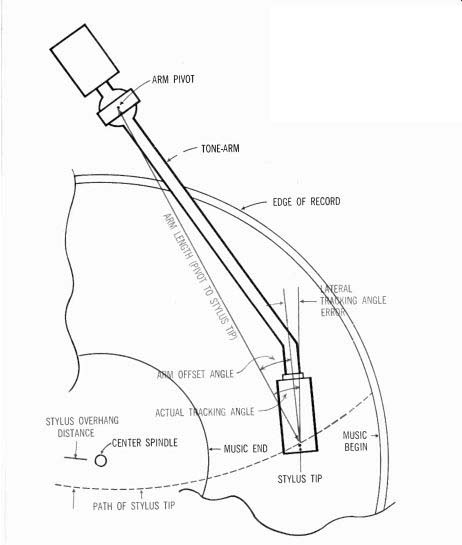
STYLUS OVERHANG is the distance between the center of a turntable spindle and a stylus tip when the (pivoted) tone arm is positioned above the spindle. This dimension, together with the arm's offset angle, de fines the lateral tracking angle (LTA) error of the pickup at any position on the record. When this error becomes fairly large-more than a few degrees--it increases the distortion on all records and additionally degrades the channel separation on stereo discs. The careful listener can hear the distortion on midrange instruments and voices; the sound takes on a rasping quality, an unnatural crispness with an accompanying loss of background clarity. Reducing the LTA error to a few degrees reduces this distortion noticeably.
The LTA error results from the discrepancy in the way records are cut by a radially moving head, and the way they are commonly played by a pickup moving in an arc at one end of a pivoted arm. Records, in other words, are made to be played with the stylus engaging the groove in a tangential manner, in line with the groove. But a cartridge that is describing an arc across the record cannot engage the groove tangentially except at one or perhaps two points-and so the error arises.
A straight-line or radial-tracking arm obviates, of course, the whole matter of lateral tracking angle error. With such an arm there is no need for stylus overhang; the arm is adjusted so that the stylus is centered over the spindle, and that's that. With a pivoted arm, the longer the arm, the broader the arc it would describe and thus the lower the angular error. Practical considerations, however, dictate that the length of a pivoted arm (length being defined as the distance from its pivot to the stylus tip at the other end; see drawing) for twelve-inch discs be held to about eight or so inches. The design feature used in just about every arm to compensate for this length is the offset-angled head which-from the standpoint of the pickup's path across the record effectively lengthens the arm and broadens the arc.
A further refinement is the stylus overhang dimension which, when correctly adjusted, reduces the lateral angular error even more.
The offset angle of the arm is, of course, predetermined and fixed during manufacture. The stylus overhang dimension, then, depends on the offset angle, plus a few additional considerations: the distance between a stylus tip and the mounting holes of a particular cartridge (which can vary from about 444 of an inch to a shade over 1/2 an inch); the exact length of the arm (which is nominally 8 inches but which also may vary among different models); and the exact position of the arm's pivot with respect to the platter (which is, of course, fixed in the case of preassembled manual and automatic players but which is determined by the user in the case of a separate "professional" arm and turntable).
Mathematical analysis made at CBS Labs for an 8-inch tone arm with optimally offset head shows, for instance, that a stylus overhang of 0.72 inches will give the lowest error: 3.5 degrees at the outside of the record, zero at two other points, and rising to 1.2 degrees at the inside near the label. The analysis further shows that the error at the inside should be less than half that at the outside for the lowest aver age distortion across the entire record. It also reveals that a change in overhang dimensions by 1/4 of an inch either way increases the error to 6 degrees, nearly doubling the distortion.
 .
.
-------- Several important dimensions are involved as a pivoted tone arm moves across a record. Note that the length of the arm is defined as the distance from its pivot to the stylus tip. This type of arm can he truly tangent to the record groove only at one or two points along the disc, hut the resultant angular error can he minimized by using the correct stylus overhang distance, as explained in the accompanying story.
While this data applies, strictly speaking, only to the specific arm and pickup used for this analysis it does point up generally the importance of correct stylus overhang for the critical listener. Further, it permits extrapolation, as per the dimensions given below. Many of the top-of-the-line models of record player (automatic or manual) do include an over hang adjustment-usually in the form of a movable pickup platform and a gauge to use when installing the cartridge. Our advice is to use it, carefully following the instructions furnished. For separate arms, again follow the instructions and template supplied for mounting the arm-but remember that when you change cartridges you may also have to change the overhang distance. For this purpose, the following table will serve as a guide regardless of what cartridge is used:
Arm length (inches) | Stylus overhang (inches)
7 1/2 | 0.77
8 | 0.72
8 1/2 | 0.68
9 | 0.64
10 | 0.58
12 | 0.48
For record changers with no provision for adjusting stylus overhang, these figures also apply, although there is no ready way to check them since the arms on such units cannot be moved over the center spindle. Obviously, the manufacturer of such a unit has settled on a compromise dimension based, presumably, on his estimate of the average dimensions of the cartridges most likely to be used with the unit.
With such a record player you may hit just the right stylus overhang distance. Then again you may not. Better read our test reports.
-------------
(High Fidelity)
Also see:
Understanding Tonearms (Audio, June 1980)--part 1
Understanding Tonearms (Audio, June 1980)--part 2
Tone Arm Damping--The Overlooked Feature (High Fidelity, Jul. 1975)