by JULIAN D. HIRSCH
FROM time to time I have warned against accepting any phono-cartridge measurement at face value. For one thing, there is no such thing as making a cartridge measurement without a test record, and the test record must be specified if the measurement is to have any validity.
In a recent conversation, a representative of a manufacturer of high-quality cartridges pointed out certain discrepancies, particularly in channel separation, between our published test report on one of his products and the data he obtained on that same product in his own laboratories. Both of us understood the reason for the discrepancy, since in our test reports we plainly state that we use a CBS STR-100 record for frequency response and channel-separation measurements and the cartridge manufacturer used a different disc. (His experience with the STR-100 record, by the way, tended to confirm our data.) Nevertheless, the published ratings on the cartridge in question were considerably better than our test findings, and the manufacturer was understandably concerned lest readers not aware of the limitations of cartridge testing assume that his claims were unjustified or exaggerated. Our conversation led me into a brief but revealing comparative study of the effects of the test record on the key measurements of frequency response and channel separation. The role of the cartridge loading and the tone arm have been discussed in earlier "Technical Talk" articles.
Most cartridge manufacturers use the Bruel & Kjaer 2009 test record for their cartridge testing, and when an individually run response curve is included with a cartridge (as on some of the more expensive models) it is generally made on B&K equipment with their record. The B&K graphic level recorder is widely used throughout the world, especially since it interfaces with many other B&K instruments used for audio and acoustic measurements. Thus, it is quite reasonable for lab oratories already equipped with B&K instruments to use the B&K record for their cartridge measurements, and a number of independent manufacturers of test records have also designed theirs to be used with the B&K recorder.
In case anyone is wondering why the record and the recorder are so inextricably linked, it is because the sweep characteristics of the record must match the chart speed and calibration of the recorder. If a record sweeps logarithmically from 20 to 20,000 Hz in a given time period, the recorder's chart paper must be calibrated correctly and move at the prescribed speed for correct readout.
Although B&K is probably the dominant manufacturer of such test instruments in the world today, there are other records based on the use of GenRad (formerly General Radio) recorders. All the test discs in the CBS Technology Center series and the STEREO REVIEW SRT 14 record have their sweeps timed to match the GR recorder and its calibrated chart paper. At H-H Labs, we use the GR recorder and CBS records, and we have found them to be generally satisfactory.
However, it seems that many of today's cartridges have a better separation characteristic than is "built into" the CBS STR 100 (the "workhorse" of the CBS record series). The separation data we obtain are simply not representative of what many manufacturers claim and really do achieve when their specified test records are used. The majority of cartridge manufacturers do not specify their test records, and therefore we do not worry unduly about matching their often scanty specifications. Although this situation is not really fair to the manufacturers concerned, there is no solution presently in sight.
Perhaps one day an IHF phono-cartridge measurement standard will be issued, at which time cartridge measurements will be come at least as repeatable and meaningful as those of today's tuners and amplifiers.
For the foreseeable future, we expect to continue to use the CBS records for the main part of our cartridge measurements, but in some cases we may supplement the test data with spot frequency-separation measurements made with more advanced records. To illustrate the magnitude of the problem, we measured the frequency response and channel separation of a high-quality phono cartridge with a number of different test records, keeping all other test conditions constant. The results, for me, reinforce what I have long said: no cartridge rating or performance specifications should be accepted without question, whether they come from the manufacturer or from an independent reviewer, as indicators of absolute cartridge performance (which is a meaningless concept at any rate).
Measurements show only how a cartridge performed with a given test record, and they can be used quite legitimately in comparing different cartridges.
ER frequency-response measurements on our test cartridge, we used two samples of the CBS STR 100 record. One was several years old and had been used for testing many cartridges. The other was brand new, from the latest pressing run of the record, and our curve was taken on its very first playing. We also used a CBS STR 170 record that is similar to the STR 100 but with a smooth transition from constant velocity to constant amplitude at 500 Hz.
The other records were designed for use with the B&K recorder. We had to recalibrate the frequency scales on our charts to match their sweep rates and re-plot them for com parison with the CBS test records. One was the Denon 7001, which we have used for some time for measuring low-frequency arm resonances. The other was the JVC TRS-1007.
Both sweep from 20 to 20,000 Hz in synchronism with the B&K recorder chart. Finally, we used an Audio-Technica AT-6605 record, which has discrete bands at a number of frequencies, including 1, 10, 15, 20, and 30 kHz. These are primarily for measuring channel separation.
As a check on our measurements, we had
data run on the same sample of the cartridge by its manufacturer, using both the JVC TRS-1007 and B&K 2009 records. The plotted curves show the frequency response of the right channel of the cartridge from 500 to 20,000 Hz, as measured in our laboratory.
Somewhat to our surprise, the old and new CBS STR 100 records gave virtually identical frequency-response and channel-separation curves. Although we could see little sign of wear in the CBS records (the old one perhaps ought to have been retired years ago, yet its output was almost indistinguishable from that of the new, virgin pressing), it was plain that the inherent channel separation in this record was far inferior to that of some other records.
Except for the Denon 7001, all the records gave very similar response curves, which was also unexpected.
---------------
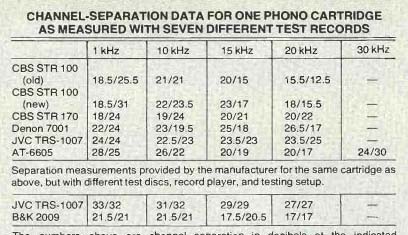
CHANNEL-SEPARATION DATA FOR ONE PHONO CARTRIDGE AS MEASURED WITH SEVEN DIFFERENT TEST RECORDS.
Separation measurements provided by the manufacturer for the same cartridge as above, but with different test discs, record player, and testing setup.
The numbers above are channel separation in decibels at the =indicated frequencies. The first number is the left-channel measurement, the second the right-channel measurement.
An example of the wide variation in separation figures that can be obtained from the same high-grade phono cartridge measured with seven different test discs.
Note the surprising discrepancies between channels at various test frequencies.
----------
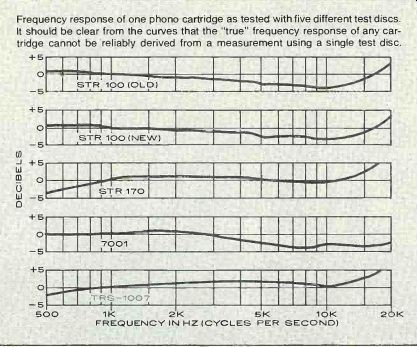
Frequency response of one phono cartridge as tested with five different test discs.
It should, be clear from the curves that the "true" frequency response of any cartridge cannot be reliably derived from a measurement using a single test disc.
---------------------
The chart of channel-separation data is much more striking in its implications. Notice that the Japanese test records yield higher separation figures, in general, than the CBS records, outstripping them by 6 to 10 dB at 1,000 Hz. No wonder the manufacturer felt that his cartridge was not getting its due from our tests! We were somewhat disturbed to find that his measurements on the same cartridge, using the JVC record, produced separation figures well beyond what we could achieve in our tests. However, except for the cartridge itself, the two sets of data had nothing in common--different arms, loading, and test records were used. We noted, too, that the manufacturer's data produced by the B&K 2009 record were for the most part not as good as we were typically getting from the CBS test records.
THE difference between the two separation figures (L and R channels) tells us something about the symmetry, or lack of it, in the records and the cartridge. At one time, we would have suspected that the cartridge was asymmetrical, but the almost perfect cross talk symmetry obtained with the JVC TRS-1007 record was too good to be a coincidence, and in this case we must conclude that the cartridge in question is almost perfectly symmetrical and that the differences we measured were properties of the various test records.
To sum up: our measurements with the CBS records can still be used to compare cartridge frequency response and even to com pare the channel separation of most cartridges, although the numbers may not agree with a given manufacturer's specifications. If we measure a channel separation of, say, 15 dB at 10,000 Hz and the manufacturer of the unit claims 25 dB, do not leap to the hasty conclusion that he is exaggerating or that we are in error. Probably neither party is at fault, and the discrepancy arises simply because of the different test records we are using for our measurements.
-----------
EQUIPMENT TEST REPORTS: Hirsch -Houck Laboratory test results on the BGW Model 210 stereo power amplifier, Ultralinear Model 228 speaker system, J. C. Penney Model 3275 AM/FM stereo receiver, Koss Pro/4 AAA stereo headphones, and Realistic SCT-30 stereo cassette deck
====================
Also see:
Digital Mastering--A Progress Report (Jan. 1979)
Turntables -- What Are Your Options (Jan. 1985)
Source: Stereo Review (USA magazine)