HOW TO GET INTO THE MUSIC BUSINESS--It's simple: make a demo, get a manager, and keep pushing
by RICK MITZ
-------------------
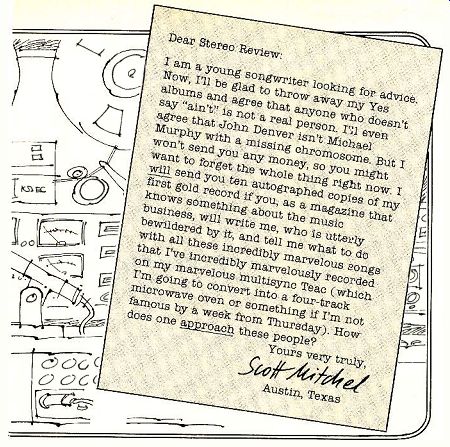
Dear Scott:
So you want to be a songwriter, or per haps a performer? (Isn't that how all those high-school "how to" books begin?) No, not "want to be"-anybody who writes songs is a songwriter, just as anyone who gets up and sings them for someone else is a performer. You just want more people to know about it than you, your mother, and your marvelous multi-sync Teac (or microwave oven, depending on whether we've gotten to you in time).
A week from Thursday, huh? Well, pre pare yourself. It might take until Friday two or three years from now.
Actually, Scott, you're not alone. There are a million tunes out there looking for mouths to sing them and thousands of mailmen waiting to deliver the royalty checks they've earned. You turn on your radio and you hear songs-songs you could well have written better or sung better. So why haven't you? Well, you've probably been hooked by the time-worn romantic fantasy of how it's all supposed to begin, a fantasy based on a few success-story articles in the tabloids and three remakes of A Star Is Born. You sit on a drugstore stool humming, and some kingpin of the music biz happens by, discovers your overwhelming talent, and immediately makes you rich and famous. Unfortunately, if you spend all your time sitting on drugstore stools humming, it's very likely you'll be discovered only by the men in the white jackets.
Record-company execs don't often wear white jackets, but they do wear headphones a lot, and attached to those headphones are wires leading to tape machines on which are turning tapes of unknown songwriters and performers showing off their potential.
Those tapes are called demonstration tapes, and the demo tape is the single most important thing you should know about when you're trying to get anyone in the music business interested in your songs or your act. It doesn't make much sense to put in a person-to-person call to the president of Columbia Records and ask him to sit and listen while you sing him your latest punk-rock ditty over the phone.
If you want to get your music heard, you have a limited number of options. You can hope to be "caught" in a live performance by a music executive who will quickly sign you to a long-term recording contract (which is a great option-if you have a live performance that's promising enough and if the executive doesn't have to travel to San dusky to catch you). You can hang around the exec's office, make a nuisance of your self, and hope for the best. Or you can call a rich uncle and ask him to give you a record album for your birthday-your own LP perhaps 10,000 copies? Or you can get your stuff-and your life-in order and get ready to make a real commitment to your career by making a demonstration tape. With a demo tape, your voice (or piano, guitar, whatever) can be heard in music executives' offices all over the country while you're home taking a bath.
PRODUCING THE DEMO
You can take another kind of bath when it comes to producing that demo tape. Some people spend hundreds-even thousands of dollars and end up making the wrong kind of tape. Most aspiring songwriters and performers don't realize how very important that demo can be to their career. In fact, more than anything else--more, even, than a weekend in the country with the head of any record company-the demonstration tape is the key to opening the door to a career in music. It is the main means of communication between you and your prospective employer. Think of it as a résumé set to music. But also keep in mind that no matter how professional your tape is, it is still merely a tool in the difficult job of building a career. A tape featuring a thirty-seven-piece orchestra and all the overdubbing you can muster will not disguise poor material or a poor performance. And even if everything is great, it's more than possible that no one will take the bait.
Okay. Maybe you're feeling a bit discouraged at this point, Your fantasy of instant fame and fortune is boiling down to the reality of hard work, dedication, and a preliminary cash outlay. What you need, Scott, are a few encouraging words from people who've made it, so we asked for a few.
Here's what Stevie Wonder has to say:
"If you're a songwriter by heart, instinct, and personality, nothing anyone says will keep your talent from finding its way into the business. A lot of people say you need drive to realize your talent, but the truth is that your talent is your drive." Says James Taylor, celebrating his eleventh year in the music business, "I really believe that if someone has talent-and if he sticks to it-he will make it. I really believe that." Besides all the faith and determination stuff you'll hear about; there's often some luck involved too. Take the case of Danny Peck, who one day accompanied a friend to Arista Records. He mentioned to the producer there that he too sang and wrote songs. The producer handed him a guitar and gave him an impromptu audition. Miracle of miracles, Peck was asked to sign on the dotted line, and now he is working on his second Arista LP.
Another true story: a young man worked in the mail room of a large music-publishing company. One day during his lunch break, he slipped into a studio and started playing some of his own songs. A company producer liked what he heard and decided to use the songs for an album he was working on.
And, just to get you totally hooked on the idea of making it big, listen to the success story of a super-hot disco group, K.C. and the Sunshine Band. It wasn't always so sunny for them. Says Richard Finch, the group's co-leader, "During high school, I was involved in a local soul group in Miami, but I didn't know how to get into recording.
I knew this guy in school and he knew a record distributor, so we hung around the record warehouse a lot. I got a job there, packaging records during the day. At night, I would go into the recording studio in the back of the building and hang out, learning how to use all the equipment. And there was this other guy who worked in the warehouse and had a band, Harry Casey (later to be come K.C.). We met and decided to pool our talents and make a demonstration record. I remember that one night we came up with a song called Rock Your Baby. It was released locally and sold 250,000 copies.
And from that LP, we had a national hit called Get Down Tonight.
"I know it sounds easy," Finch says.
"We had a bit of luck. And I don't know how long it's going to last. But I think you have to push, you have to have a lot of incentive. You can't get depressed. You have to let things roll off your shoulders." Okay-so much for inspiration. Now on to the How To's. How do you go about pre paring a demo tape? The best way is to follow the Rachlin Routine. Harvey Rachlin is known as the Godfather of the Grooves.
He's also a songwriter, music publisher, record producer, and-best of all-author of a wonderfully informative book called The Songwriter's Handbook, which does for songwriting what all those manuals have done for sex: it tells you how (and, perhaps more important, how not) to go about it.
Rachlin has many sound ideas on how to get into the music business.
"A demo," Rachlin says, "is a recording of a song that's used to show its potential to producers, recording artists, record companies, and music publishers in hopes that they'll record or publish it." There are many types of demo tapes, he says, and the kind of demo you make depends on a couple of things-like who you're sending it to and what your budget is. For example, you can send a demo tape of your voice and your song to a record company in hopes of having the company like not only your song, but also your performance enough to offer you a recording contract.
You will want to send your tape to the pop A-&-R (artists and repertoire) department of a record company. But it's important to call first and try to get the name of the right per son in the department to whom the demo should be sent. And it's also important to familiarize yourself with the repertoire on certain labels. For example, Casablanca deals mainly with rhythm-and-blues artists, and your folk-song recital would probably not be an appropriate submission. It should be noted that there are some record companies that will not listen to unsolicited tapes; they only want tapes--even by totally unknown artists-that are presented by a manager.
-------------
OUTSIDE READING
THE following are sources of information about the music business that might be helpful to you in your pursuit of that elusive stardom.
BOOKS
How to Write a Hit Song . . . and Sell It. by Tommy Boyce, $7. Wilshire Book Co., 12015 Sherman Road, North Holly wood, Calif. 91605.
The Songwriter's Handbook, by Harvey Rachlin. $8.95. Funk & Wagnalls, 666 Fifth Avenue, New York, N.Y. 10019.
The Songwriters' Success Manual, by Lee Pincus, $6.95. Music Press, 21 East 40th Street, New York, N.Y. 10016.
This Business of Music, by Sidney Shemel and M. William Krasilovsky. $16.95. Billboard Publications Inc., 1515 Broad way. New York, N.Y. 10036.
Official Talent & Booking Directory, $40. Published (annually) by Specialty Publications, Inc., 7033 Sunset Boulevard, Suite 22. Los Angeles, Calif. 90028. (Lists everything-including T-shirt companies!)
RECORD BUSINESS MAGAZINES
Billboard, 1515 Broadway. New York, N.Y. 10036. Besides its weekly trade publication, Billboard publishes special supplements that are invaluable for the song writer. These include: Billboard International Buyer's Guide (lists domestic and foreign music publishers, record companies, producers, wholesalers, etc.), Bill board's Annual Campus Attractions (contains the names or recording artists, their record labels, their managers and booking agents, addresses and phone numbers free for subscribers), Billboard's Annual World of Country Music (lists top country songs, labels, music publishers, artists, and country news).
Cash Box, 119 West 57th Street, New York, N.Y. 10019. Published weekly; also publishes an annual directory.
Record World, 1700 Broadway, New York, N.Y. 10019. Published weekly; also publishes an annual directory.
SONGWRITER MAGAZINES
Songwriter's Review, 1698 Broadway, New York. N.Y. 10019. Published every two months; carries features of interest to songwriters as well as tips, advice, and trade information. Songwriter Magazine, P.O. Box 3510, Hollywood, Calif. 90028. Features include interviews, information on which music publishers are looking for material, chart listings, and music news. New on the Charts Music Business Reference, 1500 Broadway, New York, N.Y. 10036. Lists songs, artists, producers, publishers, and record labels making the charts, plus their addresses and phone numbers and information on the artists.Tunesmith, P.O. Box 3839, Hollywood. Calif. 90028. A monthly newsletter telling which artists, producers, and publishers are looking for material. Depending on where you live, some of these publications may be available on the newsstand (and in some libraries). however, we recommend that you first write to the publication to find out the subscription cost (it may be cheaper than the newsstand price) and where you can get the publication in your area.
----------------------
MUSIC BIZ...
. . . they don't want to see your sheet music; songs today are heard, not read."
-----------------
So, it might not be a bad idea to get one.
"Your best chance is with music publishers, who are more likely to take you on," Rachlin says. "They will try to find you a record company if you want to record your own songs. But mainly they act as trustees for your music." Music publishers will do a number of things for you. They will screen songs and try to get them commercially recorded, they will promote and protect the copyright, and they will collect income from all sources.
There are a number of types of music publishers, and you'd better know what you're looking for before you start sending them your material. There are small, one-person companies and huge corporations like Chappell Music, which is described further on in this article. There are thousands of publishers who will not want to hear your songs, or anybody else's, for that matter, for they are not functioning publishing companies but rather legal entities formed to retain owner ship (and collect royalties) of material they already have. So don't just pick a publisher out of the trade listings. Find out if they're interested in auditioning new material. (Incidentally, these people don't want to see your sheet music; songs today are to be heard, not read).
Many publishers have staff people whose job it is to screen new material that comes into the office, to find potential hits, and then to get them recorded through their various contacts-producers, other artists, A-&-R men. You can either mail your tape to the publishing firm or try to get a personal appointment. Many fledgling songwriters have been surprised-and delightfully so at how easy it has been to get personal appointments with some of the top people in the business.
DIRECT SUBMISSION
There is another way to make yourself known, and that's to submit your songs directly to record producers, those behind-the-grooves people who oversee each note that goes into an album. What you have to do is find out which producer is working with which performer. (You can find that out by carefully reading the trade papers, the three biggest being Billboard, Cashbox, and Record World. These papers are also an invaluable fount of information on the most up-to-date activity in all areas of the music biz.) Of course, some producers-Elton John's for one-are obviously not looking for new material because their artists record only their own material. But today, song writers seem to be in luck; we are in a musical era when such established songwriters as Waylon Jennings and James Taylor are happy to sing other people's songs as well as their own.
There are two types of record producer:
the staff producer who works exclusively for a record company, and the independent record producer who is a free-lance but who will make independent agreements with record companies. Established independent producers often have their own publishing companies. Also, a record company's A-&-R chief often doubles as producer for one or more artists signed to the company.
Now, what about the demo tape itself? "The simple demo," Rachlin says, "contains a voice accompanied by a piano or a guitar, and it's made on a home cassette or reel-to-reel tape recorder. It's important that the melody and the lyrics sound clear." There's also a more sophisticated type of demonstration tape. "This would be a demo with a rhythm section-piano, bass guitar, lead or rhythm guitar, drums--a lead vocal and background vocals, made in a recording studio, usually on four or eight tracks. This could be expensive (at least $500) and should not be done without a great deal of thought. "I See the article "Semi-Pro Recording," dealing with technical aspects of how to make a demo tape, on page 58.] Rachlin stresses that "every attempt should be made to have a 'neutral' demo, one that doesn't sound like it's for a particular artist, but best represents the song so that it could be re corded by anybody. Then you don't lock yourself into any artist's particular style, and your chances of generating wider interest in your song will be increased." But what should you use to make a de mo-cassette, reel-to-reel tape, or acetate dub (the actual preliminary disc)? There are some things you should know about each before deciding. Cassettes, rightly or wrongly, are considered the least professional, and many music companies even to day simply do not have the equipment to play cassettes. However, they are accept able if that's the only kind of equipment you have. The sound quality of an acetate dub lessens rapidly after repeated playing. If you do submit one, however, be sure to have the following typed clearly on the la bel: name of the song, speed of the record, your name, address, and phone number.
---
MUSIC BIZ...
1. Make a demo tape.
2. Get a manager.
3. Perform whenever you can.
4. Keep pushing.
--
Acetate dubs can be single-faced or double faced (containing two selections, one on each side).
Reel-to-reel tapes are considered the most "professional" way to submit your songs.
They usually have the best sound, and you can put several songs on the tape although it is not advisable to submit more than four songs when first presenting your material (choose the best, of course). Other advantages of reel-to-reel tapes are that they can be leadered (songs separated by white tape, by yourself or by the individual examining them) for easy access to any selection, and the tape can be easily edited. Be sure to type the tape speed (7 1/2 ips is the best), the selections contained, and your name, address, and phone number on a label securely attached to the tape box. After all that is done, have about five copies made (one to be placed in secure storage) and send out three or four tapes all at once. If you don't hear from the people. "wait about three or four weeks before you do any following up," Rachlin suggests.
OTHER CHANNELS
You can enter the annual American Song Festival contest. Past winners have included such artists as Tim Moore and Galdston and Thom, who, in addition to their prize money, won recording contracts with Asylum and Warner Bros. Records, respectively. The Song Fest folks guarantee that each song submitted will be listened to at least twice, and the judges are producers, music executives, artists, and publishers. There are several different categories for different kinds of music, and all entries should be submitted on tape. Before taking this route, however, write first for more information to the American Song Festival, 5900 Wilshire Blvd., West Pavilion, Los Angeles, Calif. 90036 or use the coupon with the ad on page 163 of last month's issue.
Thirsty Ear is a new syndicated series of college radio programs (sort of a younger, smaller version of the King Biscuit Flower Hour) which is carried on many stations throughout the country. New artists are featured in concert as well as interviewed. Usually the cost of the program is subsidized by the artist's record company, but since you don't yet have a record company, you'll have to subsidize it yourself if you'd like to get on. The fee is about $10 per station, and there are a lot of stations. But that fee includes recording and duplication expenses.
If you're interested in finding out more about this outlet, contact Peter Gordon, 43 Route 46, Pine Brook, N.J. 07058 (telephone 201-575-7820).
Many colleges and schools around the country are now offering courses and work-shops on precisely what this article is about-how to get into the music business.
Contact the music departments of some of the schools in your area, and see what's available. In New York, two of the best known are at the New School for Social Re search, 65 Fifth Avenue, New York, N.Y. 10003, and the Zadoc Institute for Practical Learning, Suite 1500, 2 Pennsylvania Plaza, New York, N.Y. 10001.
PUBLISH YOURSELF
If nothing else works out, you can always become your own publisher. Even if things do work out, you can move on to publishing your own material. You should know, though, that there is great financial risk in starting your own publishing company. Expenses can be high, and there are no guarantees of success. And after all, do you really want to be a salesperson or an artist? It's also possible to make and sell your own masters (finished tape recordings of songs from which records are made). A record company will sometimes purchase a finished master, go directly to disc with it, and-what do you know?-you've made a record album, or a single. Making masters is a long and involved process, however, and it means selecting material, selecting the right artists (if it isn't you), choosing a producer and arranger, setting up rehearsals, hiring musicians, getting a studio and an engineer, and working with union regulations. And then, of course, you have to sell that master.
There are several books that discuss this approach in much greater detail (see the bibliography on page 61).
One more thing: beware of song sharks.
They are the vanity press of the music publishing business. You've probably seen their ads on the back pages of comic books: "Send Us Your Lyrics!" If you do send them your lyrics, for a fee they will have them set to music (probably by someone who answered their "Send Us Your Melody!" ad) and then send a copy (or several, if you wish) back to you. They will not make you rich and famous, but you will add considerably to their income. The moral here: know who and what a company is before you get involved with it. Even if you're about to sign an exclusive contract with a major record company, always check every thing out.
There are no rules, no formulas, in the music business. There's no foolproof recipe for attaining stardom, no yellow brick road leading to gold records in emerald cities. But there are some touchstones that are more or less vital to you in your pursuit of a career in music. First, the demo tape, truly a demonstration of what you can (and can't) do.
Handle it with care. Second, unless you're a very unusual bird, concentrate on your music and let someone else handle the business side of your career. A manager-the right manager-can cut the hungry years down to a minimum. Third, perform as much as you can; you need experience and exposure to get as good as you can be. Fourth, keep pushing. Hum songs of inspiration to your self as the mailman brings back yet another rejected demo tape. Remember: it's still your tape they're rejecting, not you. Hang on and push. It can happen, but you have to make it happen.
So, thanks for writing, Scott. We'll be waiting for those ten autographed copies of your first gold record-and a marvelous home-cooked meal from your microwave oven. And we'll be listening for you on the radio.
-----------------------
ADVICE FROM THE EXPERTS
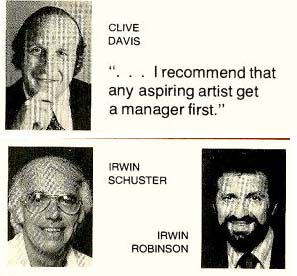
CLIVE DAVIS " ... I recommend that any aspiring artist get a manager first." CLIVE Davis, former president of Columbia Records, is now head of Arista Records, a company he took over several years ago and with a magical musical touch transformed into one of the leading companies in the industry. To day, artists on the label include Barry Manilow, Melissa Manchester, the Bay City Rollers, and about seventy others. Davis is one of those men with golden ears who have an uncannily consistent ability to spot talent on tape and on stage, and his record company is well respected for its care and nurturing of new talent. So we asked Davis what makes those golden ears perk up and just how an aspiring performer or song writer can get to them.
"There are many ways to get into the music business. It all depends, of course, on the kind of talent you have and the category you fall into. The best way is to create a local following. If you live in Kansas, become well-known there with your songs or your band. Even make recordings locally. Then, later, you will receive national attention." What about submitting demonstration tapes? "I have never signed any body-even though I know the talent is there-through an unsolicited tape. On the other hand, there are tapes that are sent in by managers who have a track record, and then we listen and go see the acts in a showcase. But most often, we seem to sign an artist who's creating something exciting in an in-person situation, Then, we also try to meet with a manager in the business who has experience or a track record in order to get that manager interested. I would prefer to hear a tape first but then I would want to go to a live audition." Davis says that he tries to sign artists very selectively. "I don't want to play odds and sign five people and hope that one makes it. I want to keep our ratio of successful artists high. Today it costs about $100,000 or $150,000 initially for a new artist, so I view each artist's signing very, very carefully." What criteria does Davis use in deciding to sign an artist? "Originality, someone who's identifiable, someone who can write potential hit singles. I look at the lyric content. And there must be an electricity that can be projected on-stage as well. For example, Barry's and Melissa's performing abilities are very striking.
"When I sign someone, I trust my instincts. But I'm not a dice roller. I also get involved creatively, getting the right producer paired with the right artist. You have to know what-and what not-to do. For example, some times you just have to leave an artist alone. Patti Smith just does what she wants to do. Others we will submit material to-like Bar ry. You supply an input where you feel it might be needed." Does Davis have any specific recommendations for aspiring artists? "Well, as far as demos go, I don't think it makes any difference if it's on a cassette or on a reel-to reel. Do I listen to them myself if they are sent to me? No. I send them to the A-&-R people. But I recommend that any aspiring art ist get a manager first. It's important that you get someone knowledgeable and experienced in business so you can concentrate on the creative side of things. Most important: have a commitment to work hard and a knowledge that it will not happen overnight. It's not easy. Music isn't a get-rich-quick thing. You have to be able to grow and develop a long-term career. I think there are a lot of people who don't put their houses in order.
It's important to have talent, but it's also important to develop your craft to get your career going."
IRWIN SCHUSTER; IRWIN ROBINSON
CHAPPELL MUSIC is considered to be the largest music publishing company in the world. And that's large. Their client roster includes such diverse stars as Charles Aznavour, Rodgers and Hammerstein (not to mention Rodgers and Hart), the Ohio Players, Lonnie Liston Smith, and Graham Parker, along with many others.
The top men behind the music are Chappell president Irwin Robinson and vice president Irwin Schuster, two Irwins who have been in the music business for a total of thirty years. One day recently, they took time off to talk about how to break into the music business.
Schuster: "I think that a song writer should be attuned to what is happening in the market for which he or she is writing, and I think to day it's basically a singles-oriented market. It's important to know what's happening, and then to write the best songs you can. And I think that a beginning writer should shoot for the biggest market, which is the Top Forty radio market." Robinson: "True. But don't copy and don't plagiarize. There are certain kinds of songs that are played on the radio because they're appealing, because they have a memorable 'hook.' They have a lot of things in common, even though they may say 'I love you' ninety different ways." Schuster: "A writer should write about the most universal topic, which is love. Everyone's in love-or missing love." Robinson: "When it comes to demos, I think that pushiness and aggressiveness pay off. They get whatever you have out there to be heard." Schuster: "And when you're sending in a demo, make sure you put someone's name on the envelope or make some kind of a phone contact. It helps. We listen to all the tapes we get, but I don't think that what we do is 'pick hits.' That's not totally accurate.
We pick songs that could be hits.
We start with the raw material.
When someone comes in with a demonstration tape we have to decide if it's meaningful. We have to decide if it has the hook, if X, Y, or Z artist would record it. We might even have a new demo of the song made at our own expense if we like it enough." Robinson: "The music business has changed. Before, writers were not singing their own songs.
But today, we have two kinds of writers: the pure songwriters, whose only outlet is someone else recording their songs, and the singer-songwriter-Stevie Wonder, Carole King, Paul Simon.
There are little old ladies who write ten songs a day, tape them, and send them in. And we listen to them. And of course, the girl who washes my hair at the barber shop told me that she's got a friend . . . . We get all kinds.
But a song is sent in and then gets put in a bundle of songs. When a producer knows that he's doing an album, he lets it be known.
Even if a song isn't chosen for a particular album, it may not be a bad song. For example, if Streisand's producer calls up, you send him four songs. How do we know which four songs to send out of a catalog of more than 200,000? We know our songs, and when someone asks, we send a lyric sheet or a demo that's appropriate for the artist." Schuster: "I think a songwriter should send the best possible demo tape. Remember, a demo is a demonstration of a song within the limitations of a budget. Keep it simple if you can. If we sign you, we can help you get a record con tract at no extra fee but we get the publishing money, which is a standard fifty-fifty split. Some artists, of course, don't give away their publishing rights-they try to sell their songs themselves. It depends on what your interests are. One thing to remember: this business has no rules. Shaun Cassidy didn't exist as an entity in our business one year ago. And who was Debby Boone?"
Robinson: "Ninety percent of what's done to sell a disc is done in the studio. You can't make a hit if it isn't in the grooves."
TOMMY MOTTOLA
"Listen to what's going on so you know what your competition is." "Tommy Mottola Lives on the road;
He lost his lady Two months ago." So go the opening lyrics of one of the biggest hits of the last few years, Cherchez la Femme, written by Dr. Buzzard's Original Savannah Band for their manager, Tommy Mottola, who, at twenty eight, is one of the biggest and hottest managers in the music business (he also manages Hall and Oates, Odyssey, and several others). You can find Mottola several nights a week auditioning demonstration tapes. On one of those nights he took time off to talk about how he thinks people can make it in the music business.
He ought to know.
"I started in the business as a musician. I've been through it. I played with local rock bands, and I tried to make as many demos as possible, on home tape-recording machines or in recording studios, wherever. I think that if an act or an artist has something worth while going, the best way to get an executive interested is through a tape. It's easy to listen to. He can put it on at the end of the day.
We do that here at Champion Entertainment Organization two or three nights a week. And we listen to each and every tape that's sent to us. We heard Dr. Buzzard through a demo tape, then we heard them in a live audition, and then we signed them.
"The number-one thing I listen for in a tape is the songs. They are the essence and the heart of what's going to become of a career. If an artist has great songs and makes mediocre records well, he can still make records. A great visual image and the ability to excite and turn on an audience--those are the other qualities I look for.
"This is the way I view the whole business: everyone has to expend energy, money and emotional output. So I want to help develop a career that will have credibility and longevity.
"I've been said to have 'famous ears.' I think that being attuned to music since I was six gave me an advantage. I worked for a music-publishing company for nearly six years and ran their contemporary music division. But you're born with it or you're not. Actually, I've really never been wrong! "I invite people-anyone-to send me tapes. That's what it's all about. And I do have some advice for people starting out: listen to what's going on out there so you know what your competition is.
Get involved in showcase situations as close to New York or Los Angeles as possible. Although my very last recommendation would be to move there, they are the two music capitals. But get something going before you take the big plunge.
"Demos? Reel-to-reel are the best. You can't get as good quality on a cassette, but a cassette is okay. Personally, I would rather hear the raw vocal and piano or guitar because I want to hear the song. One more thing: it's totally possible to break into the music business. It takes the desire to make it, the will and the drive and the persistence. And-oh, yeah the talent."
---------------------
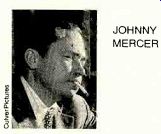
... AND THEN I WROTE ": HOW THE PROS DO IT". required listening for all aspiring lyricists.
THE 92nd Street "Y" on Lexington Avenue in New York City has played host over the years to every sort of cultural event-children's plays, concerts, operas, poetry readings, art exhibits, lectures, modern dance--in performances of a generally high order. Some of this material has found its way onto records-Caedmon's historic recording of the famous stage reading of Dylan Thomas' Under Milk Wood, for example, and, more recently, some outstanding evenings of poetry. Now a new label, Laureate Records, has released a three-record set edited down from archive tapes of the "Lyrics and Lyricists" series at the "Y" started by Arthur Cantor of the Billy Rose Foundation back in December 1970, when "An Evening with E. Y. (Yip) Harburg" of Finian's Rainbow fame packed the house. Harburg is not to be heard in this first volume, but he may be expected to turn up on one of the sequels to be prepared if the initial re lease succeeds. Meanwhile, this handsomely packaged set (produced by Mau rice Levine, who has been artistic director and host for the series) should be required listening for all aspiring lyricists, and it is first-rate entertainment for any body interested in the history and craft of American musical comedy.
The first-and most diverting-of these "evenings" with the people who wrote the words of America's songs is devoted to the late Johnny Mercer, an urbane and witty man if ever there was one, in an "and-then-I-wrote" routine you might not believe could be as appealing as it is. It is even more difficult to believe that this most "alive" of songwriters, who was born in Savannah, Georgia, in 1909, is no longer with us, but died on June 25, 1976. (As John O'Hara said of George Gershwin's death, "I don't have to believe it if I don't want to.") Mercer fell in love with music as a boy, sang in a chapel choir, wrote his first lyric (for Sister Susie, Strut Your Stuff) when he was fifteen, and went on to become an aspiring actor in Greenwich Village. But when he showed up hoping for a part in the 1930 edition of Garrick Gaieties, he was told that they needed songs more than performers.
Mercer wrote the words to Out of Breath and Scared to Death for that show (he sings it here) and the lyrics-as well as
----66 JOHNNY MERCER
some of the tunes-for many others from Lazybones to That Old Black Magic, Blues in the Night, and Moon River.
He also wrote Pardon My Southern Ac cent-but he himself had scarcely a trace of one by the time of his "Y" appearance on March 14, 1971. Recounting his adventures on Broadway, where he wrote the words (and the score) for Top Banana and the lyrics for Li'l Abner, Texas Li'l Darlin', and the 1959 flop Saratoga, he improvises on the spot:
"There's E. Y. Harburg sitting unobtrusively in the seventeenth row/And Mr. Harold Arlen with whom I wrote a very unsuccessful show." But most of Mercer's shows were hits, to be sure, and anecdotes abound as he recalls his New York experiences and describes his years in Hollywood as a Paramount Pictures composer and lyricist and as a businessman (he was one of the founders of Capitol Records). And whatever Mercer leaves out, Edward Jablonski supplies in full in his generously informative liner notes. What can't be conveyed without hearing the record, however, is the ebullience and charm of Mercer himself, the verve with which he sings (on key) dozens of stanzas from his songs-including the old Pepsodent commercial about poor Miriam who neglected using irium--and the infectious enthusiasm of the "Y" audience. Mercer is ably assisted by Margaret Whiting and Robert Sands, who offer an exemplary duet on the ballad Hit the Road to Dreamland.
Alan Jay Lerner (his "Y" appearance, another sellout, dates back to December 12, 1971) is a graver master of ceremonies than Mercer, but he makes up for the solemnity of his approach to his craft and his career by discussing, in an illuminating way how the lyrics of a song take shape-a process he modestly places "a little above photography and woodcarving." Tracing the evolution of several individual songs, especially those he collaborated on with "Fritz" Loewe for Camelot, My Fair Lady, and Gigi, Lerner recites passages from the lyrics he wrote at various stages of their development. It's a revelation. The New York-born, Harvard-educated Lerner also recalls how Loewe introduced him self to his young collaborator-to-be at the Lambs Club, reviews the ups and downs that led to the eventual success of Brigadoon, Paint Your Wagon, and other landmark musicals by Lerner and Loewe, and tells how it was to work with Burton Lane on the songs for On a Clear Day. He compares writing lyrics for Kurt Weill (words first) with his experiences in collaborating with Loewe (music first, usually) and reveals that Loewe hated The Street Where You Live so much (I rather hate it too) that it was al most dropped from the score during the New Haven tryouts. In the course of his lecture, Lerner also sings some of the best-loved numbers from Camelot, Gigi, and My Fair Lady, as well as an out-take from the last called Oh Come to the Ball, a pretty but pat little item. Lerner's voice is scarcely as musical as Mercer's, but professional singers J. T. Cromwell, Barbara Williams, and Bobbi Baird are on hand to come to his rescue. The excellent notes are by Stanley Green.
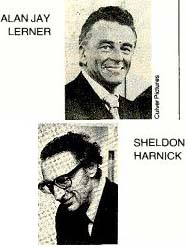
ALAN JAY LERNER; SHELDON HARNICK
The final record in this first volume features Sheldon Harnick, who appeared at the "Y" on February 14, 1971. Harnick can't sing too well either, and he tends to discuss his craft more in the manner of a stand-up comic than of a singing lecturer. But he is such a winning fellow that it's impossible to resist his breezy way with his own autobiography as he jokes about his stormy childhood in Chicago, tells how he was fired by Xavier Cugat after one day as a member of the orchestra, and performs the songs he wrote the words for in a manner that makes up in good humor what it lacks in musical accuracy. Harnick is most adept with his comic songs, such as The Boston Beguine from New Faces of 1952, as well as, from Shoestring Revue, the still funny novelty number Garbage, the story of a girl "who was cool-and collect ed" (Bea Arthur, TV's "Maude," sang it in the show). He also delivers a number of hits from Fiorello, She Loves Me, The Rothschilds, and Fiddler on the Roof, including two perfectly good songs that were dropped from the last score--When Messiah Comes and How Much Richer Could One Man Be?
Zero Mostel he ain't, but Harnick puts over his own material by dint of sheer high spirits, and he is also ably helped out from time to time by singers Margery Gray and Mary Louise. At the piano throughout the al bum is Richard Leonard, who manages to keep up with everybody.
Each of the three records comes complete with testimonials from such luminaries as Carol Burnett, Richard Rodgers, Julie Andrews, Gene Kelly, Bing Crosby, and Fred Astaire.
I can only second them.
-Paul Kresh
LYRICS AND LYRICISTS, VOLUME 1.
An Evening with Johnny Mercer. Johnny Mercer, Margaret Whiting, Robert Sands (vocals); Richard Leonard (piano). Out of Breath and Scared to Death; I'm Going Back to the Farm; Medley Paul Whiteman period (three songs); Blues Improvisation Medley (four songs); Medley-Camel Caravan (three songs); Unaccompanied Medley (three songs); Medley-Capitol Records period (three songs); Glow Worm; Miriam (Pepsodent commercial); Hit the Road to Dreamland; Bon Vivant; Final Medley (twenty-nine songs). An Evening with Alan Jay Lerner. Alan Jay Lerner, Bobbi Baird, J.T. Cromwell, Barbara Williams (vocals); Richard Leonard (piano). How to Handle a Woman; Why Can't a Woman?; I Talk to the Trees; Wouldn't It Be Loverly?; Oh Come to the Ball; On the Street Where You Live; Come Back to Me; What Did I Have That I Don't Have?; I'm Glad I'm Not Young Any more; I Loved You Once in Silence; Gigi; Camelot; On a Clear Day; I've Grown Accustomed to Her Face. An Evening with Sheldon Harnick. Sheldon Harnick, Margery Gray, Mary Louise (vocals); Richard Leonard (piano). The Suave Young Man; How Could I?; The Merry Little Minuet; The Boston Beguine; At the Basilica of St. Anne; Garbage; Worlds Apart; Little Tin Box; 'Tit To morrow; The Picture of Happiness; She Loves Me; Dear Friend; Sunrise, Sunset; Do You Love Me?; When Messiah Comes; How Much Richer Could One Man Be?; If I Were a Rich Man; In My Own Lifetime. LAUREATE LL-601/2/3 three discs $24.95 (plus $1.35 handling costs and sales tax where applicable from Laureate Records, Post Office Box 1275, Radio City Station, New York, N.Y. 10019).

--------
Also see:
SEMI-PRO RECORDING--How to make your own demo tape, VINCENT FICARA and PETER PONZOL
TAPE TALK--Morse Mozart, CRAIG STARK
Source: Stereo Review (USA magazine)